A list of GIPS compliant firms is a list of firms that claim compliance with the Global Investment Performance Standards and have told CFA Institute so. The claim is self-declared: every firm that claims compliance must file a GIPS Compliance Notification Form when it first claims, and again each year by 30 June, and CFA Institute's own sample policy treats being named on its website as the firm's choice. Appearing on such a list does not mean a firm has been verified, does not say what the firm includes, and says nothing about any one composite's record. A consultant or asset owner screening managers learns those things from the firm's GIPS reports and from four questions: verified or not, the firm definition, the composite list, and recent material errors. Botminds' GIPS Compliance Reporting is built for the firms on the other side of those questions, keeping every composite decision cited and signed so the claim stays supportable when someone asks.
Examples from the solution use its sample data, a fictional firm called Quillfield Capital.
What a claim of GIPS compliance guarantees, and what it does not
The claim guarantees: The firm applies the standards firm-wide; compliance "cannot be met on a composite, pooled fund, or portfolio basis" (1.A.1).
The claim does not tell you: How broadly the firm is defined: a division held out as a distinct business can be "the firm" (1.A.2).
The claim guarantees: Every actual, fee-paying, discretionary segregated account is in at least one composite (3.A.2).
The claim does not tell you: Which composites exist, until you ask for the list of composite descriptions (1.A.23).
The claim guarantees: The firm must make every reasonable effort to give each prospect of a strategy its GIPS report, with the required numbers and disclosures (1.A.11, section 4).
The claim does not tell you: Whether those numbers have been independently tested: that needs verification, and even then not report by report.
The claim guarantees: Nothing presented anywhere in the firm may be false or misleading (1.A.7).
The claim does not tell you: Whether the firm has had to correct a material error, unless you read the report's disclosures (4.C.38).
The claim guarantees: The firm has filed the notification form, initially and annually (1.A.38).
The claim does not tell you: Whether any outsider has checked the claim: verification is recommended, not required (1.B.3).
Is there a list of GIPS compliant firms?
Yes: firms that claim compliance notify CFA Institute, and CFA Institute names firms on its website. The underlying obligation is provision 1.A.38: "The firm must notify CFA Institute of its claim of compliance by submitting the GIPS Compliance Notification Form." In CFA Institute's sample policies and procedures manual, the section on that form includes the line "XYZ Investments allows its name to be listed on the CFA Institute website as a GIPS compliant firm" (CFA Institute, policies and procedures manual guide, 2023). The listing is therefore built on the firms' own notifications, and the sample treats appearing on it as the firm's decision.
Two conclusions follow for anyone using the list to screen managers. A name on the list is a firm's own statement that it complies. A name missing from it is not proof that a firm does not claim compliance. In both cases the firm's GIPS composite report, which must carry its compliance statement, is the better evidence, and any prospect who qualifies for a strategy is entitled to receive it (1.A.11).
The GIPS compliance notification form: what it is and when it is due
The form is how a firm tells CFA Institute that it claims compliance. Under 1.A.38 it "must be filed when the firm initially claims compliance", "must be updated annually with information as of the most recent 31 December, with the exception of firm contact information", and "must be filed annually thereafter by 30 June" (GIPS Standards for Firms, 2020).
The calendar behind a claim of compliance
30 June
Annual deadline for the GIPS Compliance Notification Form
1.A.38: information as of the previous 31 December, except contact details
12
Months, at most, before a prospect must get an updated report
1.A.12
5
Years a terminated composite stays on the firm's list
1.A.22
A verifier checks the form too: required verification procedure 16 is to determine that the firm "has met the requirement to notify CFA Institute of its claim of compliance" (GIPS Standards for Verifiers, 2020). CFA Institute's sample policy puts the filing in the compliance calendar for 31 March, three months ahead of the deadline, and names a primary and a secondary contact. A firm whose one GIPS officer is on leave in June should not be relying on memory.
Does GIPS compliance mean verified?
No. Verification is a separate, voluntary engagement with an independent verifier, and the compliance statement in every GIPS report tells you which kind of firm you are reading. Provision 4.C.1 fixes three forms of words, and "The firm must not exclude any portion of the respective compliance statement."
Three compliance statements, and what each one tells a reader
| The statement says | What it means | What to ask for |
|---|---|---|
| "... has been independently verified for the periods [dates]. The verification report(s) is/are available upon request." followed by a second paragraph on what verification does and does not cover | A verifier has tested the firm's policies and their firm-wide application for those periods. Not a specific report's accuracy. | The verification report, and whether its periods reach the latest year shown. |
| The same, naming a composite that "has had a performance examination for the periods [dates]" | That composite and its report were also tested in detail. | The performance examination report, and its periods. |
| "... has not been independently verified." | The claim is the firm's own, with no outside test. | The firm's policies for valuation, calculation and preparing reports, which must be available on request (4.C.16). |
Read the dates, not just the word. A firm verified through 2023 and presenting 2025 has a gap, and the statement will show it. The standards forbid closing it with wording: "The firm must not state that it has been verified unless a verification report has been issued." What a verifier actually tests explains how much, and how little, the word covers.
Four questions a consultant should ask about any GIPS claim
The list says a firm claims compliance; the firm's own documents say what the claim is worth. These four questions can each be answered from the report or from documents the firm must provide on request.
Four questions that turn a name on a list into evidence
- 1. Verified, and for which periods?
Read the compliance statement; ask for the verification report, and for a performance examination report if one is claimed.
- 2. What exactly is "the firm"?
The report must disclose the definition used for total firm assets and firm-wide compliance (4.C.3). Check what it leaves out.
- 3. Which composites exist, including ones that closed?
Ask for the complete list of composite descriptions, which must include composites terminated in the last five years (1.A.22, 1.A.23), and for reports on similar strategies (1.A.24).
- 4. Any material errors or significant events?
Corrections stay disclosed for at least a year (4.C.38); significant events likewise (4.C.19). Ask whether you received any earlier version of the report.
Question two in detail: what is "the firm"?
The firm is whatever entity the firm has defined, provided it is "an investment firm, subsidiary, or division held out to the public as a distinct business entity" (1.A.2). The glossary's test for a distinct business entity includes being organizationally and functionally separate and retaining discretion over its assets, with possible criteria such as being a legal entity, serving a distinct market or client type, or using a distinct investment process. The standards recommend "the broadest, most meaningful definition of the firm" (1.B.4), but do not require it.
This matters because compliance is firm-wide only within the definition. The sample firm in the solution defines its compliant firm as its institutional and fund business, excluding its wealth business, which is held out to the public separately; total firm assets of $814.6 billion are measured on that basis. A consultant comparing two managers' total firm assets, or assuming a retail strategy is covered by an institutional claim, needs that sentence from each report.
Question three in detail: the composite list
The list of composite descriptions is the one document that shows whether a firm's marketed record is representative. The standards' preamble says why composites exist at all: firms must maintain and make available information about all of the strategies they manage, and "These requirements prevent firms from cherry-picking their best performance." The list must be complete, must keep terminated composites for at least five years, and must be given to any prospective client who asks (1.A.22, 1.A.23).
Use it to look for siblings. If a firm markets a Global Value composite and also runs a Global Value Concentrated composite and a Global Value Ex-Tobacco composite, ask for all three reports; the firm must provide a report for any composite on its list to a prospect who requests it (1.A.24). A composite that closed two years ago after a poor run is on the list too. Verifiers test the list's completeness under procedure 4.
Question four in detail: errors and significant events
A material error does not end a firm's compliance; hiding one would. When a firm corrects a material error in a composite report, it must disclose the change for at least one year and for as long as it is relevant (4.C.38), and send the corrected report to the current verifier, current clients and former verifiers who received it, with every reasonable effort to reach current prospects who did (1.A.20). Significant events that help a prospect interpret the report, such as the departure of a portfolio manager, carry the same minimum life (4.C.19).
One nuance for consultants: the error disclosure is not required in a report given to someone who never received the erroneous version. A consultant meeting a firm for the first time may therefore see a clean report. Asking directly whether the composite's report has been corrected in the past year is reasonable, and the firm's error log will answer it. How a track record survives an error or a team move sets out what the firm must do in each case.
What regulators have said about false claims of GIPS compliance
The GIPS standards are voluntary, but a false claim of compliance is a misstatement like any other. The standards themselves invite regulators to "Consider taking enforcement action against firms that falsely claim compliance with the GIPS standards", and an SEC examination risk alert has pointed to the Commission doing so under the advertising rule that applied before the current Marketing Rule took effect.
The Commission has found a violation of the Advertising Rule when an adviser’s advertisement falsely claimed it complied with GIPS®.
SEC Office of Compliance Inspections and Examinations, Risk Alert, 14 September 2017 (on the former Advertising Rule)
The same alert listed, among the most frequent advertising deficiencies, claims "that their advertised performance results complied with a certain voluntary performance standard, when it was not clear to staff that the performance results in fact adhered to the performance standard’s guidelines." A firm claiming compliance in an advertisement must also follow the standards' own advertising guidelines or include a GIPS report (section 8); those guidelines "apply only to firms that already claim compliance" (8.A.1).
How GIPS Compliance Reporting keeps a firm's claim supportable
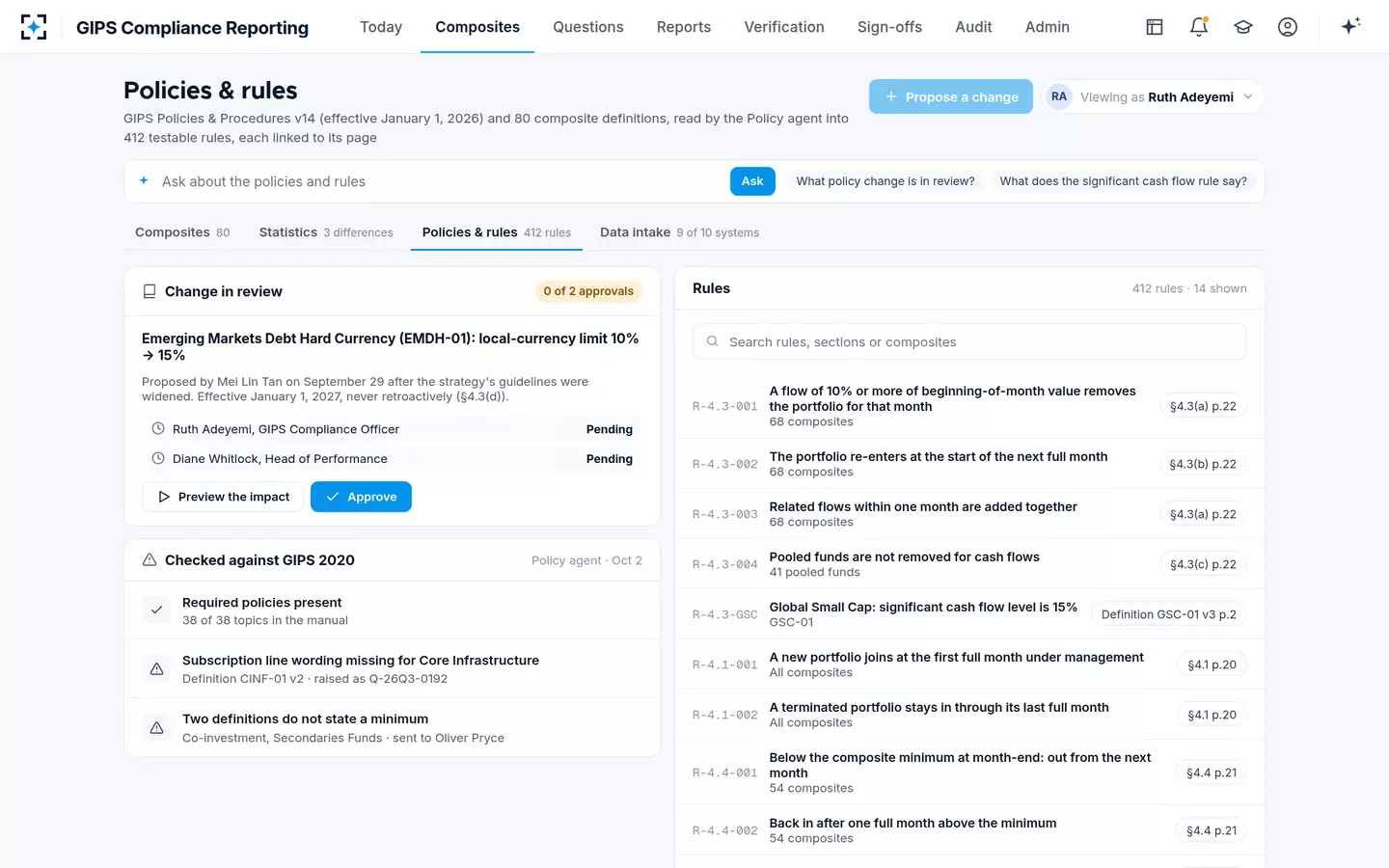
For the firm making the claim, every question above has a document behind it, and the solution keeps those documents current. Its Policy agent reads the firm's policies and procedures manual and composite definitions, turns them into testable rules each cited to its page, and checks the manual against the 2020 standards, listing the gaps. At the sample firm it found all 38 required policy topics present and flagged two gaps in composite definitions for a person to fix.
The policies behind the claim in GIPS Compliance Reporting, checked against GIPS 2020
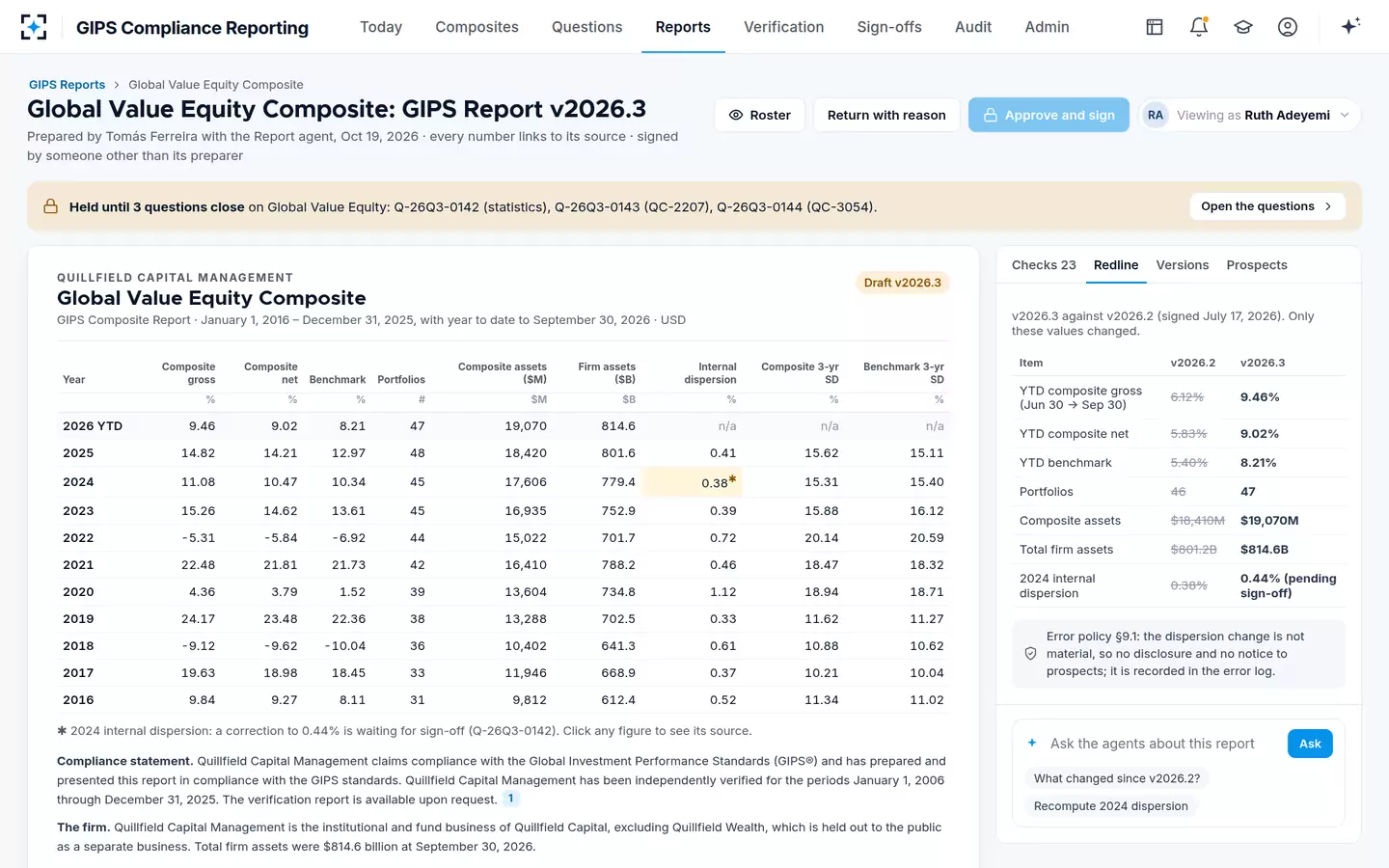
Each composite report it drafts carries the firm definition, the compliance statement and the composite description from the signed versions, and every figure links to its source. The Report agent also lists every prospect who received an earlier version, which is the list a correction has to reach.
The compliance statement and firm definition, as a prospect reads them
For a firm preparing to be verified, or switching verifier, the binder to bring to GIPS verification firms lists what to have ready. The whole workflow is on the GIPS Compliance Reporting page.
Questions people ask
Where can I find GIPS verified firms?
Ask the firm. A verified firm's compliance statement in every composite report says it has been verified, for which periods, and that the verification report is available on request (4.C.1a). The verification report, not a listing, is the evidence.
Can a firm claim compliance for just one division?
Yes, if that division is defined as the firm and is held out to the public as a distinct business entity (1.A.2). The claim then covers everything inside that definition, and the report must disclose the definition (4.C.3).
Who files the CFA Institute GIPS compliance form?
The firm that claims compliance, when it first claims and every year by 30 June, with information as of the previous 31 December (1.A.38). CFA Institute's sample policy assigns it to the performance manager, with the chief compliance officer as secondary contact.
Can a firm say a single strategy is GIPS compliant?
No. Compliance is firm-wide and "cannot be met on a composite, pooled fund, or portfolio basis" (1.A.1), and a firm that does not meet every applicable requirement may not claim partial compliance (1.A.8).
Can a firm claim GIPS compliance in an advertisement?
Only if it already claims compliance and either follows the GIPS Advertising Guidelines or includes a GIPS report (section 8, 8.A.1). For SEC-registered advisers the Marketing Rule applies to the same advertisement.
Does the list show whether a firm has had errors?
No. Material errors are disclosed in the corrected report for at least a year (4.C.38), not in any listing. Ask whether the composite's report has been corrected and whether you received an earlier version.