A GIPS compliant track record is a composite's annual performance history, at least five years and building to ten, calculated and presented under the GIPS standards by a firm that complies with them firm-wide. What makes it worth something to a prospect is that it is hard to change. The 2020 GIPS Standards forbid altering historical performance because the firm reorganized, forbid applying a new composite definition or minimum asset level retroactively, require material errors to be corrected and disclosed to the people who saw them for at least a year, and allow a record to follow a team to a new firm only if substantially all the decision makers move, the process stays intact and the records come too. Each of those rules depends on the firm knowing exactly what it published, to whom and why. Botminds' GIPS Compliance Reporting keeps that history: decisions are signed with reasons, policy changes apply only from their effective date, published figures are never overwritten, and every prospect who received a report version can be listed.
Where a figure comes from the solution, it is sample data on a fictional firm, Quillfield Capital; other worked numbers are illustrative.
One material error, from discovery to the end of its disclosure
- Fix~1 month
- Disclosure stays in the reportat least 12 months, and as long as relevant
- Fix~1 month
What makes a track record GIPS compliant?
A track record is GIPS compliant when the firm that presents it complies with every applicable requirement of the standards across the whole firm, and the record itself was built under them. Compliance "cannot be met on a composite, pooled fund, or portfolio basis" (1.A.1), so there is no such thing as one compliant composite at a non-compliant firm. To claim compliance at all, the firm must have complied for at least five years, or since it was founded (1.A.3) (GIPS Standards for Firms, 2020).
The record is protected by its construction rules. Every actual, fee-paying, discretionary segregated account must be in at least one composite (3.A.2). Terminated portfolios stay in the history up to their last full measurement period (3.A.9), so a firm cannot drop a lost client's bad years. Terminated composites stay on the firm's list for at least five years (1.A.22). A change to a composite definition must not be applied retroactively (3.A.6), and neither may a change to a minimum asset level (3.A.11). The firm "must not link actual performance to historical theoretical performance" (1.A.27).
Older, non-compliant history may be shown, but only before the minimum effective compliance date of 1 January 2000, or 1 January 2006 for real estate, private equity and wrap fee composites, and it must be disclosed as such (1.A.29, 4.C.20). From those dates forward, the record is compliant or it is not shown.
What is a material error under GIPS?
A material error is an error in a GIPS report "that must be corrected and disclosed in a corrected" report, and the firm decides, in its written error correction policy, which errors meet that test. The glossary's definition is deliberately circular: the standards set the consequences of materiality, and leave the threshold to each firm's policy.
CFA Institute's guide to writing a policies and procedures manual offers a sample definition that many firms adapt: an error is material "if the magnitude of the omission or misstatement of performance information, in light of surrounding circumstances, makes it probable that the judgment of a reasonable person relying on the information would have been changed" by it. The same sample adds that errors are considered in the aggregate for each reporting period, so several small ones can together be material (CFA Institute, policies and procedures manual guide, 2023).
Errors are not only numbers. The sample policy treats "missing, incomplete, or incorrect disclosures" as qualitative errors, and any disclosure error that may have affected a prospect's decision to invest as the most serious level.
GIPS error correction policy: the four levels in the standard setter's sample
The sample error correction policy sorts errors into four levels by size and sets an action for each. The thresholds below are the guide's for equity annual returns; it sets lower ones for fixed income and mostly relative ones for assets, portfolio counts and risk statistics.
Four levels of error in CFA Institute's sample policy, and what each one requires
| Level | Equity annual return changes by | What the firm does |
|---|---|---|
| Level 1 | Less than the Level 2 threshold | Nothing. |
| Level 2 | At least 10 bps but under 15 bps, and at least 5% of the return | Correct the data and the report. Do not disclose the change. |
| Level 3 | At least 15 bps but under 20 bps, and at least 5% of the return | Correct, and disclose the change. Do not distribute the corrected report. |
| Level 4: material | At least 20 bps and at least 5% of the return, or any change that turns outperformance into underperformance | Correct, disclose, and send the corrected report to the current verifier, current clients and former verifiers who received it, and make every reasonable effort to reach current prospects who received it. |
Two details in that sample are worth copying. It does not differentiate errors by the period in which they occurred: an error in a 2017 return is treated like one in last year's. And it requires an error incident report for every error, recording the composite, the affected portfolios and periods, how it was found, the materiality calculation, the action level and the steps taken to stop it recurring. That report is what a verifier reads under procedure 15, which tests that errors "have been treated in accordance with the firm’s error correction policies and procedures" (GIPS Standards for Verifiers, 2020).
How long must an error be disclosed in a GIPS report?
For at least one year after the correction, and for as long as it is relevant to interpreting the record. Provision 4.C.38 says the firm "must disclose any change to the GIPS Composite Report resulting from the correction of a material error", that "this disclosure must be included for a minimum of one year and for as long as it is relevant to interpreting the track record", and that the disclosure "is not required to be included in a GIPS Composite Report that is provided to a prospective client or prospective investor that did not receive the GIPS Composite Report containing the material error."
That last sentence makes distribution records part of the track record. A firm that can show who received which version can give new prospects a report without the disclosure. One that cannot has to treat everyone as a past recipient: CFA Institute's sample policy says that if the firm "is not certain if a specific party received" the erroneous report, it will assume they did. The reach of one error, in people and in cost, is the subject of what a material error really costs.
The standards' own sample money-weighted report shows what such a disclosure looks like: "An incorrect amount was previously used for a cash distribution that occurred in 2020. The since-inception annualized gross and net composite returns have been restated from 8.4% and 7.9% to 7.4% and 6.9%, respectively."
Can a GIPS track record move with a team to a new firm?
Yes, if four conditions are met for that composite, and if any one fails, the earlier performance "must not be linked to the ongoing performance record of the new or acquiring firm" (1.A.32). The conditions are tested composite by composite, not for the team as a whole.
The four conditions for linking a track record from a past firm
- Substantially all the decision makers moved
Research staff, portfolio managers and other relevant staff must be employed by the new firm. One star manager without the team does not qualify.
- The decision-making process is substantially intact and independent
Joining a firm that imposes its own investment committee or model breaks the chain.
- The new firm has records to support the performance
The custodian statements, valuations and membership history of the old composite. Without them there is nothing to verify.
- There is no break between the old firm and the new
If there is a gap and the other conditions hold, the record may still be shown, but before and after the break separately and never linked (1.A.33).
The records condition is the one teams underestimate. A portfolio manager's personal spreadsheet of monthly returns is not a record that supports performance; the verifier will want the same third-party documents it asks for at any firm, and procedure 12(j) checks that "The requirements relating to investment decision makers, the decision-making process, and supporting records have been met" and that ported composite performance "includes all portfolios that met the composite definition at the past firm". A team that leaves with only its best accounts' history does not have a portable record.
The standards' own sample report shows a compliant case. Its disclosure 4 reads, in part: "Performance prior to May 2014 occurred while the investment management team was affiliated with another firm. The investment management team has managed the composite since its inception, and the investment process has not changed."
Linked, or shown with a break
When the conditions fail, or a composite simply runs out of portfolios, the history does not disappear; it stops being continuous. The standards treat both cases the same way.
What a prospect sees: a linked record or a record with a break
Linked record: All four portability conditions met with no gap (1.A.32); or no interruption in composite membership.
Record shown with a break: A gap between old and new firm (1.A.33), or the composite lost all its portfolios and later restarted (4.A.5).
Linked record: One continuous series of years.
Record shown with a break: Years before and after the break, both shown, with the break clearly marked.
Linked record: Returns are geometrically linked across the whole period.
Record shown with a break: Performance before the break must not be linked to performance after it.
Linked record: That past-firm performance is presented, and for which periods (4.C.37).
Record shown with a break: The break shown clearly in the table, and past-firm periods disclosed where they apply (4.C.37).
The same break rule catches small composites. If a significant cash flow policy removes the only portfolio in a composite for a month, the composite has no members that month and its record must restart, with no link across the gap. Reading a firm's claim from the outside covers the questions a consultant should ask when a record shows a break or a ported history.
What reorganizations and acquisitions cannot change
A firm can redefine itself, merge, buy another manager or rename a composite, and none of it may touch the numbers already published.
Changes in the firm’s organization must not lead to alteration of historical performance.
GIPS Standards for Firms, 2020, provision 1.A.28
What changes is the disclosure. A redefinition of the firm must be disclosed with its date and description (4.C.21), a composite renaming for at least a year (4.C.23). An acquired firm's assets that do not comply must be brought into compliance within one year of the acquisition, going forward (1.A.34). And the firm's policies and procedures must be kept in every version: CFA Institute's guide notes that both current and previous versions must be maintained "so there is an accurate history of policies and procedures for the entire period for which the firm claims compliance."
How GIPS Compliance Reporting protects the record's history
In the solution, history is a property of the system, not a habit. A policy or composite definition change needs the GIPS Compliance Officer and the Head of Performance, shows which portfolios it would move first, and applies from its effective date only. The agents never move a portfolio, change a published figure or change a policy. Every decision is recorded with who made it, when, why and on which evidence, and cannot be edited afterwards.
A signed decision in GIPS Compliance Reporting, with the evidence filed where the verifier will look
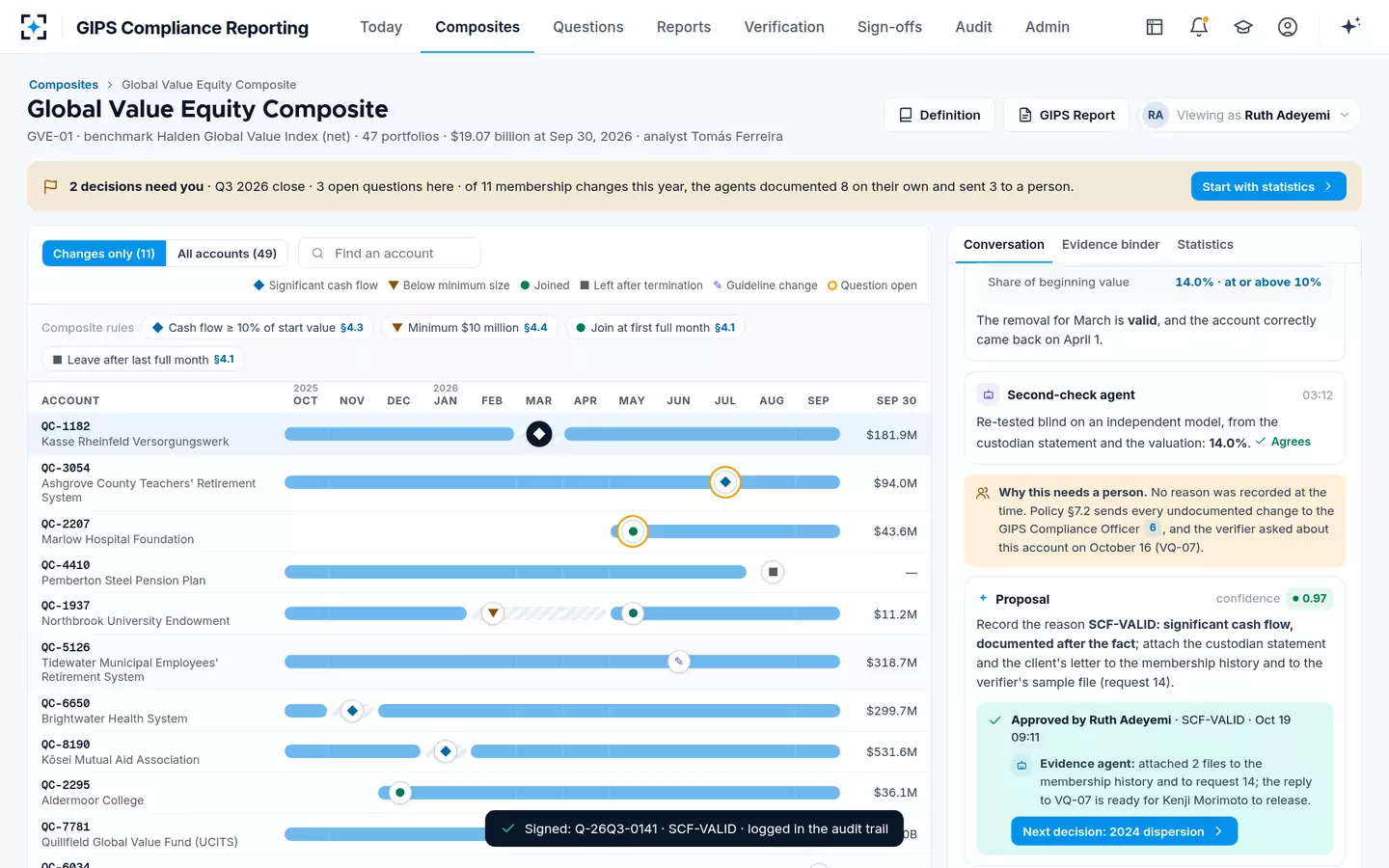
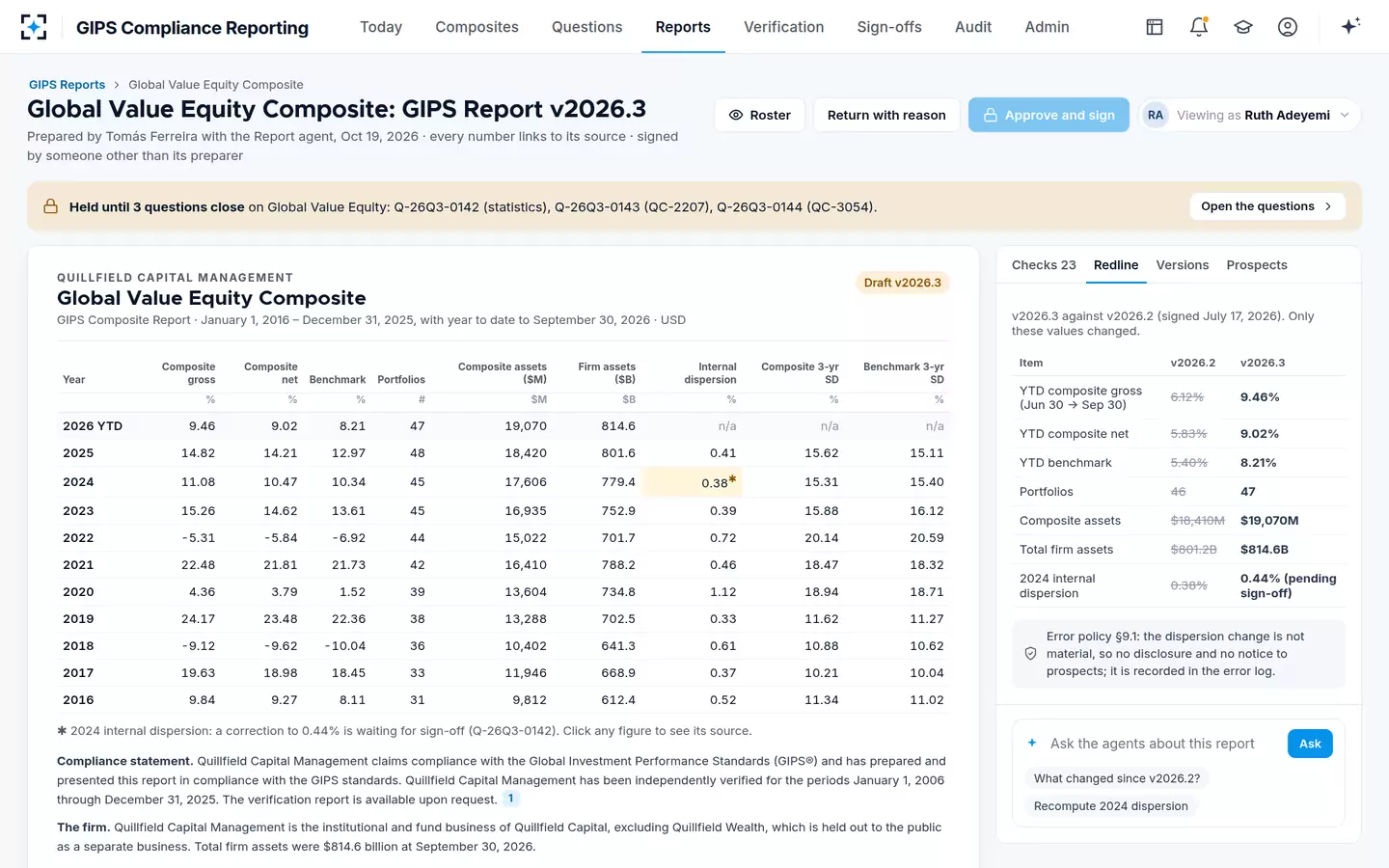
When a published figure turns out to be wrong, the Statistics agent raises it as a question instead of correcting it, the firm's error policy is applied, and a material error needs both the officer and the Head of Performance. The Report agent then lists every prospect who received the earlier version from the CRM, which is the list 1.A.20 and 4.C.38 turn on. At the sample firm, a 2024 dispersion figure recomputed from 0.38% to 0.44% fell under the firm's own materiality level, so it is corrected in the next report without disclosure and kept in the error log.
The corrected figure waits for sign-off, and the redline shows exactly what changes
See the full cycle on the GIPS Compliance Reporting page.
Questions people ask
What does GIPS compliant performance mean?
Performance calculated and presented under the GIPS standards by a firm that complies with all of their applicable requirements firm-wide. A single composite cannot be compliant on its own, a firm may not claim partial compliance (1.A.8), and statements that a calculation methodology is "in accordance" with the standards are prohibited (1.A.9).
Can a firm restate past returns?
Only to correct an error, under its error correction policy, and a material correction must be disclosed for at least a year (4.C.38). A reorganization, a redefinition of a composite or a new minimum asset level must never change history (1.A.28, 3.A.6, 3.A.11).
Do former prospects get a corrected report?
No. Provision 1.A.20 requires the corrected report for the current verifier, current clients and former verifiers that received the erroneous version, and every reasonable effort for current prospects who received it. Former clients and former prospects are expressly excluded.
What if a team moves but the old firm keeps the records?
Then the performance cannot be linked to the new firm's record, because the new firm must have records to support it (1.A.32c). The history may be presented only if all the conditions are met; supporting records are not optional.
Does a composite's track record end if all its portfolios leave?
Yes. The record ends, restarts when portfolios return, and both periods are shown with the break clearly marked and no linking across it (4.A.5).
How long must a terminated composite stay on the firm's list?
At least five years after its termination date (1.A.22). A prospect may ask for the list of composite descriptions, and for the report of any composite on it (1.A.23, 1.A.24).