GIPS compliance reporting is the work of producing, distributing and correcting the GIPS composite and pooled fund reports that a firm's claim of compliance requires, for every strategy, updated at least once a year and given to every qualifying prospect. When a published figure is wrong, the fix is usually small: a recomputed dispersion, a restated return. The cost is in the reach. Under the 2020 GIPS Standards a material error must be corrected, disclosed in the report for at least a year, and sent to the current verifier, current clients and former verifiers who received the wrong version, with every reasonable effort to reach current prospects who did. For an SEC-registered adviser the same report is a performance claim the firm must be able to substantiate, and a false claim of compliance has ended in penalties and an industry bar. Botminds' GIPS Compliance Reporting is built to shrink both sides: fewer wrong figures reach a report, and when one does, the list of everyone who received it is already there.
Worked figures are illustrative unless a caption says they are the solution's sample data, which describes a fictional firm, Quillfield Capital.
One report version, 66 recipients: where a material error's correction has to go
What is GIPS compliance reporting, and where do errors enter?
It is the reporting side of a claim of compliance: building each composite from the firm's membership rules, calculating its returns and statistics, assembling the report with its disclosures, and putting the right version in front of every prospective client of the strategy (1.A.11). Errors enter at every stage, but the ones that survive review are rarely arithmetic. They are inputs: a portfolio in the composite for a month it should have been out, a part-year portfolio in the dispersion figure, a benchmark the index provider has since restated, or a disclosure that went missing when the person who knew about an event moved on.
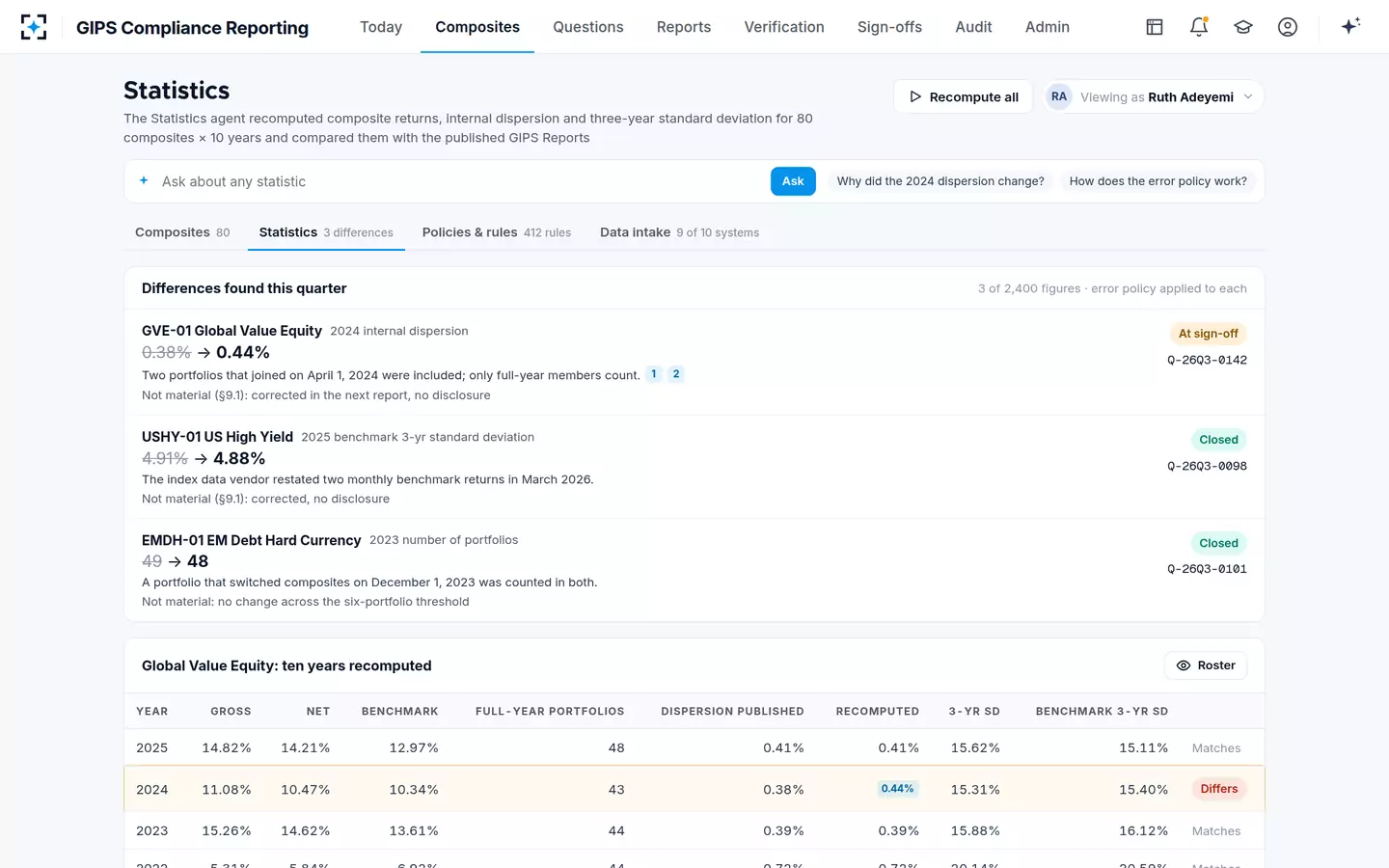
The sample firm in the solution gives a sense of frequency in one firm's books. Recomputing returns, internal dispersion and the three-year standard deviation for 80 composites over ten years, 2,400 figures, found three that differed from the published reports, each from one of those causes. Three in 2,400 sounds small until each one is multiplied by the number of report versions that carried it and the number of people who received each version.
What happens if a GIPS report is wrong?
The firm's own error correction policy decides, and the standards decide what the most serious level requires. The standards define a material error only by its consequence: one "that must be corrected and disclosed in a corrected" report. Where the line sits is the firm's choice, written in advance. CFA Institute's sample policy uses four levels, from no action through correction without disclosure, correction with disclosure but no distribution, to the full material-error response (CFA Institute, policies and procedures manual guide, 2023).
The cost of each level of error in CFA Institute's sample policy
| Level | What the firm does | Who hears about it | How long it shows |
|---|---|---|---|
| 1 | No action | Nobody | Never |
| 2 | Corrects the data and the report | Nobody is told | Never: no disclosure |
| 3 | Corrects, and discloses the change | Anyone who receives the report from then on | At least one year, under the sample policy |
| 4: material | Corrects, discloses, and distributes the corrected report | Current verifier; current clients and former verifiers who received it; every reasonable effort for current prospects who received it | At least one year, and as long as relevant (4.C.38) |
Who must receive a corrected GIPS report?
For a material error in a composite report, provision 1.A.20 lists them: the corrected report goes to the current verifier; to current clients and any former verifiers "that received the GIPS Composite Report that had the material error"; and the firm must "make every reasonable effort" to provide it to all current prospective clients and prospective investors that received the erroneous version. The firm "is not required to provide the corrected GIPS Composite Report to former clients, former investors, former prospective clients, or former prospective investors" (GIPS Standards for Firms, 2020).
Every word of that list depends on knowing who received which version, and when they stopped being a prospect. That is why the standards already require a firm to "demonstrate how it made every reasonable effort" to provide reports (1.A.17), and why CFA Institute's sample policy keeps a log of every report sent: the marketing material, the date of the report, who received it, and when. Without the log, the sample policy's fallback applies: if the firm is not certain a party received the erroneous report, it assumes they did. The reach then becomes everyone the firm cannot rule out.
The disclosure carries its own cost. It must stay for at least a year (4.C.38), so for twelve months every recipient of the strategy's report reads that the firm got a number wrong. The provision spares only prospects who never received the erroneous version, which again only a distribution log can show.
The same error, two policies: material at one firm, not at another
Because materiality is set by each firm, the same correction can cost almost nothing at one firm and a full distribution at another. The solution's sample data has a clean example. A published 2024 internal dispersion of 0.38% included two portfolios that joined on 1 April 2024; recomputed from full-year portfolios only, it is 0.44%.
A dispersion figure moves from 0.38% to 0.44%: what two error policies require
The sample firm's policy: An absolute threshold: 0.10 percentage points.
CFA Institute's sample policy: For internal dispersion, a relative threshold: a change of 10% or more is Level 4.
The sample firm's policy: 0.06 points: below the threshold.
CFA Institute's sample policy: 0.06 on 0.38 is a 15.8% change: above it.
The sample firm's policy: Not material. Corrected in the next report, no disclosure, no notice; recorded in the error log.
CFA Institute's sample policy: Material. Corrected, disclosed for at least a year, and sent to the verifier, current clients and current prospects who received it.
The lesson is not that one policy is right. It is that the threshold, written once, decides the cost of every future error, and should be chosen with that cost in view and applied consistently. A firm should also be ready to explain to a verifier, under procedure 15, why its threshold suits a dispersion column whose values are often well under one point. What a material error does to a track record follows the correction from discovery to the end of its disclosure.
Can the SEC enforce GIPS?
Not as such: the GIPS standards are voluntary, issued by CFA Institute. But for an SEC-registered adviser, a GIPS report used in marketing is a performance claim under federal rules, and a false claim of compliance is a misstatement under the Investment Advisers Act. The Marketing Rule bars an advertisement from asserting any material fact the adviser lacks a reasonable basis to back up when the SEC asks (17 CFR 275.206(4)-1(a)(2)). A GIPS report sent to many prospects is likely to meet the rule's definition of an advertisement, a communication to more than one person that offers advisory services.
The books-and-records rule then requires the adviser to be able to rebuild every performance figure it distributes from its own papers, for at least five years after the end of the fiscal year it last sent them (17 CFR 275.204-2(a)(16), (e)(3); the client reporting accuracy guide quotes the rule). The SEC's examiners have reported finding the gap: in an April 2024 risk alert they observed that "Advisers did not maintain documentation to support performance claims included in advertisements" (SEC Division of Examinations, Risk Alert, 17 April 2024).
What a false claim of GIPS compliance cost one adviser
The case regulators and performance teams cite is ZPR Investment Management. In a 2015 opinion, the Commission found that the adviser and its principal had misrepresented GIPS compliance in magazine advertisements and newsletters that left out returns the GIPS advertising guidelines required, and had told a fund database that its compliance was verified "to the present" months after its verification firm resigned. The Commission wrote that "because GIPS prohibits claims of partial compliance", the statements were misleading (SEC opinion, Advisers Act Release 4249, 30 October 2015).
ZPR Investment Management: civil penalties imposed in 2015, and after the appeal
The penalties are the smaller part of the story. The industry bar on the principal, which the court left in place, barred him from association with investment advisers, brokers and other regulated firms, and the Commission's 2018 order recalls its finding that the firm "ignored the advice of its GIPS verification firm". The case was not about a calculation error. It was about claiming compliance in materials that did not meet the standards, and about a verification claim that had outlived its verifier: errors of reach, where a statement went out to people who relied on it.
The cost nobody budgets: the next verification gets bigger
An error also changes the next verification. When a verifier finds errors, or documents that cannot be produced, the Standards for Verifiers treat that as a reason to select a larger sample or apply additional procedures. Under procedure 15 the verifier must also understand every error in GIPS reports that occurred in, was found in, or affects the periods being verified, select errors for testing, and confirm that each was handled under the firm's own error correction policy and, if material, sent to the people 1.A.20 names.
So a corrected error has to be corrected in a way that can be shown: the incident report with its materiality calculation, the before-and-after report versions, and the list of recipients with the dates they were sent the correction. A firm that handled the error well but cannot produce that trail pays for it twice, once in the correction and again in the verifier's extra hours. In the solution, each correction carries its reason, the error policy applied, the approvers and the report versions, so the trail is the record itself.
How to size GIPS controls to the exposure
The budget for GIPS controls should follow the reach of an error, not the effort of fixing one. No regulator or independent study publishes what an error costs a firm; here is how to measure it for your own firm.
Measure your own exposure to one material error
- Count report versions in circulation
Composites times versions issued in the last year: annual updates, quarterly refreshes, corrections.
- Count recipients per version, by category
Current clients, current prospects, former prospects, consultants and databases, current and former verifiers. If you cannot split them, every recipient is in scope.
- Time how long it takes to produce that list
For one composite and one version, from the question to a list you would sign.
- Recompute a year of figures independently
Returns, dispersion and the three-year standard deviation, from portfolio-level data. The share that differs is your error rate.
- Test your materiality threshold on those differences
How many would have been material under your policy, and under the standard setter's sample?
- Price the distribution and the disclosure
Staff hours per recipient, the verifier's extra procedures, and a year of the disclosure in every report you send.
The third step usually decides the budget. A firm that needs a week to say who received a report version will need a week for every correction, and is the firm most likely to fall back on assuming everyone received it.
Where GIPS Compliance Reporting cuts the cost of an error
The solution works on both terms of the exposure: how often a wrong figure reaches a report, and how far it travels when one does. Before publication, every membership event is tested against the firm's rules and every exception re-tested blind by a second agent on a different model, and the Statistics agent recomputes every composite's figures and raises each difference as a question. It never overwrites a published number.
Differences found before they spread: three figures in 2,400, each with its cause
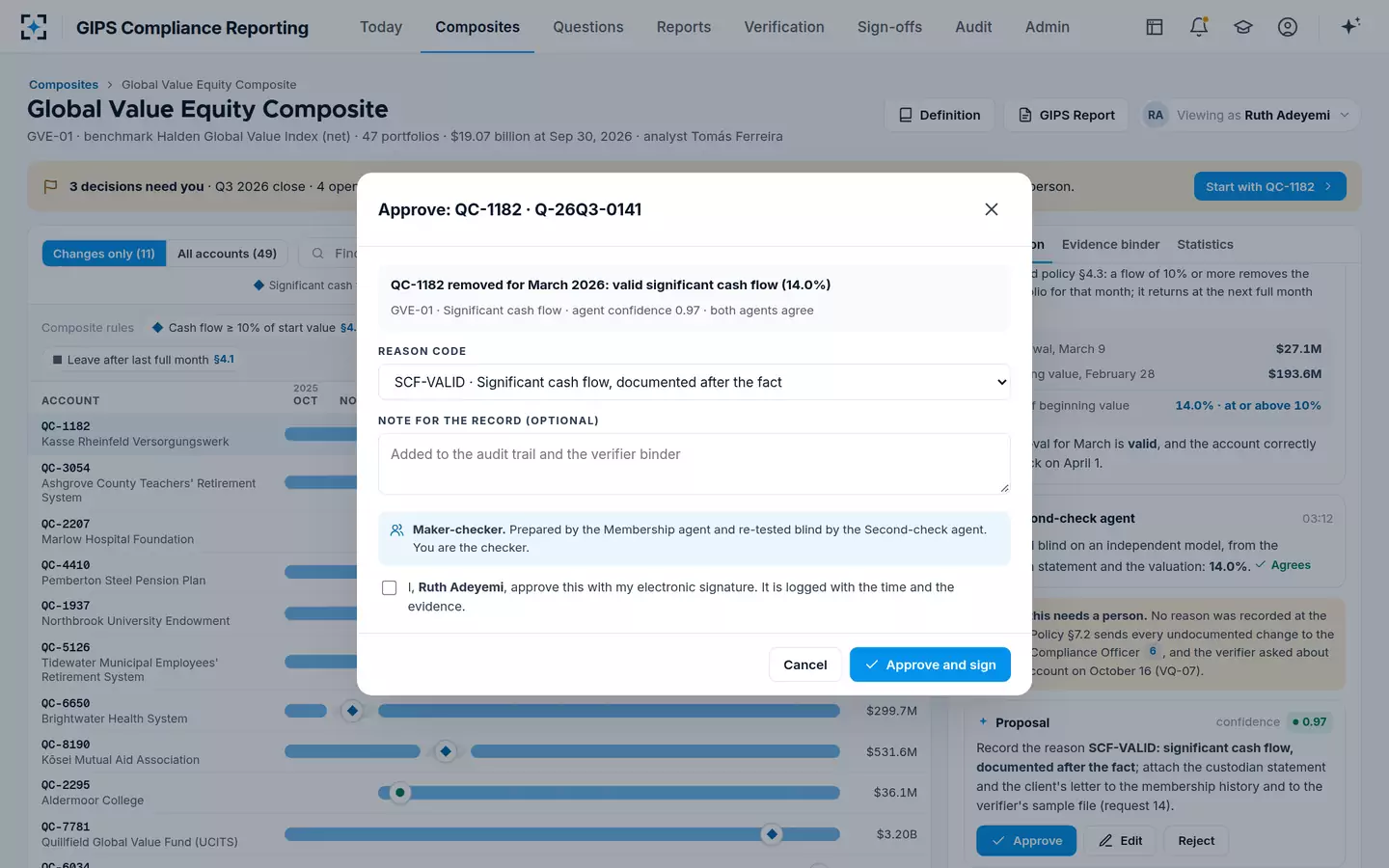
After a material error, the Report agent lists every prospect who received the earlier version from the CRM, so the distribution in 1.A.20 starts from a list rather than a search. A material error needs both the GIPS Compliance Officer and the Head of Performance, and every approval carries a reason code and an electronic signature; the preparer of a report cannot approve it.
Every correction signed with a reason code in GIPS Compliance Reporting
For a buyer, the fair test is the firm's own history: run the agents over a year the verifier has accepted and count what they find, then price those findings with the checklist above. How the agents decide what to ask a person and what a verifier will expect to see complete the picture. The solution is on the GIPS Compliance Reporting page.
Questions people ask
What is GIPS performance reporting compared with GIPS compliance reporting?
The terms overlap. Performance reporting usually means calculating and presenting composite and fund returns; compliance reporting adds the obligations around them, such as distribution to prospects, disclosures, error correction and the annual notification to CFA Institute (1.A.38).
Is a non-material error disclosed?
Not necessarily. Disclosure is required for material errors (4.C.38); for lesser errors the firm's policy decides. CFA Institute's sample policy discloses its Level 3 errors without distributing the report, and corrects Level 2 errors silently.
Does a corrected report go to consultants?
If they received the erroneous version and are current prospective clients, yes: consultants representing qualifying investors count as prospective clients, and the firm must make every reasonable effort to reach them (1.A.20).
Does a material error mean a firm loses GIPS compliance?
No. The standards expect errors and set out how to correct them; a firm that corrects, discloses and distributes as required remains compliant. Hiding a known material error would breach the rule that nothing presented may be false or misleading (1.A.7).
How long must performance records be kept?
Under the GIPS standards, the supporting data must be available within a reasonable time for every period presented (1.A.25). For an SEC-registered adviser, the records behind any performance it distributes must survive at least five years after the end of the year it last went out (17 CFR 275.204-2(e)(3)).