The GIPS verification process is an independent firm's test of whether a firm's policies for building composites and calculating, presenting and distributing performance were designed in line with the GIPS standards and applied across the whole firm. It is not required, but the standards strongly recommend it. The verifier agrees the terms in writing, obtains the firm's policies and procedures, selects a sample of composites, portfolios and reports from every period being verified, and tests each against the policies and against documents from third parties such as custodians and clients. It ends with a representation letter signed by management and, if the records support it, a verification report. The work is hard because the evidence is scattered: a single removal from a composite can rest on a client letter in German, a custodian statement and a policy page from two versions ago. Botminds' GIPS Compliance Reporting attaches that evidence to each membership decision when it is made, so the file already exists when the verifier's sample arrives.
The examples come from the solution's sample data: Quillfield Capital, a fictional firm, and Hartcliffe Verification LLP, its fictional verifier.
One sampled removal, six pieces of evidence: what the verifier will ask to see
| Evidence | Where it lives | The verification procedure it serves |
|---|---|---|
| The policy in force that month, with its effective date | The policies and procedures manual, every version kept | 2. Policies and procedures; 7(b) policies consistently applied |
| The portfolio's membership history: out in March, back on April 1 | The performance measurement system | 7. Assignment of portfolios to composites |
| The client's instruction to withdraw | Document management: the client's letter, in its own language | 10. Client subscription and redemption notifications |
| The flow itself | The custodian's statement for the month | 10. Custodian, fund accounting and broker statements |
| The value it was measured against | Portfolio accounting, the book of record | 7(j). Significant cash flow policy followed; 9. Input data |
| The arithmetic, the decision, who made it and when | The decision log, with the approver's reason | 7(b) and 1. Recordkeeping: support available within a reasonable time |
What is GIPS verification?
Verification is testing of a whole firm, by an independent verifier, under the required procedures of the GIPS Standards for Verifiers. The 2020 standards describe what it provides: assurance "on whether the firm’s policies and procedures related to composite and pooled fund maintenance, as well as the calculation, presentation, and distribution of performance, have been designed in compliance with the GIPS standards and have been implemented on a firm-wide basis" (GIPS Standards for Firms, 2020).
Two limits follow from that sentence, and both appear in every verified firm's compliance statement. Verification is firm-wide, so it "cannot be carried out only on a composite or a pooled fund", and firms "must not state that a specific composite or pooled fund has been “verified”". And it is about policies and their application, not about any one number: the verified-firm statement ends with "Verification does not provide assurance on the accuracy of any specific performance report." A firm that wants assurance on one composite's report can add a performance examination, discussed below.
The minimum first verification covers one year of presented performance, and the standards recommend that firms be verified for every period for which they claim compliance (GIPS Standards for Verifiers, 2020).
Is GIPS verification required?
No. The standards say "It is strongly recommended that firms be verified" and list it as a recommendation (1.B.3), and a firm may claim compliance without it, using the compliance statement for a firm that "has not been independently verified." In the institutional market, though, the regulator has described the practical position plainly.
Although optional, verification has become a de facto requirement for an adviser to be considered by institutional investors and also provides "marketing advantages."
SEC opinion in ZPR Investment Management, Advisers Act Release 4249, 30 October 2015
The same opinion shows the other side of that value. In that case a fund database was still told the firm's compliance was verified "to the present" months after the verification firm had resigned, and the Commission found the claim false and material. A verification report covers named periods only, and the standards forbid any claim of verification that no report backs (what a GIPS claim tells a consultant reads those dates).
The GIPS verification process, from engagement letter to report
The process has a fixed shape, set by the Standards for Verifiers. It starts with an engagement letter, which must state the objective and scope including the periods, both sides' responsibilities, the inherent limitations, that the GIPS standards are the criteria, that the verification gives no assurance on the operating effectiveness of the firm's controls, and that management will sign a representation letter at the end.
Planning comes next, and it sets the evidence standard for everything after. The verifier must presume that "Information obtained from independent third parties provides greater assurance than information obtained from the firm", and that direct inspection, observation or recalculation is more persuasive than information obtained indirectly. The standards add: "Testing by inquiry on its own is insufficient to satisfy the required verification procedures when other testing procedures could reasonably be performed." A performance analyst's explanation of why an account left a composite is a starting point, not evidence.
Then come sample selection and the sixteen testing procedures, the representation letter signed by management, and the verification report. The verifier should also issue a recommendation letter "describing specific findings, recommendations, and other areas for improvement". If the records cannot support a verification, no report may be issued, and the verifier must tell the firm why.
What does a GIPS verifier test? The sixteen procedures
The required procedures cover the firm's whole performance process, from its definition to its notification to CFA Institute. Every firm being verified goes through all sixteen, on a sample.
The sixteen required verification procedures, and the question each one asks
- 1. Recordkeeping
Is the data behind every report captured, kept and available within a reasonable time?
- 2. Policies and procedures
Are they consistent with the standards, and "complete, clear, unambiguous, and adequately documented"?
- 3. Firm definition
Is the firm, and has it always been, appropriately defined?
- 4. Lists of composites and pooled funds
Are the lists complete?
- 5. Total firm assets
Is the list of portfolios complete, without double counting, and correctly split between composites and the rest?
- 6. Portfolios excluded from composites
Are non-discretionary classifications supported by the client's agreement and guidelines?
- 7. Assignment of portfolios to composites
Timing of new, terminated and moved portfolios; minimum asset levels; significant cash flows; non-fee-paying portfolios.
- 8. Outlier returns
Do unusual portfolio returns hide data errors or wrong membership?
- 9. Input data
Are flows, income, taxes, costs, fees and valuations treated as the policies say?
- 10. Performance based on actual assets
Are holdings, income and cash flows backed by third-party documents?
- 11. Performance measurement
Recalculated on a sample: right formula, right fee treatment.
- 12. GIPS Reports
Every number accurate and consistent with records; every required disclosure present.
- 13. Providing GIPS Reports
Did the firm make every reasonable effort to give reports to prospects?
- 14. Marketing materials
Are references to the standards proper, and any GIPS advertisement complete?
- 15. Error correction
Were errors handled under the firm's policy, and material ones sent to the right people?
- 16. Notification to CFA Institute
Was the GIPS Compliance Notification Form filed?
Procedure 7 is where most of a performance team's time goes, because it reaches down to individual portfolios. The verifier obtains membership details "including which portfolios are included, with their returns and values, for all period(s) being verified", including new, existing and terminated portfolios, and tests a selection against each composite-specific policy. The significant cash flow policy is one of those tests, and often the one with the most events.
How the verifier's sample is chosen, and what makes it grow
The verifier must test the entire firm but may sample, and must draw the sample from the entire period being verified. The Standards for Verifiers list ten criteria the verifier must at least consider, among them the number of composites and pooled funds, the number of portfolios in each composite, composite assets relative to total firm assets, the internal control environment, the number of years, the systems used to build composites and calculate performance, and the use of outside service providers.
One sentence in that section matters most to the firm being verified: "Missing or incomplete documents, or the presence of errors, would warrant selecting a larger sample or applying additional verification procedures." A file that cannot be produced does not just fail one test; it makes the next part of the engagement bigger. The standards even suggest one way to pick a sampled portfolio: the one "that has the largest effect on composite performance because of its size".
The defensible file: one membership event, end to end
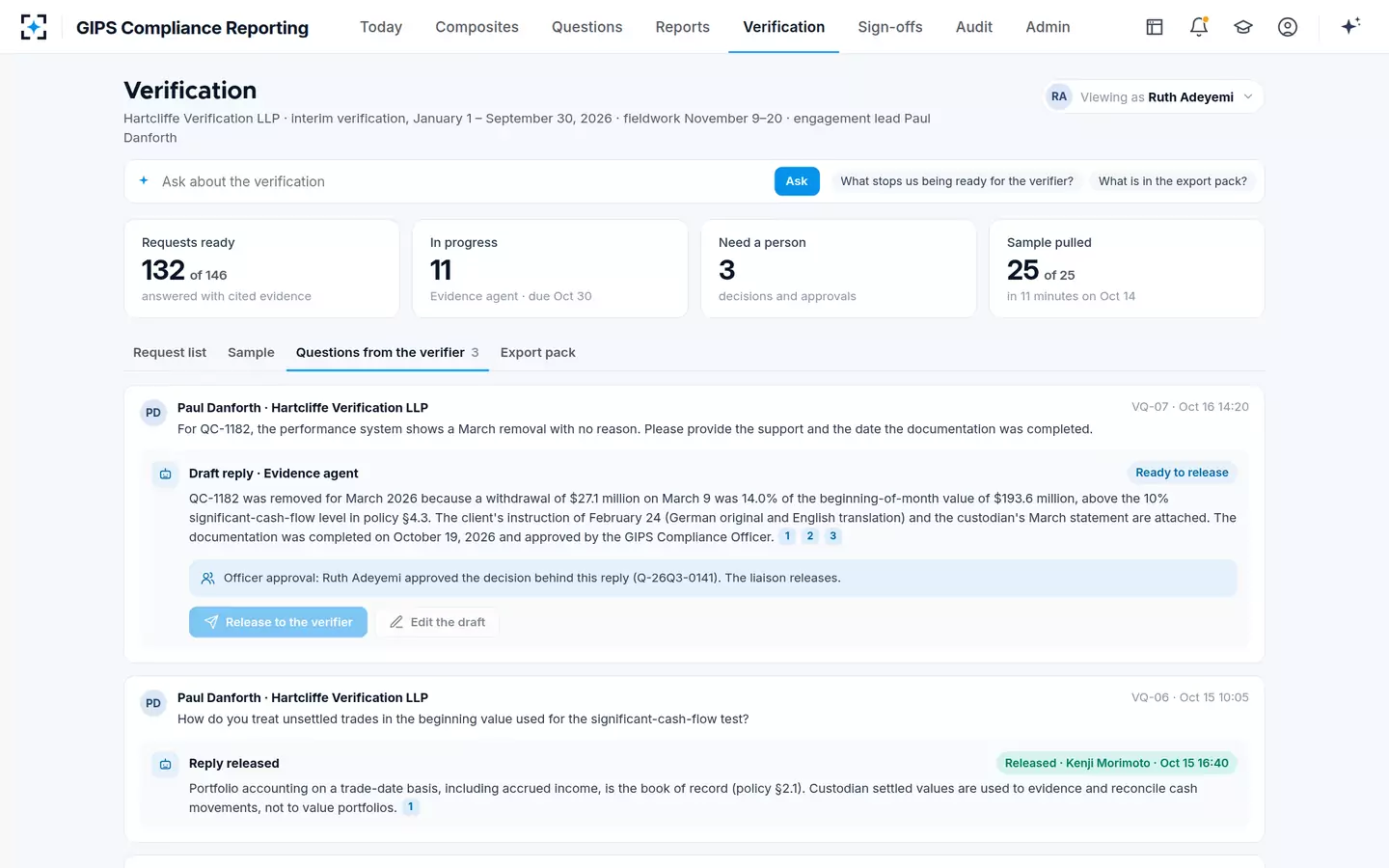
A file is defensible when someone other than its author can rebuild the decision from it, using the policy and documents from outside the firm, and reach the same answer. Take the sample firm's account QC-1182, a German pension fund's mandate in the Global Value Equity Composite. The performance system showed it out of the composite for March 2026 and back on April 1, with no reason recorded. The verifier, on October 16, asked for "the support and the date the documentation was completed".
The file the solution assembled answers in the order a verifier reads. The policy: section 4.3 of the firm's manual removes a portfolio for the month when a client flow is 10% or more of its beginning-of-month value, and returns it at the next full month. The instruction: the client's letter of February 24, in German, to withdraw EUR 25 million on March 9 for a reallocation to bonds, with the mandate's guidelines unchanged. The flow: the custodian's March statement showing $27.1 million out on March 9. The value: $193.6 million on February 28 in portfolio accounting. The arithmetic: 14.0%. The decision: approved by the GIPS Compliance Officer on October 19 with a reason code, after a second agent re-tested it blind from the custodian statement and the valuation and also reached 14.0%.
Note the honest part of that answer. The removal was valid, but its documentation was completed in October, not in March, and the reply says so. Procedure 1 asks whether the data is available "within a reasonable time", and the books-and-records rule for SEC-registered advisers keeps the records behind any performance figure an adviser distributes alive for five years after the year it last went out, two of them at the adviser's own office (17 CFR 275.204-2(e)(3)). Documentation completed late is better than none; documentation completed at the time is what the file should normally show.
A verifier's question answered from the evidence in GIPS Compliance Reporting
The GIPS verification report and letters: what they say and do not say
A verification produces three documents, and only one of them is public. The representation letter is signed by management at the end of fieldwork: among other things, that the firm complies with the standards for the periods verified, that its policies are properly described and implemented firm-wide, that its reports are "a fair and honest representation", that there has been no known fraud affecting compliance, and that no relevant documents have been withheld. The verification report is what a prospect may ask for. The recommendation letter is the verifier's private list of findings.
Verification or performance examination: what each one tests
Verification: The whole firm; never a single composite.
Performance examination: One composite or pooled fund, and its report.
Verification: Whether policies for composites, calculation, presentation and distribution are designed in compliance and implemented firm-wide.
Performance examination: Whether the composite was built and its performance calculated in compliance, and its report prepared and presented in compliance.
Verification: Strongly recommended (1.B.3).
Performance examination: "Neither recommended nor required"; only with or after a verification.
Verification: That testing was on a sample basis, and that it gives no assurance on any specific performance report.
Performance examination: An opinion, in all material respects, that the composite was constructed and its report prepared in compliance, for periods no longer than those verified.
Verification: The two-paragraph verified-firm statement (4.C.1a).
Performance examination: The statement naming the composite and its examined periods (4.C.1b).
The verification report must, among other contents, name the defined firm and the periods, state that it was performed under the required procedures, state that testing was on a sample basis, confirm the verifier's independence, and state that it gives no assurance on any specific performance report or on the operating effectiveness of the firm's controls. Its opinion is that the firm's policies were, "in all material respects", designed in compliance and implemented firm-wide.
How GIPS Compliance Reporting keeps the verification file current
In the solution, evidence is filed when the decision is made, not when the verifier asks. Each membership event is tested against the firm's written rules by the Membership agent and documented with its reason and sources when confidence is at least 0.95 and every source was read at 0.90 or above; at the sample firm, 1,823 of the 1,846 events tested for January to September 2026. The rest become questions for a person, each with its type, account, owner and due date.
Questions, not guesses: 23 events in GIPS Compliance Reporting that need a person
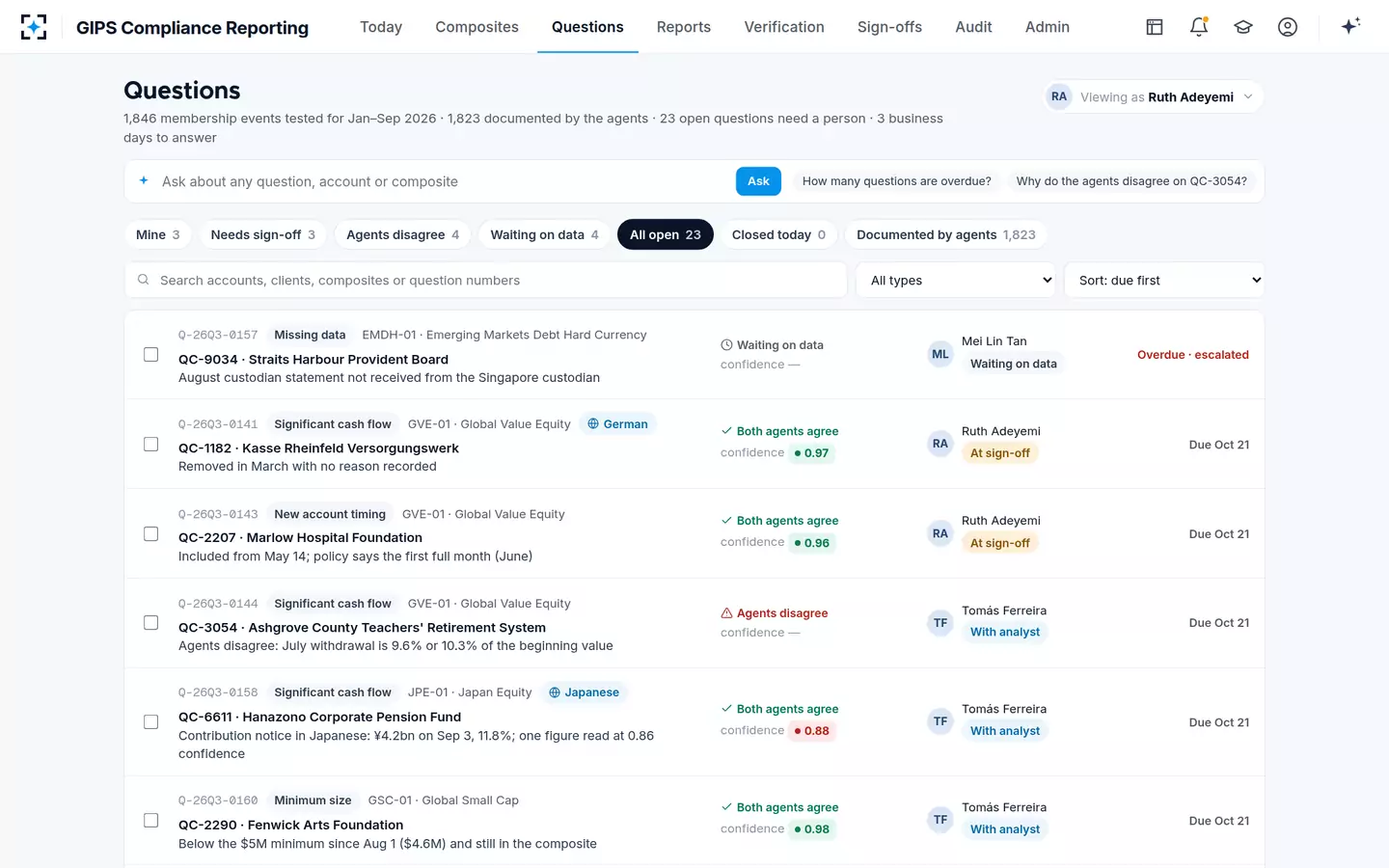
The Evidence agent maps each signed decision to the verifier's request list as it happens, pulls the support for the verifier's sample, and drafts cited replies to the verifier's questions; at the sample firm the 25-account sample was pulled in 11 minutes. It releases nothing itself: the GIPS Compliance Officer approves sample files and replies, and the verification liaison releases them. What a firm should have ready before it chooses or changes verifier is set out in the binder to bring to GIPS verification firms, and the whole workflow is on the GIPS Compliance Reporting page.
Questions people ask
Is there a GIPS certification process?
No. The standards have no certification: a firm claims compliance itself and may choose to be verified by an independent verifier. A firm may describe itself as verified only for the periods a verification report covers, and never describe a single composite as verified.
How often are firms verified?
The standards set no frequency; the initial minimum period is one year, and verification is recommended for every period for which compliance is claimed. The sample policy in CFA Institute's guide to policies and procedures manuals has the firm verified annually after year end.
What is in a GIPS verification letter?
Firms often mean the verification report, which gives the verifier's opinion that the firm's policies were designed in compliance and implemented firm-wide for named periods, and must say testing was on a sample basis. The recommendation letter is separate: the verifier's findings and suggested improvements, addressed to the firm.
Can a verifier refuse to issue a report?
Yes. A verification report "must not be issued when the verifier knows that the firm is not in compliance with the GIPS standards or the records of the firm cannot support a verification", and the verifier must tell the firm why.
Does the verifier test every portfolio?
No. The verifier must subject the entire firm to testing but may use a sample drawn from every period verified, sized for the firm's circumstances. Missing documents or errors justify a larger sample or extra procedures.
Can a firm use the same verifier for a performance examination?
It may, but it need not: the verification and the performance examination "need not be performed by the same verifier", and the examined periods must be covered by a verification.