GIPS performance reporting turns portfolio data into composite returns, statistics and GIPS reports, and almost every step depends on a membership decision: which portfolios were in which composite, in which month, and why. Most of those decisions follow mechanically from the firm's written policies, which is why they suit automation. A minority cannot be settled from the data or the policy: a custodian file that has not arrived, a cash flow whose size depends on which valuation you use, a client letter with one figure that is hard to read. Software that fills those gaps with a reasonable-looking value produces a report that looks complete and cannot be supported. Botminds' GIPS Compliance Reporting uses agents that test every membership event against the firm's own rules, document the ones they can prove from sources, and turn the rest into questions for a named person, with the answer and the signature kept as evidence.
Figures from the solution are sample data on a fictional firm, Quillfield Capital.
One membership event in GIPS Compliance Reporting: tested, re-tested, and asked when in doubt
Agent
Intake agentLoads portfolios, valuations, external cash flows and fee and discretion flags each night, and matches custodian statements to the book of record.
Never: Never fills a missing value: the item waits on data and the analyst is told.
Agent
Policy agentTurns the policies manual and composite definitions into testable rules, each cited to its page.
Never: Never changes a rule in force, or applies a change retroactively.
Agent
Membership agentTests the event against the composite's rule, reads the client's letter and the custodian statement, and writes the reason in plain words.
Never: Documents on its own only at confidence 0.95 or above, with every source read at 0.90 or above; never moves a portfolio.
Agent
Second-check agentRe-tests every exception and a 20% sample of passes, blind, on a different model.
Never: Cannot read the first answer first, and cannot resolve a disagreement.
A person decides
Performance analystAnswers the questions the rules and data cannot settle, and decides when the agents disagree.
A person decides
GIPS Compliance OfficerApproves undocumented changes and countersigns disagreements, with a reason code and an electronic signature.
What should GIPS performance reporting automate, and what must it never guess?
Automate the tests that the firm's written policy fully determines; never automate the answer when the policy or the data is silent. The GIPS standards make the reason concrete. A firm must "document its policies and procedures used in establishing and maintaining compliance with the requirements of the GIPS standards ... and apply them consistently" (1.A.5), and "All data and information necessary to support all items included in GIPS Composite Reports ... must be captured, maintained, and available within a reasonable time frame" (1.A.25) (GIPS Standards for Firms, 2020).
A new account that funded on 14 May joins under a first-full-month rule in June: the policy decides, so an agent can decide too, and show its working. A cash flow of 9.6% or 10.3% depending on whether trade-date or settled values are used is not decided by a 10% rule alone; it is decided by the policy's choice of book of record, and if the policy has no such clause, no one can decide it consistently by guessing. The test of good automation is whether every documented decision could be re-performed by a verifier from the policy and the source documents, with nothing supplied by the software's judgement.
At the sample firm, that line falls a long way toward automation. Of 1,846 membership events tested for January to September 2026, the agents documented 1,823 with their reason and sources, and sent 23 to a person.
1,823 of 1,846 events settled by the rules; why the other 23 needed a person
The 23 questions
- Agents disagree · 17.4%
- Waiting on data · 17.4%
- Other questions for the analyst or officer · 65.2%
The gaps that look like data
Every gap below can be filled with a plausible value, and every plausible value would pass a format check. Each needs a question instead.
Six gaps in GIPS performance reporting: the tempting guess and the right question
| The gap | The tempting guess | The question, and who answers it |
|---|---|---|
| A custodian file is late: August statements for four accounts have not arrived | Use the accounting value and move on | Waiting on data: the analyst chases the custodian; the item escalates when overdue |
| A new account's discretion flag is blank | Assume discretionary and include it | Is it discretionary under the firm's definition? The analyst reads the agreement and guidelines (3.A.2) |
| A withdrawal is 9.6% or 10.3% of value, depending on the source | Pick the reading that keeps the composite tidy | Both readings, the cause and the governing clause go to the analyst; the officer countersigns |
| A contribution notice in Japanese has one figure read at 0.86 confidence | Take the figure as read | The analyst confirms the figure from the original before the test is relied on |
| A removal was keyed in with no reason | Write a reason now and date it then | The officer approves it as documented after the fact, with a reason code |
| An account was included from 14 May; the policy says the first full month | Leave it, the effect is small | A proposed correction to join from June instead (the May return moves from 1.84% to 1.83%), for a person to approve |
Why a filled gap breaks the standards, not just the data
A guessed value fails three requirements at once. It is not consistent application of a policy, because the policy did not say it (1.A.5). It is not data "available within a reasonable time frame" to support the report, because nothing supports it (1.A.25). And it cannot survive verification, because the verifier must treat evidence from independent third parties as stronger than the firm's own, and must check holdings and cash flows against custodian statements and client notifications (GIPS Standards for Verifiers, 2020).
There is a fourth, quieter failure: a guess hides the gap from the people who could close it. A late custodian file that is silently replaced by an accounting value never reaches the analyst who could chase it, and the report goes out with a number nobody chose. A question puts the gap in front of an owner with a deadline, and the answer becomes part of the file. What a defensible file looks like shows the difference at fieldwork.
How an agent should ask: an owner, a clock and both readings
A useful question names the event, the rule, what the agent found, why it could not decide, who must answer and by when. In the solution, each open question carries its type, composite, account, whether the two agents agree, the confidence, the owner and a due date; the sample firm's answer clock is three business days, and overdue items escalate to the Head of Performance the next day.
Questions in GIPS Compliance Reporting: 23 events the rules could not settle
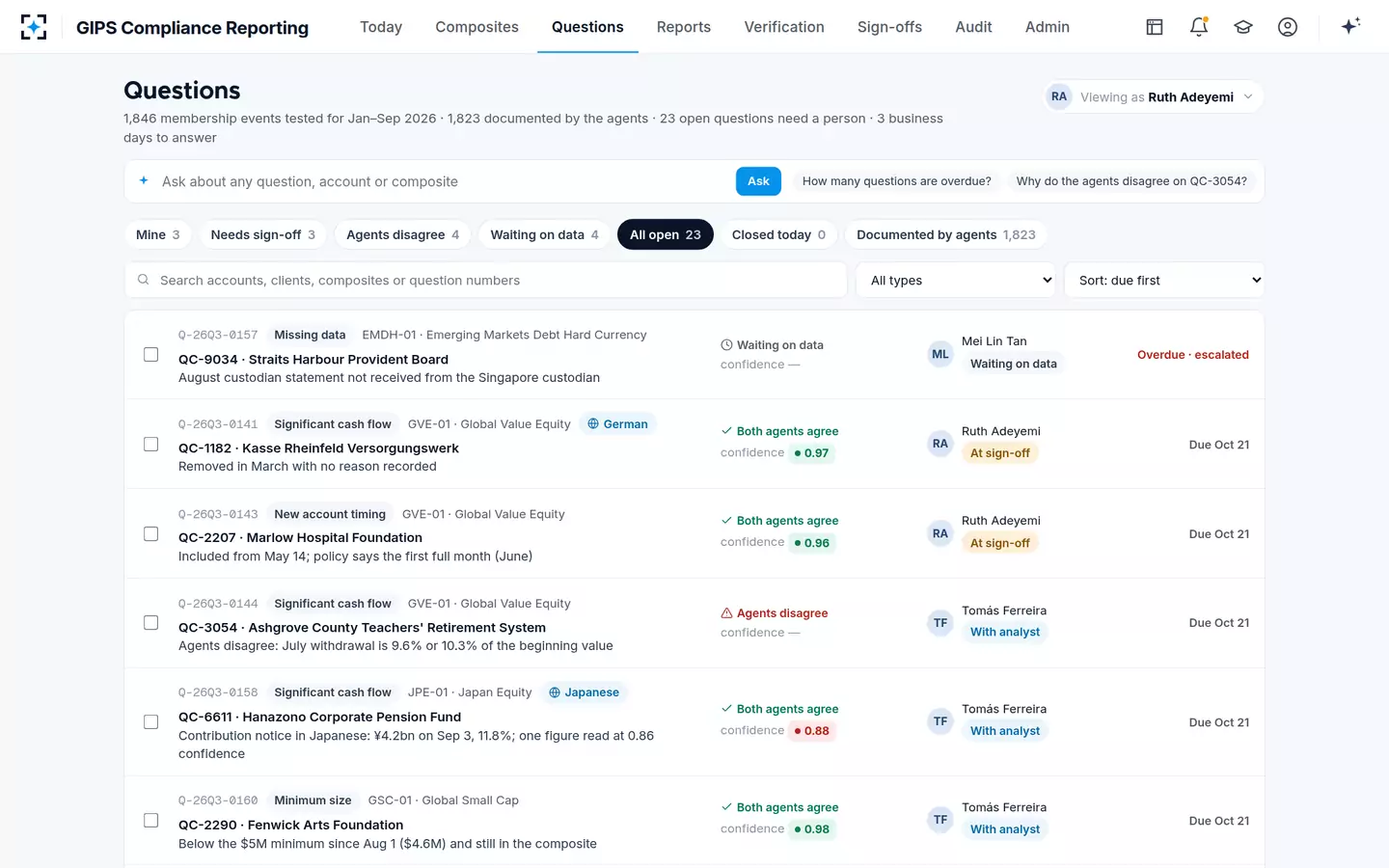
Asking is cheap only if the questions are few and good. A system that sends every event to a person has automated nothing; one that sends none is guessing. The confidence threshold is the dial between them, and it belongs to the firm: the sample firm documents an event automatically only at 0.95 or above with every source read at 0.90 or above, and a person decides everything else.
Who decides a composite exception?
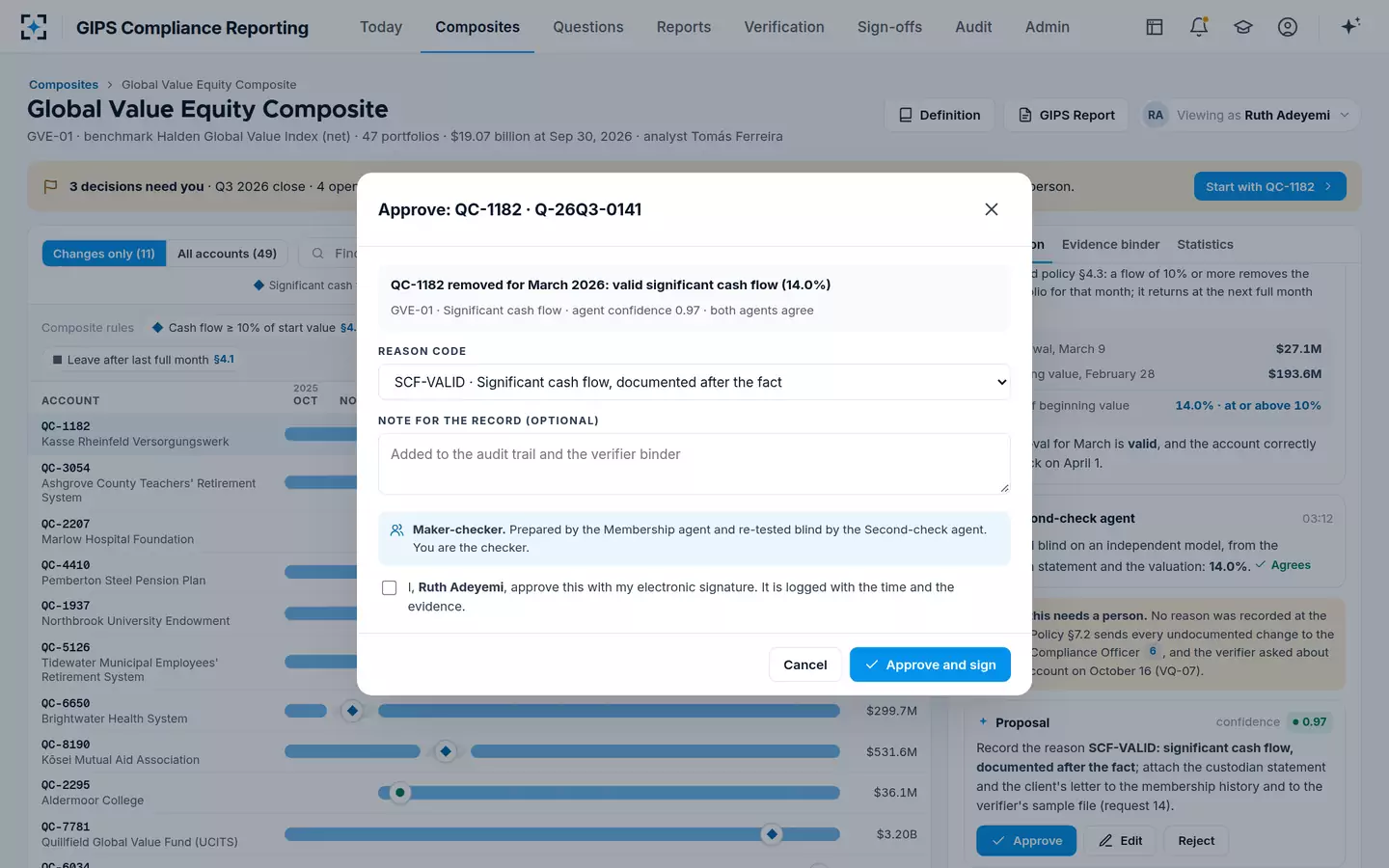
A person who did not prepare it. In the solution, an analyst prepares and the GIPS Compliance Officer approves, with a reason code and an electronic signature; a preparer's Approve button is blocked and says why. Any undocumented change goes to the officer. A disagreement between the two agents goes to the analyst, and the officer countersigns. A change to a policy or composite definition needs two approvers, the officer and the Head of Performance, shows its impact first and applies from its effective date only.
This mirrors what the standards already require of the firm's own policies: composite definitions not applied retroactively (3.A.6), significant cash flow levels defined "on an ex ante, composite-specific basis" (3.A.12). An agent that could change a rule, or apply it to a past month, would let the system rewrite the record it is meant to protect. How a significant cash flow level is set shows why that rule matters in practice.
The officer approves with a reason code and a signature in GIPS Compliance Reporting
What should an agent never decide in GIPS reporting?
Anything that changes what the firm has published, what its rules say, or who has seen what. The list below is the boundary the solution enforces; it is also a fair checklist for any automation a performance team considers.
Eight decisions an agent should never make on its own
- Move a portfolio into or out of a composite
Agents propose; a person moves it.
- Fill a missing value
The item waits on data and someone is told.
- Settle a disagreement between two independent checks
Both readings go to an analyst, with the clause that governs.
- Change a published figure
A difference becomes a question, with the error policy applied.
- Change a policy, or apply one retroactively
Two approvers, effective date only.
- Approve its own work, or let a preparer approve theirs
Maker and checker are different people.
- Sign or send a GIPS report
The report stays blocked while its composite's questions are open.
- Release evidence to the verifier
The officer approves; the verification liaison releases.
Two agents, one of them blind: why disagreement is useful
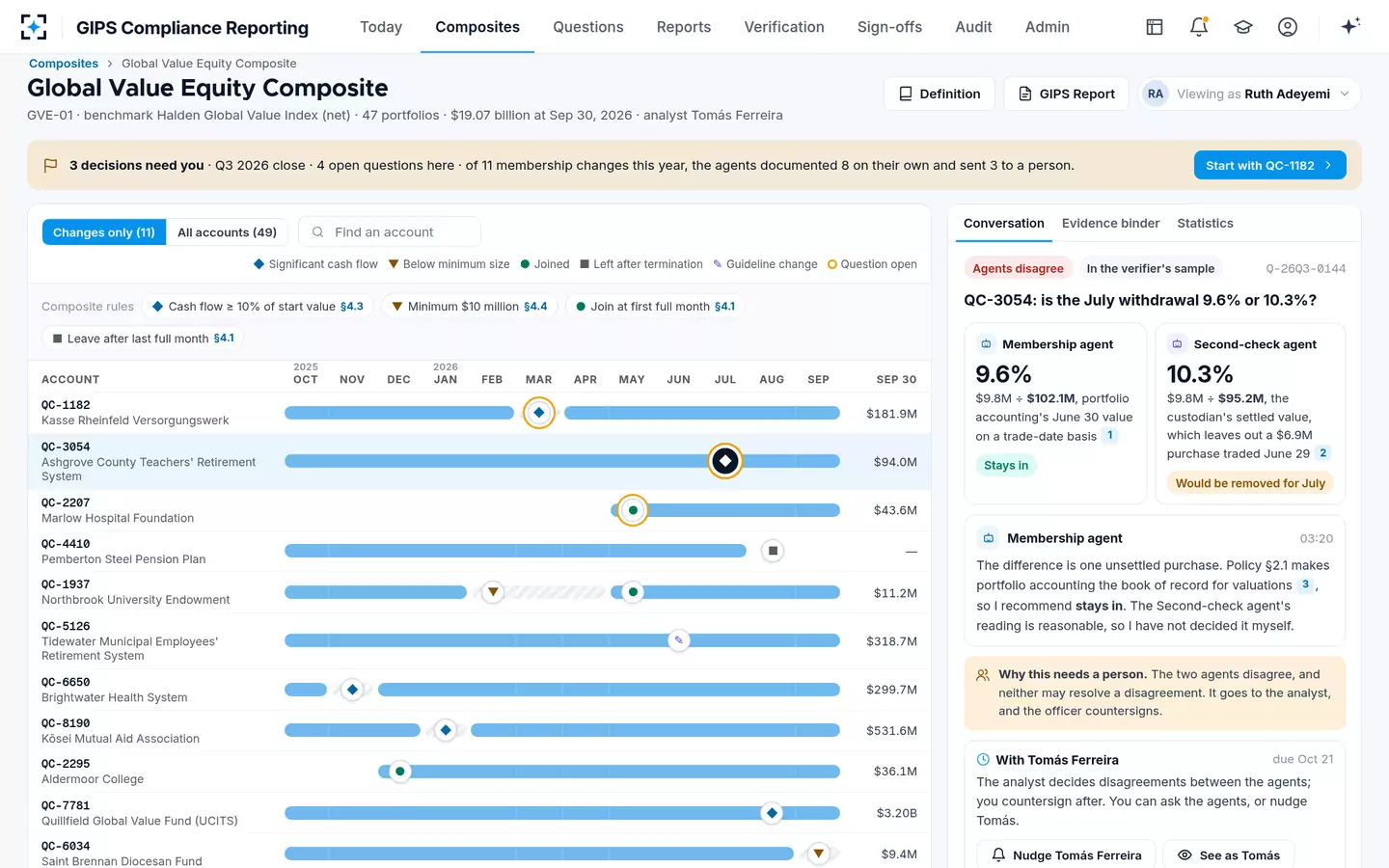
A second check only adds assurance if it cannot copy the first. The solution's Second-check agent re-tests every exception and a 20% random sample of passes from the source records, on a different model, without seeing the first agent's answer. At the sample firm it re-tested 365 documented events and agreed with all of them, and it disagreed on four exceptions, each of which went to a person.
When the two agents disagree, GIPS Compliance Reporting shows both readings and asks
GIPS compliance software: what to ask before you buy
Whatever the product, these questions separate tools that help a performance team stand behind its reports from tools that only make them faster to produce. The right-hand column is what a good answer looks like.
Questions for any vendor of GIPS compliance or performance reporting software
Ask: What happens when a statement, value or flag is missing?
A good answer: The item waits, a named person is told, and nothing is estimated without a person choosing to.
Ask: Where do the membership rules come from?
A good answer: From your policies manual and composite definitions, each rule cited to its page, versioned with effective dates.
Ask: When does the software decide alone?
A good answer: Only above a threshold you set, and every decision shows its sources and arithmetic.
Ask: Who checks the checker?
A good answer: An independent re-test that cannot see the first answer, with disagreements sent to a person.
Ask: Can a setting change re-test past months?
A good answer: No. Changes apply from their effective date, after the approvals you set.
Ask: Can I produce a sampled event's support in minutes?
A good answer: Yes, from third-party documents in their original language, with who decided and when.
Ask: Does it replace our performance system?
A good answer: It should not need to: it reads from the performance system, portfolio accounting, custodians and the CRM.
Be equally clear about what agents will not do. They will not create a custodian statement that was never kept, decide whether an error is material outside the firm's written policy, or make a firm's policies better than they are; the Policy agent can list gaps against the 2020 standards, but people write the policy.
How to test agents on a year your verifier already accepted
The test of any automation in GIPS reporting is a year whose answers are already known. Take the last period your verifier accepted, run the agents over its membership events and statistics, and compare what they documented, what they asked and what they missed. Speed is the least interesting result; these four are the ones to count.
Four measures for a pilot on last year's composites
| Measure | How to count it | What a good result looks like |
|---|---|---|
| Documented share | Events the agents documented on their own, divided by all events | High where the policy decides, lower in a messy year. Near 100% on a year with known problems is a warning, not a success. |
| Agreement with the accepted year | Documented events whose outcome matches the decision the verifier accepted | Every difference traced to a source document or a policy clause, and each one worth a look. |
| Questions worth asking | Questions a reviewer agrees the policy and data could not settle | Most questions survive review; a pile of trivial ones means the threshold is too cautious. |
| Silent errors | Documented events a reviewer would overturn | None. Each one is a reason to raise the confidence threshold or fix a rule. |
The last row is the one that decides whether agents can be trusted with the next quarter. A system that documents a removal wrongly but confidently has created a file that looks defensible and is not, which is worse than an undocumented removal. Botminds runs GIPS Compliance Reporting this way: on the firm's own policies manual and a past year of composite membership, with the agents backtested against a year the verifier has already accepted before they touch a live quarter.
What examiners say they are watching
The SEC's Division of Examinations says firms are now using what it calls super intelligence, or SI, in client communications, compliance monitoring and other work, and its fiscal 2027 priorities say examiners are stepping up their work on how those tools change outcomes and on whether existing duties are still met once the tools are in the loop (SEC Division of Examinations, Fiscal Year 2027 Examination Priorities, 23 October 2026). For a GIPS firm that means the same verifier questions as before, asked of a process that now includes agents: who calculated the figure, from what, and who approved it.
For GIPS reporting, the existing obligations are the ones already discussed: performance claims an adviser can substantiate, records behind every figure it distributes, and a claim of compliance that is true. Agents that ask rather than guess leave a trail an examiner can follow: the question, the person who answered it, the evidence and the time. A performance team considering agents, and the one-person teams that most need them, will find the GIPS officer's duties changes shape rather than disappears. The solution is on the GIPS Compliance Reporting page.
Questions people ask
Is GIPS compliance software the same as performance measurement software?
No. Performance measurement software calculates portfolio and composite returns from accounting data. GIPS compliance work sits around it: composite membership decisions and their evidence, statistics, reports, distribution, errors and verification. The solution reads from the performance system rather than replacing it.
Can AI test GIPS composite membership?
It can test membership events against written rules and source documents, which is most of the volume, and show its reasoning. It should not decide events the policy or data leave open; at the sample firm, 23 of 1,846 events went to a person.
What confidence level should agents need before acting alone?
The firm sets it. The sample firm documents an event automatically only at 0.95 or above, with every source document read at 0.90 or above. A lower level saves review time and adds risk; a verifier will judge the outcome, not the setting.
What happens when a custodian file is late?
Affected events wait on data and the analyst is told; nothing is estimated. At the sample firm, a late Singapore custodian file left four August statements missing, and the question escalated when it became overdue.
Do the agents calculate portfolio returns?
No. Portfolio returns come from the firm's performance measurement system. The Statistics agent recomputes composite returns, internal dispersion and the three-year standard deviation from those returns and compares them with the published figures.
Who can override an agent?
Any authorized person, with a reason code. At the sample firm, overrides of an agent are reported monthly to the Head of Performance, so patterns in where people disagree with the agents are visible.