A GIPS composite report example has two halves. The first is a table with one row per year, at least five years and building to ten, showing the composite's return, the benchmark's total return, the number of portfolios, composite assets, total firm assets, a measure of internal dispersion and the three-year standard deviation of composite and benchmark. The second is a page of disclosures: who the firm is, what the strategy is, how fees and dispersion were calculated, and whether the firm has been verified. Every item answers a numbered provision of the 2020 GIPS Standards for Firms, and a firm that claims compliance must make every reasonable effort to give the report to every prospective client of the strategy. Botminds' GIPS Compliance Reporting exists because that report is rebuilt by hand at many firms: its agents redraft each report from signed figures, check the disclosures and redline it against the last signed version, and a person who did not prepare it signs it.
The annotations below follow the 2020 standards line by line, with the standards' own sample report as the worked example. The screens come from the solution's sample data, a fictional firm called Quillfield Capital with 80 composites and 3,412 portfolios.
The ten things a GIPS composite report must show for each year
- a. Five years of GIPS-compliant performance, growing to ten
One more year is added each year until the report shows at least ten. Since-inception if the composite is younger than five years.
- b. The composite return for each annual period
Time-weighted, asset-weighted across the portfolios in the composite, labelled gross or net of fees (4.A.3).
- c. and d. Stub periods at the start and the end
From inception to the first year end, and from the last year end to termination. Never annualized: returns for less than a year must not be (2.A.12).
- e. The benchmark total return for the same periods
Unless the firm decides no appropriate benchmark exists, and says why (4.C.31). A price-only benchmark is not allowed (1.A.18).
- f. The number of portfolios at each year end
Optional when there are five or fewer, if the report says so (4.C.39).
- g. Composite assets at each year end
Actual assets managed by the firm only, never double counted (2.A.2, 2.A.3).
- h. Total firm assets at each year end
Every discretionary and non-discretionary portfolio in the defined firm, fee-paying or not (2.A.1).
- i. Internal dispersion of portfolio annual returns
Not required when five or fewer portfolios were in the composite for the full year; the report then says it is not applicable (4.C.40).
- j. Three-year annualized ex post standard deviation
From 36 monthly returns, for the composite and the benchmark, as of each year end. If 36 months are not yet available the report says so (4.C.36).
- And above all: label the periods and the fee basis
A reader must be able to tell which years are shown and whether returns are gross or net without asking.
What is a GIPS composite report, and who must receive one?
A GIPS composite report is the document in which a firm that claims compliance with the Global Investment Performance Standards presents the track record of one composite: an aggregation of portfolios managed to a similar mandate, objective or strategy. It is the one document the standards require a firm to put in front of prospects. Provision 1.A.11 says the firm "must make every reasonable effort to provide a GIPS Composite Report to all prospective clients when they initially become prospective clients", and adds the line that matters most in practice: "The firm must not choose to which prospective clients it presents a GIPS Composite Report." (GIPS Standards for Firms, 2020).
The obligation runs on a clock. A prospect who is still a prospect must get an updated report at least once every 12 months (1.A.12), and every report must include the most recent year within 12 months of that year end (1.A.16). The standards recommend going further and updating reports quarterly (1.B.2). The definition of a prospective client is wider than many sales teams assume: it covers anyone who has expressed interest in a composite strategy and qualifies to invest, and investment consultants count when they represent such people.
The firm also has to be able to show it tried. Provision 1.A.17 requires it to "demonstrate how it made every reasonable effort" to provide the report, which in practice means a record of which version went to whom and when. That record is what makes an error survivable later: when a published figure turns out to be wrong, it is the list of everyone who must receive the correction.
How many years must a GIPS report show?
A GIPS composite report must show at least five years of GIPS-compliant annual performance, or since inception if the composite is younger, and then add a year each year until it shows at least ten. The standards recommend showing more than ten years once the record exists (4.B.6). A firm claiming compliance for the first time must itself have complied for at least five years, or since it was founded (1.A.3).
A new claim shows five years, and the table grows by one row a year until ten
Older history is allowed with a condition. A firm may link performance that does not comply with the standards to its compliant record, but only for periods before the minimum effective compliance date: 1 January 2000 for most composites, and 1 January 2006 for real estate, private equity and wrap fee composites (1.A.29). Any such period must be disclosed as non-compliant (4.C.20).
For an SEC-registered adviser the table sits beside a second rule. The Marketing Rule requires an advertisement that shows a composite's performance to show one-, five- and ten-year periods ending no earlier than the most recent calendar year end (17 CFR 275.206(4)-1(d)(2)). The SEC's adopting release addressed the overlap directly: "an adviser that complies with the GIPS standards may present annual returns for the past ten years ... in addition to performance results for the final rule's required periods" (86 FR 13024, March 2021). In practice the annual GIPS table and the rule's three periods travel together.
The standards' own sample report, read line by line
Appendix A of the 2020 standards prints a sample report for a fictional firm, Spinning Top Investments, and its Large Cap Growth Composite from February 2011 to December 2020. It is the most useful GIPS composite report example there is, because each line was written to satisfy a provision. Its table has ten rows: 2011 is a stub from 1 February, the dispersion column shows n/a for that first year, and the three-year standard deviation starts in 2014, once 36 months of returns exist. Firm assets are blank before 2014 because the composite came with an acquisition in May 2014.
Fourteen disclosures in the sample report, and the provision each one answers
| # | What the sample discloses | Provision |
|---|---|---|
| 1 | The claim of compliance and the verification paragraph, for 1 January 2011 to 31 December 2020 | 4.C.1(a) |
| 2 | The firm: an independent US equity manager, not affiliated with a parent; the 2014 acquisition | 4.C.3 |
| 3 | The composite: large-cap US growth portfolios, key material risks, a $5 million account minimum ($2 million before July 2016), and its former name | 4.C.4, 4.C.23, 4.C.24 |
| 4 | Performance before May 2014 was earned at another firm and is linked: the team and process are unchanged | 1.A.32, 4.C.37 |
| 5 | The benchmark and what it holds | 4.C.5 |
| 6 | Time-weighted returns; valuations and returns in US dollars | 4.C.9 |
| 7 | What gross and net mean, the model fee of 1/12 of 1.00% a month, withholding taxes, the fee schedule, and the pooled fund in the composite with its fee and expense ratio | 4.C.6, 4.C.7, 4.C.11, 4.C.25 |
| 8 | Policies for valuation, calculation and preparing reports are available on request | 4.C.16 |
| 9 | The list of composite descriptions and of broad distribution pooled funds is available on request | 4.C.15 |
| 10 | Created November 2011; inception 1 February 2011 | 4.C.13, 4.C.14 |
| 11 | Internal dispersion is the equal-weighted standard deviation of full-year portfolios since 2014, asset-weighted before | 4.C.10 |
| 12 | What the three-year standard deviation measures: the preceding 36 months of gross composite and benchmark returns | 4.A.1(j), 4.C.44 |
| 13 | The significant cash flow policy since November 2011: above 25% of beginning value, removed for that month | 4.C.35 |
| 14 | The CFA Institute trademark sentence | 4.C.2 |
Three things in that sample deserve a second look. Disclosure 3 carries a name change and a minimum change, each a separate requirement. Disclosure 11 records that the firm changed its dispersion measure in 2014, so a reader knows the column is not one series. And disclosure 13 tells a prospect that some portfolios left the composite in months of large client flows, which bears directly on how representative the record is. How big a flow has to be is the firm's own choice, and how a firm chooses its significant cash flow level is a decision with its own arithmetic.
Which disclosures every GIPS composite report carries
Some disclosures appear in every report regardless of circumstance. The compliance statement comes first, in one of three fixed forms: for a verified firm, for a verified firm whose composite has also had a performance examination, and for a firm that has not been verified (4.C.1). The verified form has two paragraphs and, in the standard's words, is "complete only when both paragraphs are shown together, one after the other". Its second paragraph includes a sentence many prospects never notice: "Verification does not provide assurance on the accuracy of any specific performance report."
After it come the standing disclosures: the trademark sentence (4.C.2); the definition of the firm used for total firm assets (4.C.3); the composite description (4.C.4), which must cover the strategy's material risks and how leverage, derivatives and short positions are used if they are material; the benchmark description (4.C.5); the fee basis of gross and net returns (4.C.6, 4.C.7); the reporting currency (4.C.9); which measure of internal dispersion is shown (4.C.10); the current fee schedule (4.C.11); the inception and creation dates (4.C.13, 4.C.14); and the availability of the composite list and the firm's policies on request (4.C.15, 4.C.16).
The standards are explicit that firms do not need negative disclosures: if a strategy does not use leverage, nothing about leverage is required. That is one reason no fixed count of disclosures exists. The checklist a firm actually runs depends on its composites, and the sample firm in the solution checks 23 for each of its reports.
Disclosures that appear only when something has happened
A second group of disclosures is triggered by events, and several have a minimum life. These are the ones that go missing, because the person who rebuilds the report next year may not know the event happened.
Event-driven disclosures: what triggers each one and how long it stays
| When this happens | The report must disclose | How long |
|---|---|---|
| A significant event that helps a prospect interpret the report (a portfolio manager leaves, for example) | The event (4.C.19) | At least one year, and as long as relevant |
| A material error is corrected | The change to the report (4.C.38) | At least one year, and as long as relevant |
| The composite is renamed | The name change (4.C.23) | At least one year, and as long as relevant |
| The composite is redefined | The date and description of the redefinition (4.C.22) | No minimum stated |
| The benchmark changes going forward | The date and description (4.C.32a) | As long as the old benchmark's returns are shown |
| The benchmark is changed retroactively | The date and description (4.C.32b) | At least one year, and as long as relevant |
| A significant cash flow policy is adopted | How significant is defined, and for which periods (4.C.35) | No minimum stated; the periods are named |
| The composite has three years of history but not 36 monthly returns | That the standard deviation is not presented for that reason (4.C.36) | Until 36 months exist |
| The return type changes, for example money-weighted to time-weighted | The change and its date (4.C.42) | At least one year, and as long as relevant |
| The minimum asset level changes | The change (4.C.24) | No minimum stated |
The material-error row has a twist that is easy to miss. The disclosure must stay for at least a year, but it is not required in a report given to a prospect who never received the erroneous version. A firm that can tell who got which version can send new prospects a clean report; a firm that cannot must assume everyone did. What happens to a track record after an error follows that path from discovery to the corrected report.
GIPS pooled fund report: what changes from the composite report
A GIPS pooled fund report presents one fund rather than a group of portfolios, so the columns that describe a group fall away. There is no number of portfolios and no internal dispersion; the fund's own returns, its benchmark, fund assets, total firm assets and the three-year standard deviation remain (6.A.1). The standards treat the two reports differently in who must receive them, too.
Composite report or pooled fund report: what each must carry
GIPS composite report: A composite: every portfolio managed to the strategy, segregated accounts and qualifying pooled funds alike (3.A.5).
GIPS pooled fund report: One pooled fund, from its pooled fund inception date, with what that date represents disclosed (6.C.12).
GIPS composite report: Number of portfolios and internal dispersion each year (4.A.1 f, i).
GIPS pooled fund report: Neither: a single fund has no dispersion across portfolios (6.A.1).
GIPS composite report: Every prospective client of the strategy, with an update every 12 months while they remain one (1.A.11, 1.A.12).
GIPS pooled fund report: Every prospective investor in a limited distribution pooled fund; for broadly distributed funds it is optional (1.A.13, 1.A.15).
GIPS composite report: The fee schedule appropriate to prospective clients; for a pooled fund in the composite, its fee schedule and expense ratio (4.C.11).
GIPS pooled fund report: The fee schedule appropriate to prospective investors, and the share class used for net returns where there are several (6.C.7, 6.C.10).
A limited distribution pooled fund can also be served by the composite report, if the fund sits in that composite (1.A.13b). Many firms do exactly that, which means the composite report reaches fund prospects too, and a correction to it reaches them as well.
Where the numbers in a GIPS report usually go wrong
The table looks like arithmetic, but most of its errors are membership errors. A composite must include only portfolios managed for the full measurement period (3.A.8), and internal dispersion is computed only from portfolios that were in the composite for the whole year. A portfolio that joined in April belongs in the monthly composite returns from its first full month, but not in that year's dispersion. Mix the two and the dispersion column is wrong even though every portfolio return is right; the internal dispersion calculation, worked with six portfolios, shows by how much.
The sample firm's own recomputation is a fair picture of the scale. Its statistics agent recomputed returns, internal dispersion and the three-year standard deviation for 80 composites over ten years, 2,400 figures, and found three that differed from the published reports. One was a 2024 dispersion of 0.38% that included two portfolios that joined on 1 April 2024; with only full-year members it is 0.44%. Another was a 2023 portfolio count of 49 that counted a portfolio in both composites after it switched between them. The third was a benchmark standard deviation the index vendor had since restated.
The Global Value Equity roster: each account's year, and the rules it is tested against
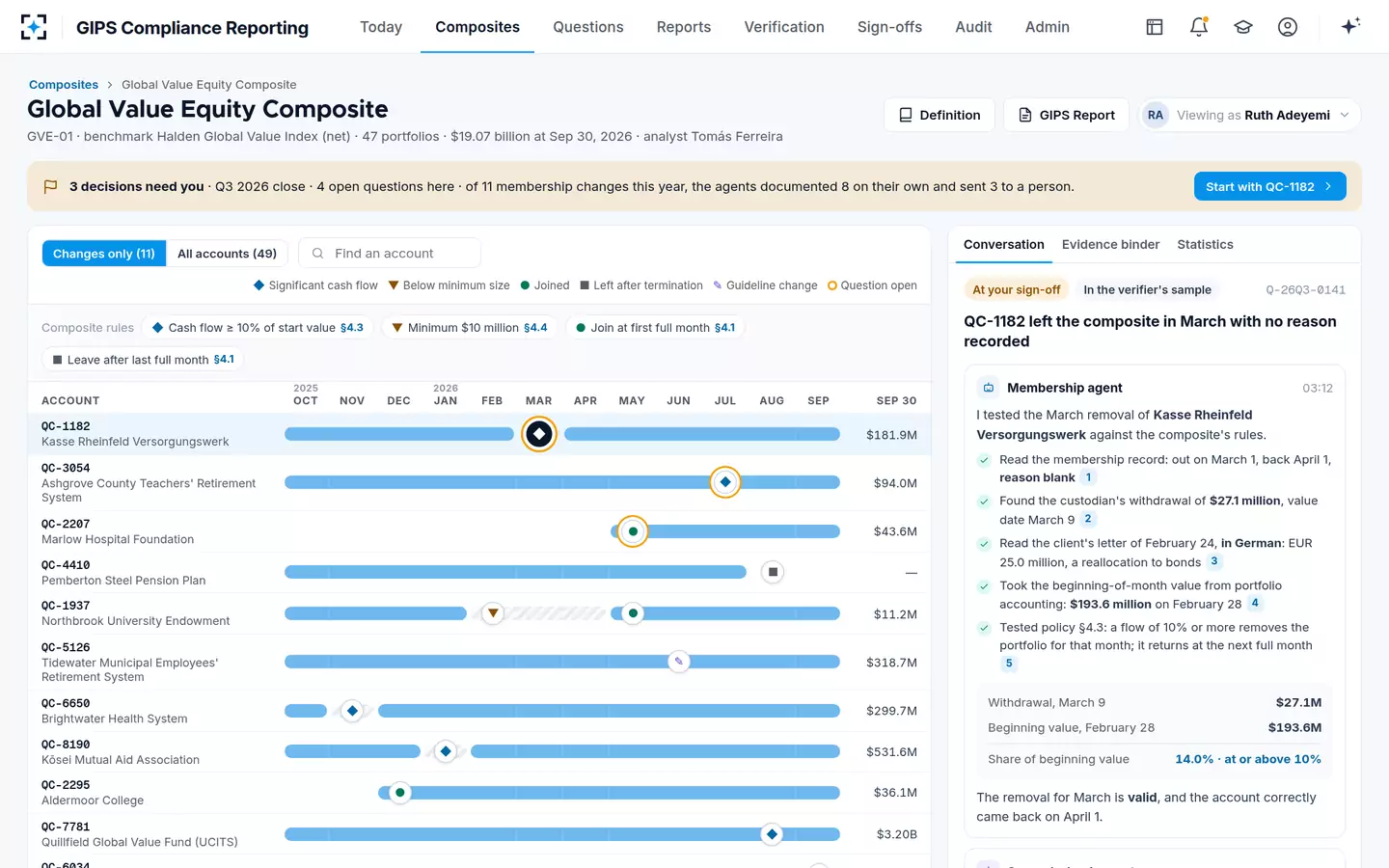
Other recurring faults come straight from the provisions above: a stub period annualized when it must not be (2.A.12); a benchmark whose returns exclude dividends (1.A.18); total firm assets that leave out non-fee-paying or non-discretionary portfolios (2.A.1); a three-year standard deviation shown before 36 monthly returns exist; and a verified-firm compliance statement printed with only its first paragraph.
How GIPS Compliance Reporting drafts and holds each report
In the solution, the report is the last step, not the first. The Report agent drafts and refreshes each GIPS composite report and pooled fund report from figures people have already signed: the ten-year table, the required statistics, the disclosures on the firm's checklist and a redline against the last signed version. Every number links to its source. It never signs or sends a report, the analyst who prepared it cannot approve it, and a composite's report stays blocked while any of its membership questions is open.
A GIPS composite report in GIPS Compliance Reporting, redlined and held until its questions close
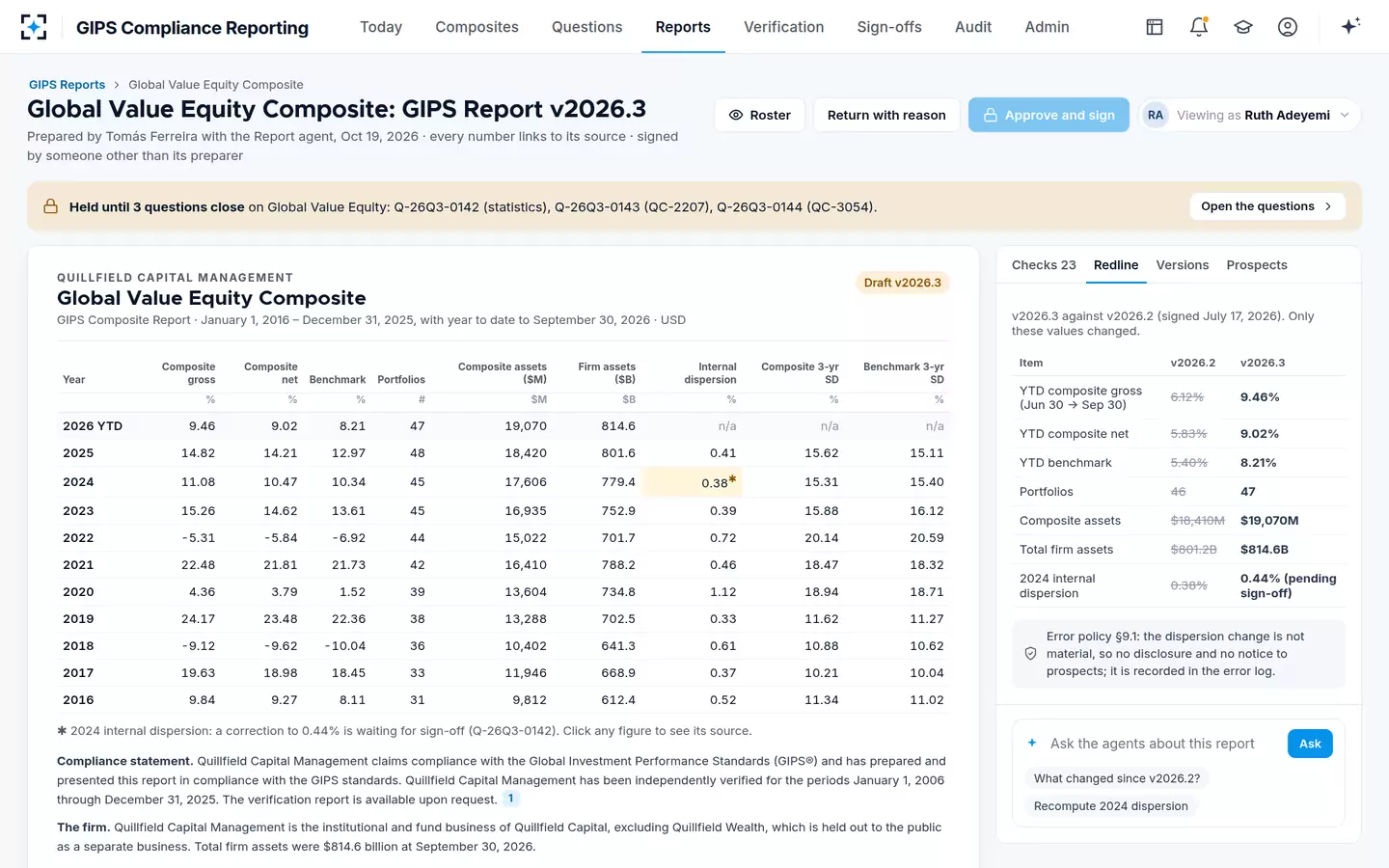
The redline is the part that saves a reviewer's time. Against the version signed in July, only seven values changed: three year-to-date returns, the portfolio count, composite assets, total firm assets and one dispersion figure. A reviewer who reads those seven, and the reason each changed, has reviewed what is new; the unchanged rows were signed in July. To see the whole cycle, from the first membership question to the signed report, start from GIPS Compliance Reporting.
Questions people ask
What is a GIPS report?
GIPS Report is the standards' collective term for the two documents a compliant firm presents: the GIPS composite report and the GIPS pooled fund report. Each can present time-weighted returns or, where provision 1.A.35's conditions are met, money-weighted returns; sections 4 to 7 of the 2020 standards give one section to each report and return type.
What are the GIPS compliance requirements for a composite report, in short?
Five to ten years of annual composite and benchmark returns, portfolio count, composite and total firm assets, internal dispersion and the three-year standard deviation (4.A.1), plus the disclosures in section 4.C. The firm must also give it to every prospective client of the strategy and update it within 12 months of each year end (1.A.11, 1.A.16).
Does a GIPS composite report have to be updated quarterly?
No. The requirement is annual: each report must include the most recent year within 12 months of that year end. Quarterly updates are a recommendation (1.B.2), and many firms add a year-to-date row, which must not be annualized.
Can a GIPS composite report show only net-of-fees returns?
Yes, provided they are labelled as net and the fee basis is disclosed, including whether model or actual fees were used (4.A.3, 4.C.7). The standards recommend showing both gross and net (4.B.1); an SEC-registered adviser using the report as an advertisement also has the Marketing Rule's requirement to show net performance with any gross figure, which the gross and net attribution guide extends to attribution.
What does n/a mean in the internal dispersion column?
It usually means five or fewer portfolios were in the composite for that full year, so no dispersion measure is required; the report must then say the measure is not applicable (4.C.40). In a first stub year, as in the standards' own sample, there are no full-year portfolios at all.
Does a GIPS report have to include a benchmark?
Yes, unless the firm determines that no appropriate benchmark exists, in which case it must disclose why (4.A.1e, 4.C.31). Any benchmark shown must reflect the composite's mandate and be a total-return measure; a price-only index is not allowed (1.A.18).