GIPS verification firms are the independent auditing, consulting and other firms that test whether an investment firm's GIPS policies were designed in compliance with the standards and applied across the firm. They all follow the same required procedures, set out in the 2020 GIPS Standards for Verifiers, so the differences that matter when choosing one are independence, experience with your kinds of composites, and how they work with you. What varies far more between engagements is the firm being verified: the standards tell the verifier to widen the sample when documents are missing, so a firm whose policies, lists and membership evidence are ready pays for less testing and waits less. Botminds' GIPS Compliance Reporting does not verify anything. It keeps the firm's side of the engagement ready: every composite decision tested against the firm's own rules and filed with its sources, the verifier's request list answered as the work happens, and the sample pulled in minutes.
Figures from the solution are sample data on a fictional firm, Quillfield Capital, or Botminds' estimates, labelled as such.
The binder: twelve things a GIPS verifier will ask for, and where each comes from
- The GIPS policies and procedures manual, every version, with effective dates
Verifier procedure 2. The firm must document its policies and apply them consistently (1.A.5).
- The firm definition and any redefinitions
Procedure 3; disclosed in every report (4.C.3, 4.C.21).
- The lists of composite and pooled fund descriptions
Procedure 4. Terminated composites stay for five years (1.A.22).
- Total firm assets by portfolio at each year end, reconciled to the general ledger
Procedure 5: every portfolio, no double counting (2.A.1–2.A.3).
- Non-discretionary portfolios and the reason for each
Procedure 6, tested against agreements and guidelines.
- Composite membership for every period, with a reason for every event
Procedure 7: new, terminated and moved portfolios, minimum asset levels, significant cash flows.
- Third-party evidence for flows and holdings
Procedure 10: custodian, fund accounting and broker statements, client subscription and redemption notices.
- Calculation support a verifier can re-perform
Procedure 11: portfolio and composite returns, fees, dispersion and the three-year standard deviation.
- Every GIPS report version, and who received which
Procedures 12 and 13; the firm must be able to demonstrate its efforts (1.A.17).
- Marketing materials that mention the standards
Procedure 14, including any GIPS advertisements.
- The error log and an incident report for each error
Procedure 15: errors handled under the firm's policy.
- GIPS Compliance Notification Form filings
Procedure 16; filed annually by 30 June (1.A.38).
What do GIPS verification firms do?
They perform verifications, and sometimes performance examinations, under the GIPS Standards for Verifiers. The standards describe them simply: "Verifiers are auditing, consulting, and other firms that have a high degree of knowledge about the investment management industry." A verifier must have "a practical level of expertise regarding audit methodology and investment management practices", must understand all the requirements and recommendations of the GIPS standards including the Guidance Statements, interpretations and Q&As, must know the laws on calculating and presenting performance, and "must be independent from the firm" (GIPS Standards for Verifiers, 2020).
Every verifier runs the same minimum procedures: planning, sample selection, sixteen testing procedures, a representation letter and a report. So the work product is standardized. What is not standardized is everything around it: the verifier's familiarity with your asset classes, how it sizes samples for your firm, whether it relies on other audit work, and how it communicates during fieldwork. The verification process, step by step covers the procedures themselves.
How to choose among GIPS verification firms
Start with independence, because the standards make it the firm's job too. If a firm chooses to be verified, "it must gain an understanding of the verifier’s policies for maintaining independence and must consider the verifier’s assessment of independence" (1.A.39) (GIPS Standards for Firms, 2020). CFA Institute's sample policy shows what that looks like in practice: before renewing, the firm obtains the verifier's independence policies, the performance manager discusses any questions with the verifier, and the firm checks internally "whether there are other services performed by the verifier for the firm that could cause an independence issue" (CFA Institute, policies and procedures manual guide, 2023).
Then judge fit. Ask how the verifier will size its sample for your number of composites, portfolios and years, and what it will rely on: the standards allow a verifier to rely on the audit or internal control work of a qualified independent third party, or on other audit work it has done for the firm, but the reliance must be assessed and documented. Ask which of your composites it has seen before in other firms: private markets, wrap fee, carve-outs and overlay strategies each have their own provisions. And ask how it handles requests: one list at the start, or a rolling conversation, and through what channel.
Finally, settle the scope in writing. The engagement letter must state the periods being verified; the minimum initial period is one year, and the standards recommend verification "for all period(s) for which compliance with the GIPS standards is claimed." If a performance examination of a flagship composite is wanted, it can only be done with or after the verification, by the same verifier or another.
How much does GIPS verification cost?
Verifiers don't publish prices, and no regulator or independent study publishes typical fees, so the useful answer is what drives the price. The standards themselves note that in setting the minimum procedures, "the GIPS standards governing bodies considered the cost and effort that firms must undertake to be verified." Beyond that minimum, the verifier must consider these criteria when sizing its sample, and each one moves the hours:
The number of composites and pooled funds; the number of portfolios in each composite; the composite definitions and pooled fund strategies; the legal structure of the pooled funds; composite and pooled fund assets relative to total firm assets; the firm's internal control environment; the number of years being verified; the systems used to build and maintain composites; the methods and systems used to calculate and report performance; and the use of outside service providers.
One driver sits entirely with the firm. Under the standards for verifiers, missing or incomplete documents, or errors, justify a larger sample or extra procedures, which means more hours on the invoice. To estimate your own cost before asking for quotes, count four things: composites and portfolios in scope, years to be verified, membership events in those years (joins, terminations, removals, moves), and the share of those events whose reason and source document you can produce today. The last number is the one you control.
How long does GIPS verification take?
The standards set no duration, and no regulator publishes one; it depends on the scope and, again, on the binder. The figure below is Botminds' estimate of where a quarter's GIPS work and the verification that follows go at a firm the size of the fictional sample firm, by hand and with the solution. It is an estimate, not a measured result.
Where a quarter's GIPS work and the verification go, in business days
- Matching10
- Tests3
- Stats2
- Reports4
- Verifier requests15
- Other2.75
- Verifier3
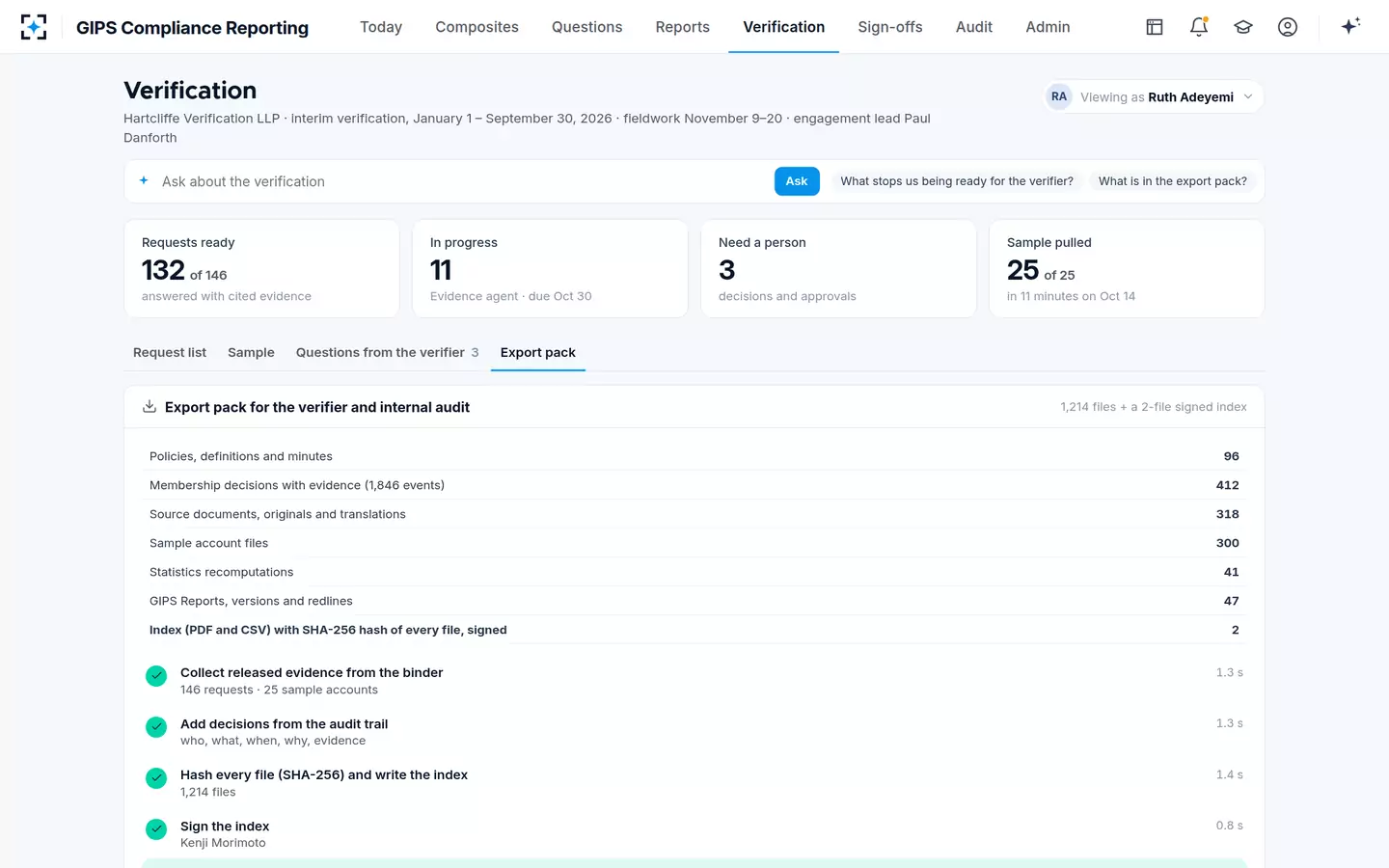
The longest bar is the request list, and its length comes from the binder: each line is a search through custodian files, document management and inboxes for something that should have been filed when the event happened. In the solution's sample data, the verifier's list has 146 lines; three weeks before fieldwork, 132 were answered with cited evidence and the 25-account sample was pulled in 11 minutes.
Your first verification: how far back to go
A firm claiming compliance for the first time must already have complied for at least five years, or since its inception (1.A.3), but its first verification can cover as little as one year. The choice is a trade between cost now and questions later. One year is the cheapest engagement, but the compliance statement will then show a verified period much shorter than the five or more years in the report's table, and a consultant reading the dates will notice the gap. The standards recommend verification for every period for which compliance is claimed.
Going further back adds work, and most of it falls where evidence is missing. Every additional year adds membership events, report versions and custodian statements to the population the verifier samples from, and older years are where evidence is thinnest. A practical sequence is to verify the most recent year or two first, rebuild the files for earlier years while that engagement runs, and extend the verified period as the binder catches up. How a consultant reads the verified dates explains why the gap matters.
The two letters you sign: engagement and representation
Every verification starts and ends with a letter the firm signs. Read both before choosing a verifier, because they set what you are promising.
What the engagement letter and the representation letter must contain
| Engagement letter (before work starts) | Representation letter (before the report) | |
|---|---|---|
| Purpose | Agrees the terms of the verification | Management confirms the facts the verifier relied on |
| Scope | The objective and scope, including the periods being verified | The periods on which the verifier is reporting |
| Responsibilities | The verifier's and the firm's | Management "bears all responsibility for maintaining compliance", including producing and distributing reports |
| Limits | The inherent limitations; no assurance on the operating effectiveness of controls | No events up to the letter's date that would materially affect results or the outcome |
| Substance | The GIPS standards are the evaluation criteria | The firm complies firm-wide; reports are "a fair and honest representation"; no known fraud affecting compliance; no documents withheld |
The representation letter is where a firm's knowledge of its own gaps matters. Management signs that all necessary documents were provided and none withheld, and that the firm complies with the standards for every period verified. A GIPS officer who knows that some removals were never documented should fix that before signing, not after.
Switching GIPS verification firms: what carries over
A change of verifier does not reset the firm's history. A new verifier may accept the verification work of a previous one as part of the basis for its report, after assessing its scope, periods, results and the other verifier's qualifications. Former verifiers also stay in the error loop: if a material error is later found in a report a former verifier received, the corrected report goes to that former verifier as well as to the current one (1.A.20).
The firm's own records must bridge the change. The new verifier will start with procedure 2, the policies and procedures, and will expect every version in force during the periods being verified. CFA Institute's guide says both current and previous versions of the manual must be kept, and that firms must be able to show when each change took effect, so that "anyone who is reviewing the policies and procedures, including verifiers, will know which policy was in place for which time period."
Where GIPS Compliance Reporting fits beside a verifier, and where it does not
The solution sits on the firm's side of the table. It is not independent of the firm, so it cannot verify, examine or attest to anything, and its output is evidence for the verifier to test, not a substitute for testing. It does not replace the performance measurement system or portfolio accounting: it reads portfolios, returns, valuations and cash flows from them, and from custodians, the fund administrator and the firm's documents.
Three parties in a verification: who does what
The verifier: Tests that policies are consistent with the standards and complete, clear and unambiguous.
The firm, with GIPS Compliance Reporting: The Policy agent turns the manual into rules cited to their pages and lists gaps against GIPS 2020; people change policies, with two approvals.
The verifier: Samples portfolios and tests timing, cash flow and minimum-size rules against third-party documents.
The firm, with GIPS Compliance Reporting: Every event is tested as it happens and filed with its reason and sources; undocumented or uncertain events go to a person.
The verifier: Recalculates a sample of returns and report figures.
The firm, with GIPS Compliance Reporting: The Statistics agent recomputes every composite's figures and raises each difference; it never overwrites a published number.
The verifier: Sends the request list and questions.
The firm, with GIPS Compliance Reporting: The Evidence agent drafts cited answers; the GIPS officer approves and the verification liaison releases.
The verifier: Forms the opinion.
The firm, with GIPS Compliance Reporting: People decide every exception, materiality question and release; the agents propose and explain.
Two limits are worth stating plainly. If a custodian statement or client letter was never kept, no software can produce it; the solution will show the gap early, as a question waiting on data, rather than at fieldwork. And materiality is the firm's call: the solution applies the firm's error correction policy as written, and a material error needs the GIPS Compliance Officer and the Head of Performance.
The export for the verifier and internal audit in GIPS Compliance Reporting
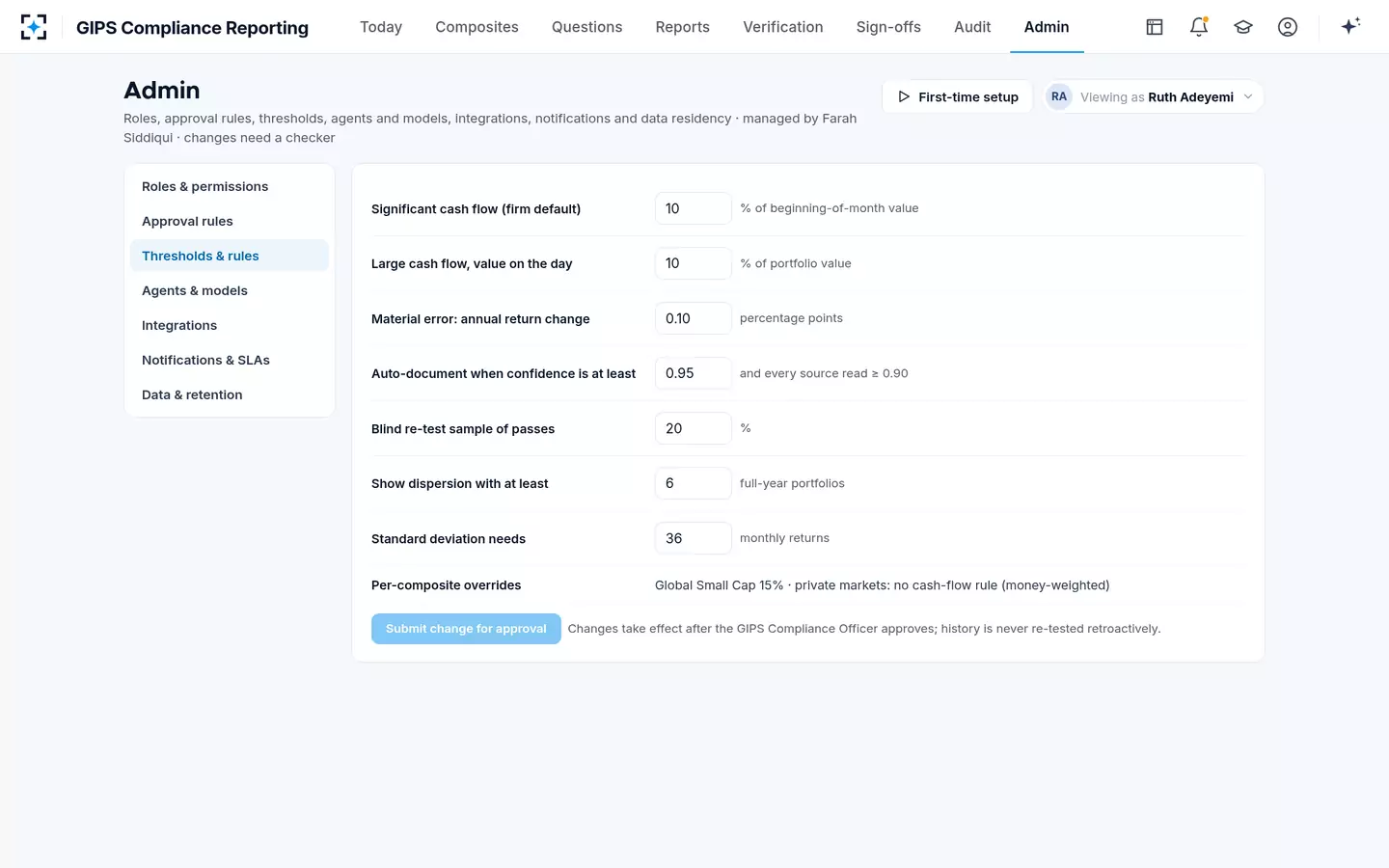
The thresholds the evidence is tested against are the firm's own settings, changed only with approval and never applied to past periods.
The firm's thresholds as settings in GIPS Compliance Reporting
The fair way to judge the solution is on a year the verifier has already accepted. Botminds runs GIPS Compliance Reporting on a firm's own policies and procedures manual and a past year of composite membership, and the agents are first backtested against a year the verifier has signed off, so the comparison is with a known answer. How the agents handle the events they cannot settle is in GIPS performance reporting with agents that ask, and the report the binder ultimately supports is in the annotated composite report. The solution itself is on the GIPS Compliance Reporting page.
Questions people ask
What is the difference between GIPS verification services and GIPS consultancy?
Verification is the independent test under the Standards for Verifiers; consultancy is help building policies, composites or reports. A verifier must be independent of the firm, and the standards refer to CFA Institute's Guidance Statement on Verifier Independence for further guidance; the firm must also consider the verifier's independence assessment (1.A.39).
How much does GIPS verification cost?
Verifiers don't publish prices. Cost follows the sample: number of composites and portfolios, years verified, systems and outside providers, and the firm's control environment. Missing documents enlarge the sample, so a complete binder is the one lever the firm holds.
How long does GIPS verification take?
No standard duration exists. In the solution's sample data, fieldwork is scheduled for two weeks, November 9 to 20; the larger variable is how long the firm takes to answer the request list, which depends on whether evidence was filed when each event happened.
What does a verifier ask for first?
The policies and procedures (procedure 2), the firm definition (3), the composite and pooled fund lists (4) and total firm assets by portfolio (5). Membership details for every period, with returns and values, follow under procedure 7.
Can a firm be verified for past periods?
Yes. The initial minimum is one year of presented performance, and the standards recommend verification for every period for which compliance is claimed; a firm may ask for several past years at once, which enlarges the sample.
Can the verifier rely on our auditor's work?
It may rely on the audit or internal control work of a qualified and reputable independent third party, after assessing its scope, periods, results and the party's competence and objectivity, and it must document that reliance.