Marketing material review software for an investment adviser or fund distributor, also called marketing review or advertising review software, is best judged on pieces you have already reviewed. Take last quarter's approved and returned factsheets, pitch books, website pages, social posts and translations; run them through the software without telling it what your reviewers found; then compare its findings with your reviewers' comments, claim by claim. Four weeks is a workable length for doing that properly. The decision then rests on three things a demo cannot show: what the software missed, whether each finding cites the rule and the record behind it, and how much noise it adds. Botminds' SEC Marketing Rule Compliance was built to be tested this way, and its own setup runs the agents on past pieces with known findings before any piece goes live.
Four weeks, most of them spent comparing, not configuring
- Pick the pieces, write the keyWeek 1
- Keep reviewing as normalWeek 2
- Compare findings, claim by claimWeek 3
- DecideWeek 4
- Connect records, load policiesWeek 1
- Run blind on the pilot setWeek 2
- Explain each findingWeek 3
- Export the recordsWeek 4
What is marketing material review software?
Marketing material review software takes an advertisement or other client communication through a compliance review: routing it to reviewers, checking it against the firm's rules, recording decisions and approvals, and keeping the file. For an investment adviser the rules are the SEC Marketing Rule and the firm's own policies under the compliance rule; for a broker-dealer, FINRA Rule 2210's content standards, approvals and filings. Products range from workflow and archiving tools to lexicon checkers to agents that read each claim against the firm's records; how to judge marketing compliance software compares them.
A pilot is the only fair comparison because the hard cases are the firm's own: its composites, its fee schedules, its disclosure library, its languages, its audience policy for hypothetical performance. A vendor's sample piece tests the vendor's sample.
How to pilot marketing compliance software: choose last quarter
Use pieces your reviewers have already decided, because then you know the answer. Last quarter's approved pieces show what the software adds to a clean review; its returned pieces show whether it catches what your reviewers caught. Add planted defects to a few clean copies, as described in how to test the reviewer, so the pilot measures recall on defects you placed yourself.
A pilot set weighted to where the risk is
Week 1: connect the records and write down the answers
The first week is about access and the answer key. The software needs read-only access to the systems that prove claims: the performance system for gross and net returns, portfolio accounting for holdings and AUM, the consultant database for rankings, the CRM for testimonial consents, the approved disclosure library, Form ADV and the firm's marketing policies. Without them it can read but not substantiate, and the pilot will measure the wrong thing.
In parallel, write the key. For each piece in the set, list what your reviewers found and decided, from their comments and the approval record, and for each planted defect, what you placed and where. Keep the key away from the vendor. If your review comments are too thin to reconstruct the findings, that itself is a result: the April 2024 risk alert found advisers that could not show documentation for the performance claims in their advertisements (SEC risk alert, April 2024).
Week 2: run blind, in parallel with normal review
Run the whole set through the software in its default configuration plus your policies, with no hints. Your reviewers carry on with live work; nothing the software produces is used for a real approval. Two practical rules keep the comparison honest: no re-runs after looking at the key, and every page processed, including scanned handouts and image-only slides, so the pilot sees the pages the software cannot read.
What a reviewer sees on each pilot piece: every claim, its rule, its record
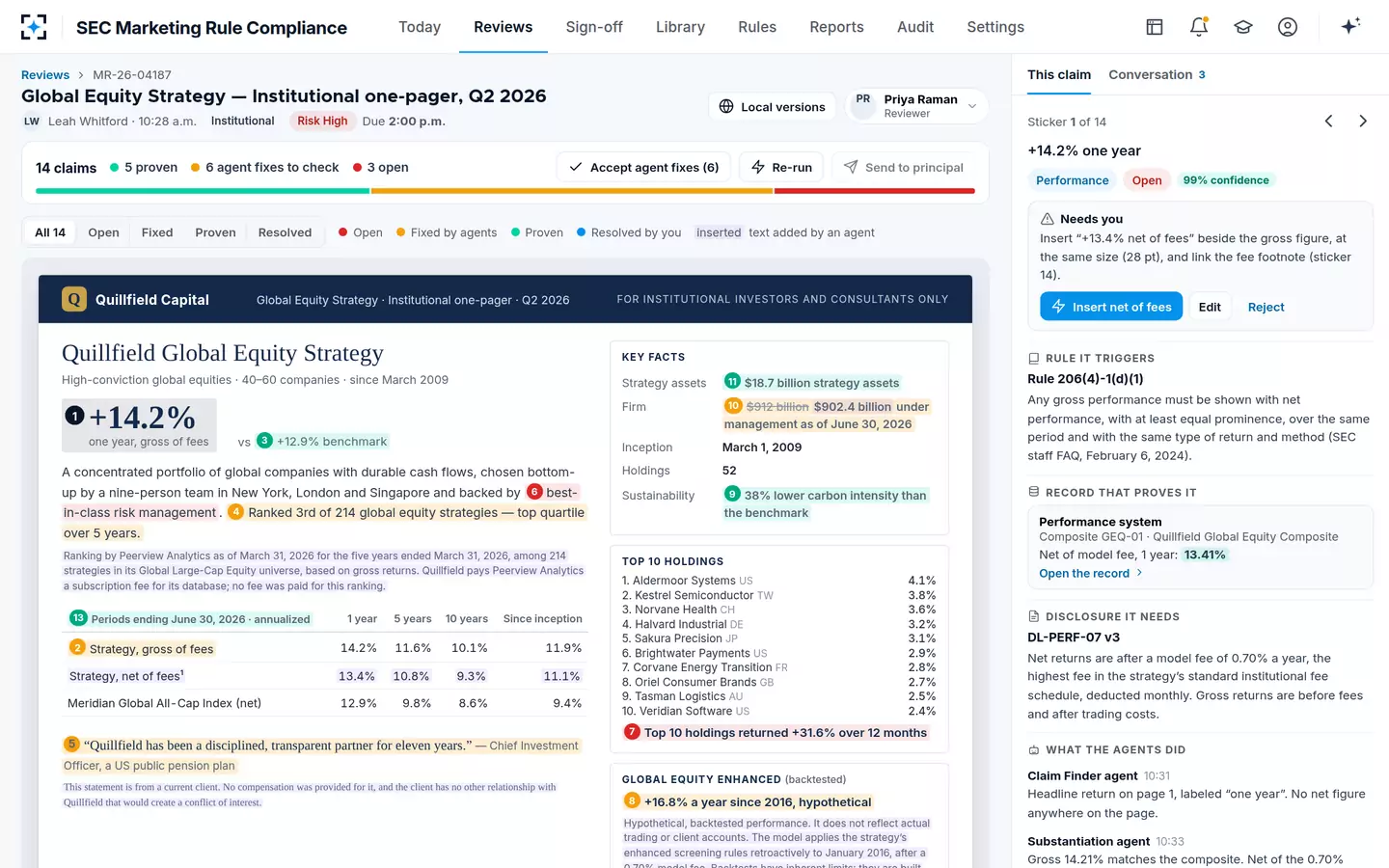
Week 3: compare findings with your reviewers' comments
Week three is the pilot. For every piece, line up the software's findings against the key, claim by claim, and sort each into one of four boxes: found by both, found only by your reviewers (a miss), found only by the software (a new finding or a false alarm, which a senior reviewer decides), and found by neither but planted (a shared miss). The new findings deserve the most care. On approved pieces they are either noise or defects that went out, and the second kind needs a decision of its own about the live library.
The pilot scorecard: six numbers to decide on
| Measure | How to count it | What a good result looks like |
|---|---|---|
| Recall on planted defects | Planted defects found ÷ planted defects | Every planted performance defect found; they are arithmetic |
| Recall on your reviewers' findings | Reviewer findings also found by the software ÷ reviewer findings | High, with each miss explained by a missing record or policy |
| Evidence quality | Findings citing the right rule and the right record ÷ findings | Every finding opens its record; no "please check" without a source |
| New findings that were real | Software-only findings confirmed by a senior reviewer | Some, each a defect your process can now catch |
| Noise | False alarms per clean piece | Low enough that authors will read the rest |
| Records export | Time to produce the file for one piece and for one month | Minutes, with the piece, records, decisions and names |
Week 4: decide on misses and evidence, not on demos
Decide with the scorecard and the misses list in front of you. Each miss has a cause: a record the software could not reach, a policy that was not loaded, a page it could not read, or a check it does not make. The first three are fixable in implementation; the fourth is a product limit, and the decision is whether your reviewers can cover it.
Evidence quality weighs as much as recall. A finding that cites the rule paragraph and opens the composite, the fee schedule or the consent record can be decided in seconds and defended to an examiner; a finding that says "performance may need review" moves the work back to the reviewer. The records export matters for the same reason: an adviser keeps advertisements and the records behind their performance for five years from the end of the fiscal year of last use (Rule 204-2), and a broker-dealer records the approving principal and the date for each retail communication (FINRA Rule 2210(b)(4)).
Marketing review process: where the software sits in it
A marketing review process for an investment manager has the same steps with or without software: submission, classification, claim-by-claim checking, decisions, the author's changes, approval, release, recordkeeping and, later, expiry. A pilot should map where the software acts at each step and where a person still does, because that map becomes the written procedure the firm adopts afterwards.
In the solution the map runs as follows. The author submits from the content library or marketing workflow. The Intake agent classifies the piece under Rule 206(4)-1 and Rule 2210, sets its risk tier, service level and reviewer, and shows why; below its confidence threshold a person classifies. The Claim Finder agent marks every claim; the Substantiation agent proves each to its record or leaves it open; the Disclosure agent proposes approved text; the Second Review agent re-reads the whole piece blind. The reviewer decides every open finding with a reason code and sends wording requests to the author, who chooses the words. The reviewer prepares the review; the approver signs; the Recordkeeping agent keeps the piece and its records and watches it for expiry.
Two places in that map deserve the closest look in a pilot. The first is the hand-off to the author, because back and forth over wording is where elapsed time collects even when checking is fast. The second is expiry: a pilot on last quarter's pieces is also a test of whether the software would have found the pieces that went stale when this quarter's returns arrived.
What systems does marketing review software connect to?
To substantiate rather than just read, it connects to the systems where proof lives. In the solution these are the content library and marketing workflow, the performance system, portfolio accounting and data feeds, the consultant database and CRM, the disclosure library and rule book, and the FINRA filing portal and archive.
What to connect, and what each connection proves
- Content library and marketing workflow
Where pieces arrive, with their distribution lists, which decide whether a piece is an advertisement and its FINRA class.
- Performance system
Monthly gross and net returns for every composite and fund: net of fees, the 1, 5 and 10-year periods, benchmarks.
- Portfolio accounting and data feeds
Holdings, contribution, firm AUM, index and ESG data: extracted performance, top-holdings boxes, AUM claims.
- Consultant database and CRM
Rankings with their dates, periods and fees; testimonial consents, client status and compensation.
- Disclosure library and rule book
Approved disclosure text with versions, Form ADV, and the firm's marketing policies, including the hypothetical-performance audience policy.
- FINRA filing portal and archive
Filing submissions and comment letters, and the write-once archive where the approved piece and its records are kept.
How do you go live with marketing compliance software?
Go live in stages, starting where the evidence from the pilot is strongest. The sample firm in the solution, Quillfield Capital, a fictional manager, went live region by region after first-time setup ran the agents on 400 past pieces that people had reviewed in 2025, with their known findings. Each agent's version carries its last evaluation, and changes to agents, thresholds and policies are proposed by an administrator and approved by the chief compliance officer.
Every agent's version, threshold and last evaluation, before and after go-live
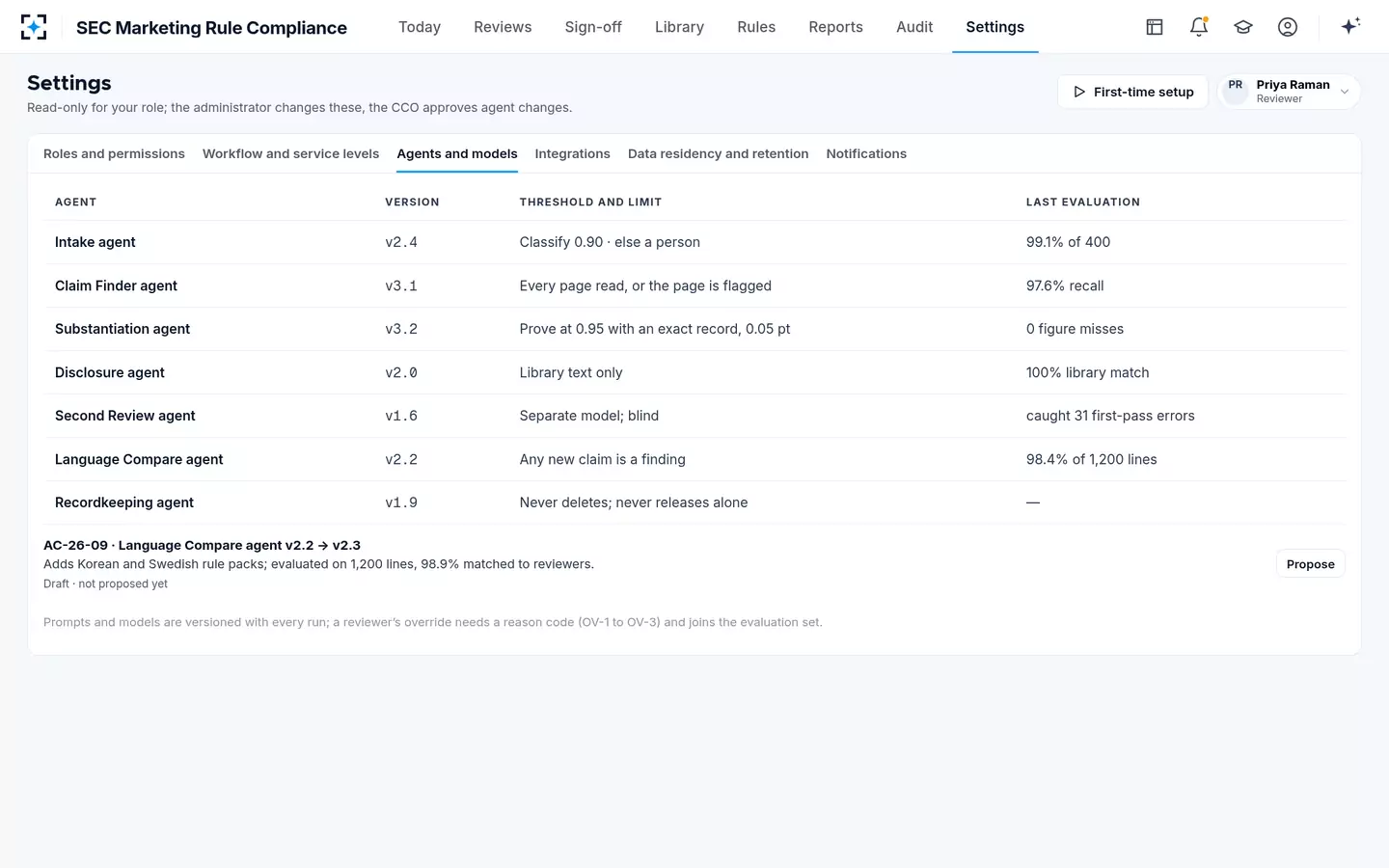
That governance is not optional. The compliance rule requires written policies fit to prevent breaches, reviewed every year for whether they work (Rule 206(4)-7), and FINRA has said its rules apply when firms use AI just as they do with any other tool, including its supervision rule (FINRA Regulatory Notice 24-09). Software that reviews advertisements is part of the control, so its changes need the same approval and testing as a policy change. Re-run the pilot's planted-defect set after each agent change and at each annual review.
Pitfalls that make a pilot look better, or worse, than it is
Four mistakes recur. Running only clean, approved pieces measures noise and nothing else. Letting the vendor see the key turns recall into a rehearsal. Skipping integrations and judging the software on reading alone hides the substantiation it was bought for. And scoring only recall ignores whether findings can be defended: a tool that flags every superlative will find every superlative, and teach authors to ignore it.
The opposite mistake is also common: judging the pilot on how many findings the reviewers already had. The point of the comparison is the gap in both directions, the misses and the new findings, and a decision about who covers each. To run the pilot on your own pieces, start from SEC Marketing Rule Compliance.
Questions people ask
How long does a marketing compliance software pilot take?
Four weeks is a workable length on last quarter's pieces: a week to connect records and write the answer key, a week to run blind, a week to compare and a week to decide. The usual delay is access to the performance system and disclosure library, which is why the comparison should not start until they are connected.
What should a marketing review software pilot measure?
Recall on planted defects and on your reviewers' own findings, the share of findings that cite the right rule and record, new real findings, false alarms per clean piece, and the time to export the file for a piece or a month. Fix the thresholds before the run.
Should the pilot use live pieces?
No. Use pieces already decided, so you know the answer and nothing the software produces affects a real release. Live use comes after the decision, in stages, with reviewers deciding every finding and approvers signing as before.
Does marketing review software need to be approved by the CCO?
The rules do not name software, but the chief compliance officer administers the policies it applies under Rule 206(4)-7, and FINRA expects supervision of the tools firms use. In the solution, every change to an agent, a threshold or a policy is proposed by one person and approved by the CCO.
What happens to defects the pilot finds in pieces already in circulation?
Treat them as findings on live advertisements: decide whether to correct, refresh or withdraw each piece, and record the decision. The SEC has reduced penalties for advisers that corrected Marketing Rule problems before its staff contacted them, so finding and fixing them yourself has value.