The best marketing compliance software for an investment adviser or broker-dealer is the one whose limits match the rules. The SEC Marketing Rule and FINRA Rule 2210 leave a person accountable for every advertisement: the adviser for its policies and its claims, and a registered principal for each broker-dealer retail communication. Software can find every claim on every page, fetch the record that proves it, recompute net of fees, check each disclosure and keep the file. It should not approve a piece, sign for a principal, file with FINRA or write new disclosure language. Judge a tool by how clearly it keeps that line, and by whether it shows its evidence. Botminds' SEC Marketing Rule Compliance is built that way: seven agents prepare the review, a reviewer decides each finding, and a named approver signs.
What marketing compliance software should do, and what stays with people
What agents may do: Classify a piece as an advertisement or not, and its FINRA class, showing the exclusion or count relied on
What stays with a named person: Correct the classification, and decide any piece below the confidence threshold
What agents may do: Mark every performance figure, rating, testimonial, superlative and hypothetical on every page
What stays with a named person: Decide whether a borderline claim is fair and balanced
What agents may do: Fetch read-only copies of the records behind each claim and recompute net of fees and periods
What stays with a named person: Accept a fix, or reject it with a reason
What agents may do: Insert approved text from the firm's library, with its version
What stays with a named person: Write or change disclosure language, through the CCO
What agents may do: Check that author, preparer and approver are different people; keep the file
What stays with a named person: Approve, sign and file with FINRA
What should the best marketing compliance software do?
It should do the reading and the fetching, completely and with evidence. Most of a reviewer's hours go into finding the claims and chasing the records behind them, not into the judgement. In Botminds' own estimate for a routine factsheet, reading and marking claims and waiting for records take nine of about twenty elapsed hours. Software that does that part well gives the reviewer back the time for the part that needs a person.
Five capabilities separate useful tools from document workflow with a checklist attached. First, claim detection on every page, including images, tables and footnotes, with nothing skipped silently. Second, substantiation against the firm's own systems: the performance system, portfolio accounting, the CRM, the consultant database, Form ADV. Third, recomputation, because a gross-only return or a stale period is found by arithmetic, not by reading. Fourth, approved-text disclosure from a versioned library. Fifth, a record an examiner can read: what was checked, against which record, by whom, when.
Marketing compliance software features, compared by what they actually check
| Approach | What it checks | What it misses |
|---|---|---|
| Workflow and archive | Routing, version control, approvals, retention | Whether any claim is true or any figure is right |
| Lexicon and rules engine | Restricted words, missing standard legends, required phrases | Gross without net, stale periods, selected results, undated ratings that use allowed words |
| General-purpose AI review | Tone, readability, obvious overstatements | The firm's records: it cannot prove a number it cannot see |
| Agents connected to the firm's records | Each claim against its record, recomputed figures, disclosures from the library, local versions against the master | Policy questions and approval, which stay with people by design |
Can AI review marketing materials for compliance?
It can do much of the review, and the rules do not change because it does. FINRA said in Regulatory Notice 24-09 (June 2024) that its rules are intended to be technologically neutral, that they apply when firms use generative AI just as with any other tool, and that Rule 2210's content standards apply whether a communication is written by a person or generated by a tool (FINRA Regulatory Notice 24-09). The SEC's fiscal 2027 examination priorities use their own term for these tools, "super intelligence (SI)", and put client communications and compliance monitoring among the jobs firms now give them; the standard examiners apply to the output is the one that applied before (SEC Division of Examinations, FY2027 priorities).
Two consequences follow for a buyer. A tool that reviews advertisements is part of the firm's supervisory system and needs the same governance as any other control: versioned, tested, with a record of what changed. And a tool that drafts advertisements produces content the firm must review like any other. The SEC has already charged advisers over false claims about their own use of AI, a reminder that the vendor's claims, too, need substantiation; see the SEC's AI-washing cases.
What should marketing compliance software never do?
It should never approve, never sign and never invent. Approval is a person's duty under FINRA Rule 2210(b)(1) for retail communications and under most firms' own policies for adviser advertisements. A signature is an attestation that a named person looked; software cannot attest. Disclosure language is legal text the firm owns, so a tool that drafts new disclosures on the fly creates text no one approved.
Three quieter limits matter as much. Software should never mark a claim proven without an exact match to a record, because "close enough" is how a gross figure passes as net. It should never resolve a disagreement between its own checks; the person deciding should see both. And it should never edit the source record, or the review becomes evidence of something the firm's systems never said.
Limits written as settings, not promises
0.90
intake confidence below which a person classifies the piece
0.95
confidence, with an exact record match, before an agent may mark a claim proven
0.05pt
largest difference from the record a proven figure may have
3
different people required: author, preparer and approver
Evidence: why the record matters more than the model
A review is only as strong as the record behind each claim, because the SEC's substantiation test turns on what the adviser could produce on demand. The SEC said in the adopting release that if an adviser cannot substantiate a material claim when the Commission asks, it will presume there was no reasonable basis for it (Release IA-5653). Examiners in April 2024 listed advisers that kept no documentation behind the performance claims in their advertisements (SEC risk alert, April 2024).
So the right demo question is not "what did the AI find?" but "show me the record". Take a sample one-pager as it runs through the solution, from Quillfield Capital, a fictional manager: its headline read +14.2% one year, gross of fees, with no net figure. One click opens the record behind the number.
The record behind one number: what a reviewer should see before deciding
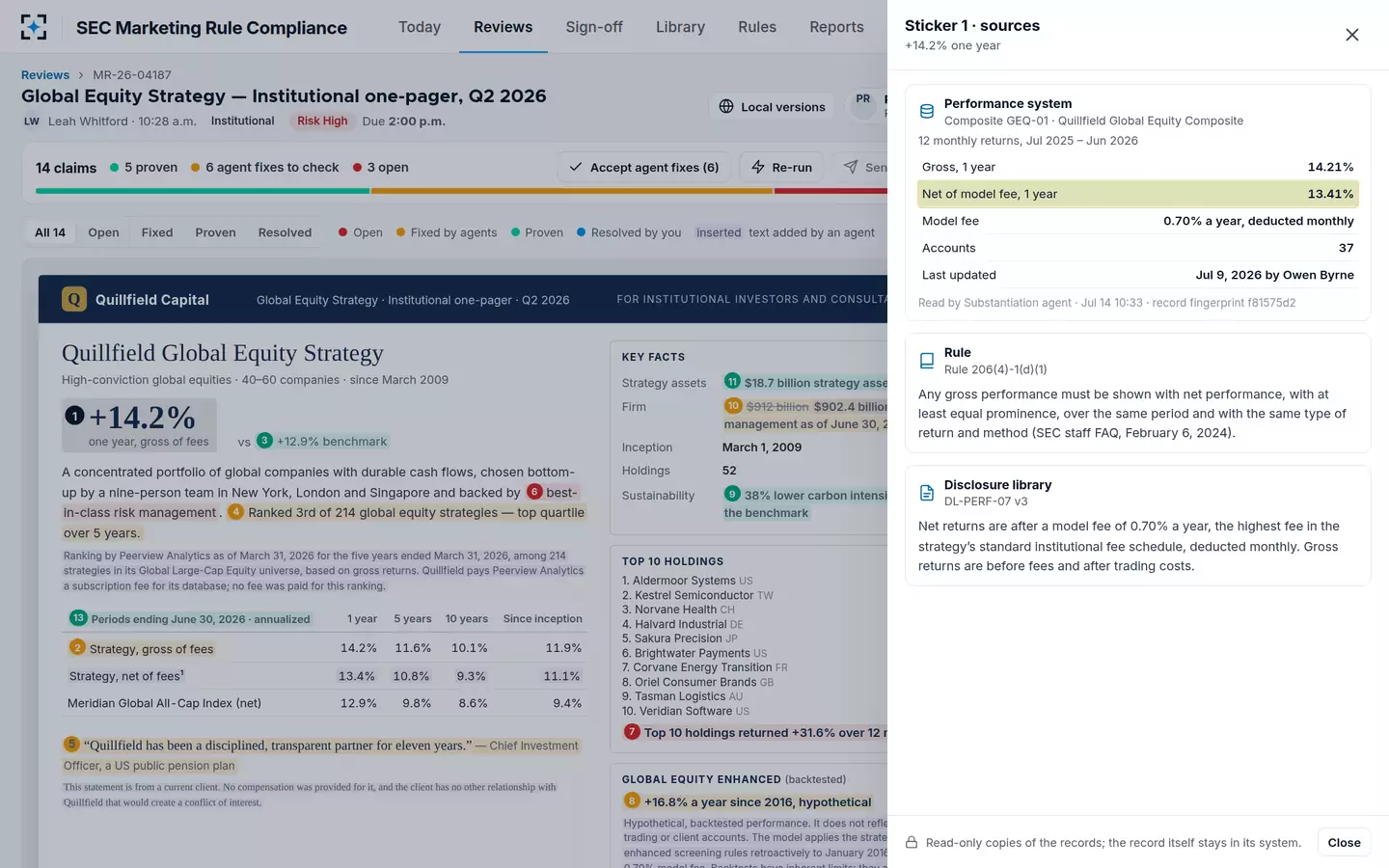
The record is kept with the advertisement, because the books-and-records rule requires the records behind any advertised performance for five years from the end of the fiscal year of last use (Rule 204-2). Software that shows a finding but cannot export the record behind it leaves the firm assembling files by hand when the SEC asks.
A blind second check, and what to do when checks disagree
A single pass misses what it was not looking for. The solution runs a second agent over every piece, on a separate model, without the first agents' notes, and escalates every disagreement to the reviewer with both arguments. On the sample one-pager it disagreed once, on a "top 10 holdings" line that was really a list of the ten best contributors. The reviewer removed it as selected results.
When evaluating any tool, ask how often its checks disagree and what happens then. A tool that never disagrees with itself is either very good or not checking. A tool that resolves its own disagreements has made a judgement no one can see. How to measure a reviewer's catch rate, human or software, is set out in how to test the reviewer.
The checks buyers forget: translations, stale pieces and FINRA clocks
Most evaluations test one English factsheet. The defects that reach investors often sit elsewhere: in a translated version nobody re-read, in a piece that was compliant when approved and went stale when new returns landed, or in a FINRA filing whose clock started on first use. Good marketing compliance software covers all three, because each repeats every quarter.
Translations first. A local version is a new piece, and a translator can add a claim the approved master never made. In the sample firm, a German UCITS factsheet said the fund followed an approach "with low risk" where the English master said "risk-managed approach", for a fund whose risk indicator was 4 of 7. Every figure and date in six languages matched; that one line did not. The solution compares each local version with the approved master line by line and treats any new claim in translation as a finding for the local reviewer, never something it approves itself.
Stale pieces next. An approved factsheet keeps circulating after the quarter it describes. When the sample firm's second-quarter returns were published on 9 July 2026, 318 live pieces still showed first-quarter figures; the solution drafted refreshes for 112 and listed 206 waiting on their records, with each piece set to expire 21 days after the new returns under the firm's own policy. A rating can expire the same way. Ask any vendor how it finds the pieces already in circulation, not just the ones in review.
Then the clocks. A broker-dealer's investment company retail communications are filed with FINRA within 10 business days of first use, and certain pieces with self-created rankings 10 business days before (FINRA Rule 2210(c)). Software that classifies a piece at intake should start that clock and show it, and keep FINRA's comment letters with the piece they concern, so the answer is drafted from the same records as the review.
How do you evaluate marketing compliance software?
Run it on your own past pieces and ask the questions below. Vendors' feature lists overlap; their answers to these do not.
Ten questions for any marketing compliance software provider
- Show me the record behind this finding.
Not a summary of it: the record, its date and its version, opened from your own system.
- What happens below the confidence threshold?
A person should decide, and the threshold should be a setting your CCO approves.
- Can it approve, sign or file anything?
The right answer is no, and the duty check should prove it on every piece.
- Where does disclosure text come from?
Your approved library, with versions, or text the tool writes?
- Does it recompute net of fees and the 1, 5 and 10-year periods?
From monthly returns, using the model fee rule your policy sets.
- How does it treat hypothetical performance?
Against your audience policy, by channel, or only by keyword?
- Does it check local-language versions against the approved master?
Line by line, for figures, dates and new claims a translator added.
- What does an examiner receive?
One export for a piece, a period or a request: piece as approved, records, decisions, names and dates.
- How are its agents changed and tested?
Versioned, evaluated on known past findings, approved before use.
- What does it do with a page it cannot read?
Flag it and ask for the source file, never skip it.
Where SEC Marketing Rule Compliance fits, and where it does not
It fits a manager that produces hundreds or thousands of factsheets, pitch books, one-pagers, website pages and social posts a quarter, with a performance system, a disclosure library and a review team, and often an affiliated broker-dealer and local-language versions. There the arithmetic of hours and the risk of a stale figure both scale with volume, and the record behind each claim is spread across systems. The cost of clearing one approved piece shows how to put a number on that.
It fits less well where volume is low. An adviser that publishes a handful of pieces a month, with one performance composite and no broker-dealer, can run a careful checklist and a second reader at little cost; the gain from agents is smaller than the work of connecting them. And it does not fit as a substitute for anything the rules give to people: the CCO's policies, the reviewer's decisions, the principal's signature. If a buyer is looking for a tool to remove those, no compliant tool will.
One click inserts net beside gross; the reviewer still accepts it
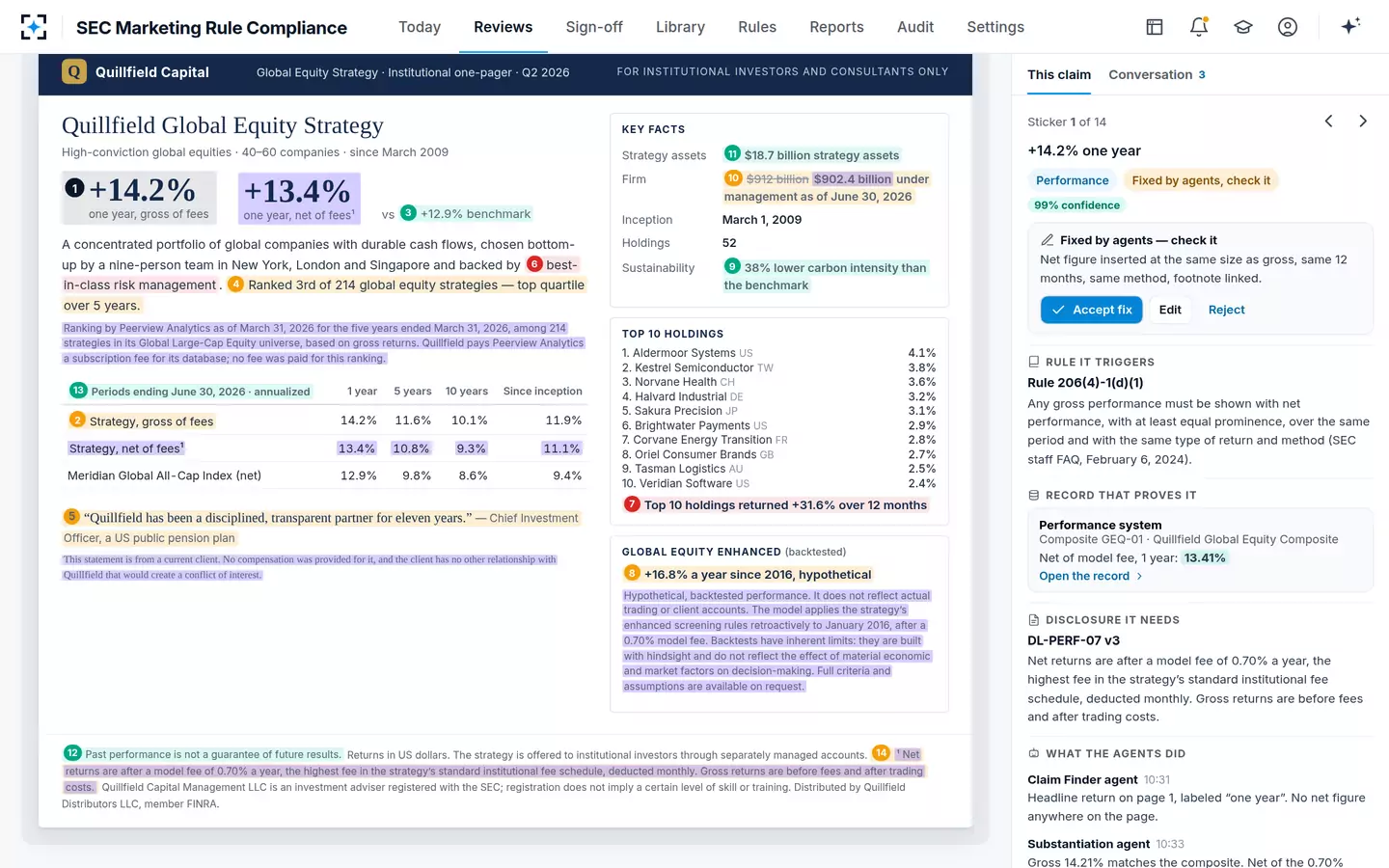
To see the agents on your own approved and returned pieces, start from SEC Marketing Rule Compliance.
Questions people ask
Can marketing compliance software approve an advertisement?
It should not. FINRA Rule 2210 requires an appropriately qualified registered principal to approve a broker-dealer's retail communications before use or filing, and an adviser's own policies normally name a person. Software can prepare the review and check that the right people signed, but approval is a person's act.
Do FINRA rules apply to AI-generated communications?
Yes. FINRA's Regulatory Notice 24-09 says its rules are technologically neutral and that Rule 2210's content standards apply whether a communication is generated by a person or by a technology tool. An AI-drafted factsheet needs the same review and approval as any other.
What is the difference between marketing compliance software and a lexicon tool?
A lexicon tool flags words and missing legends. The SEC's most common Marketing Rule findings, such as gross performance without net, hypothetical performance shown to the public and undated ratings, can be written in entirely allowed words, so they are found by checking records and arithmetic, not vocabulary.
How long does it take to evaluate marketing compliance software?
A useful evaluation runs the software on a quarter's worth of pieces your reviewers have already decided, and compares findings. Four weeks is a workable length; the four-week pilot plan sets out each week.
Does marketing compliance software replace the compliance reviewer?
No. It changes what the reviewer spends time on: less reading and chasing records, more deciding. In the sample firm, the reviewer still decides every open finding with a reason code, prepares the review and attests to it before an approver signs.