Ad compliance software for investment managers is not sold from a public price list, so the useful number is your own: the cost of getting one advertisement approved, before and after. That cost is mostly people's time, and most of the time is not judgement. It is reading, waiting for the records behind each figure, going back and forth with the author, and chasing a signature, then doing it again for each translation and for a FINRA filing where one is due. The SEC itself estimated that the Marketing Rule's performance provisions alone would take advisers about 1.2 million hours. Botminds' SEC Marketing Rule Compliance is ad compliance software that takes the reading and the record-chasing to agents and leaves the decisions with reviewers and principals, so the place to measure it is the cost per approved piece.
Where a routine factsheet's review hours go, by hand and with agents
By hand · about 20.5 elapsed hours
- Reading and marking claims · 14.6%
- Waiting for records · 29.3%
- Net of fees, periods and disclosures · 17.1%
- Author back and forth · 19.5%
- Sign-off and filing the record · 19.5%
With the solution · about 3.9 elapsed hours
- Reading and marking · 12.8%
- Records · 12.8%
- Net, periods and disclosures · 10.2%
- Author back and forth · 38.5%
- Sign-off · 25.7%
How much does ad compliance software cost?
Vendors of marketing and advertising compliance software do not publish prices, and no regulator or independent study publishes what firms pay. Prices are quoted against volume, users, integrations and regions. The figure you can know is the other side of the equation: what each approved piece costs you today, and how much of that cost a tool would remove. With that number, any quote can be judged in a line.
The split above shows why the per-piece view matters. In Botminds' estimate, nearly 30% of the elapsed time on a routine piece is spent waiting for the record behind a number, and almost two-fifths more on the back and forth with the author and the wait for sign-off. Software that shortens the reading but leaves the waiting has saved the reviewer an hour and the piece very little. The solution's design aims at both: the record arrives with the claim, and the author sees each request in plain words.
What did the SEC estimate the Marketing Rule would cost?
The SEC's own burden estimate for the performance provisions of the rule, made under the Paperwork Reduction Act when the rule was adopted, came to 1,198,686 hours a year across all affected advisers, with an internal cost of $413,475,121 and external costs of $3,774,000 (Release IA-5653, Table 4). Initial work was amortised over three years, so the figures are annualised.
The time-period condition alone was estimated at over half a million hours
Per adviser, the SEC's estimates were 15.5 hours a year for net-of-fees performance, 39.7 for the time-period requirement, 27.5 for related performance and 24.5 for hypothetical performance, plus 17.67 hours for oversight of testimonials and endorsements. These are averages across thousands of advisers, many with one composite and a few pieces a year. For a manager with hundreds of composites and a quarterly factsheet wave of hundreds of pieces, the same work repeats piece by piece, which is where an estimate per adviser stops being useful and a cost per piece starts.
The SEC's own arithmetic for the rule's performance conditions
1.2mhours
estimated each year for the performance provisions, across advisers
$413m
estimated internal cost of that time each year
39.7hours
per adviser per year for the 1, 5 and 10-year periods alone
What does FINRA charge to review an advertisement?
FINRA charges a review fee for each communication filed with its Advertising Regulation Department, with a higher charge for expedited review. Both of FINRA's fee pages put expedited review at $600 for an item of up to ten pages, plus $50 for each page over ten, and FINRA says it will send expedited responses "no later than close of business on the third review day" (FINRA, How to File). Pages over ten in a regular filing cost $10 each.
FINRA's own pages give two different base charges for a regular filing: the By-Laws schedule shows "$125.00, plus $10.00 for each printed page or webpage reviewed in excess of 10 pages" (FINRA By-Laws, Schedule A, Section 13), while the filing guide shows "$ 300.00 for the first ten pages of material". Confirm the current charge in FINRA's filing system before you budget. Either way the fee is small next to the people time; the bigger cost of a filing is the clock, since investment company retail communications are due within 10 business days of first use (FINRA Rule 2210(c)(3)), and the comment letters that come back.
How long does a compliance review of a factsheet take?
No regulator or independent study publishes review times for advertisements. The way to know is to measure: take the timestamps your marketing workflow already holds for a quarter, from submission to approval, and split the elapsed time into the stages in the chart above. Most firms find the touch time is a fraction of the elapsed time.
In the solution's sample firm, Quillfield Capital, a fictional manager, one institutional one-pager went from the author's submission at 10:28 a.m. to the principal's approval at 11:05 a.m. on 14 July 2026, 37 minutes, with fourteen claims checked and three decided by the reviewer. That is sample data on a single piece; a fair comparison uses your own pieces, routine and complex, over a full quarter.
The cost of one approved piece, as a sum
Cost per approved piece adds four kinds of cost. Each can be measured from records a firm already keeps, and each moves differently when software arrives.
Cost per approved piece, in four terms you can measure
Review time
reviewer hours × loaded hourly cost
Reading, marking, deciding, preparing. Count every pass, not just the first.
Marketing compliance
Records time
hours spent producing evidence × loaded cost
The performance team pulling composites, the data team checking AUM, the CRM owner confirming a testimonial's status.
Performance and data teams
Approval and filing
principal hours + FINRA fees + filing-desk time
Plus expedited fees when a deadline forces them, and the time to answer comment letters.
Registered principals
Rework and versions
returns to author + translations re-reviewed + stale pieces refreshed
Each return is a second review. Each local version is a new piece. Each quarter's new returns re-open live pieces.
Marketing operations
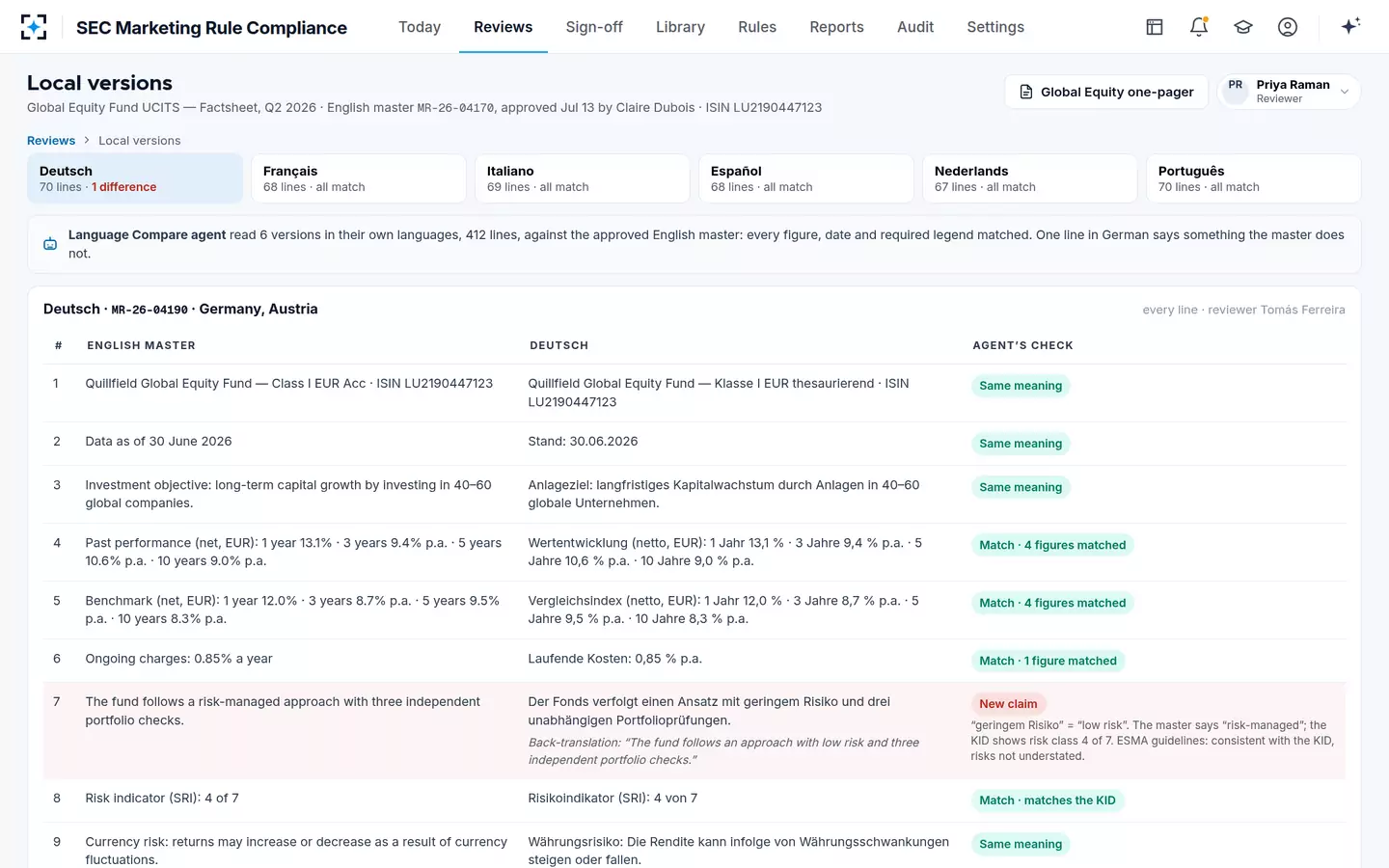
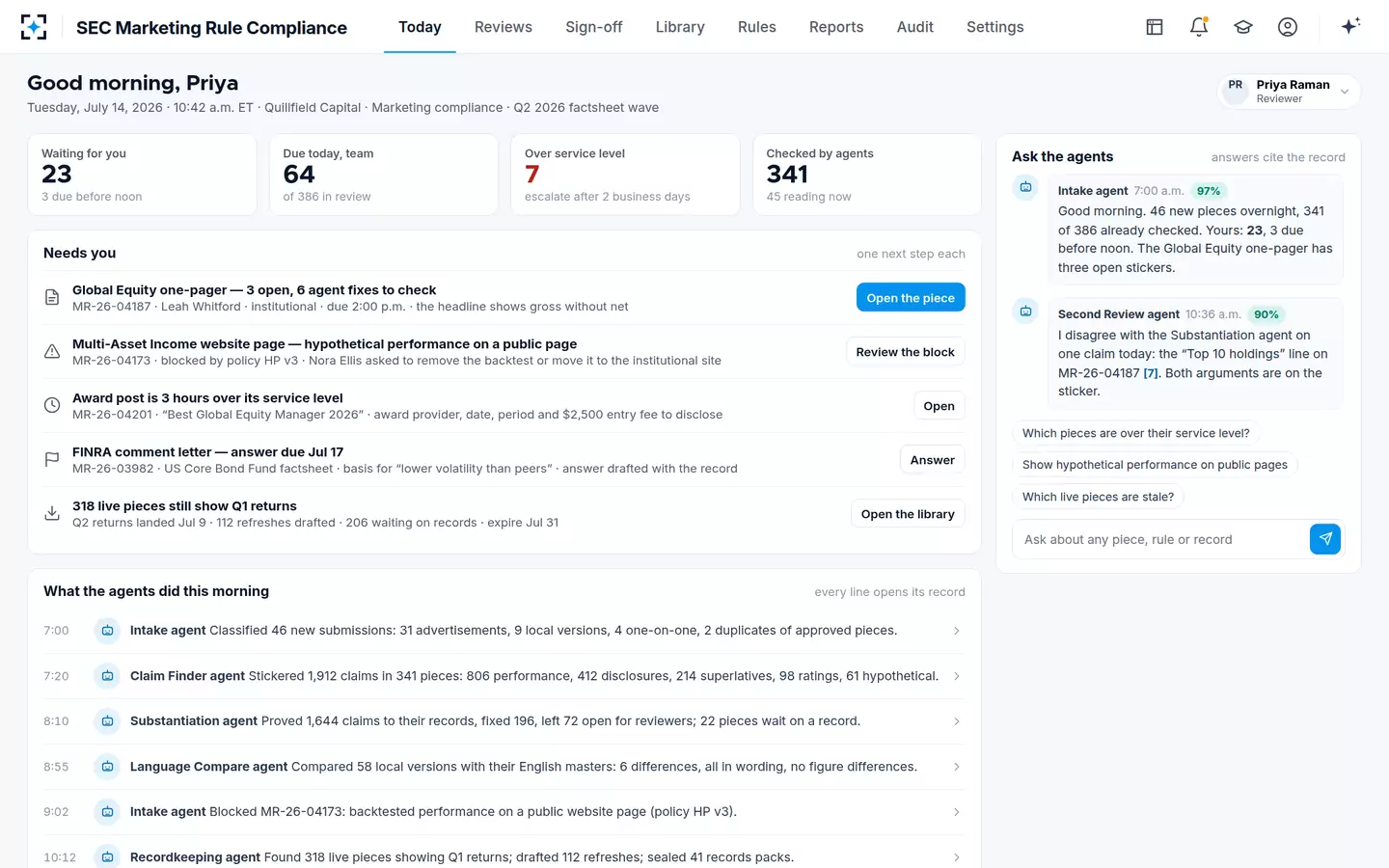
The fourth term is the one firms leave out, and it is often the largest at quarter-end. In the sample firm's library, Q2 returns published on 9 July left 318 live pieces showing Q1 figures, with refreshes drafted for 112 and 206 waiting on their records. Every one of them is another review, and every translation of each is another again.
Each local version is another piece to review
Why the quarter-end wave sets the cost, not the average week
Marketing review capacity is sized for the quarter-end wave, not for the average week, so the unit cost that matters is the one at the peak. When new quarterly returns land, every factsheet, one-pager and pitch book that quotes performance must be refreshed, re-reviewed and re-approved within days, together with its translations, while new campaigns keep arriving.
The sample firm shows the shape. By mid-morning on 14 July 2026, Quillfield Capital had received 612 pieces since 1 July, with 386 in review and 64 due that day; one reviewer alone had 23 waiting, three due before noon, and seven pieces across the team were already past their service level. Its settings give high-risk pieces, such as those with hypothetical performance or paid testimonials, one business day, standard pieces two, and social posts four hours, escalating to the chief compliance officer after two business days over.
At those volumes the arithmetic is unforgiving. With Botminds' estimate of about 20.5 elapsed hours for a routine piece reviewed by hand, most of it waiting, a wave of several hundred pieces cannot meet a one- or two-day service level without either more reviewers or less checking. The second option is how stale periods and gross-only figures reach the market. To size your own peak, take last quarter's submissions by day, the service level for each tier and the touch time per piece, and see how many reviewer-days the busiest fortnight needed.
The peak also sets the value of software. A tool that saves an hour a piece in a quiet month saves little; the same hour across the wave is the difference between hiring temporary reviewers and not, and between checking every claim and sampling.
What changes the unit cost, and what does not
What ad compliance software can take out of the unit cost, and what it cannot
Cost the agents can remove: Reading every page and marking claims; recomputing net of fees and periods; finding the approved disclosure
Cost that stays: Deciding borderline claims and preparing the review
Cost the agents can remove: Chasing the performance team for each figure, when the systems are connected
Cost that stays: Fixing a record that is wrong at source
Cost the agents can remove: Comments the author has to interpret; most of the back and forth
Cost that stays: The author's choice of wording
Cost the agents can remove: Assembling the file for the principal and FINRA
Cost that stays: The principal's time and FINRA's fee
Cost the agents can remove: Line-by-line comparison of every translation; finding stale live pieces
Cost that stays: Local reviewers' decisions on new claims
The cost of a Marketing Rule failure, beyond the penalty
Penalties are the visible cost of a failed review, and they are moderate: from $20,000 to $850,000 per adviser in the SEC's Marketing Rule orders so far, set out in SEC Marketing Rule enforcement actions. The less visible costs are larger for a manager whose marketing is its pipeline: undertakings to review every advertisement in circulation, a disciplinary history that consultants and due-diligence teams ask about, and pieces withdrawn mid-campaign.
Self-correction has a measurable value. In April 2024 the SEC gave four of five advisers charged over website hypothetical performance reduced penalties because they took corrective steps before SEC staff contacted them (SEC press release 2024-46). A review that finds its own errors in the live library is cheaper than one that waits for an examiner to.
Building the business case, and when ad compliance software is not worth it
Build the case from one quarter of your own data: pieces approved, elapsed and touch time by stage, returns to authors, translations, FINRA filings and fees, and pieces refreshed after new returns. Multiply out the four terms, divide by approved pieces, and you have today's unit cost. Then run the software on a sample of the same quarter's pieces and measure the same terms; the method is set out in the four-week pilot on last quarter's ads.
The case is weak where volume is low and records are simple: an adviser with a few pieces a month, one composite and no broker-dealer can keep a careful checklist and a second reader for less than any integration costs. It is strongest where volume, composites, channels and languages multiply, because the per-piece work repeats while the agents' setup does not. In between, the deciding numbers are usually the waiting time for records and the number of local versions.
The quarter-end queue, with what the agents already did
See the agents on your own pieces at SEC Marketing Rule Compliance.
Questions people ask
Is marketing compliance software priced per user or per piece?
Vendors use both, and some price by volume band or by integration, but they do not publish their price lists. Whatever the model, convert the quote to a cost per approved piece at your own volume, so you can compare it with what each piece costs you today.
What are FINRA's advertising filing fees?
Expedited review is $600 per item plus $50 per page over ten, on both of FINRA's fee pages. The regular base charge was shown as $125 on the By-Laws schedule and as $300 for the first ten pages on FINRA's filing guide, with $10 for each further page on both; confirm it in FINRA's filing system before budgeting.
Does every advertisement have to be filed with FINRA?
No. Filing applies to broker-dealer retail communications in certain categories, such as those promoting a specific registered fund, which are filed within 10 business days of first use. Investment adviser advertisements are not filed with the SEC at all; they are kept under the books-and-records rule.
Can ad compliance software reduce the time to approve a factsheet?
It can shorten the parts that are waiting and reading, which in Botminds' estimate are most of the elapsed time on a routine piece. It cannot shorten the reviewer's decisions or the principal's approval, and the gain depends on whether the performance system and disclosure library are connected.
What is the hidden cost in marketing compliance review?
Rework and versions: pieces returned to authors, translations reviewed again, and live pieces refreshed when new quarterly returns or expired ratings make them stale. They are rarely counted because they do not look like new work, but each is a review.