Under the SEC Marketing Rule, an investment adviser may show a third-party rating in an advertisement only if it has a reasonable basis to believe any questionnaire or survey behind the rating was built to make favourable and unfavourable answers "equally easy" and not to produce a predetermined result, and if the advertisement clearly and prominently discloses three things: the date of the rating and the period it covers, who created and tabulated it, and any compensation the adviser paid in connection with obtaining or using it (Rule 206(4)-1(c)). The rule reaches every "best adviser" badge, top-manager list and peer ranking on a website, a pitch book or a social post. It is hard in practice because ratings are reused long after they are won, and because payments for entry, logos and placement are easy to forget. Botminds' SEC Marketing Rule Compliance matches each rating in a piece to its record, with its date, period, provider and fee, and sets an expiry on it so it cannot quietly age.
Ratings are a short line in the rule and a long line in the findings
5
advisers charged in September 2024 over untrue or undated third-party ratings
5+years
age of some ratings those advisers showed without the date they were given
3
disclosures every rating needs: date and period, provider, and any payment
What is a third-party rating under the SEC Marketing Rule?
A third-party rating is "a rating or ranking of an investment adviser provided by a person who is not a related person", where that person "provides such ratings or rankings in the ordinary course of its business" (Rule 206(4)-1(e)(18)). Two tests sit inside that sentence: independence from the adviser, and a business of rating. Both matter, because a statement that fails either is not a rating at all; it is a testimonial or an endorsement, with different conditions.
The adopting release explained the business test: it "would largely correspond to persons with the experience to develop and promote ratings based on relevant criteria", and it separates ratings from statements that resemble them but are "not made by persons who are in the business of providing ratings or rankings" (Release IA-5653). A magazine's annual ranking of advisers is a rating. A consultant's favourable note about you in a newsletter is, at most, an endorsement.
Rating, testimonial or endorsement: three kinds of praise, three sets of conditions
| Third-party rating | Testimonial | Endorsement | |
|---|---|---|---|
| Who gives it | An unrelated person that rates or ranks in the ordinary course of business | A current client or private fund investor | Anyone else, including former clients |
| Main conditions | Survey due diligence; date and period, provider and payment disclosed clearly and prominently | Client status, any compensation and material conflicts disclosed clearly and prominently; terms and conflicts described | The same as a testimonial, stating that the person is not a client |
| Written agreement | Not required | Required if compensated above $1,000 in 12 months | Required if compensated above $1,000 in 12 months |
| Common failure | Undated, old, or paid for without saying so | From someone who was not a current client | Paid promoter with no disclosure at the point of use |
Is a top advisor list a third-party rating?
Usually, if a publisher or research firm that ranks advisers as part of its business compiles it, and it is unrelated to the adviser. The harder question is what the list actually measures. The release warned that an advertisement "would be misleading if it indicates that the adviser is rated highly without disclosing that the rating is based solely on a criterion, such as assets under management, that may not relate to the quality of the investment advice". In April 2024 examiners reported ratings whose methodologies rested on assets, client numbers, or nominations by the adviser's own staff (SEC risk alert, April 2024).
Can an adviser advertise an award?
Yes, if the award is a third-party rating that meets the conditions, and the advertisement is not otherwise misleading. The rule does not require an award to be prestigious; it requires the reader to be able to judge it. That is the purpose of the three disclosures, and of the due-diligence condition behind them.
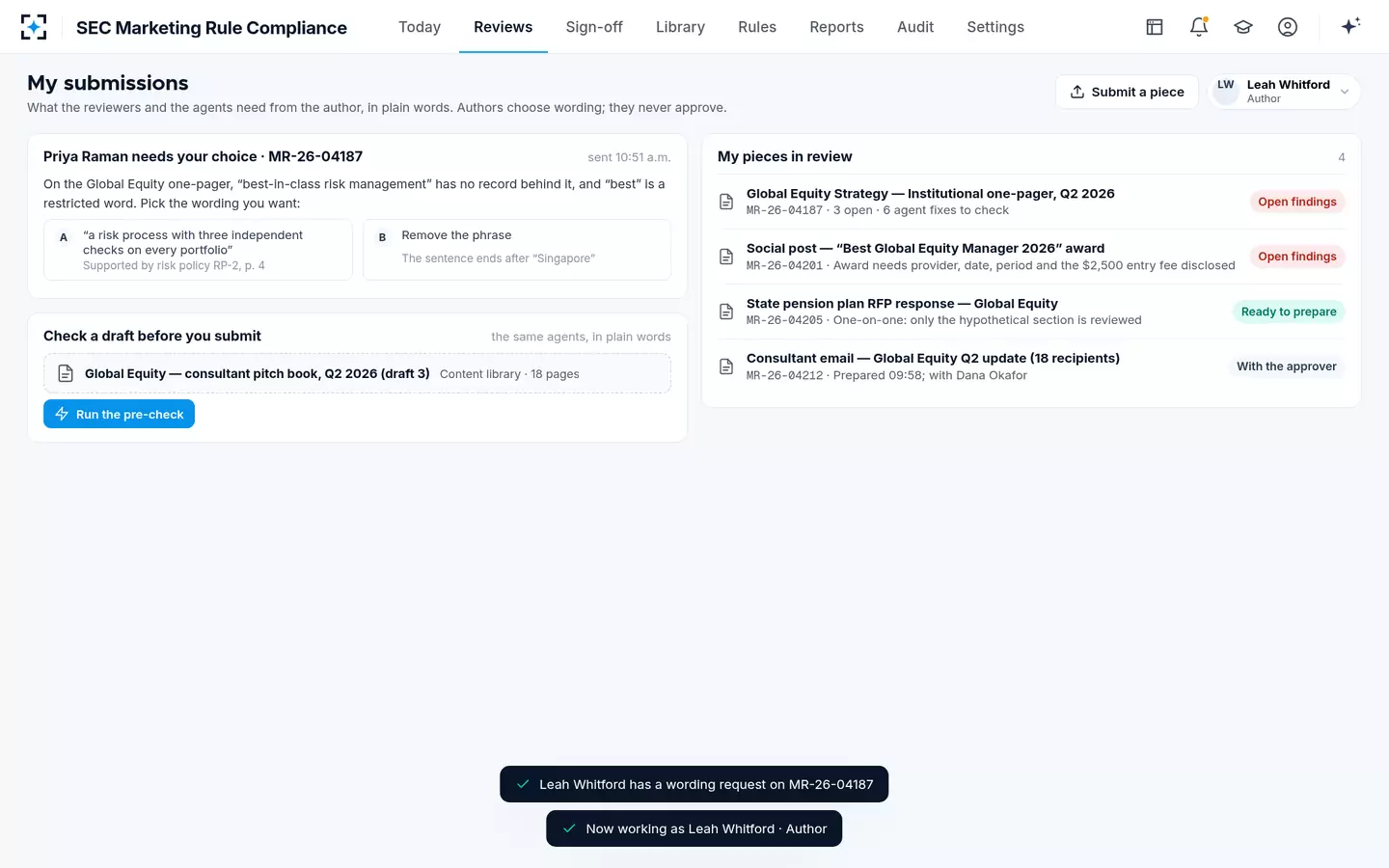
Take a sample social post as it runs through the solution, from Quillfield Capital, a fictional manager: "Best Global Equity Manager 2026". The agents found four things the post needed and lacked: the provider's name, the date of the award, the period it judged, and the $2,500 entry fee the firm had paid. Each maps to a line of Rule 206(4)-1(c), and the entry fee is the one most often left out.
The award as drafted, and the award as the rule requires it
As drafted: "Best Global Equity Manager 2026"
As released: The same words, with the facts below at least as prominent as the badge
As drafted: Only "2026"
As released: The date the award was given and the period of performance or activity it judged
As drafted: A logo
As released: The provider named in text, not left to a logo a reader may not recognise
As drafted: Not mentioned
As released: That the firm paid a $2,500 entry fee to be considered
As drafted: Not considered
As released: A file note of the provider's published method or written representations, showing the questions were balanced and the result not predetermined
What disclosures do third-party ratings need?
Three, each "clearly and prominently": the date the rating was given and the period it was based on; the identity of the third party that created and tabulated it; and, if applicable, that the adviser paid compensation, directly or indirectly, in connection with obtaining or using it. The adviser may rely on the rating itself to carry them if it reasonably believes the rating does so clearly and prominently.
"Clearly and prominently" has a specific meaning. The release said that "the disclosure must be at least as prominent as the third-party rating", and that hyperlinked disclosures would not meet the standard; the disclosure belongs in the advertisement. In December 2025 examiners listed exactly these failures: hyperlinks for disclosures, smaller fonts, disclosures placed at the bottom of a web page away from the rating, and logos that did not identify who created the rating (SEC risk alert, December 2025).
Disclosure does not cure a misleading rating. The release gave the example of an advertisement that cites a recent, dated rating based on "an aspect of the adviser's business that has since materially changed", which would still mislead, and noted that an adviser may need to disclose subsequent, less favourable results in the same rating.
How old can a rating be in an advertisement?
The rule sets no maximum age. It requires the date and period to be disclosed, and the release explained why: "Ratings from an earlier date, or that are based on information from an earlier period, may not reflect the current state of an investment adviser's business," and "An advertisement that includes an older rating would be misleading without clear and prominent disclosure of the rating's date."
The SEC enforced that in September 2024 against four advisers whose advertisements showed ratings "some of which were more than five years old" with no dates. Examiners in December 2025 described a variant: ratings listed by a range of years, including a year in which the adviser had not won. Age, in other words, is a disclosure problem until it becomes a misleading-impression problem, and a firm's own policy is the place to set a limit.
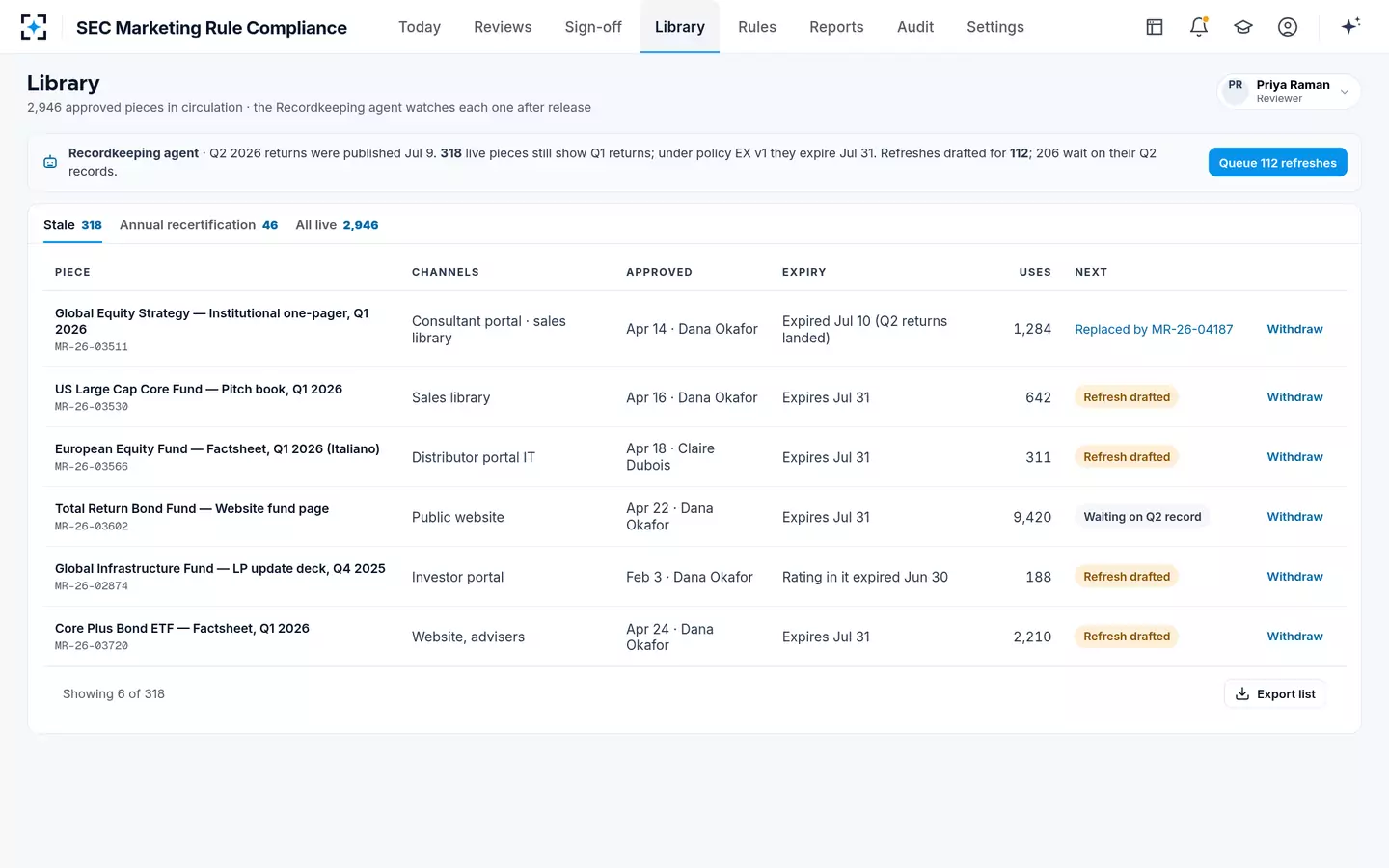
The practical answer is an expiry date. A rating does not change, but the advertisement around it lives on, and the longer it lives the more likely the rating no longer reflects the firm. In the sample library, one live investor deck carries the note "Rating in it expired Jun 30", with a refresh drafted.
A rating that has expired takes the piece around it out of date
Do you have to disclose paying for an award?
Yes, if the adviser paid "directly or indirectly" in connection with obtaining or using the rating. The release described two common models: advisers that pay a ratings firm for the right to use a rating or ranking in their advertising, and advisers that pay to be included in the initial pool from which the rating is drawn. Both are compensation that must be disclosed.
The December 2025 risk alert widened the list in practice. Examiners found undisclosed payments for the use of a provider's logos or reprints, for priority placement or enhanced exposure in the provider's own advertisements, for referrals through links on the provider's site, and fees paid simply to be considered. A firm's rating file should therefore record every payment to a rating provider in the past cycle, not just the invoice labelled "award".
What due diligence does a third-party rating need?
The adviser needs a reasonable basis to believe that any questionnaire or survey behind the rating was "structured to make it equally easy for a participant to provide favorable and unfavorable responses" and "not designed or prepared to produce any predetermined result" (Rule 206(4)-1(c)(1)). The release accepted that rating firms may not share proprietary methods, and named two alternatives to obtaining the questionnaire: written representations from the provider about how the survey is designed, structured and administered, or the provider's own public description of its method.
What it did not accept is relying on the rating alone. In December 2025 examiners described advisers with neither policies for this condition nor any step taken to meet it. Where an adviser does obtain the questionnaire, the books-and-records rule requires a copy to be kept (Rule 204-2(a)(11)(ii)), and the April 2024 alert found advisers that completed such questionnaires and kept no copy.
The rating file: what to hold for every rating before it appears in an advertisement
- The rating itself, with the date given and the period judged
Taken from the provider, not from the firm's own press release.
- The provider's identity and its relationship to the firm
Confirm it is not a related person and that it rates in the ordinary course of business.
- The basis for the survey due diligence
The questionnaire if obtained, kept under Rule 204-2(a)(11)(ii); otherwise the provider's published method or written representations.
- Every payment to the provider in the cycle
Entry and nomination fees, logo and reprint licences, placement and referral fees, subscriptions.
- What the rating actually measures
If it rests on assets, client numbers or staff nominations, say so, or do not use it.
- The approved disclosure text, and where it sits
At least as prominent as the rating, within the advertisement, never only behind a link.
- An expiry date
Set by firm policy, after which every live piece carrying the rating is reviewed or withdrawn.
Testimonials and endorsements beside the ranking
Ratings rarely travel alone. A pitch book with a ranking often carries a client quotation, and a website with an award often links to review sites. Those are testimonials and endorsements, with their own conditions: clear and prominent disclosure of whether the person is a client, whether they were paid and any material conflict, a written agreement with any promoter paid more than $1,000 in twelve months, and no payments to disqualified persons. The SEC charged Wahed Invest in November 2024 over paid endorsements by professional athletes that "lacked required disclosures" (SEC, Wahed order summary).
The December 2025 alert found that the most common testimonial failure was the same as for ratings: disclosures missing at the time of use. It also described clients paid in gift cards to write reviews on third-party sites, and "de minimis" programmes whose individual payments were each under $1,000 but whose twelve-month total was not. The SEC Marketing Rule checklist sets these out with the performance conditions.
How SEC Marketing Rule Compliance checks a rating
The Claim Finder agent marks every rating, ranking, award, logo and testimonial on every page. The Substantiation agent matches each rating to its row in the consultant database, with its date, period, provider and fee, and each testimonial to its consent in the CRM, with compensation and conflicts. The Disclosure agent proposes the approved disclosure text from the firm's library at the required prominence. The author sees what is missing in plain words; the reviewer accepts or rejects each finding; an approver signs.
The author sees exactly what the award post needs
After release, the Recordkeeping agent watches each rating's expiry and flags every live piece that carries it. The solution does not decide whether an award is worth showing or whether a provider's method is sound enough; those are the compliance officer's calls. It makes sure the file exists, the disclosures are there, and the rating does not outlive its relevance unnoticed. See the full review at SEC Marketing Rule Compliance.
Questions people ask
Does the SEC Marketing Rule require ratings to be recent?
No maximum age is set. The rule requires the date given and the period covered to be disclosed clearly and prominently, and the SEC said an older rating without its date would be misleading. A rating based on an aspect of the business that has since materially changed can mislead even with its date.
Can a rating's disclosures sit in a footnote or behind a link?
Not behind a link. The SEC said hyperlinked disclosures do not meet the clear and prominent standard, and that the disclosure must be at least as prominent as the rating. A footnote in much smaller type at the bottom of a page was among the failures examiners reported in December 2025.
Is a fund's star rating or peer ranking a third-party rating?
The rule's definition covers ratings and rankings of an investment adviser. A rating of a fund's or strategy's performance can also raise the performance conditions, such as the time periods and net of fees, and the general prohibitions apply to both. Many firms apply the rating disclosures to peer rankings too; in the sample piece, a ranking of a strategy as third of 214 shows its provider, date, five-year period and the fee arrangement.
What records must an adviser keep for a third-party rating?
A copy of every advertisement as disseminated, and a copy of any questionnaire or survey used to prepare a rating it includes if the adviser obtains one, under Rule 204-2(a)(11). Each is kept for five years after the fiscal year of the advertisement's last use, the first two on the adviser's premises.
Do broker-dealers have the same rating rules?
Not in the same form. FINRA applies its own content standards to rankings in broker-dealer communications, and investment company retail pieces with rankings in categories the fund group creates must be filed with FINRA ten business days before use. A fund factsheet distributed by an affiliated broker-dealer has to meet both sets.