Under the SEC Marketing Rule, hypothetical performance means "performance results that were not actually achieved by any portfolio of the investment adviser", including model portfolio results, backtests and targeted or projected returns (Rule 206(4)-1(e)(8)). An adviser may advertise it only if it adopts and implements policies reasonably designed to make it relevant to the likely financial situation and investment objectives of the intended audience, and explains both the criteria and assumptions behind it and its risks and limitations. Hypothetical figures are the Marketing Rule's most enforced problem because they are the easiest numbers to make look good. Botminds' SEC Marketing Rule Compliance marks every hypothetical figure in a factsheet, pitch book or web page, tests it against the firm's own policy for the piece's audience, and blocks it where the policy does not allow it.
The rule does not treat hypothetical results as false. It treats them as a different kind of number, one with no investor and often no money behind it, and asks who should see it. That is the fence: not a ban, but a boundary drawn around the audience, the disclosure and the record.
Published predictors lose a quarter of their return out of sample and over half after publication
What is hypothetical performance under the SEC Marketing Rule?
Hypothetical performance is any performance result that no portfolio of the adviser actually achieved. The definition is deliberately wide: the three named examples, model portfolios, backtests and targeted or projected returns, are introduced with "includes, but is not limited to". What it leaves out is as useful to a reviewer as what it covers.
What counts as hypothetical performance, and what does not
| Presentation | Hypothetical? | Why |
|---|---|---|
| Model portfolio results | Yes | Named in (e)(8)(i)(A): the model was not a portfolio anyone held |
| Backtest of a strategy over years it was not run | Yes | Named in (e)(8)(i)(B): a strategy applied to data from periods when it was not actually used |
| Targeted or projected return | Yes | Named in (e)(8)(i)(C), for a portfolio or for the services offered |
| Annualising a few weeks of live results | In substance, yes | The SEC's first Marketing Rule case turned on "annualized" returns built from a short live period |
| Seed capital or proprietary portfolio results | No | Actually achieved by a portfolio of the adviser; the release warns against nominal amounts invested to avoid the label |
| Interactive analysis tool a client runs | No, if conditions are met | Excluded by (e)(8)(ii)(A) with disclosure of method, limits and that results vary |
| Predecessor performance shown under (d)(7) | No | Real results at another firm, subject to their own conditions |
Is model portfolio performance hypothetical?
Yes. Performance derived from model portfolios is the first example the definition names, because the model is not a portfolio that earned the results. Where real accounts are managed to the model, their composite is actual performance; the model's own line is not. A factsheet that shows both side by side should label which is which, and the model's line carries every hypothetical condition.
Why backtests flatter: the evidence on hindsight
A backtest flatters because it is built after the fact, by someone who knows how the period ended. The SEC gave that as its reason for the rule: hypothetical presentations "pose a high risk of misleading investors since, in many cases, they may be readily optimized through hindsight", and such performance "does not reflect actual losses or other real-world consequences if an adviser makes a bad investment or takes on excessive risk" (Release IA-5653).
The size of the effect has been measured. R. David McLean and Jeffrey Pontiff studied 97 variables that academic papers had shown to predict stock returns. Portfolios built on them earned 26% less out of sample than in the original studies, and 58% less after the papers were published (The Journal of Finance, 2016). These were peer-reviewed results with published methods. A strategy backtest written by the same team that will sell it has fewer checks, not more.
For a reviewer the implication is practical. A backtest is not wrong because it is a backtest; it is incomplete without the information that lets the reader discount it: when the strategy was designed, what was changed after seeing the data, what fees and trading costs were assumed, and how the live record, if any, compares.
Under the Marketing Rule, hypothetical performance may be used only when three conditions are met
Rule 206(4)-1(d)(6) sets three conditions, and all three must hold. In exchange, the rule relieves hypothetical performance of three other performance conditions: the one-, five- and ten-year periods in (d)(2), the related-portfolio test in (d)(4) and the extracted-performance test in (d)(5).
The three conditions on hypothetical performance, and what each needs in practice
- Policies that tie it to the audience
Written policies and procedures, adopted and implemented, reasonably designed to make the hypothetical performance relevant to the likely financial situation and investment objectives of the intended audience. In practice: named investor types, how you know a recipient is one, and how distribution is limited to them.
- The criteria and assumptions, explained
Enough for the audience to understand how the figure was calculated: the strategy rules, the period, the data, the fee and cost assumptions, and what was changed after the fact.
- The risks and limitations, explained
Enough to understand the limits of using the figure in an investment decision. For private fund investors this may be offered rather than provided, as long as it is provided promptly on request.
- And still: net beside gross
The net-of-fees condition in (d)(1) applies to hypothetical results too. In December 2024 the SEC charged an adviser for gross hypothetical performance shown without net.
- And still: the general prohibitions
A backtest that meets all three conditions can still be unfair or misleading under (a)(6) or (a)(7).
The first condition is the one that does the fencing. The adopting release gave examples of how an adviser might draw the line: by past experience with types of investors who ask for such information, or by categories such as qualified clients or qualified purchasers, or institutions only. It added that the policies should address "how the adviser's dissemination of the advertisement would seek to be limited to that audience".
Can hypothetical performance go on a website?
Rarely, and the enforcement record shows why. The adopting release was blunt: "We believe that advisers generally would not be able to include hypothetical performance in advertisements directed to a mass audience or intended for general circulation." A public web page is the plainest case of general circulation, because the adviser cannot form any expectation about who will read it.
"As discussed above, hypothetical performance directed to mass audiences generally will not be able to meet this standard."
SEC, Investment Adviser Marketing, Release IA-5653 (December 2020)
That sentence became the SEC's most repeated Marketing Rule charge. In September 2023 nine advisers paid $850,000 between them "for advertising hypothetical performance to the general public on their websites without adopting and/or implementing" the required policies (SEC press release 2023-173). Five more followed in April 2024, and The Pacific Financial Group in August 2024 with a $430,000 penalty. The full list is in SEC Marketing Rule enforcement actions.
Hypothetical performance is where the SEC has charged most
18of 30
advisers charged under the Marketing Rule, 2023 to 2025, were charged over hypothetical performance
2,700%
"annualized" return the first Marketing Rule case objected to, built from a short live period
$430k
penalty on one adviser for hypothetical performance on its public website (August 2024)
A password-protected area changes the facts only if the policy behind it is real: who is admitted, on what basis, and whether that basis matches the investor types the policy names. An institutional log-in that any visitor can request is still general circulation.
Hypothetical performance disclosure: what a reader needs to discount the number
The rule asks for "sufficient information" rather than a template, so the test is whether the intended audience could reconstruct, roughly, how the number was made and how much to trust it. A reviewer can check six things.
First, the label: the word hypothetical, or backtested, or model, beside the figure, not only in a footnote. Second, the period and its relation to the strategy's real start. Third, the rules applied and whether any were changed after seeing results. Fourth, the fee: the SEC's staff FAQ, quoting the adopting release, says that where the intended audience is expected to pay more than the actual fees, the net figure has to use a model fee at the level that audience would be charged. Fifth, trading costs and capacity. Sixth, the live record, if there is one, beside the backtest.
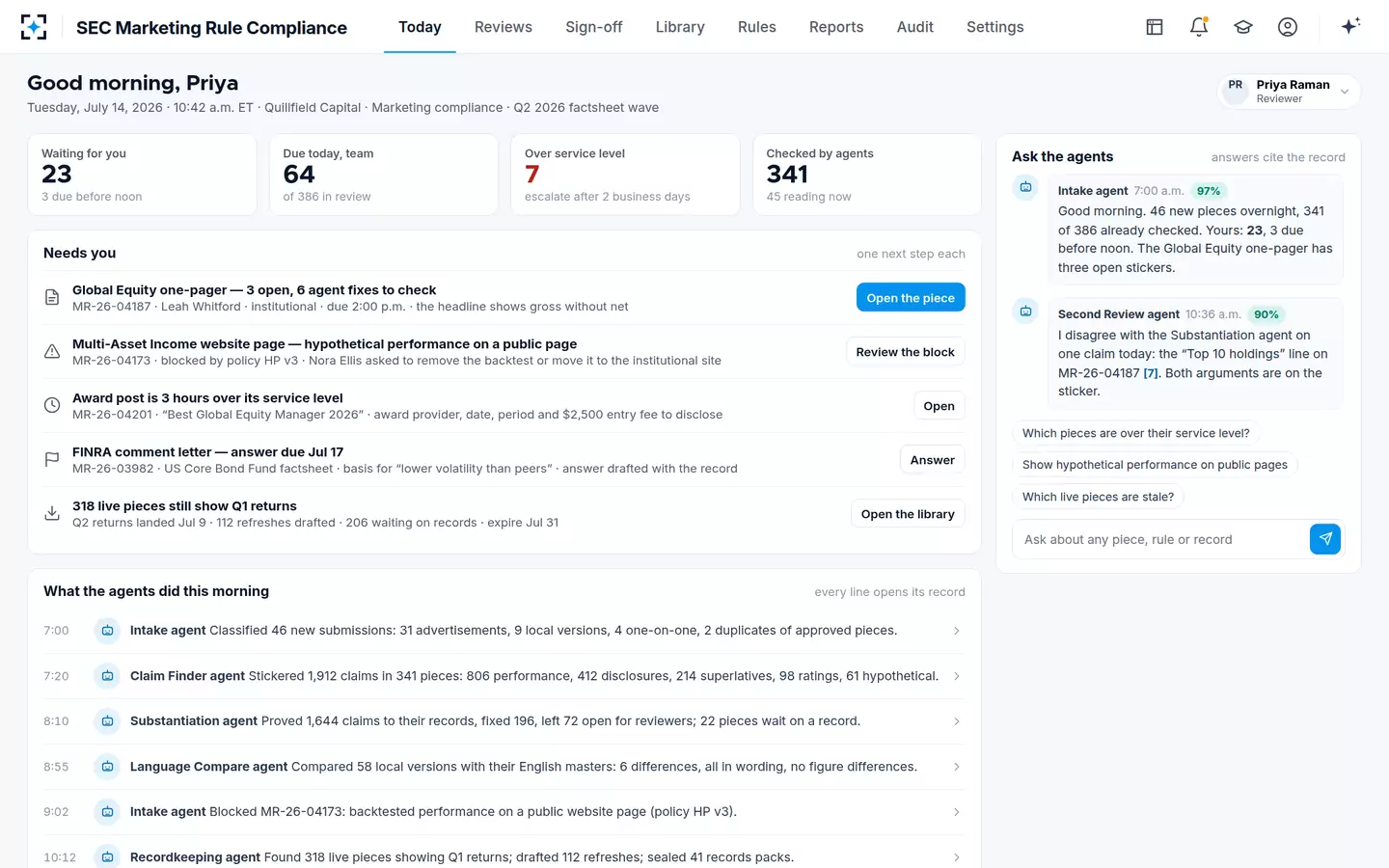
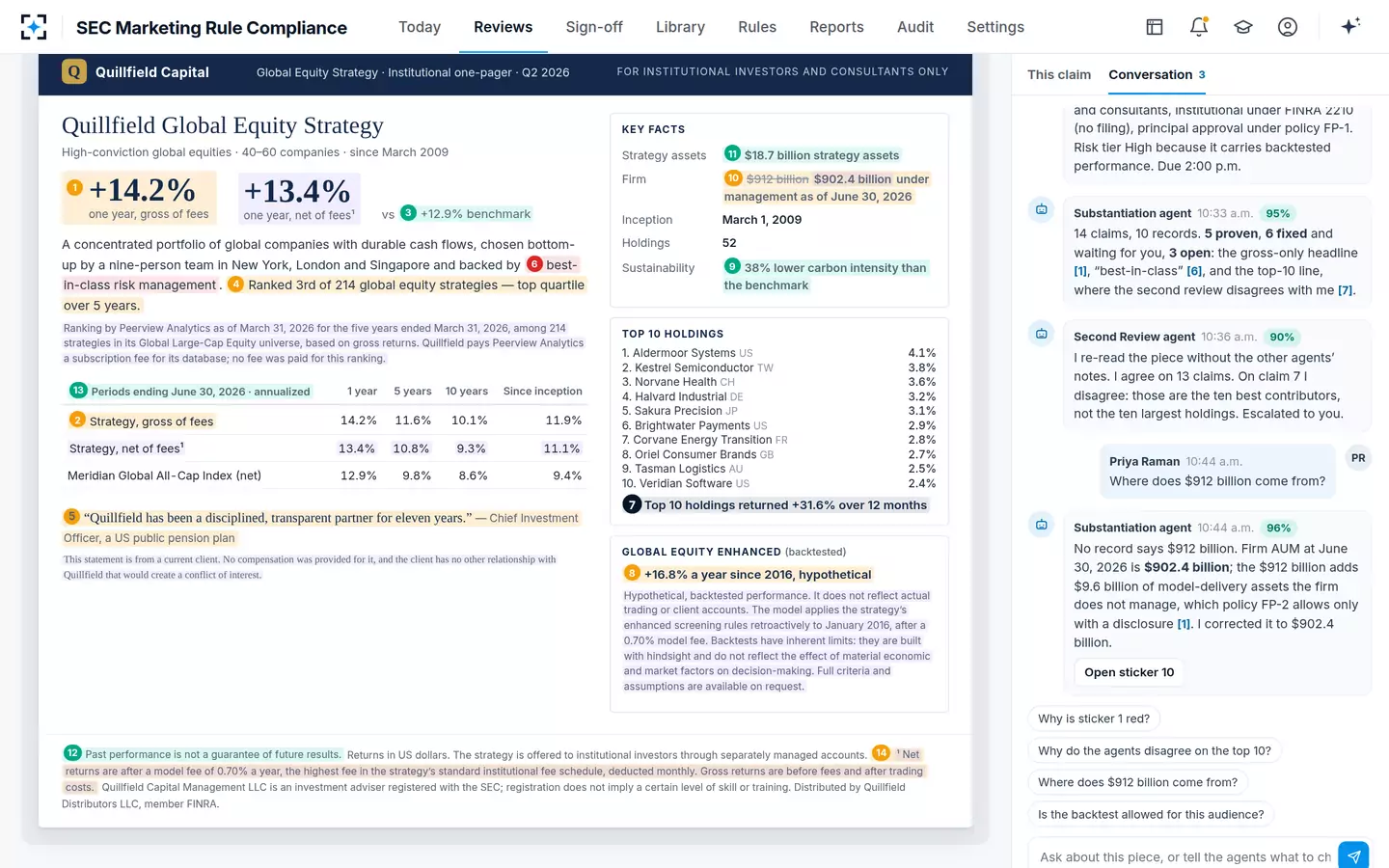
Take a sample institutional one-pager as it runs through the solution, from Quillfield Capital, a fictional manager. Its "Global Equity Enhanced" box showed "+16.8% a year since 2016, hypothetical", with a note that the model applied the strategy's enhanced screening rules retroactively to January 2016, after a 0.70% model fee, and that backtests are built with hindsight and do not reflect the effect of material economic and market factors on decision-making. Its audience was institutional consultants and prospects, which the firm's hypothetical-performance policy allows. The same firm's Multi-Asset Income website page, carrying a backtest, was blocked before release.
A backtest on a public page is blocked before anyone reads the rest
The exclusions: one-on-one, unsolicited, and private funds
Hypothetical performance can make even a single-recipient communication an advertisement. Under the definition of advertisement, a communication to "one or more persons" counts if it includes hypothetical performance, unless it is provided in response to an unsolicited request from a client or private fund investor, or to a private fund investor in a one-on-one communication (Rule 206(4)-1(e)(1)).
Those exclusions are narrower than they look. On our reading, an RFP is a request from the investor, so performance it asks for can sit within the unsolicited-request exclusion, while a backtest the adviser adds on its own initiative was not requested. In the sample firm's intake, a one-on-one RFP response to a state pension plan was classified as not an advertisement, with its hypothetical section still reviewed. That is a cautious approach, and a defensible one: the Advisers Act's anti-fraud provisions apply whether or not a piece is an advertisement.
Records: what to keep behind a hypothetical figure
The books-and-records rule requires the adviser to keep the records needed to show how any advertised performance was calculated, and it expressly includes copies of all information provided or offered under the hypothetical-performance conditions (Rule 204-2(a)(16)). The five-year clock starts when the fiscal year of the advertisement's last use closes. For a backtest, that means the data, the code or spreadsheet, the strategy rules as applied, the fee assumption, the disclosure as shown, and the policy decision that cleared the audience.
The last item is the one most often missing. The SEC's charges were not that backtests were wrong, but that the policies tying them to an audience did not exist or were not followed. A record that shows who decided the audience fit, against which version of the policy, is the evidence that the first condition was met.
How SEC Marketing Rule Compliance fences hypothetical performance
The solution treats every hypothetical figure as a separate claim with its own checks. The Intake agent records the piece's intended audience and channels and marks any piece with hypothetical performance as high risk. The Claim Finder agent marks each model, backtested, targeted or annualised figure. The firm's hypothetical-performance policy is a versioned setting: the agents apply it to the audience and channel, and either the piece passes with the firm's approved hypothetical disclosure inserted from its library, or it is blocked with the reason shown. The reviewer can ask the agents why, in plain words.
Ask the agents whether the backtest is allowed for this audience
Where it stops is the decision the rule leaves to the firm. The solution does not decide which investor types hypothetical performance suits; the chief compliance officer approves that policy, and changes to it are proposed, approved and versioned. For broker-dealer pieces, where the rules differ again, see the 2026 FINRA Rule 2210 changes, and for the whole review, SEC Marketing Rule Compliance.
Questions people ask
Does hypothetical performance need the one-, five- and ten-year periods?
No. Rule 206(4)-1(d)(6) says an adviser that meets the hypothetical-performance conditions need not comply with the time-period condition in (d)(2), or with the related- and extracted-performance conditions. The general prohibitions still apply, so a period chosen to flatter can be unfair under (a)(6).
Must hypothetical performance be shown net of fees?
Yes, if gross is shown. The net-of-fees condition in (d)(1) covers any presentation of gross performance, and in December 2024 the SEC charged Atlas Financial Advisors for showing gross hypothetical performance without net. Where actual fees are lower than the intended audience would pay, SEC staff say a model fee reflecting the anticipated fee must be used.
Are target returns in a private fund pitch book hypothetical performance?
Yes. Targeted or projected returns are named in the definition. A pitch book sent to more than one prospective investor is an advertisement and needs the three conditions; the rule eases only the risks-and-limitations condition for private fund investors, who may be offered that information promptly rather than given it up front.
Is backtested performance ever allowed in a retail advertisement?
The rule does not forbid it, but the adopting release said hypothetical performance aimed at a mass audience generally cannot meet the audience condition. An adviser would need policies showing why the performance is relevant to a defined retail audience and how distribution is limited to it, which is hard to do for broad retail channels.
Do investment analysis tools count as hypothetical performance?
Not if the adviser meets the rule's conditions for an interactive tool that a client or prospect uses to produce simulations: describing the criteria, method, limitations and key assumptions, explaining that results vary, describing the investment universe and any bias, and disclosing that the outcomes are hypothetical.