The investment adviser is primarily responsible for establishing Marketing Rule policies and procedures. The SEC's compliance rule makes it unlawful for a registered adviser to give advice unless it adopts and implements written policies and procedures reasonably designed to prevent breaches of the Act and the SEC's rules under it, the Marketing Rule among them, reviews them at least annually, and designates a chief compliance officer to administer them (Rule 206(4)-7). In practice the chief compliance officer writes and runs the marketing policies, and the firm adopts them and answers for them. What the SEC rule does not require is anyone's signature on each advertisement; FINRA's rule does, for a broker-dealer's retail communications. For a firm with both, that difference decides who signs a factsheet. Botminds' SEC Marketing Rule Compliance records the author, the reviewer who prepares the review and the approver who signs, as three different people, on every piece.
One factsheet, from draft to release: who does what
A person decides
AuthorDrafts the piece and chooses the wording when a claim needs a change.
Never: approving their own piece
Agent
Intake and claim agentsClassify the piece under both rules, mark every claim and fetch the record behind it.
Never: deciding a borderline claim
A person decides
Marketing compliance reviewerDecides each finding with a reason and prepares the review, attesting to what was checked.
A person decides
Registered principal or approverApproves a FINRA retail communication before use or filing; approves under firm policy elsewhere.
Never: the author or the preparer
Agent
Recordkeeping agentKeeps the piece as approved with its records, both names and the dates.
Never: releasing a piece without both names
Who is primarily responsible for establishing Marketing Rule policies and procedures?
The firm is, through its chief compliance officer. Rule 206(4)-7 puts the obligation on "you", the registered adviser: adopt and implement the policies, review them annually, and designate an individual who is a supervised person to administer them. The Marketing Rule adds no separate policy requirement of its own except for hypothetical performance, where policies on the intended audience are a condition of use. Everything else in the marketing programme lives under the compliance rule.
The SEC said so when it adopted the Marketing Rule: "Advisers should address their marketing practices in their policies and procedures under the compliance rule" (Release IA-5653). The same release set the standard those policies must meet: they should be objective and testable, reasonably designed to prevent violations in the advertisements the adviser actually disseminates. A policy that restates the rule does not meet it. Examiners in April 2024 reported policies that "Consisted only of general descriptions and expectations related to the Marketing Rule", and others that ignored websites and social media or were never written down at all (SEC risk alert, April 2024).
Does the SEC Marketing Rule require pre-approval of advertisements?
No. The SEC proposed an internal review and approval requirement in 2019 and dropped it. After comments that pre-approval of nearly every communication would slow advisers down and force them to screen everything, the Commission said: "After considering these comments, we are not adopting the proposed internal review and approval requirement."
"We did not adopt the proposed pre-review and approval requirement; nevertheless, we appreciate commenters' concerns. Accordingly, the compliance date will be eighteen months following the effective date of the rules."
SEC, Investment Adviser Marketing, Release IA-5653 (December 2020), on the compliance date
The release then listed tools a firm might use instead or as well: internal pre-review and approval as "an effective component" of a compliance programme, reviews of a risk-based sample, approved templates, spot checks and periodic reviews. Most firms chose pre-approval anyway. The April 2024 risk alert found that advisers which updated their marketing policies typically set up a review process, and "Many of these advisers also required preapproval of advertisements before dissemination."
The choice has a consequence. A firm that writes pre-approval into its policy has made it a requirement for itself, and an examiner will test whether it happened. The same risk alert found advisers whose policies required net-of-fee performance with every performance advertisement and whose advertisements did not show it.
Who approves retail communications under FINRA 2210?
An appropriately qualified registered principal. Rule 2210(b)(1)(A) requires one to approve each retail communication "before the earlier of its use or filing with FINRA's Advertising Regulation Department" (FINRA Rule 2210), with a narrow exception for a piece another member has already filed and FINRA has cleared, used unchanged. The firm's records must show "the name of any registered principal who approved the communication and the date that approval was given".
The other classes are reviewed differently. Correspondence, to 25 or fewer retail investors in 30 days, falls under the supervision and review procedures of FINRA Rule 3110, where a principal's review must be evidenced in writing and merely opening a message does not count (FINRA Rule 3110); what that evidence looks like is set out in the FINRA rule on email review. Institutional communications need written procedures for principal review, which may sample rather than pre-approve if they include training and surveillance. FINRA's Regulatory Notice 26-14 proposed in July 2026 to replace blanket pre-use approval of retail communications with risk-based supervision; it is a proposal, covered in the 2026 FINRA Rule 2210 changes.
What is the difference between a retail communication and correspondence?
The count of retail investors. A written communication distributed or made available to more than 25 retail investors within any 30 calendar-day period is a retail communication; to 25 or fewer, it is correspondence. The SEC rule draws a different line, at more than one person, which is why the same email can be an adviser advertisement and broker-dealer correspondence at once.
Two rule books, one factsheet: the responsibility map
For an adviser alone, or a broker-dealer alone, the chain is short. For a dual registrant, or an adviser whose funds are sold by an affiliated broker-dealer, each piece answers to both, and the duties do not line up.
Who is responsible for what, under each rule
| Duty | Adviser (SEC rule) | Broker-dealer (FINRA) | Dual registrant or affiliate |
|---|---|---|---|
| Written policies | Required under Rule 206(4)-7; administered by the chief compliance officer | Written supervisory procedures under Rules 2210 and 3110 | Both sets, mapped to each other so one review satisfies both |
| Approval of each piece | Not required by the rule; required if the firm's policy says so | Registered principal, before use or filing, for retail communications | The principal's approval, with the adviser's policy checks recorded beside it |
| Filing with the regulator | None | Investment company and certain other retail pieces, before or within 10 business days of first use | Filing clock starts from the broker-dealer's first use |
| Records | Advertisements and performance records, five years from the end of the fiscal year of last use | Communications and approvals, three years; plus the Rule 2210 record of use dates and approver | Keep the longer period, in one file |
| Annual review | At least annually, including whether marketing policies kept up with rule changes | Supervisory control testing under FINRA Rule 3120, reported to senior management at least annually | One review that tests both against the pieces actually used |
The records row is where firms most often fall between two stools. Advertisement records under Rule 204-2 run for five years counted from the close of the fiscal year in which the piece was last used, two of them in an office of the adviser (Rule 204-2(e)(3)). A broker-dealer keeps its communications and their approvals for at least three years, the first two easily accessible (Rule 17a-4(b)(4)). A file kept to the broker-dealer's clock is not enough for the adviser's.
What is the CCO's role in reviewing advertisements?
The chief compliance officer owns the policies, not every review. The rule designates the CCO to administer the compliance programme; it does not require the CCO to read each advertisement. In most firms with a marketing compliance team, reviewers apply the policies piece by piece, principals or other approvers sign, and the CCO decides the policy questions: which investor types may see hypothetical performance, which words are restricted, how long a rating may be shown, what the review samples.
Four seats around one advertisement
Today
Builds the piece, waits days for comments and learns the rules from them.
With agents
Sees each finding in plain words, chooses the wording, and can pre-check a draft before submitting.
Still theirs: The words
Today
Reads every page with a highlighter and chases the record behind each number.
With agents
Opens a piece with every claim already matched to its record, and decides the open findings with a reason.
Still theirs: Each decision, and the attestation that the review is complete
Today
Signs a PDF without seeing who checked what, and why.
With agents
Approves a prepared review with every decision, its reason and the evidence on one screen.
Still theirs: The approval
Today
Assembles the ad, the proof and the approvals from several systems when the SEC asks.
With agents
Exports one record for a piece, a period or an exam request, and approves every policy and agent change.
Still theirs: The policies, and the annual review
Marketing rule books and records requirements, in one list
The Marketing Rule's records sit in Rule 204-2 rather than in the rule itself. An adviser must keep a copy of every advertisement it disseminates, with a memorandum of the reasons for any specific recommendation that does not state them; a copy of any questionnaire or survey behind a third-party rating, if it obtained one; for testimonials and endorsements, a record of the required disclosures where they were not in the advertisement and the basis for believing the testimonial complied; and all the accounts, working papers and other records needed to show how any advertised performance was calculated, including the information given under the hypothetical-performance conditions (Rule 204-2(a)(11), (a)(15) and (a)(16)).
The cases show what happens when the list is not kept. Two of the nine advisers in the SEC's September 2023 sweep failed to keep copies of their advertisements, and in September 2025 the SEC found that Meridian Financial "failed to maintain copies of all of its advertisements, including advertisements that appeared on its website" (SEC, Meridian order summary). A website is an advertisement that changes; keeping it means keeping each version.
The annual review has to catch the Marketing Rule
The annual review under Rule 206(4)-7(b) is where the CCO's ownership is tested. In a risk alert of 14 September 2026, the SEC's examiners listed annual reviews that missed changes in the rules, including marketing policies never updated for the amended Marketing Rule itself, almost four years after its compliance date (SEC risk alert on annual compliance reviews, September 2026). The same alert criticised reviews that were late, undocumented or never followed up.
For marketing, a useful annual review compares the written policies with a sample of what was actually published: did every performance piece show net beside gross, did every rating carry its date, was every hypothetical figure cleared for its audience, was every approval recorded? The SEC Marketing Rule checklist, and how to test the reviewer, turns that comparison into a repeatable test.
How SEC Marketing Rule Compliance keeps the signatures straight
The solution writes the responsibility map into the workflow. Intake records the rules that apply and whether FINRA approval or filing is needed. The reviewer prepares the review, attesting to what was checked; the approver sees every decision and its reason before signing. A duties check confirms that author, preparer and approver are three different people and that no agent approved anything, and nothing is released without both names.
Three different people, and agents never approve
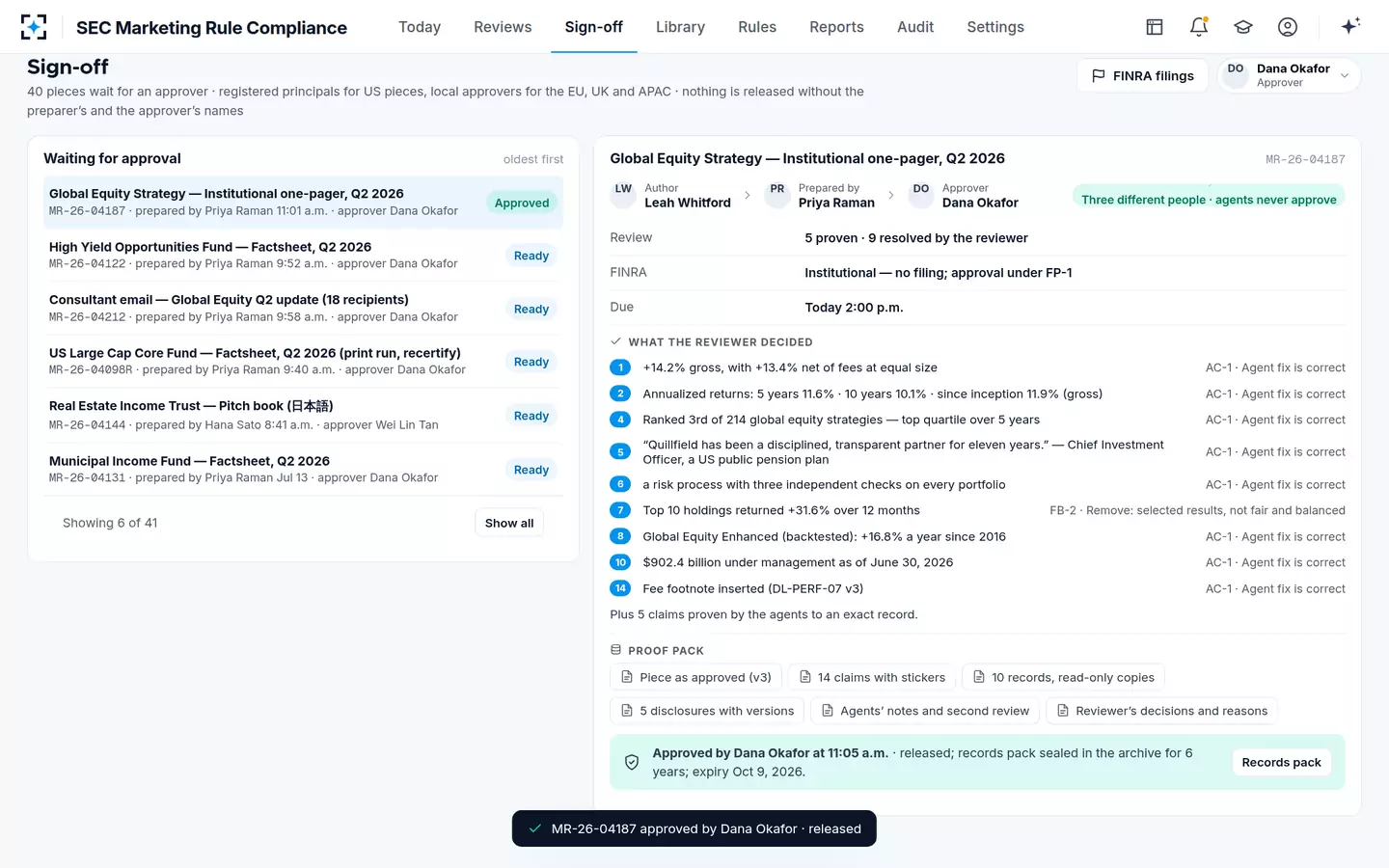
The chief compliance officer's ownership is built in the same way. Policies, restricted words, disclosure texts, service levels and the agents' own thresholds are settings that one person proposes and the CCO approves, each change versioned with the pieces it affects listed first.
The CCO approves every agent and policy change
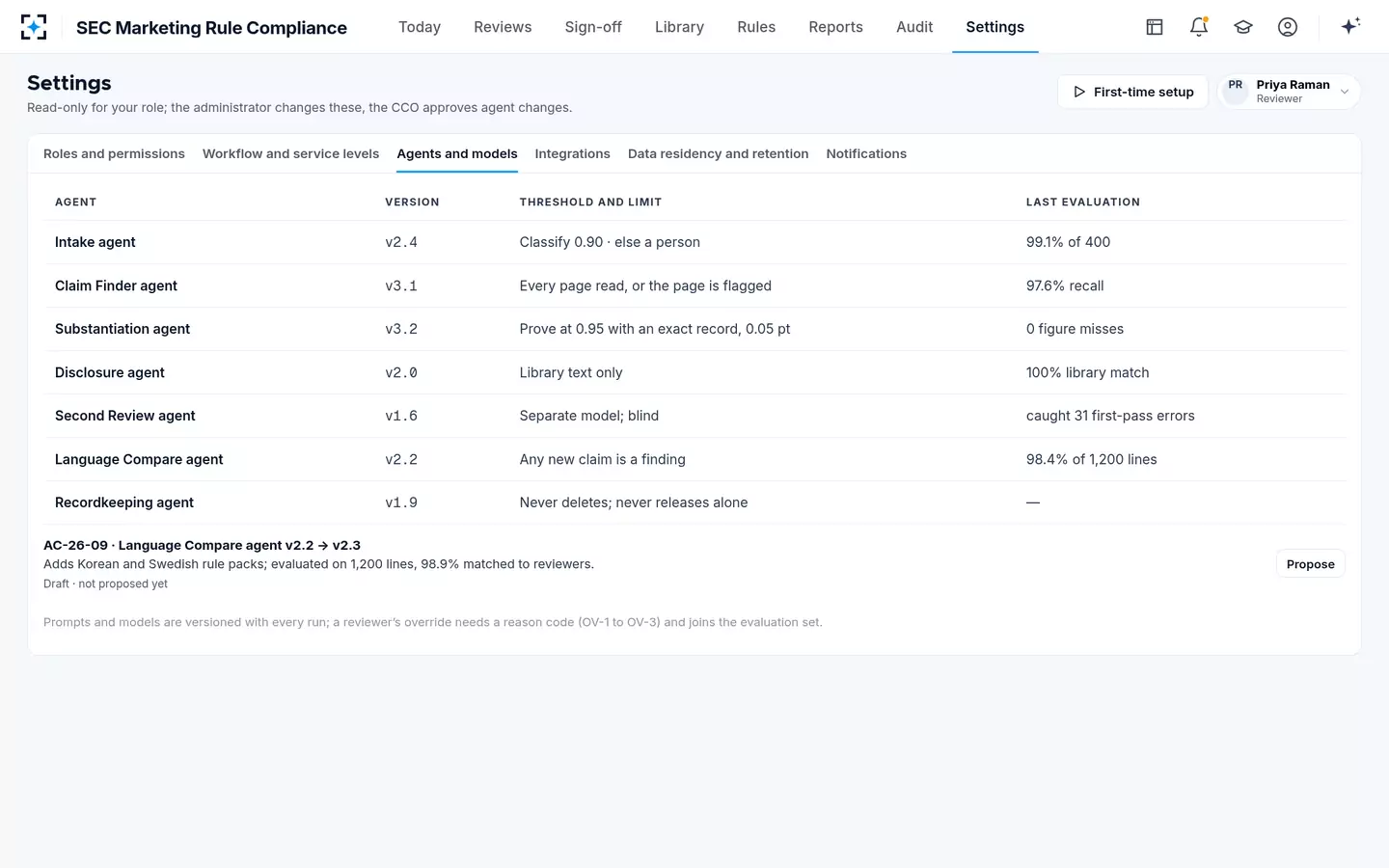
What the solution does not do is take responsibility from anyone. It cannot be the CCO, it does not approve, and it does not decide what the policy should say. It makes each person's part visible and recorded. See the full review at SEC Marketing Rule Compliance.
Questions people ask
Can the chief compliance officer also be the approver of advertisements?
Nothing in the SEC rule forbids it, and at a small adviser the CCO often is the reviewer and approver. The risk is that one person both writes the policy and decides every exception to it. Many firms separate the reviewer who prepares the review from the person who approves, and keep the author out of both.
Does a registered principal have to approve investment adviser advertisements?
Not under the SEC Marketing Rule, which has no approval requirement. A registered principal's approval is a FINRA requirement for a broker-dealer's retail communications. Where an adviser's piece is also distributed by a broker-dealer as a retail communication, the principal's approval applies to it in that capacity.
How long must advertisements be kept?
An adviser keeps each advertisement, and the records behind its performance, for at least five years after the fiscal year in which the piece last went out, two of those years in the adviser's office. A broker-dealer keeps communications and their approvals for at least three years, the first two in an easily accessible place.
Should Marketing Rule policies name restricted words?
The rule bans no words, but a list of restricted terms, such as "best", "guaranteed" or "conflict-free", is a common way to make the substantiation and fair-and-balanced tests objective. The SEC's examiners have charged firms over conflict-free claims they could not substantiate, which is an argument for listing that phrase at least.
Who answers when the SEC asks for an advertisement's file?
The firm, usually through its chief compliance officer. The request typically covers the advertisement as used, the records behind its performance and claims, the disclosures and the approval. Assembling those from separate systems is where most firms lose time.