An SEC Marketing Rule checklist runs every advertisement through five sets of questions: is it an advertisement at all; does it pass the seven general prohibitions; does every performance figure meet the net-of-fees, time-period, extracted, related, hypothetical and predecessor conditions; do testimonials, endorsements and third-party ratings carry their disclosures; and is the record being kept. The checklist below sets those out with the rule paragraph and the SEC staff's current FAQ positions. But a checklist does not catch anything; a reviewer applying it does, and examiners have found firms whose written policies required checks their advertisements never received. So the second half of this guide shows how to test the reviewer, by planting known defects in past pieces and counting what comes back. Botminds' SEC Marketing Rule Compliance applies the same checklist claim by claim, and its agents are evaluated on known findings in the same way.
SEC Marketing Rule checklist, part 1: scope, general prohibitions and performance
- Is it an advertisement?
A communication to more than one person offering advisory services, or any compensated testimonial or endorsement; to one person if it includes hypothetical performance, unless an exclusion applies. Rule 206(4)-1(e)(1).
- Does every material statement of fact have a record behind it?
AUM with its date, team size, credentials, process claims, ESG claims. (a)(1) and (a)(2).
- Does every benefit carry its material risks and limitations, and every reference to specific advice its selection basis?
(a)(4) and (a)(5). Check social posts as hard as factsheets.
- Is net performance beside every gross figure?
At least equal prominence, in a format that eases comparison, over the same period, with the same type of return and method. (d)(1).
- Is the fee used for net performance allowed?
Actual fees, or a model fee that gives net figures no higher than actual fees would, or that equals the highest fee charged to the intended audience; where the audience is expected to pay more than actual fees, staff say the model fee must reflect it. (e)(10) and the FAQ of 15 January 2026.
- Are the one-, five- and ten-year periods shown, with equal prominence, ending no earlier than the latest calendar year-end?
Not required for private funds; life of the portfolio where a period is longer than its history. Staff accept interim figures at least as current while year-end returns are calculated. (d)(2).
- Is extracted performance accompanied by the total portfolio?
Provided or offered promptly. Staff accept an extract shown gross only if the total portfolio's gross and net are shown prominently and the extract is labelled. (d)(5) and the FAQ of 19 March 2025.
- Does related performance include all related portfolios?
Or exclude some only where results are not materially higher and the periods are unaffected. (d)(4).
- Is hypothetical performance cleared for this audience and explained?
Policy on intended audience, criteria and assumptions, risks and limitations. (d)(6).
- Does predecessor performance meet all four conditions?
Same people, similar accounts, all similar accounts included, and disclosure that the results come from accounts at another entity. (d)(7).
- Nothing implies the SEC approved or reviewed the performance?
(d)(3), and no SEC logo used to suggest endorsement.
The performance section: where most of the checklist's weight sits
Performance is where checklists earn their keep, because the defects are arithmetic and hide in plain sight. The net-of-fees condition is the most familiar and still the most missed: the April 2024 risk alert found advisers whose policies required net with every performance advertisement and whose advertisements showed gross only (SEC risk alert, April 2024). The interaction between the condition and attribution reports is covered in depth in the gross-and-net guide for performance attribution.
One sample morning shows why the section dominates. Take Quillfield Capital, a fictional manager, as its quarter-end factsheet wave runs through the solution: on 14 July 2026 the agents marked 1,912 claims in 341 pieces before the reviewers arrived.
Performance claims outnumber every other kind on a quarter-end morning
Marketing rule net vs gross performance: what the staff added
The rule says net must be calculated over the same period, with the same type of return and the same method as gross. The staff FAQ adds three positions that a checklist should carry. A model fee is acceptable only within the rule's two options, and where the intended audience is expected to pay more than actual fees, a model fee reflecting the anticipated fee is needed (posted 15 January 2026). Gross portfolio characteristics can appear without net if they are plainly labelled as calculated before fees and expenses and come with the total portfolio's gross and net, though the position does not cover returns such as IRR, MOIC or TVPI (posted 19 March 2025). And extracts may appear gross only on the conditions above (updated 19 March 2025) (SEC Marketing Compliance FAQ).
SEC Marketing Rule performance time periods
The one-, five- and ten-year periods must each be presented with equal prominence and end on a date no earlier than the most recent calendar year-end. The staff's April 2021 FAQ allows interim figures at least as current while year-end figures are being calculated, for a period it says generally would be no longer than a month. The periods do not apply to private fund performance or to hypothetical performance that meets its own conditions, but the general prohibitions still forbid cherry-picked windows.
SEC Marketing Rule checklist, part 2: testimonials, ratings and records
- Is every testimonial from a current client, and does it say so?
And every endorsement labelled as from a non-client, with compensation and material conflicts stated clearly and prominently inside it. (b)(1)(i).
- Are the material terms of compensation and conflicts described?
(b)(1)(ii) and (iii); state the amount or percentage where the SEC's release says to.
- Is there a written agreement with every promoter paid more than $1,000 in 12 months?
Count the 12-month total, not each payment. (b)(2)(ii) and (e)(2).
- Is any paid promoter an ineligible person?
(b)(3) and (e)(9); staff relief for some SRO orders requires disclosing the order for 10 years (FAQ, 15 January 2026).
- Does every third-party rating show its date and period, its provider, and any payment?
Clearly and prominently, at least as prominent as the rating. (c)(2).
- Is there a basis for the rating survey's due diligence?
The questionnaire, the provider's published method or its written representations. (c)(1).
- Is a copy of the advertisement as disseminated being kept, with its records?
Including website and social versions, survey copies obtained, testimonial disclosures and the performance working papers. Rule 204-2(a)(11), (a)(15), (a)(16).
- Is the approval recorded with a name and a date?
Required for broker-dealer retail communications under FINRA Rule 2210(b)(4); evidence of the firm's own policy for adviser advertisements.
What are the most common Marketing Rule deficiencies?
The SEC's examiners have published two lists. In April 2024: unsubstantiated and untrue statements, misleading inferences, missing risks, cherry-picked advice, unfair periods, policies not implemented, missing records, and Form ADV answers that said advertisements contained no ratings or hypothetical performance when they did. In December 2025, on testimonials, endorsements and ratings: disclosures missing at the time of use, disclosures hyperlinked or in smaller type, compensation terms omitted, no written agreements, de minimis claims that broke the $1,000 total, and undisclosed payments to rating providers (SEC risk alert, December 2025). The enforcement orders add hypothetical performance shown to the public, covered in SEC Marketing Rule enforcement actions.
Every item on both lists is on the checklist above. That is the uncomfortable point: firms with these deficiencies usually had a checklist too.
How do you test a marketing compliance reviewer?
Plant known defects in pieces you have already approved, run them through the review blind, and count what comes back. It is the same method auditors use on any control: a control you have never seen fail is a control you have not tested. It works on a person, a second reader, or software, and it gives the annual compliance review something concrete to report.
The design is simple. Take forty pieces from last quarter that were approved clean: factsheets, a pitch book, website pages, social posts, a translated version. Into a copy of each, plant one or two defects from the list below, chosen so that each type appears at least twice. Keep a key of what was planted where. Send the set through the normal review without telling the reviewers which pieces are seeded.
Twelve defects to plant, and what a reviewer must cite to get credit
| Planted defect | Rule it breaks | Evidence a good finding cites |
|---|---|---|
| Gross one-year return, no net | (d)(1) | The composite's net figure for the same period |
| Periods ending before the latest year-end | (d)(2) | The most recent year-end returns |
| Net computed with a fee lower than the audience pays | (e)(10), FAQ January 2026 | The fee schedule for the intended audience |
| "Top holdings" box that lists best contributors | (a)(5), (a)(6), (d)(5) | The holdings and contribution report |
| Extract shown without the total portfolio | (d)(5) | Total-portfolio gross and net for the same period |
| Backtest on a public web page | (d)(6) | The firm's hypothetical-performance audience policy |
| Award with no date, period or provider | (c)(2) | The provider's award record |
| Undisclosed entry fee for an award | (c)(2)(iii) | The payment record |
| Testimonial from a former client presented as a client | (b)(1)(i)(A) | Client status in the CRM on the date of use |
| "Conflict-free" claim | (a)(2) | Form ADV conflicts disclosure |
| AUM figure that includes assets not managed | (a)(1) | Firm AUM record at the stated date |
| New claim in a translated version | (a)(1), local rules | The approved English master, line by line |
Scoring the test: recall, evidence and noise
Score three numbers. Recall is the share of planted defects the review found. Evidence is the share of those findings that cite the right rule and the right record; a reviewer who writes "check performance" against a gross-only return has noticed something, but not proven it. Noise is the number of findings per clean piece that were not real issues, because a review that flags everything teaches authors to ignore it.
Set thresholds before the test, not after. A reasonable starting point is that every planted performance defect must be caught, because they are arithmetic, and that every finding must cite its record. Misses go into the annual compliance review with their cause: a checklist item that was never applied, a record the reviewer could not reach, a defect type no one had seen before. Re-run the test after any change to the checklist, the team or the software.
The same test is how the solution's agents are judged. When it was set up for the sample firm, the agents were run on 400 past pieces that people had reviewed in 2025, with their known findings, before going live; each agent's version records its last evaluation, and every reviewer override with its reason code joins the evaluation set.
Each agent carries its last evaluation on known findings
97.6%
claim recall for the Claim Finder agent on the evaluation set
0
figure misses by the Substantiation agent at its proving threshold
31
first-pass errors caught by the blind second review
99.1%
intake classifications matching people's, on 400 past pieces
How do you prove an advertisement was reviewed?
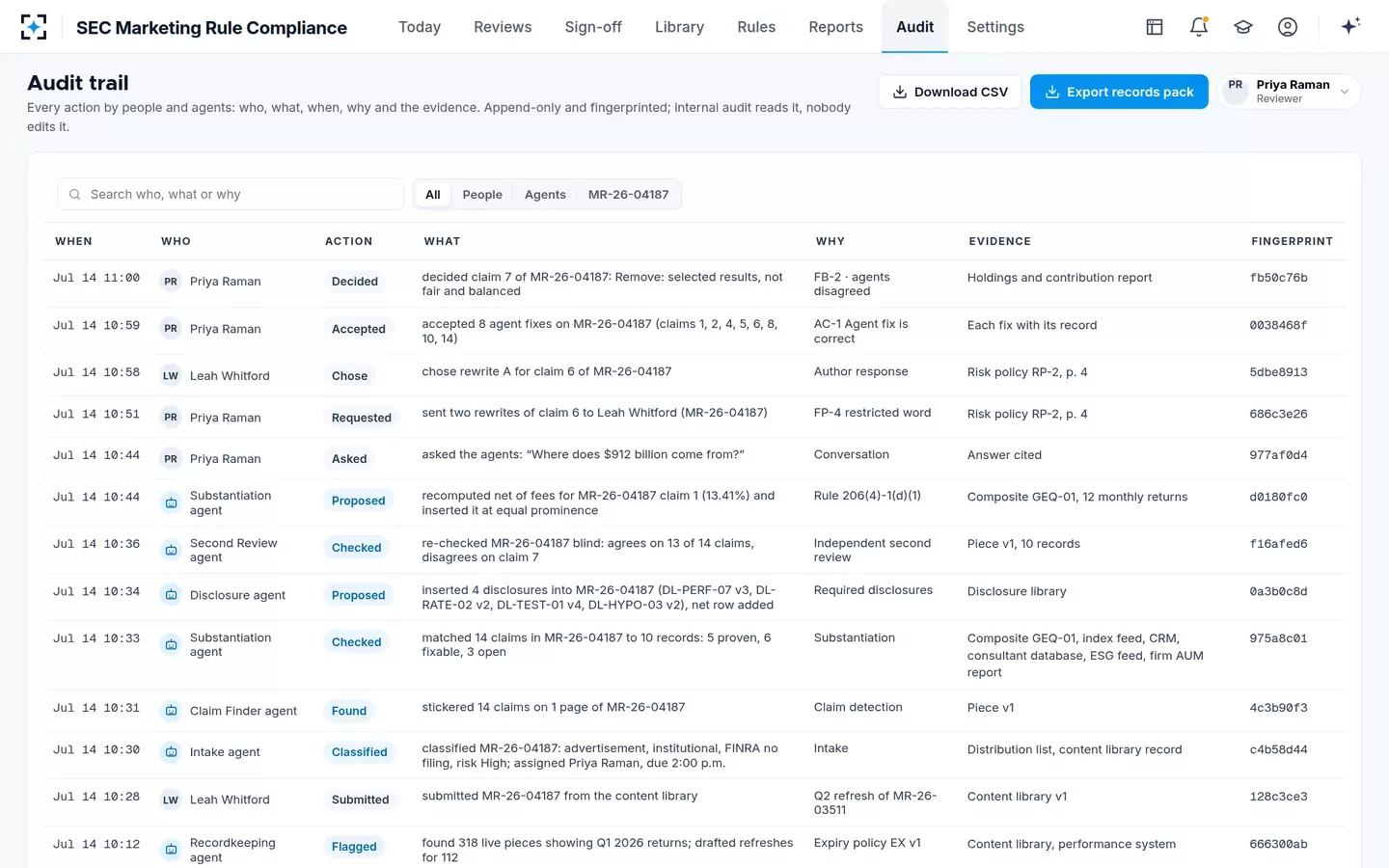
With a record that shows what was checked, against what, by whom and when. A signed PDF proves someone signed; it does not prove the net figure was recomputed or the rating's date checked. For a broker-dealer, Rule 2210(b)(4) requires the name of the approving principal and the date. For an adviser, the books-and-records rule requires the advertisement and the records behind its performance; the review itself is the evidence that the firm's policies were implemented, which is what examiners test.
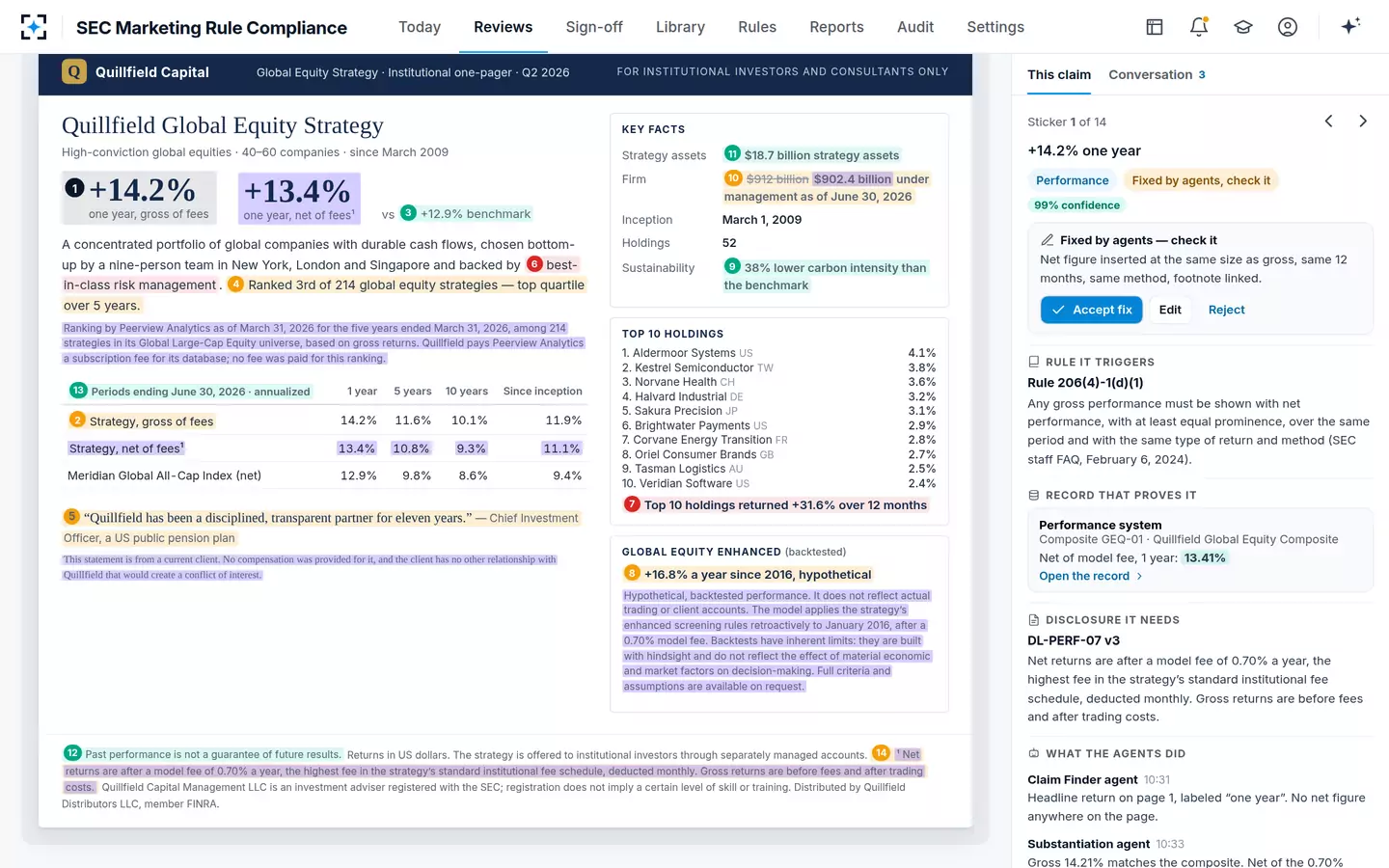
In the solution, each claim's record is kept as a read-only copy with the decision, the reason code and the person who made it. The fix the agents proposed and the reviewer accepted is shown as such.
A fix proposed by the agents, waiting for the reviewer to accept it
The record of what was decided, ready for an examiner
A tested checklist is also the best way to judge software before buying it; the four-week pilot on last quarter's ads uses the same planted-defect method. See the full review at SEC Marketing Rule Compliance.
Questions people ask
Is there an official SEC Marketing Rule checklist?
No. The SEC publishes the rule, the adopting release, a staff FAQ and risk alerts, but no checklist. Firms build their own from the rule's paragraphs; the SEC's examiners expect marketing policies to be tailored to the firm's own advertisements and channels, and examiners have criticised policies that only restate the rule.
What does the Marketing Rule FAQ say about extracted performance?
The rule requires net beside gross for an extract as well. The staff's FAQ, updated 19 March 2025, says it would not recommend enforcement if an extract is shown gross only, provided it is clearly labelled and the total portfolio's gross and net performance are shown with at least equal prominence over the extract's whole period.
What is a model fee under the Marketing Rule?
A hypothetical fee used to compute net performance instead of actual fees. It must produce net figures no higher than actual fees would, or equal the highest fee charged to the intended audience. The staff's January 2026 FAQ says actual fees can mislead where the audience is expected to pay more, in which case the model fee must reflect the anticipated fee.
How often should a marketing compliance reviewer be tested?
No rule sets a frequency. A planted-defect test fits naturally into the annual compliance review that Rule 206(4)-7 requires, and after any change to the review team, the checklist or the software. A firm that finds a miss should re-test once the fix is in place.
Does the checklist apply to social media posts?
Yes, when a post is an advertisement. The April 2024 risk alert found social media posts that highlighted performance without risks, and advisers that kept no copies of their posts; policies that ignored websites and social media were themselves a finding.