SEC Marketing Rule enforcement actions have so far been settled administrative orders against small and mid-sized advisers, brought in sweeps, with modest penalties and pointed findings. Reading the SEC's own press releases and order summaries from August 2023 to September 2025, we count nine actions against thirty advisers and about $4.47 million in civil penalties. Eighteen of the thirty were charged over hypothetical performance; the rest over unsubstantiated "conflict-free" claims, undated or untrue ratings, testimonials that did not come from clients, endorsements without disclosures and missing records. Each is a defect a reviewer can test for before a piece is released, which is the work Botminds' SEC Marketing Rule Compliance is built to do: it puts the record behind every claim in front of the reviewer before a principal signs.
Two years of SEC Marketing Rule orders, in four numbers
9
enforcement actions citing the Marketing Rule, August 2023 to September 2025
30
investment advisers charged, most of them in three sweeps
18of 30
charged over hypothetical performance
$4.47m
in civil penalties, with censures, cease-and-desist orders and undertakings
Every SEC Marketing Rule enforcement action, and what each order found
Nine actions cite the amended rule, and the SEC announced most of them as parts of an "ongoing sweep". The table lists each with the finding the SEC itself summarised. They are settled orders: the firms neither admitted nor denied the findings.
Nine SEC Marketing Rule enforcement actions, 2023 to 2025
| Date and respondent | What the SEC found | Civil penalty |
|---|---|---|
| 21 Aug 2023 · Titan Global Capital Management USA | Advertised "annualized" returns as high as 2,700 percent for a crypto strategy, extrapolating its first weeks; the SEC called it the first violation of the amended rule | $850,000, plus $192,454 disgorgement and interest |
| 11 Sep 2023 · nine advisers, including Banorte, Elm Partners and Linden Thomas | Hypothetical performance on public websites without the required policies; two also failed to keep copies of their advertisements | $850,000 combined, $50,000 to $175,000 each |
| 18 Mar 2024 · Delphia and Global Predictions | False statements about their use of artificial intelligence, among other advertising claims | $400,000 combined |
| 12 Apr 2024 · five advisers, including GeaSphere | Hypothetical performance on public websites without the required policies; GeaSphere also made false and misleading statements | $200,000 combined; four reduced for self-correction |
| 9 Aug 2024 · The Pacific Financial Group | Hypothetical performance on its public website without adopting and implementing policies | $430,000 |
| 9 Sep 2024 · nine advisers, including Abacus, Callahan and Richard Bernstein Advisors | Untrue statements about ratings; unsubstantiated conflict-free claims; testimonials not from clients; ratings over five years old shown undated | $1,240,000 combined |
| 1 Nov 2024 · Wahed Invest | Paid endorsements by professional athletes without the required disclosures; hypothetical performance without policies | $250,000 |
| 20 Dec 2024 · Atlas Financial Advisors | Gross hypothetical performance without net; books-and-records failures | $175,000 |
| 4 Sep 2025 · Meridian Financial | Website said it refused all conflicts; no copies of website advertisements; no annual compliance review | $75,000 |
Three things stand out. The respondents are rarely household names: these are firms whose websites and social posts were easy to read at scale. The penalties are small beside the SEC's recordkeeping cases, but the orders typically came with a censure and a cease-and-desist order that stays on the firm's public record. And the findings are specific enough to turn into tests.
What was the first SEC Marketing Rule enforcement action?
The first was Titan Global Capital Management USA, announced on 21 August 2023. The SEC said Titan's website showed "annualized" performance results "as high as 2,700 percent" for its crypto strategy, and that "These charges mark the first violation of the SEC's amended marketing rule" (SEC press release 2023-153). The figure was hypothetical in all but name: early weeks of a new strategy turned into a full-year number.
It set the pattern for what followed. Annualising a short period, projecting a target or running a backtest all produce numbers that no portfolio actually earned, and the rule's definition of hypothetical performance catches all three. The SEC's next three sweeps were about exactly that kind of number on public websites.
What are the most common Marketing Rule violations?
Hypothetical performance shown to the general public is the most common charge by a wide margin, followed by claims the adviser could not substantiate and third-party ratings without their required disclosures. Grouping the thirty charged advisers by the main finding against them makes the order of priorities plain.
Hypothetical performance outnumbers every other finding
The bars say where a review's effort pays. A firm that puts every hypothetical figure through an audience test, reads every superlative and "conflict-free" claim against Form ADV, and checks every rating for its date, period, provider and fee has covered most of what the SEC has charged. Why the SEC fences hypothetical performance sets out the rule behind the largest bar.
The hypothetical-performance sweeps: why the SEC kept coming back
Three of the nine actions, covering fifteen advisers, charged the same thing: hypothetical performance on a public website without the policies the rule requires to match it to the people who would see it, and Wahed's order made the same finding alongside its endorsement charges. The rule does not ban hypothetical performance; it requires that the adviser adopt and implement such policies, and the adopting release said advisers generally could not meet that standard for advertisements aimed at a mass audience.
"Because of their attention-grabbing power, hypothetical performance advertisements may present an elevated risk for prospective investors whose likely financial situation and investment objectives don't match the advertised investment strategy."
Gurbir S. Grewal, then Director of the SEC's Division of Enforcement, September 2023
The April 2024 sweep added a lesson about cooperation. Four of the five firms "received reduced penalties because of the corrective steps they undertook in advance of being contacted by the SEC staff", paying $20,000 to $30,000 each, while the fifth, GeaSphere, paid $100,000 (SEC press release 2024-46). Finding and fixing a hypothetical figure before the examiner does has a price on it.
Atlas Financial Advisors, in December 2024, showed the other half of the problem: the SEC found it advertised gross hypothetical performance "without also presenting net hypothetical performance" (SEC, Atlas order summary). The net-of-fees condition applies to hypothetical numbers as much as to real ones.
Ratings, conflicts and testimonials: the September 2024 sweep
The largest single action moved the SEC's attention from performance to everything else in an advertisement. Nine advisers paid $1.24 million between them, and the SEC's release sorted the findings into four groups (SEC press release 2024-121).
Abacus and Callahan Financial published "untrue statements about third-party ratings". Four firms claimed conflict-free advice they could not substantiate. Howard Bailey advertised two testimonials, "but neither actually came from current clients". And four firms showed third-party ratings without their dates, some of them more than five years old. Each of these is a lookup: the rating provider's own list, Form ADV's conflicts section, the CRM's client status, the date on the award. Third-party ratings and the award on your website covers the rating rules in full.
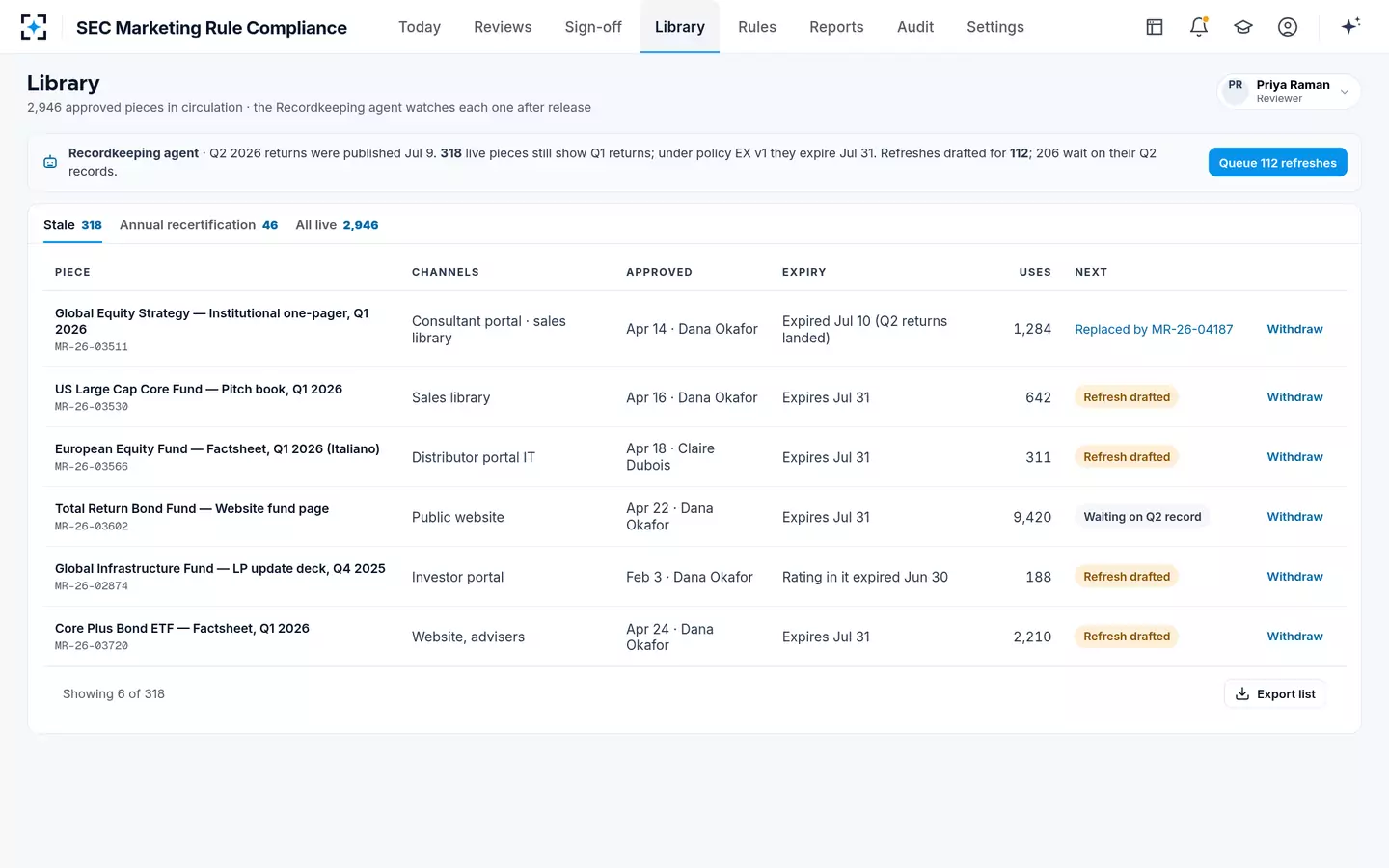
Old returns and expired ratings are a library problem, not a review problem
Marketing Rule enforcement actions in 2025, and what the risk alerts add
The pace of orders slowed in 2025. The one we found that year, against Meridian Financial in September, combined a website claim that the firm "refuse[d] all conflicts of interest" with two compliance-program failures: it did not keep copies of its advertisements and did not conduct an annual review of its policies (SEC, Meridian order summary). It is a small case that joins three obligations in one finding: substantiate the claim, keep the ad, review the program.
The examiners' risk alerts carry the more detailed message. The April 2024 alert, on the general prohibitions and records, found advisers whose policies required net-of-fees performance but whose advertisements showed only gross (SEC risk alert, April 2024). The December 2025 alert, on testimonials, endorsements and ratings, said that the most common reason a testimonial or endorsement failed was that it lacked the required disclosures when it was disseminated, and described advisers paying clients in gift cards to write reviews, hyperlinking disclosures that must be clear and prominent, and paying rating providers for logos and placement without saying so (SEC risk alert, December 2025).
How much are Marketing Rule fines?
Marketing Rule penalties have ranged from $20,000 to $850,000 per adviser in the actions above. The two largest single-firm penalties, $850,000 for Titan and $430,000 for The Pacific Financial Group, both involved hypothetical performance on a public website. Sweep penalties were set firm by firm: the September 2023 sweep ranged from $50,000 to $175,000, and the April 2024 sweep from $20,000 to $100,000.
The penalty is rarely the main cost. A settled order brings undertakings, such as hiring a consultant or reviewing every advertisement in circulation, and a disciplinary history that clients, consultants and due-diligence teams read. For a manager whose marketing is its pipeline, the remediation is the expensive part.
Turning the orders into pre-publication tests
Each finding above can be written as a question a reviewer, or software, answers before release. The list below does that for the failures the SEC has actually charged, in order of how often they appear.
Eight tests that cover what the SEC has charged so far
- Is any figure hypothetical, including annualised short periods, targets and backtests?
If yes, does the firm's written policy allow it for this audience, and is the distribution limited to that audience? Titan, two sweeps and Pacific Financial failed here.
- Does every gross figure, real or hypothetical, have net beside it at equal prominence?
Atlas showed gross hypothetical only; examiners found gross-only ads at firms whose policies required net.
- Can every material statement of fact be proven today?
Conflict-free, team size, process claims, AI claims. Read them against Form ADV and the firm's own policies.
- Does every rating show its date, period, provider and any fee?
Including logos, award badges and links to the provider's page. Ratings over five years old were shown undated.
- Is every testimonial from a current client, and every endorsement labelled as one?
Check client status in the CRM on the day of use, and the compensation and conflicts disclosure inside the testimonial itself.
- Is there a written agreement with every paid promoter above the $1,000 de minimis threshold?
Count the last 12 months in total, not payment by payment.
- Is a copy of the advertisement, as disseminated, being kept?
Websites and social posts included. Two 2023 respondents and Meridian kept none.
- Has the annual review tested the marketing policies against actual advertisements?
Meridian had no annual review; the 2024 alert found policies written but not implemented.
The full version, with every performance condition and how to test a reviewer against it, is in the SEC Marketing Rule checklist.
How SEC Marketing Rule Compliance checks for the same failures
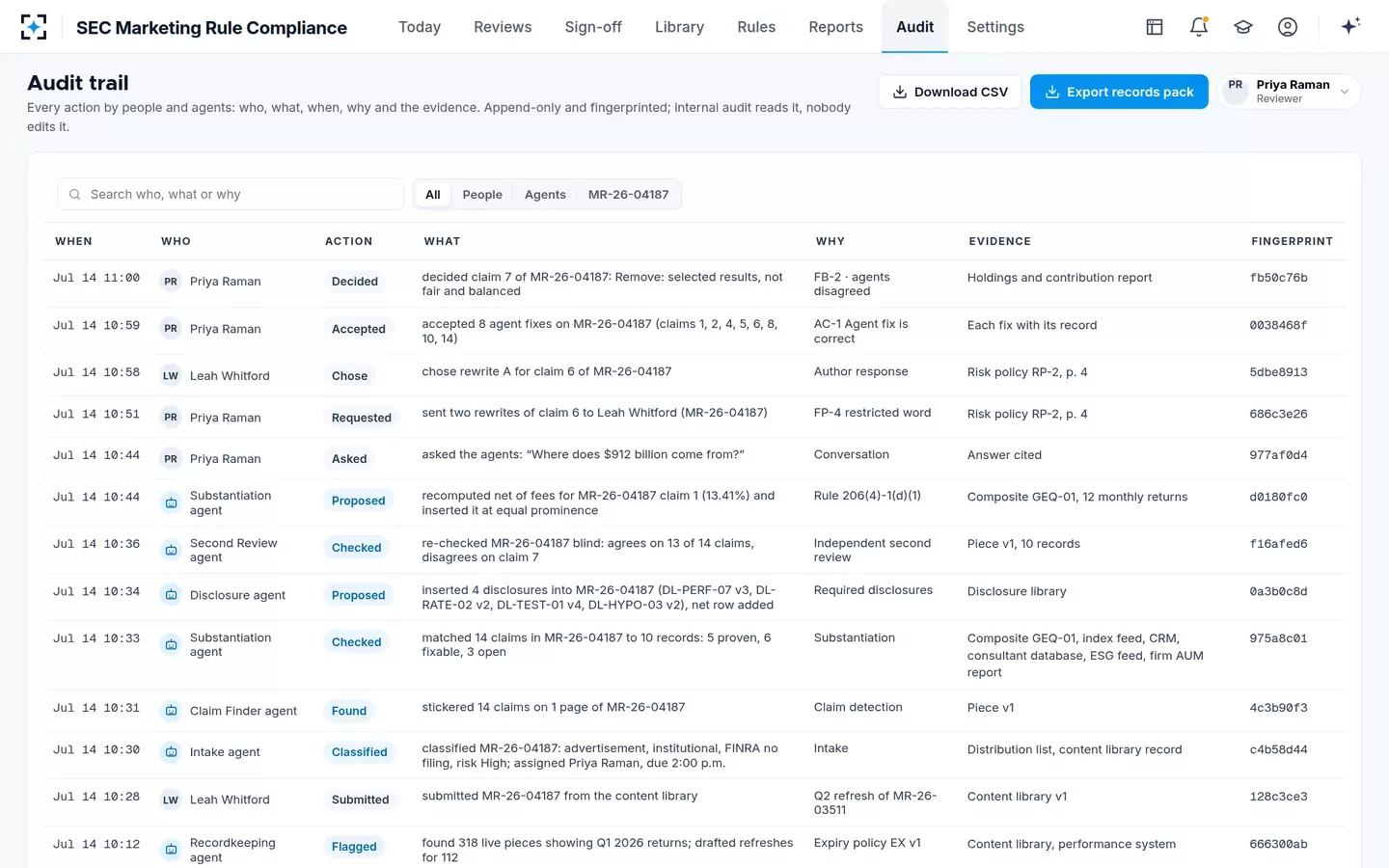
The solution's agents are built around the findings above. The Intake agent marks any piece with hypothetical performance as high risk and records its intended audience. The Claim Finder agent marks every performance figure, rating, testimonial and superlative. The Substantiation agent pulls each claim's record, recomputes net of fees and checks the rating's date and provider against the consultant database. The Recordkeeping agent keeps the piece as approved with its records, and watches live pieces for stale returns and expired ratings. The reviewer decides each finding; a registered principal or other approver signs.
Every action, by a person or an agent, with its reason and evidence
Where it does not help is just as clear. It cannot make hypothetical performance suitable for a mass audience, decide what a firm's policy should allow, or remove the judgement in a borderline claim. It makes sure that judgement is exercised with the record open, and that the record survives. See the full review at SEC Marketing Rule Compliance.
Questions people ask
How many advisers has the SEC charged under the Marketing Rule?
Thirty in the nine actions we count from August 2023 to September 2025, with about $4.47 million in civil penalties. The SEC's own enforcement results for fiscal 2024 described its continuing Marketing Rule review as producing settled charges against "more than a dozen investment advisers" in that year alone. The SEC does not publish a cumulative tally.
Which firms were in the September 2024 Marketing Rule sweep?
Nine advisers: Abacus, AZ Apice, Beta Wealth, Callahan Financial, Droms Strauss, Howard Bailey, Integrated Advisors, Professional Financial and Richard Bernstein Advisors. Between them they paid $1.24 million over untrue statements about ratings, unsubstantiated conflict-free claims, testimonials not from current clients and ratings shown without their dates.
Can an adviser reduce a Marketing Rule penalty by fixing problems itself?
The SEC has rewarded it. In April 2024 four of five advisers charged over website hypothetical performance received reduced penalties of $20,000 to $30,000 because they took corrective steps before SEC staff contacted them, against $100,000 for the fifth firm.
Is a Marketing Rule order public?
Yes. The SEC publishes each settled order with a summary on its website, naming the firm, the findings and the penalty, and announces sweeps in press releases that name every respondent. The orders on this page are all available on sec.gov.
What did the SEC's December 2025 Marketing Rule risk alert find?
It covered testimonials, endorsements and third-party ratings. The commonest failure was a testimonial or endorsement published without its required disclosures; others included hyperlinked or small-print disclosures, missing written agreements with paid promoters, de minimis claims that exceeded $1,000 over twelve months, and undisclosed payments to rating providers.