Investor relations software means two different things. For a listed company it is the IR website, the shareholder and analyst CRM and the earnings-day tools, all working under Regulation FD. For a fund manager, a transfer agent or a fund administrator it increasingly means software that answers investors: LPs and fund shareholders asking about their own distributions, balances, documents and dates. This guide is about the second kind, and its argument is that the go-live is not a software project. It starts with the questions that already have approved answers and clear rules about who may see what, adds new approved answers as compliance signs them, and keeps every other reply with a person; the time it takes is set by the approvals, not by the installation. Botminds' Investor Relations AI is built to go live that way: its agents send on their own only from wording an IR manager and compliance both approved, and everything else is drafted, cited and checked for a person to approve.
The product examples come from the solution's fictional sample data, a manager called Quillfield Capital; the plan below is our illustration, not a customer's timetable.
An illustrative go-live: the software is quick; the approvals set the pace
- Connectstep 1–2
- Import answersstep 3
- Approvalssteps 4–5
- Shadow mode2 weeks
- Livethen grow
What is the best investor relations software? First, which investor relations
The best investor relations software is the one built for the questions your investors actually ask, and a listed company's IR team and a fund's IR team ask different things of it. Choosing a corporate IR platform to answer LPs, or an LP portal to run an earnings call, buys the wrong tool. The differences run through the rules, the data and the way each fails.
Public-company IR software and fund investor relations software are different tools
Listed company investor relations: Shareholders, analysts and the market
Fund investor relations and investor services: LPs and fund shareholders, about their own account
Listed company investor relations: Regulation FD: no selective disclosure of material nonpublic information
Fund investor relations and investor services: The partnership agreement and side letters; anti-fraud rules; Regulation S-P; in the UK, DISP
Listed company investor relations: Public filings, results, guidance
Fund investor relations and investor services: Private, investor-specific records: capital accounts, notices, cash receipts, the register
Listed company investor relations: Telling one analyst something the market has not heard
Fund investor relations and investor services: Showing one investor another investor's figures, or a wrong figure
Listed company investor relations: IR website, shareholder identification, analyst CRM, event tools
Fund investor relations and investor services: Entitlement checks, cited answers from records, approvals, complaint routing, an audit trail
Does Regulation FD apply to fund investor relations?
Mostly not. Regulation FD applies to issuers with a class of securities registered under Section 12 of the Exchange Act or reporting under Section 15(d), and it expressly includes closed-end investment companies while excluding every other investment company (17 CFR 243.101(b)). A listed closed-end fund's IR team works under it; a mutual fund's and a private fund's do not. Regulation FD for listed companies is explained in its own guide.
Fund IR still has a consistency problem, just a different one. Two LPs told different tax dates, or one LP given a figure the others were not, can breach the agreement's reporting and most-favoured-nation terms and, if misleading, the anti-fraud rule for pooled vehicles. That is why the solution's Checking agent compares every answer with what other investors in the same fund were told before it reaches a person.
Investor relations software for private equity: the answering layer
For a private equity or private credit manager, investor relations software usually means three layers: a CRM for fundraising and relationships, a portal that publishes documents, and, newer, something that answers the questions LPs send after reading those documents. The first two are mature; the third is where IR hours go. Investor portal software for private equity, compared with answering the question, argues why the portal does not replace it, and Botminds' LP reporting software guide covers the reporting side.
The answering layer is also where most of the risk sits, which is why the go-live plan is built around approvals. The Bank of England and FCA's 2026 survey of UK financial firms found 80% using agents for decision support, where agents recommend and people decide, and only 2% with agents acting with broad autonomy (Bank of England and FCA, 2026). An answering system that starts by sending only approved wording sits squarely in the cautious majority.
How long does investor relations software take to set up?
The connections are the quick part; the approvals take as long as your compliance process takes. The solution's setup has five steps: connect the systems of record (the fund administrator, the transfer agency system, the CRM, the document library, email, the portal and the contact centre, the complaints register); load the fund documents; import the answers the team already uses; map roles and approvals; and set the rules. Then two weeks of shadow mode, in which the agents draft every answer and people still send.
We do not quote a duration for a firm's go-live, because the long pole is outside the software. Every template needs an IR manager's and a compliance reviewer's approval in every language it will be sent in; the never-automatic list, the thresholds and the service levels need sign-off; and the entitlement sources, especially authorized-contact lists, need cleaning. A firm with a current list of approved standard answers and a clean signatory list will be quicker than one whose standard answers live in a Word file that is copied and edited reply by reply.
What has to be approved before go-live?
Eight things, each with a named owner. None of them is a software setting a vendor can approve for you.
Eight approvals before investor relations software sends anything on its own
- The first templates, in every language they will go out in
Approved by an IR manager and co-approved by compliance; each language variant back-translated.
- The never-automatic list
Complaints, bank-detail and payment instructions, forecasts and performance promises, legal or press contact, vulnerability, fee and side-letter requests, senders not on file.
- The thresholds
Template match, checking confidence and sampling rate; in the sample settings 0.90, 0.92 and one in twenty.
- The entitlement sources
Which CRM contact lists, signatory lists and register fields decide who may see which account.
- Service levels and escalation
For example one business day for routine questions, two for sensitive ones, escalation before a deadline.
- Complaint regimes and owners
Which clocks apply to which investors, and who approves each acknowledgement.
- Bank-detail hold procedure
The call-back to a number on file, the recording, the second person.
- Where data is processed and how long records are kept
Regions by investor domicile, retention period, and the service-provider terms Regulation S-P expects.
Approval of wording is the part regulators care about most. FINRA told broker-dealers in 2024 that its rules are technologically neutral and that its communications standards apply whether a person or a tool produced the words (FINRA Regulatory Notice 24-09); the same logic applies to any firm's investor communications. Forecasts and performance language are the sharpest edge: the SEC Marketing Rule's general prohibitions explain why the solution keeps them on the never-automatic list.
Which investor questions go first?
The ones that are frequent, factual and answered from one record: a wire received, a distribution amount, the date a statement or tax document will come, how to update a contact. They already have standard answers, the record behind them is unambiguous, and an error is easy to see. Questions about fees, side letters, valuations or anything forward-looking come later or never go out on their own.
A go-live order for investor questions, safest first
| Wave | Questions | Why here | Route |
|---|---|---|---|
| First | Wire or payment received; distribution amount; statement and tax-document dates | One record answers it; a standard answer already exists | Approved template, sent on its own |
| Second | Capital account balance; unfunded commitment; amended tax form explanations | One record plus a date or basis that must be stated | Template after approval; waves for repeated questions |
| Third | Fees charged; side-letter terms; valuation questions | Investor-specific terms change the answer | Drafted and cited by agents; a person approves |
| Never alone | Complaints; bank-detail changes; forecasts; legal, press or regulator contact; vulnerability | A decision, not an answer | Always a named person |
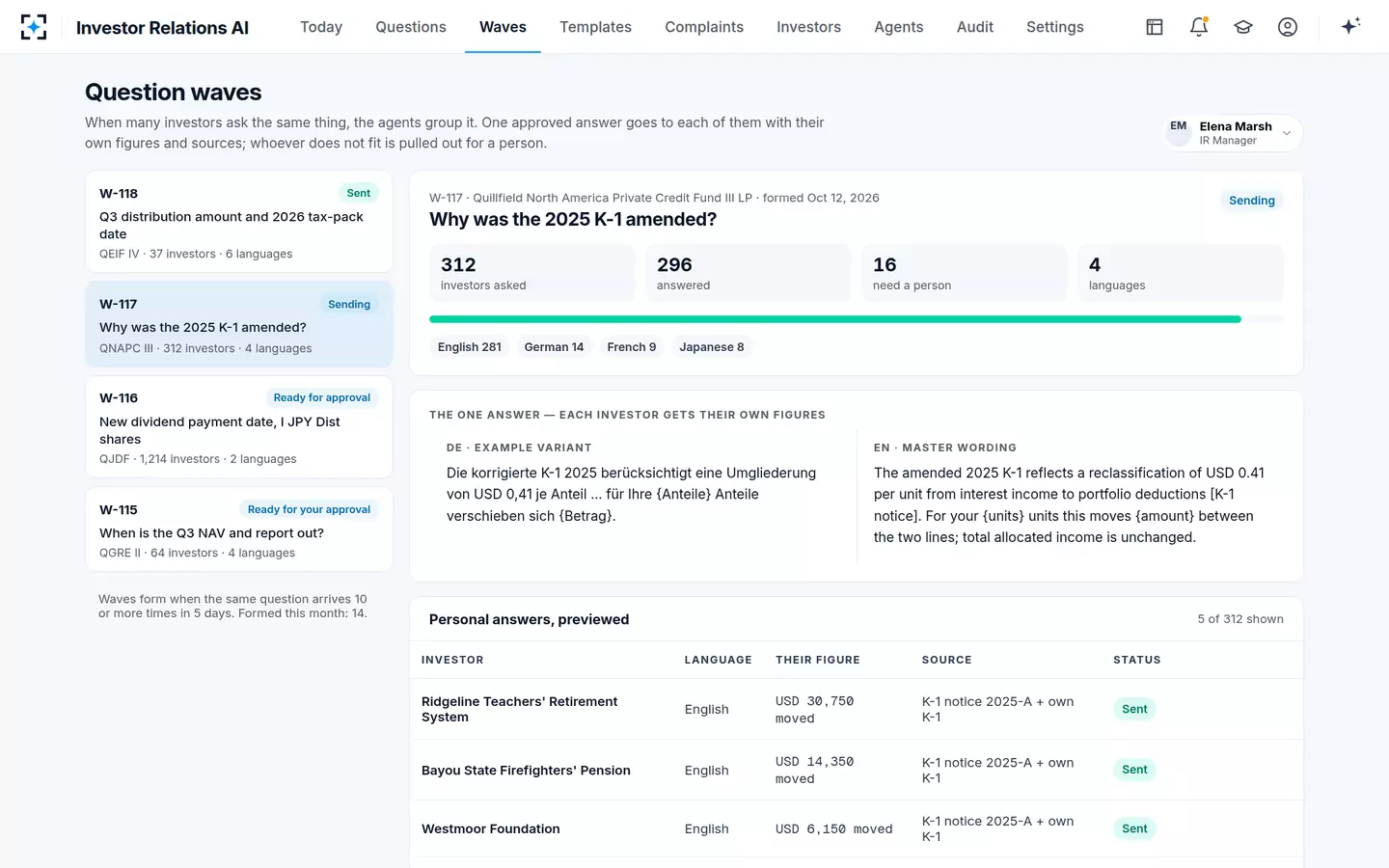
Waves are where the first months pay off. In the sample data, 312 investors in a private credit fund asked why their 2025 K-1 had been amended; an IR manager and a compliance reviewer approved one answer, and 296 were sent in four languages, each with the investor's own figure cited to its K-1 notice. Sixteen investors whose side letters had relevant terms were pulled out for a person.
One approved answer, 312 investors, each with their own figure
How do we handle languages?
As a check, not a feature. A reply in the investor's language is only as good as the number format and the meaning that survive translation. The solution drafts in the investor's language with the English beside it for the IR team, has a second model back-translate the draft, and checks number formats, so that EUR 1'284'500 in Swiss German stays EUR 1,284,500 in English. Templates are approved in every language variant, each back-translated, before they can go out on their own.
For some funds, languages are a rule, not a courtesy. A UK UCITS management company's complaint procedures must let unitholders complain in any official language of the fund's home state or of the states it was notified into (FCA DISP 1.3.1BR), and side letters often fix the language of correspondence. In the sample, a Swiss pension fund's side letter required German, and the reply went out in German with the English kept on file.
Who signs off templates?
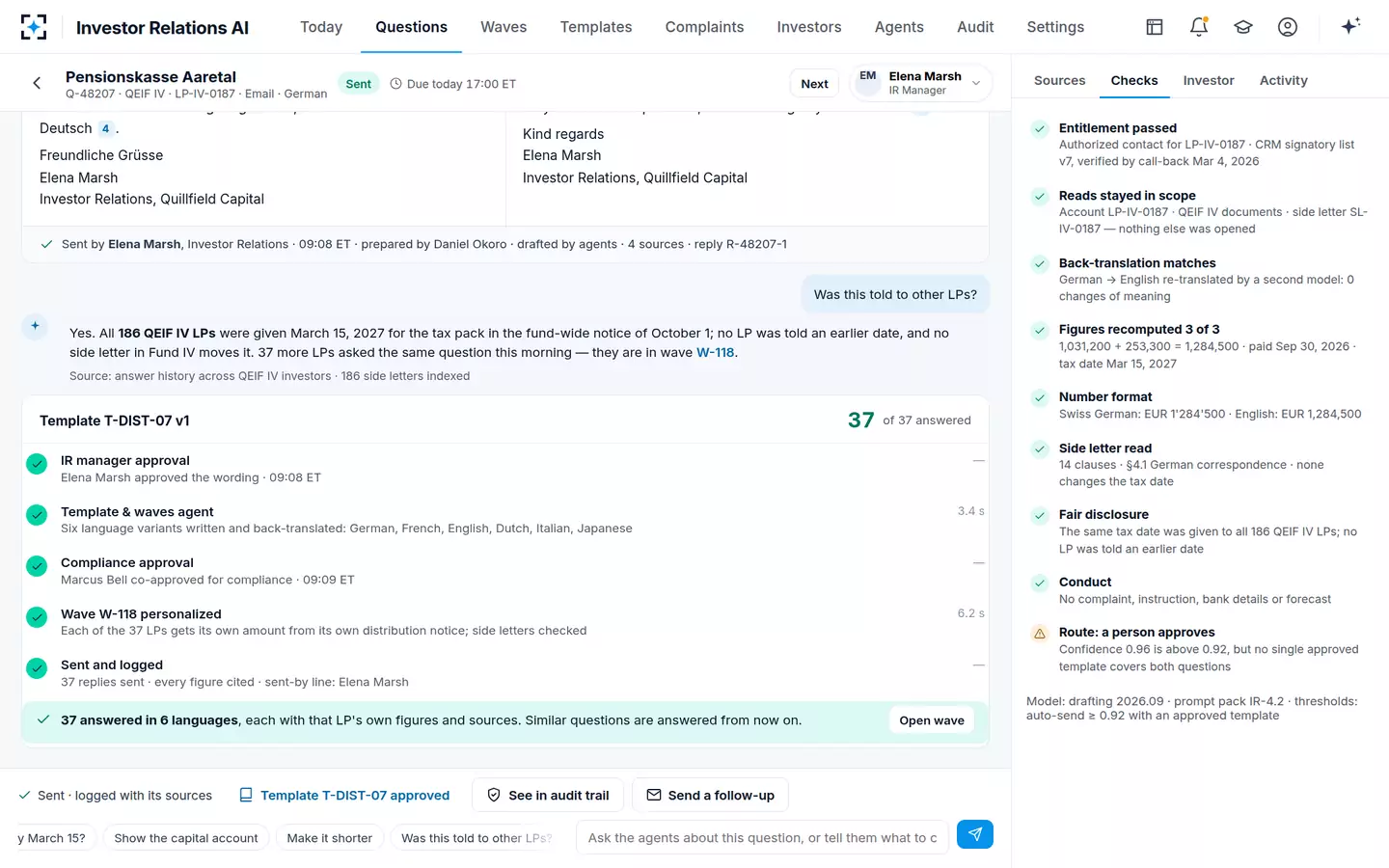
Two people, every time: an IR manager for the substance and a compliance reviewer for the wording, in every language. In the solution the Template & waves agent may propose a template from a reply that was approved, and write and back-translate its language variants, but it cannot approve one. After go-live, one in twenty automatic answers comes back to a person to be re-read, so an approved template that has started to drift is caught.
A reply approved once, proposed as a template, co-approved, and 37 more answered
Who owns which part of the go-live
Today
Approves the same kind of answer again and again, one reply at a time.
With agents
Chooses the first questions, approves the first templates and reviews only what no template covers.
Still theirs: Every reply that is not approved wording
Today
Standard answers live in a document that is copied and edited reply by reply.
With agents
Co-approves each template in every language and re-reads one in twenty automatic answers.
Still theirs: Every change to what the agents may do
Today
Bank-detail requests arrive mixed in with routine questions.
With agents
Gets every payment-instruction change held, with the call-back steps attached.
Still theirs: The call-back and the second person
Today
Depends on whoever reads a message to recognise a complaint.
With agents
Receives complaints as they are found, with the regime and the clock set.
Still theirs: Every complaint reply
How do you know the go-live is working?
Measure it on your own questions during shadow mode, before anything goes out on its own. No regulator or independent study publishes benchmarks for fund investor-relations answering, and published accuracy figures for AI on documents are sobering: a peer-reviewed study found commercial legal research tools that answer from retrieved sources still hallucinating on 17% to 33% of queries (Magesh et al., 2025). Your own shadow run is the evidence that counts.
Four measures are enough. The share of questions an approved template could have answered; the share of drafts a person sent without edits, and what the edits were; the number of figures the Checking agent's recomputation caught; and the time from arrival to approval, against the service level. The solution's sample September shows the shape of a mature month, 61.4% of 14,812 questions sent from approved templates and 98.6% inside the service level; that is sample data, and your own first month will be lower because the approved wording has not been written yet. To plan a go-live on your own questions, start from Investor Relations AI.
Questions people ask
What is investor relations CRM software?
Software that tracks relationships with investors and prospects: contacts, meetings, commitments, documents sent. For a fund it is also where the authorized-contact and signatory lists usually live, which makes it a source for deciding who may see which account, as well as a fundraising tool.
Can investor relations software answer investors automatically?
It can send approved wording on its own, if the sender is entitled and the answer is checked. In the solution, automatic answers come only from templates an IR manager and compliance approved, at a checking confidence of 0.92 or above, and one in twenty is re-read by a person.
Do we need to replace our investor portal or CRM?
No. An answering layer reads from the systems where investors' records already live: the fund administrator, the transfer agency system, the CRM and the document library. It sends replies by email or through the portal and leaves the systems of record as they are.
What is shadow mode?
A period in which the agents draft every answer but people still send them, so the firm can measure the drafts against what it actually sent. The solution's design uses two weeks of shadow mode before anything goes out on its own.
Who is accountable for an answer the software sends?
The firm, and by name the people who approved the wording. Every automatic answer traces to a template approved by an IR manager and a compliance reviewer, and every other reply carries the name of the person who approved it.