LP reporting software produces the quarterly and annual reports a private equity GP sends its limited partners: the fund's capital account and performance, fees and expenses, and a section on each portfolio company. The safest design does not hold any of those numbers itself. It reads approved figures from the systems that own them (fund accounting for capital accounts and fees, the valuation for marks, portfolio monitoring for company KPIs), drafts the report, and leaves publishing to a person. Software that replaces one of those systems, or lets an edit in the report flow back into it, is how an investor report ends up disagreeing with the valuation. Botminds' Private Equity Portfolio Monitoring drafts the portfolio company section of each fund's quarterly LP report from KPI sets already accepted into the valuation, every figure cited to its page, and never publishes.
Where this guide uses an example, it is from the solution's sample data: Quillfield Capital, a fictional sponsor with eight funds and programs, each with its own quarterly LP report, closing the third quarter of 2026.
What one investor report section depends on
3
source systems under every portfolio section: fund accounting, the valuation and portfolio monitoring
8 of 17
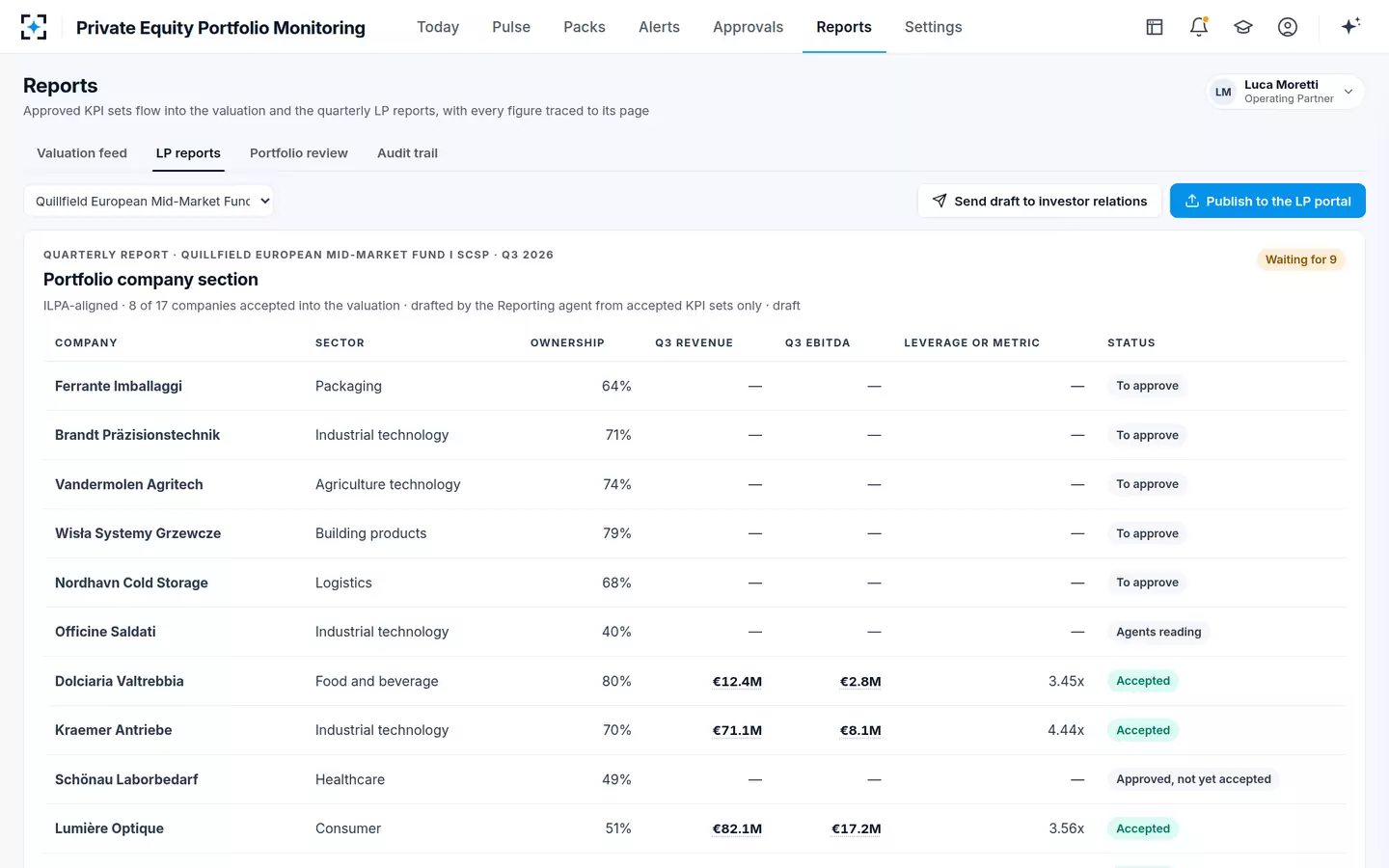
companies accepted into the valuation when the sample fund's section was first drafted; the other nine showed no figures
Day 45
the sample sponsor's house target for investor reports: November 14 for the third quarter
0
reports an agent may publish, or approved values it may change
What is LP reporting, and what should LP reporting software own?
LP reporting is the GP's regular account to its limited partners of what the fund holds, what it is worth, what it has cost them and what it has paid back. LP reporting software should own the drafting, the layout, the distribution and the history of what was sent to whom; it should not own the numbers. Every figure in an LP report belongs to an upstream system that someone is accountable for.
The distinction matters because the report is where errors become representations to investors. Rule 206(4)-8 makes it fraud for an adviser to a pooled vehicle to make a materially untrue or misleading statement to any investor or prospective investor (17 CFR 275.206(4)-8). An LP report that disagrees with the valuation has made one of its two figures untrue, and a report tool that keeps its own copy of the numbers is one easy way for that to happen.
What goes in an LP quarterly report?
An LP quarterly report for a private equity fund usually contains a capital account statement for each investor, fund-level performance (IRR and multiples, gross and net), a schedule of investments with cost and fair value, fees, expenses and any offsets, and a portfolio company section with each company's recent results and outlook. What is required, and when, is set by the fund's limited partnership agreement and side letters in the US, and by AIFMD and national rules in the EU.
The SEC's vacated 2023 rule gives a useful map of what investors had been asking for, even though no adviser ever had to comply with it. For each portfolio company that paid the adviser, it would have required a table of "origination, management, consulting, monitoring, servicing, transaction, administrative, advisory, closing, disposition, directors, trustees or similar fees or payments" (88 FR 63206, vacated June 5, 2024). In the EU, AIFMD II now requires managers to disclose to investors each year all fees, charges and expenses borne directly or indirectly by them, from April 16, 2026 (Directive (EU) 2024/927). The portfolio section is where those company-level payments are visible first. The rules side by side are in the guide to private equity reporting requirements.
Each part of an LP quarterly report, and the system that should own its figures
| Report section | Owning system | Who approves upstream | What the report tool may do |
|---|---|---|---|
| Capital account statements | Fund accounting | Fund controller | Read and lay out |
| Fund performance (IRR, multiples, DPI) | Fund accounting, from cash flows and NAV | CFO | Read and lay out |
| Schedule of investments, fair value | The valuation | Valuation committee | Read and lay out |
| Fees, expenses and offsets | Fund accounting, checked against the LPA | CFO; LPA compliance | Read and lay out |
| Portfolio company results and outlook | Portfolio monitoring | Operating partner; Head of Valuation accepts | Draft from accepted figures, cite each |
| Commentary | Deal and IR teams | Investor relations | Draft for a person to edit |
How do GPs produce quarterly LP reports today?
Without connected systems, the report is assembled: fund accounting exports capital accounts and performance, the valuation team supplies marks, the portfolio team sends a spreadsheet of company KPIs, and investor relations stitches them into a document and writes the commentary. The weakest joint is the last spreadsheet, because it is a copy, made at a moment, of figures that may have changed since.
Supervisors have seen the strain at the other end too. In its 2025 review of private market valuation, the FCA found that some firms "noted that non-disclosure agreements prevented them from sharing data on portfolio company financials and others noted the commercial sensitivity of sharing valuation models" with investors (FCA, Private market valuation practices). Whatever a GP decides to share, the company figures it does share must be the ones its valuation used. The reporting tool's job is to make that automatic, not to decide what is confidential.
Three source systems sit under the portfolio section
The portfolio company section draws on three systems: portfolio monitoring for each company's approved KPIs, the valuation for the accepted inputs and the mark, and fund accounting for ownership, cost and the quarter-end exchange rates. LP reporting software should read from all three and write to none.
Approved figures in, a draft out, a person publishes
A person decides
The operating partner approves the KPI setEach company's quarterly KPIs, mapped, re-derived and approved in Private Equity Portfolio Monitoring, every value cited to its page.
A person decides
The Head of Valuation accepts itAccepted sets become locked inputs to the quarterly valuation; a later restatement reopens only what it touches.
Agent
Reporting agent reads three systemsReads accepted KPI sets, the valuation inputs, and ownership, cost and FX rates from fund accounting.
Never: read a set that is approved but not yet accepted
Agent
Reporting agent draftsDrafts the portfolio company section of each fund's report, every figure cited; companies not yet accepted show no figures.
Never: publish, or change a value after approval
A person decides
The LP reporting manager publishesReviews the draft beside the fund accounting and valuation sections and publishes to the investor portal.
The one-way rule is what keeps the report consistent. If a figure is wrong, it is corrected where it is owned, approved again, and flows down; it is never patched in the report. In the sample, the investor portal and CRM sit at the end of the chain and receive the published section; company CFO contacts come from the CRM for the questions the Note agent drafts.
The portfolio company section Private Equity Portfolio Monitoring drafts, only from accepted figures
How do you keep the LP report consistent with the valuation?
Draft the company figures only from inputs the valuation team has accepted, lock them on acceptance, and treat any later change as a restatement that reopens the report page it touches. Consistency then follows from the order of operations rather than from a reconciliation done the night before publishing.
The sample shows both halves. When the fund's third-quarter section was first drafted, only 8 of its 17 companies had been accepted into the valuation, so only those eight showed figures; one company approved by its operating partner but not yet accepted by the Head of Valuation showed none. And when Brandt Präzisionstechnik restated its second-quarter EBITDA from €7.6M to €7.3M, the solution traced the change to page 14 of the fund's second-quarter report, published on August 27, and reopened that page for a decision rather than leaving the published figure to disagree with the corrected valuation input.
A restatement in Private Equity Portfolio Monitoring reaches back to a published investor report page
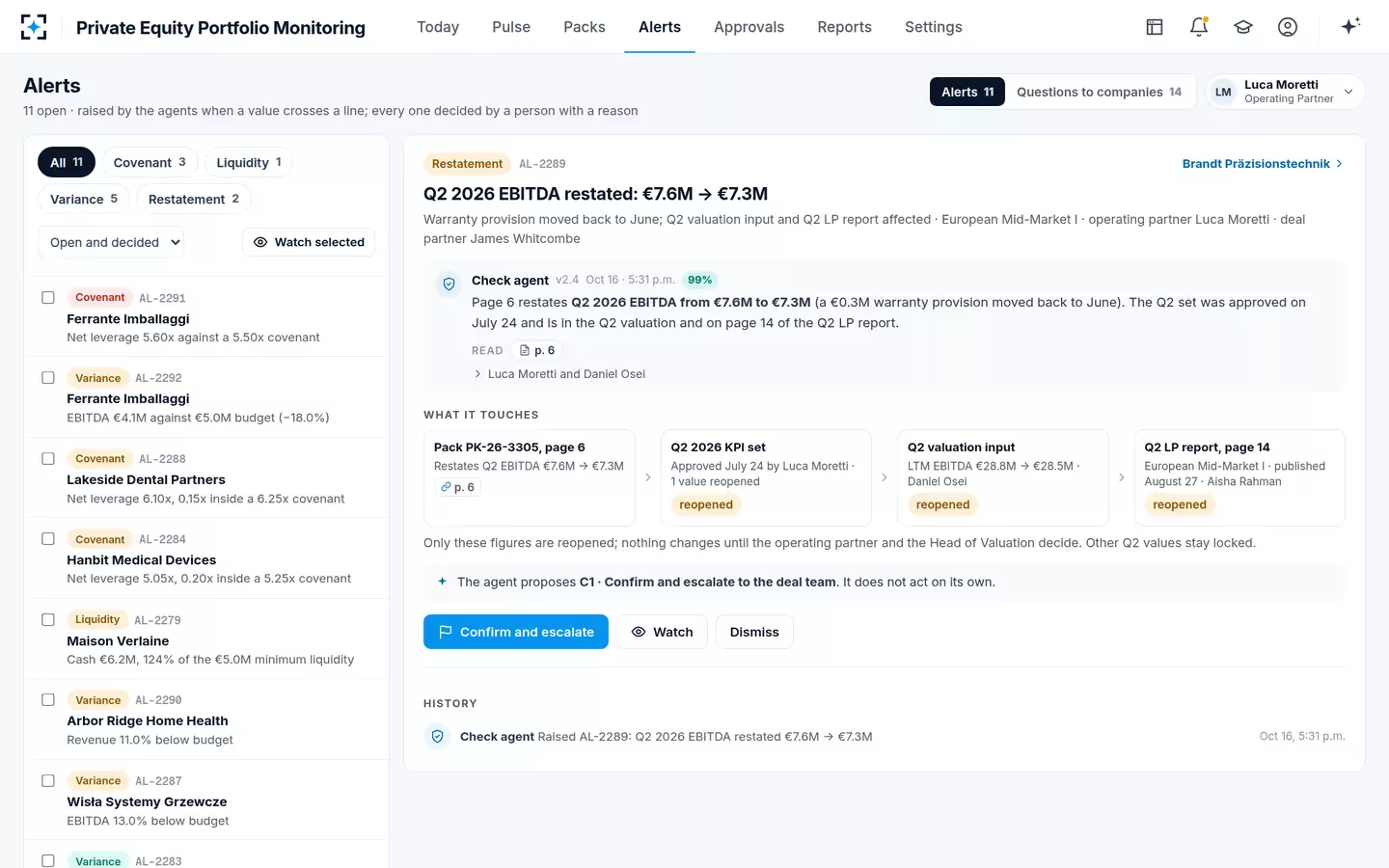
The same lineage answers an investor's question. An LP who asks why a company's EBITDA in the report differs from what its board deck said can be shown the page in the company's report the figure came from, the second reading that confirmed it and the person who approved it. How each figure gets that trail is followed hop by hop in the guide to private equity KPIs.
Can LP reporting be automated?
The drafting can be automated; the publishing should not be. A report tool can lay out approved figures, write first drafts of company summaries from the companies' own words and check that every number in the draft matches its source. A person should still read the whole report and send it, because the report is the GP's representation to its investors.
What automation should not do is just as specific. It should not fill a gap with last quarter's figure, estimate a missing company, or smooth a restatement. In the solution, the Reporting agent drafts only from accepted sets, shows a blank where a company is not ready, never publishes and never changes an approved value. Investor relations still writes the fund-level commentary.
Quarterly reports are not the only investor communication
A quarterly LP report answers for the quarter; it is a poor channel for an event that investors need to know about sooner. The FCA's October 2026 review of conflicts in private markets observed of weaker firms: "There was also limited evidence that disclosures were delivered early enough to influence decision-making." It noted that some stronger firms "were willing to exceed minimum contractual disclosure obligations where they considered that perceived conflict risks were high" (FCA, Conflicts of interest and fair customer treatment in private markets).
"Greater transparency to investors increases confidence for their decision making around private assets."
FCA, Private market valuation practices, March 2025
For portfolio monitoring the practical point is that events surface first in the company figures: a covenant crossing, a restatement, a liquidity squeeze. A monitoring system that raises them the day the company reports gives investor relations the option of telling LPs early. Whether to do so is a GP decision; having the figures in time is a systems question.
Go-live: connect in this order, and replace nothing
An LP reporting integration goes live safely when each connection is read-only first and proven on a past quarter before it is used for a live one. The order matters: start with the systems that own the most numbers, so the draft is anchored before anything is generated.
Connecting LP reporting to the systems it reads from
- 1. Fund accounting, read-only
Ownership, cost, fund structure and quarter-end FX rates. The report never writes back.
- 2. The valuation model, read-only
Accepted inputs and marks. Only accepted figures are visible to the draft.
- 3. Portfolio monitoring, as the source of company KPIs
Approved and accepted KPI sets, each with its page and approver.
- 4. The investor portal and CRM, draft only
The draft goes to investor relations; publishing is a named person's action.
- 5. A shadow quarter
Draft last quarter's report from the connected systems and compare it with what was actually sent. Explain every difference.
- 6. First live quarter in parallel
Produce the report both ways once; switch when the two agree and every difference is understood.
- 7. Restatement drill
Restate one past figure in a test copy and confirm the report page it touches is reopened, not silently changed.
In the sample, the solution's own shadow quarter re-ran a past quarter's company reporting beside the team: 2,571 of 2,594 values matched the team's approved figures, and the 23 differences were explained before go-live. The same discipline applies to the report: the first quarter it drafts should be one you have already sent.
What Private Equity Portfolio Monitoring does not do in LP reporting
It does not keep capital accounts, compute NAV, calculate fees or carried interest, or prepare tax reporting; those belong to fund accounting, and to Botminds' fund accounting solutions such as NAV Oversight where a GP wants them checked. It does not strike marks; that is the valuation team's work, laid out in the private equity valuation process at quarter end and supported by Private Markets Valuation. Credit funds' investor reports have their own solution, Investor Reporting Automation. Private Equity Portfolio Monitoring supplies the portfolio company section and the trail behind each figure in it.
Questions people ask
What LP reporting tools exist?
They fall into four kinds: fund administration and accounting systems with built-in investor statements, investor portals that distribute documents, report-assembly tools that lay out figures from other systems, and portfolio monitoring tools that supply the company section. Most GPs use more than one; the question is which system owns each figure.
How long after quarter end are LP reports sent?
In the US, as long as the fund's agreements allow; since the SEC's quarterly statement rule was vacated in June 2024, there is no federal deadline. In the sample, the sponsor's house target is day 45. EU managers also owe an annual report within six months of year-end under AIFMD.
Should portfolio company figures in the LP report be audited?
The fund's annual financial statements are audited; quarterly company KPIs in the portfolio section usually are not. That makes the trail more important: each figure should be traceable to the company's own report and to the approval that let it into the valuation.
Can LP reporting software use ILPA templates?
Most report tools can lay out a fund report in whatever template the GP and its investors agree. The SEC described such uniform reporting templates in 2023 as ones "certain investors and industry groups have encouraged"; whichever template is used, its company figures should come from the same accepted set as the valuation.
Who should publish the LP report?
A named person in investor relations or LP reporting, after reviewing the whole draft beside fund accounting and the valuation. In the sample, only the LP reporting manager's role can publish; agents cannot, and every publication is on the audit trail with who, what, when and why.