Portfolio monitoring tools for private equity collect portfolio companies' monthly and quarterly reporting, turn it into the fund's KPIs, check it, test covenants and feed the valuation and investor reports. Older tools are databases with an upload portal: the companies or the analysts still key the figures in. Newer ones use AI to read the companies' own reports. The useful way to compare them is task by task. Of the twelve tasks in a quarter close, a well-built tool can now take reading, mapping, re-deriving, variance explanation, covenant arithmetic and drafting outright; people must keep approving figures, deciding alerts, contacting lenders, choosing cures and publishing. Botminds' Private Equity Portfolio Monitoring is built on that split, with seven agents doing the first kind of work and every decision of the second kind logged against a named person.
Where this guide uses an example, it comes from the solution's sample data on Quillfield Capital, a fictional sponsor with 120 portfolio companies, closing its third quarter of 2026.
What the agents did in one sample week, and what they left to people
37
company reports read over one weekend, in nine languages
498
KPIs mapped to the fund template; 11 under the 95% confidence threshold went to an analyst
15
decisions waiting for the operating partner on Monday morning
0
figures approved, notes sent or lenders contacted by an agent
What do portfolio monitoring tools for private equity actually do?
They do three jobs: get each company's figures in, make them comparable and trustworthy, and pass them on to the people and systems that use them. Tools differ less in the screens they show than in how much of the middle job they do. A portal does the first and third and leaves the middle to people. An AI tool can do most of the middle, if it is built to show its work.
The middle job is where a quarter's effort goes. On our estimate for one analyst at the sample sponsor, retyping and mapping alone take six of twenty days, and checking three more (the estimate and how to measure your own are in the portfolio monitoring process guide). A tool that only collects and displays leaves those nine days where they were.
The twelve monitoring tasks, and who should do each
Split the quarter into tasks and ask of each: can its output be checked against a page? If yes, an agent can do it, provided a second reading or a person checks the result. If the task commits the firm to something, such as an approved figure, a message to a company or a lender, or a report to investors, it stays with a named person.
Twelve portfolio monitoring tasks: which move to agents and which stay with people
| Task | Who | How it works in the solution |
|---|---|---|
| 1. Collect reporting from the portal, email and data rooms | Agent | Reads each arrival the day it lands; flags unreadable pages and partial periods as exceptions |
| 2. Chase late companies | Shared | Reminders on a set clock; the operating partner and deal partner are copied as days pass |
| 3. Read the report in its own language and standard | Agent | Detects period, currency, units and standard; never guesses an ambiguous one |
| 4. Map each line to the fund's KPI template | Shared | Agent maps with a confidence per value; anything under the threshold goes to the analyst |
| 5. Re-derive each KPI a second way | Agent | An independent second reading; a disagreement goes to the analyst with both pages |
| 6. Spot a restated prior quarter and trace what it touches | Shared | Agent detects and traces; people decide what is reopened and changed |
| 7. Explain variances against budget and prior periods | Agent | Only the drivers the company states, cited; never an invented one |
| 8. Test covenants on each facility agreement | Agent | Headroom, step-downs, add-back and cure arithmetic, certificate dates |
| 9. Draft questions to company CFOs | Agent | In the CFO's language with the English beside, each question cited |
| 10. Approve a KPI set, decide an alert, send a note | Person | The operating partner, never the person who mapped it, never the company's deal partner |
| 11. Accept figures into the valuation | Person | The Head of Valuation; accepted figures are locked |
| 12. Contact lenders, decide a cure, publish to investors | Person | Deal team, investment committee and LP reporting; no agent may |
Three of the shared tasks deserve a closer look, because they are where tools fail quietly. Mapping looks automatable end to end until a company's report has two lines that could both be EBITDA; the tool must know when it is unsure and say so. Restatements look like a data-quality problem until one reaches an investor report already published; the tool can trace, but only people can decide. And chasing looks clerical until a late report belongs to the company nearest its covenant; the escalation clock is a judgment written down in advance.
Can AI read portfolio company reports in any language?
Yes, if it reads the report as the company sent it and shows the page beside its reading. Language is the smaller problem; accounting standards and layout are the larger ones. A tool that reads Italian but maps "EBITDA rettificato" into the reported EBITDA cell has read the language and missed the meaning.
In the sample, the Intake agent read a 24-page Italian report under Italian GAAP in euro millions, and a 31-page German report under the German Commercial Code. Every value it read opens the original page in the original language beside the English reading, with the line the value depends on highlighted. The test for any tool is the same: pick a figure on the dashboard and ask to see the page. If the answer is a PDF to search through, the reading is not cited.
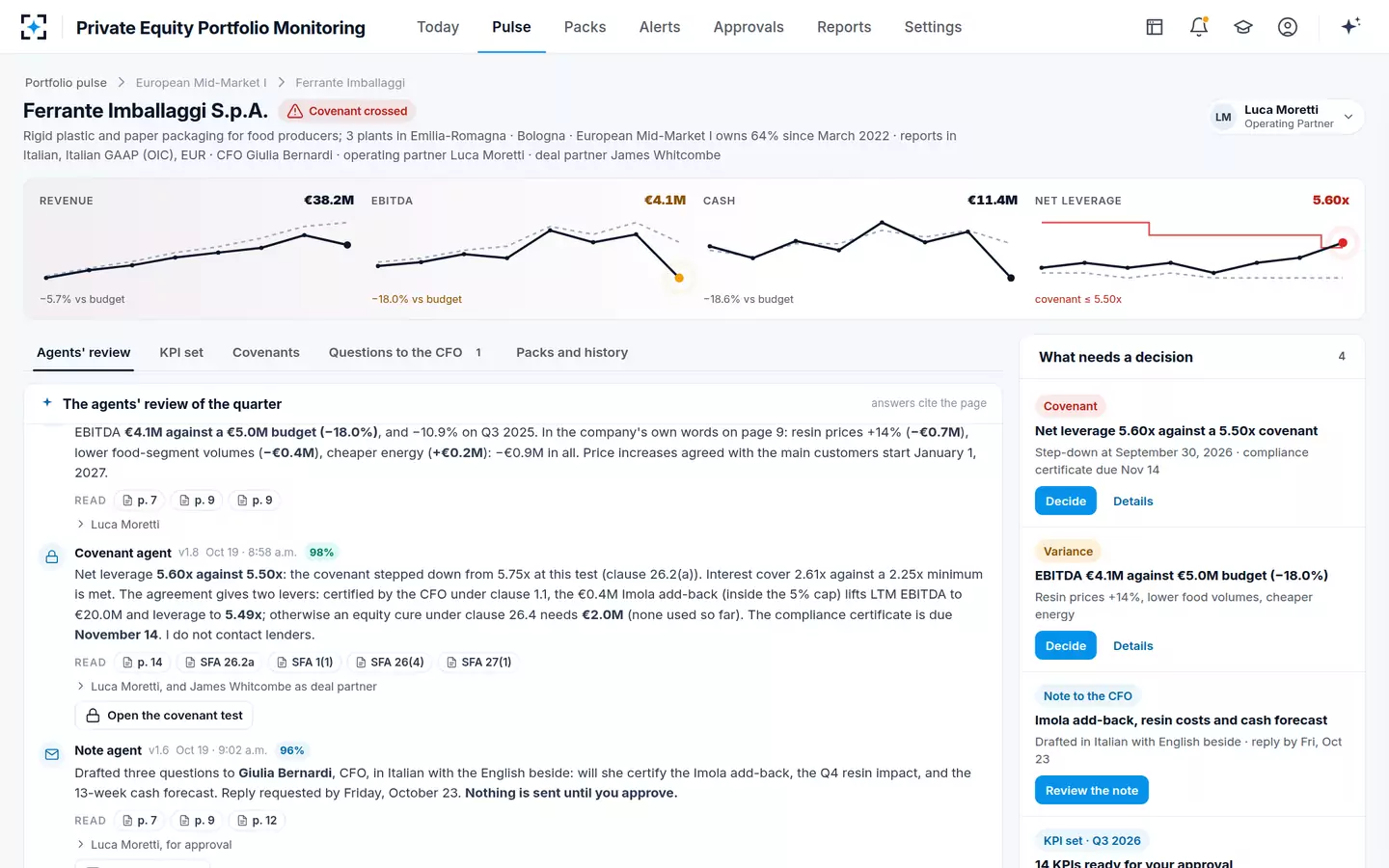
In Private Equity Portfolio Monitoring, each agent states what it read, how sure it is, and who decides next
Can AI test covenants?
AI can test covenants accurately if it applies each facility agreement's own definitions to figures it has already verified, and shows the clause for every step. It should not decide what to do about the result. The arithmetic of headroom, step-downs, add-back caps and cure amounts is mechanical once the definitions are mapped; the choice between a certified add-back, an equity cure and a waiver is a fund decision.
In the sample, the Covenant agent tested Ferrante's net leverage of 5.60x against a covenant that had stepped down to 5.50x, cited clause 26.2(a), and set out three levers in numbers: certifying a €0.4M add-back under clause 1.1 brings leverage to 5.49x; an equity cure under clause 26.4 needs €2.0M; the fourth quarter on budget leaves about 5.58x. Its last line was "I do not contact lenders." The cure itself is worked through in the equity cure guide.
Who approves AI-extracted KPIs?
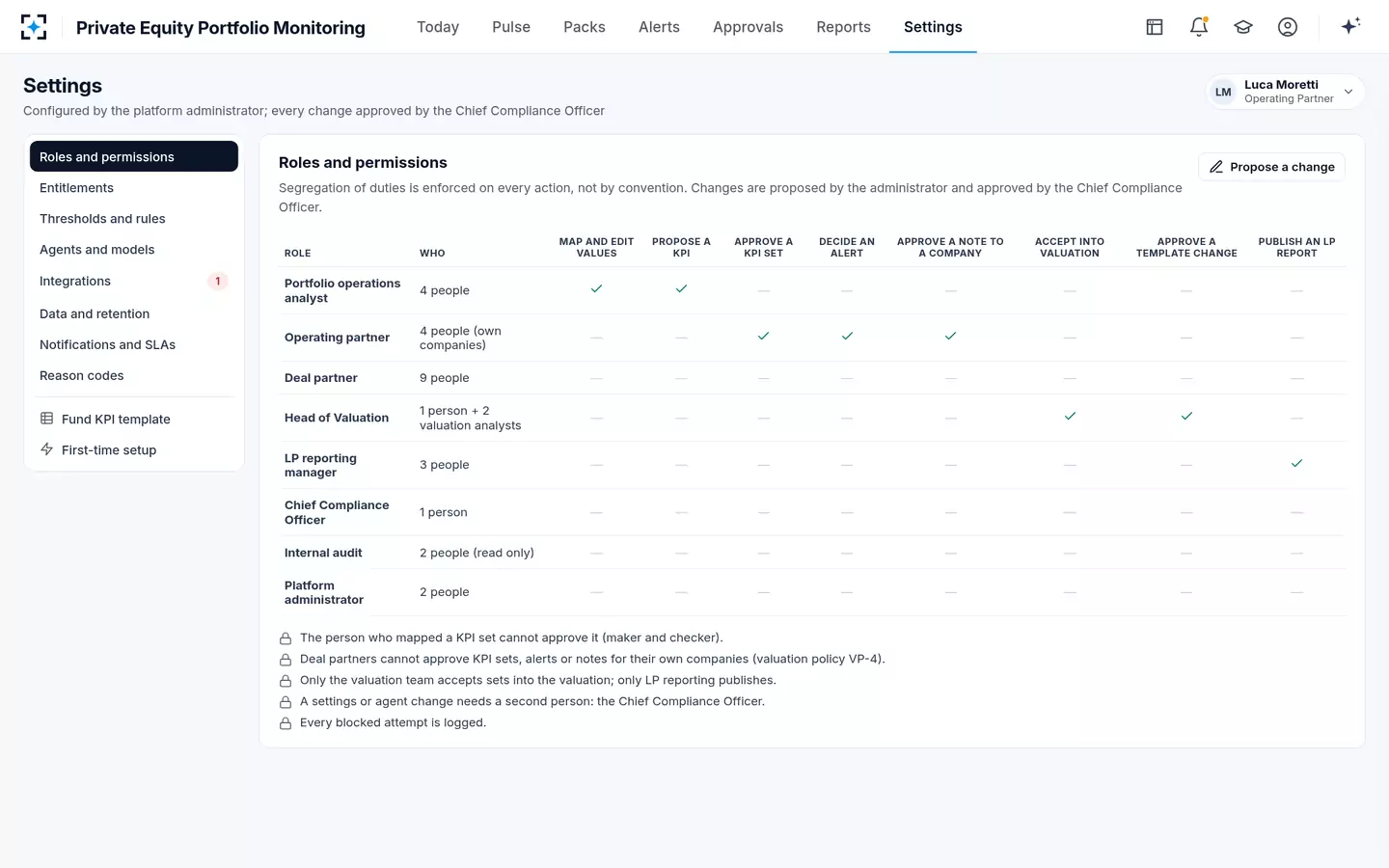
A person who did not map them and has no stake in the company's numbers: in most firms, an operating partner or the head of portfolio operations, never the analyst who confirmed the mapping and never the company's own deal partner. The approval should show what was checked, not just who clicked.
In the solution the approval dialog lists its checks before it accepts a signature: who mapped the set, that the approver is neither the maker nor on the deal team, that all 14 values were re-derived and agree, and that open alerts are decided separately. It then takes a reason code and an attestation. A tool whose approval is a single button has moved the keying and kept the risk.
Segregation of duties in Private Equity Portfolio Monitoring, enforced on every action
What will SEC examiners ask about AI tools in the back office?
They will ask whether the firm's policies cover the tool, whether its controls work as described and whether what the firm says about it is true. The SEC's Division of Examinations notes, in its fiscal 2027 priorities, that firms are building what it calls "super intelligence (SI)" into core systems, from investment analysis to code, and that it will prioritise the policies firms use to oversee SI, naming back-office operations, fraud detection and trading among the uses (SEC Division of Examinations, FY2027 priorities, Oct. 23, 2026).
Portfolio monitoring is back-office work by that description, and the existing rules already reach it. Rule 206(4)-7 requires an adviser to run a written compliance programme built to prevent breaches of the Advisers Act, and to review every year whether it is adequate and works in practice (17 CFR 275.206(4)-7). A monitoring tool that changes how valuation inputs are produced belongs in that review. When the Division reviews automated tools, it asks whether what the firm says about them is fair and accurate, and whether they run the way investors were told; those are fair questions to put to any tool before an examiner does.
The representations half has teeth. In March 2024 the SEC settled charges against two advisers that overstated their use of AI, with $400,000 in penalties between them; the then Chair's message was that an adviser must not claim an AI model it does not actually use (SEC press release 2024-36). A GP that tells its investors its monitoring is automated and verified should be able to show both.
"supplementing, but not replacing, staff judgment"
SEC Division of Examinations, on its own use of super intelligence, Examination Priorities for Fiscal Year 2027
The examiners' description of their own tools is a good standard for a GP's. The Division says its modernisation uses SI to sharpen analysis, speed up workflow and spot patterns and risks in large datasets, supplementing and not replacing staff judgment. A monitoring tool should be held to the same line: it does the reading and the arithmetic, and the people still decide.
Who governs a monitoring tool once the agents are in
Today
Reviews the monitoring process once a year and learns of spreadsheet changes afterwards.
With agents
Approves every change to thresholds, rules and agent versions before it takes effect, on the trail.
Still theirs: Approves settings and agent changes
Today
Samples a few figures a year and rebuilds their history from email.
With agents
Reads any figure's trail end to end and exports the evidence for a period.
Still theirs: Read only
Today
Maintains templates and macros that nobody else understands.
With agents
Sets up integrations and proposes changes; cannot approve a figure or a setting.
Still theirs: No approvals
Today
Approves figures on trust in the analyst.
With agents
Approves with the second reading, the independence check and the page in front of them.
Still theirs: Approves KPI sets, alerts and notes
What are the best portfolio monitoring tools for private equity? Questions to decide it
The best tool for a given GP is the one that takes the most of its twelve tasks with evidence a second person can check, on its own companies' reporting. Feature lists will not show that; a test on a past quarter will. Supervisors have noticed the difference good systems make: the FCA's 2025 valuation review found that "some firms had invested in technology to reduce operational burden and make data collection easier and more accurate" (FCA, Private market valuation practices), and its 2026 conflicts review that "fragmented systems often required manual workarounds, produced less effective management information and increased the risk of omission or error" (FCA, Conflicts of interest and fair customer treatment in private markets).
Questions to put to any portfolio monitoring tool before buying it
- Which of the twelve tasks does it do without a person keying?
Ask for each one. A tool that needs the company or the analyst to type figures into a portal has not taken the mapping.
- Does every figure open its source page?
In the original language, with the line highlighted. Not a link to the whole document.
- Is there an independent second reading?
Re-derived without seeing the first answer, and disagreements sent to a person, not averaged.
- Does it know when it is unsure?
A confidence per value, a threshold you set, and exceptions instead of guesses for periods and units.
- Are adjusted and reported figures kept apart, always?
And are covenant tests run on the agreement's definitions, with clauses cited?
- What can it never do?
Approve, send, contact lenders, publish, change an approved value. Ask to see the permission that stops it.
- How does a change to the tool get approved?
Versioned agents, tested on past reporting before release, approved by your CCO.
- Can it run last quarter beside your team?
A shadow quarter on your own past reporting is the only benchmark that predicts your next one.
Where agents do not fit
Agents are not worth it everywhere. A GP with a dozen domestic companies that all report in the sponsor's template, in one language, with no covenant close to its limit, will save little: the keying is small and the checks are quick. The case grows with the number of companies, languages and accounting standards, with covenant-sensitive companies that need testing the day their figures arrive, and with investors who ask to see the page behind a number.
Agents also do not replace the relationship work. Asking a CFO the right question, reading the tone of the answer, deciding whether a restated quarter reflects a one-off or a pattern: these stay with the analyst and the operating partner. Private Equity Portfolio Monitoring drafts the question and tracks the reply; it does not judge the CFO. For a side-by-side test of tool approaches on one late report, see the software comparison.
Questions people ask
How do portfolio monitoring tools handle foreign-language reports?
Older tools ask the company or the analyst to enter figures in the sponsor's language, so translation happens by hand before the tool sees anything. AI tools can read the original, but should keep it: in the sample, every value opens its page in the original language beside the English reading, and packages arrive in 14 languages across the portfolio.
Does a portfolio monitoring tool replace the portfolio monitoring analyst?
It replaces most of the keying, not the analyst. On our estimate for the sample, an analyst's quarter close falls from about 20 days to about 5; what remains is confirming the values the agents were unsure of, choosing between readings that disagree and handling restatements and CFO questions.
Can a monitoring tool approve figures automatically when it is confident?
It can be configured to offer bulk approval, but a person should still approve. In the sample, the operating partner may approve a clean set in one action only when every value is at 97% confidence or more and there is no open alert, and a pending change to raise that to 98% waits for the Chief Compliance Officer.
How are monitoring agents tested before they change?
By running the new version on past reporting whose figures are already approved and comparing. The solution's agents and models are versioned and evaluated on a set of 480 past reports in 14 languages, and any change is approved by the Chief Compliance Officer before it is used.
Do portfolio monitoring tools train AI models on portfolio company data?
Ask each vendor, and get the answer in the contract. In the solution, company reporting is processed and stored in the company's region, the EU, the United States or Singapore, and no company's reporting is used to train a model.