A portfolio monitoring analyst in private equity collects each portfolio company's monthly and quarterly reporting, maps it into the fund's KPI template, checks it against budget, prior periods and the company's loan covenants, and passes approved figures to the valuation team and the investor report. The title varies (portfolio operations analyst, portfolio analytics associate, portfolio monitoring associate), and the job is the same: deciding when a quarter's numbers are right enough to value and report. Most of the week, though, goes to chasing and re-keying, not judging. Botminds' Private Equity Portfolio Monitoring was built around that gap: its agents read and map the reporting, re-derive every figure and draft the follow-up questions, so the analyst's time goes to the calls only a person should make.
The examples on this page use the solution's sample data, which follows Quillfield Capital, a fictional sponsor with 120 portfolio companies in eight funds and programs, and Sofia Lindgren, one of its fictional analysts, through the third-quarter close of 2026.
The nearest official picture of the seat
$102,740
median annual pay for financial and investment analysts, May 2025
7%
projected growth in financial analyst jobs, 2025–35: "much faster than average"
24%
of financial and investment analysts work in securities, commodity contracts and other financial investments
8.7%
of private equity firms' staff are operating professionals, in a survey of 79 investors
What does a portfolio monitoring analyst do?
A portfolio monitoring analyst runs the quarterly cycle that turns company reporting into fund numbers: collect, map, check, question, hand over. Each step has a deliverable. Collecting ends with every company's reporting in hand or chased; the mapping with a KPI set in the fund's template; the checks with variances explained and covenants tested; the questions with answers from company CFOs; the hand-over with figures the valuation team and the investor reporting team can use without re-doing them.
The BLS description of financial analysts captures the outside of the job: gathering and assessing financial data, projecting trends and writing reports, and one listed duty is to "meet with company officials to gain better insight into the company's prospects" (BLS Occupational Outlook Handbook). The inside of the job, in a private equity firm, is narrower and more repetitive. The companies do not publish their numbers. They send them, in their own format, language and accounting standard, and someone has to make 30 or 120 different reports comparable.
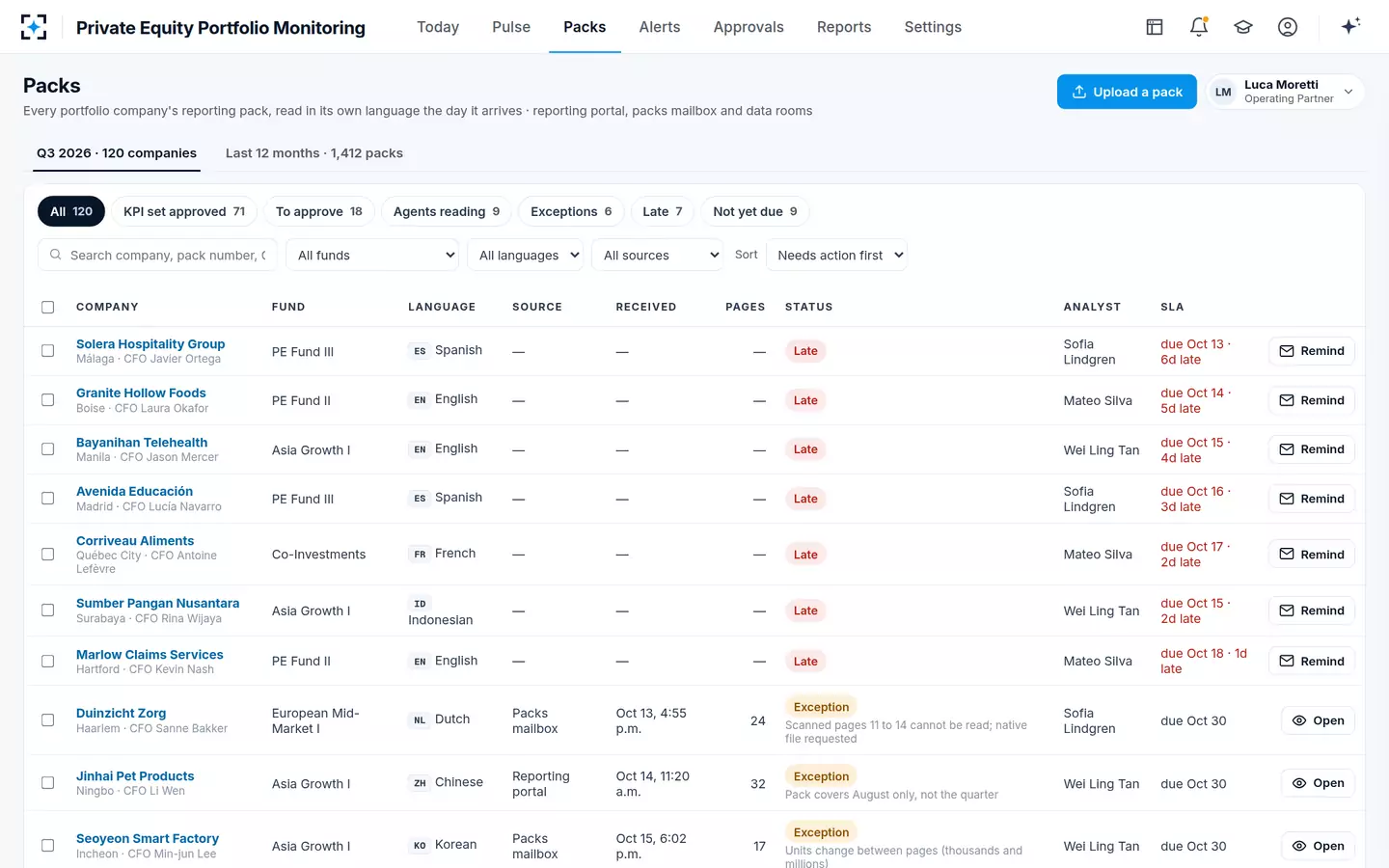
That someone is the analyst, and the comparability work is the job. At Quillfield, four analysts cover 120 companies, about 30 each. Sofia's quarter opens with a queue of reporting packages arriving by portal, email and data room in Italian, German, Dutch and Spanish; it closes when the last KPI set is approved and accepted into the valuation, day 45 on the sponsor's house calendar.
The analysts' queue in Private Equity Portfolio Monitoring on day 19 of the close
What is portfolio monitoring in private equity?
Portfolio monitoring in private equity is the sponsor's continuous check on the companies it owns: are they performing to plan, are they inside their loan covenants, are their figures fit to value and report? It sits after the deal closes and before the exit, and it runs on the companies' own reporting.
The research on what sponsors actually do after closing shows why it matters. In the survey by Gompers, Kaplan and Mukharlyamov, the median private equity investor "claims to be actively involved in all of his or her deals", and after the investment, operating partners "are involved in identifying value sources in 51% of the deals" (NBER Working Paper 21133, published in the Journal of Financial Economics, 2016). The sources of value they cite after closing, led by revenue growth and cost reduction, are exactly what monthly and quarterly reporting measures. Monitoring is how a sponsor knows whether the plan is working before the exit tells it.
Who does a portfolio monitoring analyst report to?
A portfolio monitoring analyst usually reports to a head of portfolio operations or an operating partner, and works alongside the deal team, the valuation team and investor relations without reporting to any of them. The independence is deliberate: the person who maps a company's numbers should not be the person whose carry depends on them.
Valuation supervisors look for the same separation. In its 2025 review of private market valuation, the FCA found some firms where the valuation function "would collect data and apply valuation models but had limited control or ability to challenge inputs or assumptions" (FCA, Private market valuation practices). The monitoring analyst supplies many of those inputs. Where the analyst answers to the deal team, the inputs are the deal team's.
In the sample, the segregation is written into the roles. The analyst maps and proposes; the operating partner approves; the Head of Valuation accepts into the valuation; the LP reporting manager publishes. "The person who mapped a KPI set cannot approve it", and "deal partners cannot approve KPI sets, alerts or notes for their own companies", as the solution's settings put it. Sofia can propose a figure; she cannot make it final.
Five people carry each company's numbers to investors, as Private Equity Portfolio Monitoring assigns them
Today
Collects each company's quarterly reporting, retypes it into the fund template, reconciles it to budget and prior periods, and chases the late ones.
With agents
Confirms the judgment calls the agents raise: a value under the confidence threshold, two readings that disagree, a restated quarter.
Still theirs: Maps; never approves own work
Today
Hears about a tight covenant from a spreadsheet, often late, and asks for the page behind the number.
With agents
Opens the companies that crossed a line first, with the page, the covenant test and a drafted note to the CFO.
Still theirs: Approves KPI sets, alerts and notes
Today
Wants to hear about a covenant before the lender does.
With agents
Gets the escalation weeks before the compliance certificate, with the clauses and the levers in numbers.
Still theirs: Owns the lender; never approves own companies
Today
Takes inputs from people who do not own the deal, then asks where each came from.
With agents
Accepts approved KPI sets as locked inputs, each traced to its page and approver.
Still theirs: Accepts into the valuation
Today
Checks that every company figure in the investor report matches the valuation.
With agents
Publishes a portfolio section drafted only from accepted figures.
Still theirs: Publishes
What is the difference between portfolio monitoring and portfolio management?
Portfolio management decides what to own and in what size; portfolio monitoring checks, after the decision, how what you own is doing. In a public-markets firm, a portfolio manager trades the book. In private equity, there is no daily book to trade: the "portfolio" is a set of companies held for years, and monitoring is the discipline of reading their results, testing their covenants and feeding the valuation.
The two titles also attract different people. The BLS notes that financial analysts "may advance to become portfolio or fund managers" (BLS). The monitoring seat is one of the few places in a private equity firm where an analyst sees every company in a fund, every quarter, from the inside, which is why it is a common route into operating or deal roles.
Where the analyst's quarter actually goes
The honest answer is that about half of it goes to collecting and re-keying. Our estimate of one Quillfield analyst's 20-day quarter close puts four days on collecting and chasing, six on retyping and mapping into the template, three on checks against budget and prior periods, two on covenant tests, two on questions to company CFOs and three on valuation inputs and the investor report section.
Half an analyst's quarter is mechanical work, by hand
By hand · about 20 days (estimate)
- Collecting and keying · 50%
- Checking · 15%
- Covenants and CFO questions · 20%
- Valuation and investor report · 15%
With agents reading · about 5 days (estimate)
- Collecting and keying · 40%
- Checking · 10%
- Covenants and CFO questions · 20%
- Valuation and investor report · 30%
The estimate is ours, and a team should measure its own. The method is simple: for one quarter, have each analyst log their days against the six steps, then divide each step by the number of companies. The useful comparison is not with another firm, which nobody publishes, but between your own analysts: the one who spends twice as long keying as the others is usually covering the companies with the least standard reporting. The portfolio monitoring process guide prices those days.
"Half my quarter is copying numbers out of Italian and German PDFs."
Sofia Lindgren, the sample's fictional portfolio operations analyst
The judgment calls only the analyst can make
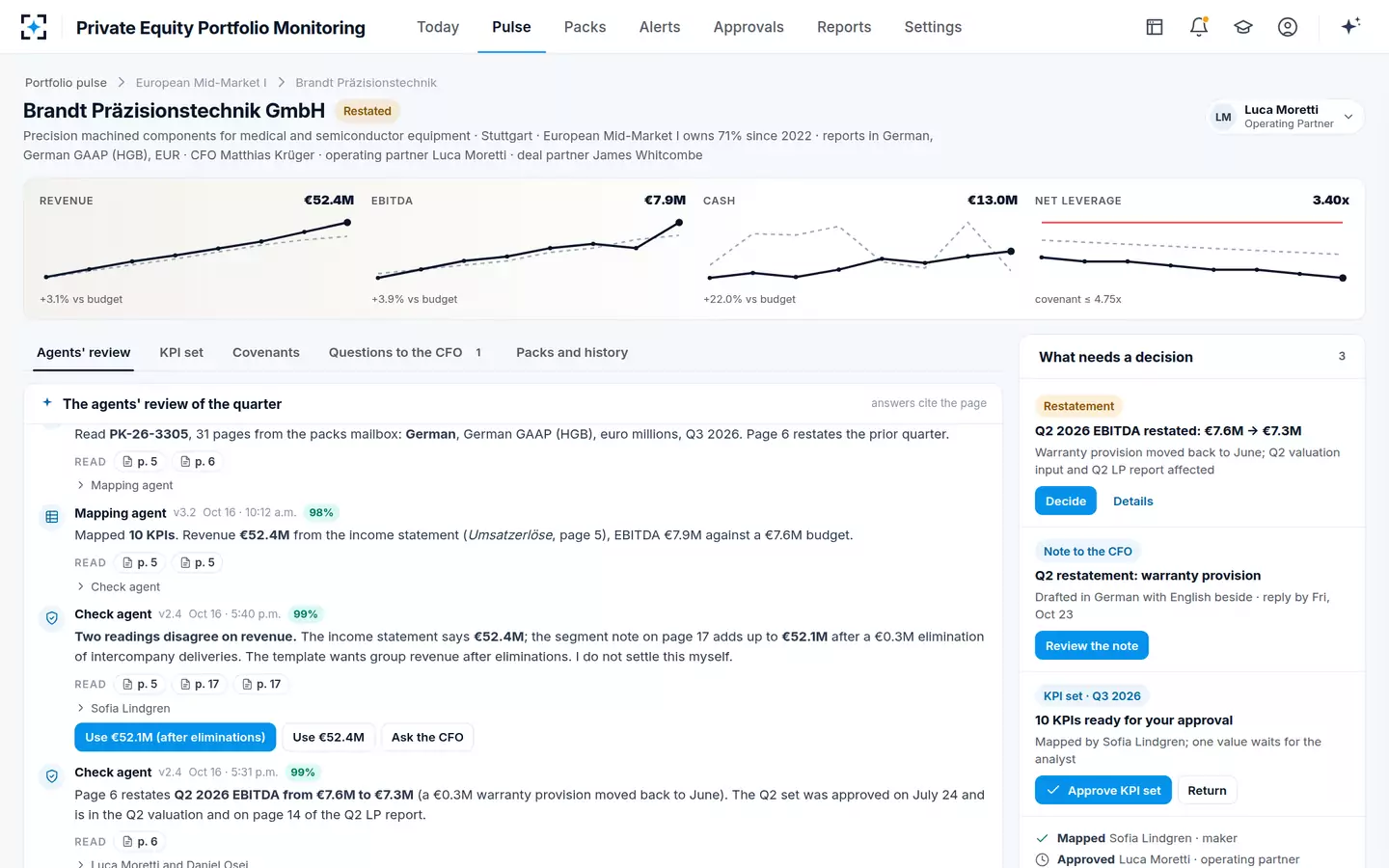
Three decisions recur every quarter, and none of them is keying. The first is which figure the template means: in the sample, Brandt Präzisionstechnik's income statement showed revenue of €52.4M while its segment note added up to €52.1M after eliminating sales between group companies. The fund defines revenue after eliminations, so the right answer is €52.1M, and the reason has to stay with the number.
The second is whether a figure is reported or adjusted. Ferrante Imballaggi's Italian report showed EBITDA of €4.1M and an adjusted €4.5M that excluded a €0.4M one-off. The mapping agent was 93% sure the €4.5M line was adjusted EBITDA; under the sponsor's 95% threshold, it asked Sofia, who confirmed it. The third is a restatement: when Brandt's third-quarter report changed its second-quarter EBITDA from €7.6M to €7.3M, someone had to decide what the change touched, and the answer included a published investor report.
The analyst's screen in Private Equity Portfolio Monitoring when the agents disagree
Why the covenant test belongs to the monitoring seat
The covenant test belongs to the analyst because the analyst holds the company's numbers first, weeks before the compliance certificate goes to the lender. Lenders write covenants tight on purpose. Dichev and Skinner, studying a large sample of private loan agreements, found that "private lenders set debt covenants tightly and use them as 'trip wires' for borrowers, that technical violations occur relatively often, and that violations are not necessarily associated with financial distress" (Journal of Accounting Research, 2002).
A sponsor that tests on the day the reporting arrives has time to choose between an add-back the CFO can certify, an equity cure, a waiver or a conversation with the lender. In the sample, Ferrante's leverage of 5.60x against a 5.50x covenant was tested the day its report arrived, October 16, four weeks before the certificate was due on November 14. What the sponsor does with that time is the subject of the equity cure guide.
The operating partner, and why the SEC has asked about the role
Operating partners are the analyst's usual approvers and the people who act on what monitoring finds. In the Gompers, Kaplan and Mukharlyamov survey, "8.7% of employees are operating professionals", part of "a total of 16% who can be considered exclusively concerned with operational engineering", against almost 75% who are deal-oriented (NBER WP 21133).
Private equity firms are staffed for deals; monitoring sits in the small operating share
The role has also drawn examiners' attention, on who pays for it. In 2020 the SEC's examination staff reported advisers that "did not provide adequate disclosure regarding the role and compensation of individuals that may provide services to the private fund or portfolio companies, but are not adviser employees (known as 'operating partners')", potentially misleading investors about who bears the cost (SEC Risk Alert, June 23, 2020). For a monitoring team, the practical lesson is that approvals should name the person and their role, so the firm can show who did the work and on whose account.
How much does a portfolio monitoring analyst earn, and what skills does the seat need?
No official statistic covers portfolio monitoring analysts specifically. The nearest is the BLS category of financial and investment analysts: median pay of $102,740 in May 2025, with 7% projected job growth to 2035, "much faster than average" (BLS). That median covers analysts in banks, insurers and corporate finance teams as well as investment firms, so it is a floor for comparison more than a benchmark; private equity firms do not publish their pay scales.
The skills are less glamorous than a deal analyst's and harder to find. Reading financial statements under several accounting standards, often in a second language. Knowing what a facility agreement's definition of Consolidated EBITDA does to a covenant ratio. Spotting a restated prior quarter in a report that does not announce it. Writing a question to a company CFO that gets an answer the first time. And keeping the trail: which page, which reading, which approval, for every figure the valuation will use.
Is portfolio monitoring a good job, and how is it changing?
It is a good seat for an analyst who wants to understand businesses from the inside, and a frustrating one where most of the quarter is re-keying. The change worth watching is which half of the job moves. Reading a report in Italian, mapping it to the template and re-deriving every figure a second way can now be done by software, with each value cited to its page. Deciding which figure the fund means, whether a restatement reaches the investor report and what to ask the CFO cannot, and should not.
In Private Equity Portfolio Monitoring, that split is enforced rather than hoped for. The agents never approve a KPI set, never send a note to a CFO and never change an approved value; anything under the sponsor's 95% confidence threshold goes to the analyst. On the sample's estimate, an analyst's quarter close falls from about 20 days to about 5, and what remains is the judgment. Which tasks move and which stay is laid out in the guide to portfolio monitoring tools for private equity.
Questions people ask
What is an operating partner in private equity?
An operating partner is a professional with operating rather than financial experience who works with portfolio companies on strategy, cost and management. In the Gompers, Kaplan and Mukharlyamov survey, operating partners helped identify value sources before the investment in 45% of deals, while outside consultants were used in almost 37% before and 27% after. Many firms place the monitoring team under an operating partner for that reason.
Is a portfolio monitoring analyst the same as a portfolio analyst?
Not usually. A portfolio analyst in an asset manager typically supports a portfolio manager with performance and risk on listed holdings. A portfolio monitoring analyst in private equity works on privately held companies' reported results, covenants and valuation inputs. The skills overlap; the data does not.
How many companies does one portfolio monitoring analyst cover?
No regulator or independent study publishes a ratio, and it depends on how standard the companies' reporting is. In the sample, four analysts cover 120 companies, about 30 each. A team can measure its own ratio by logging days per company for one quarter.
What qualifications does a portfolio monitoring analyst need?
A bachelor's degree is the usual way in, according to the BLS. Accounting training helps more than in most analyst roles, because the work is reading financial statements under several standards. A second European or Asian language is a real advantage in a fund with international companies.
Does the portfolio monitoring analyst value the companies?
No. The analyst supplies inputs, such as trailing twelve-month EBITDA and net debt, and the valuation team uses them with its own multiples and methods. In the sample, the Head of Valuation accepts each approved KPI set as a locked input; if a company later restates, only the inputs the restatement touches are reopened.