Private equity portfolio monitoring software collects each portfolio company's monthly and quarterly reporting, turns it into the fund's KPIs, checks it, tests covenants and passes approved figures to the valuation and the investor report. There are three broad approaches on the market: a spreadsheet workbook fed by email, a data-collection portal into which companies key their figures, and AI agents that read each company's own report and verify every figure a second way. The best choice for a GP is the one that catches the errors its own portfolio produces, and that is easier to see by running one week of a real quarter through each approach than by comparing feature lists. Botminds' Private Equity Portfolio Monitoring is the third approach; this guide tests all three on the same week, and is plain about where each fits.
The test week comes from the solution's sample data on Quillfield Capital, a fictional sponsor with 120 portfolio companies, in the middle of its third-quarter close of 2026. The comparison of the other two approaches is our assessment, not a test of any vendor's product.
The market the software serves
27,682
private equity funds on Form PF at the end of 2025, up from 6,891 in early 2013
4
test cases in one sample week: a foreign-language report, a disputed line, a restated quarter, a covenant crossing
2,571 of 2,594
values matching the sample team's own figures when the agents re-ran a past quarter
What is the best portfolio monitoring software for private equity?
The best portfolio monitoring software for a private equity firm is the one that, on its own companies' reporting, gets the most figures right without a person keying them, and shows the evidence for each. A firm with a dozen domestic companies reporting in its template may be best served by a disciplined workbook; a firm with a hundred companies in several languages and covenant-sensitive capital structures needs more of the reading and checking done for it.
Four kinds of error decide the comparison, because they are the ones that reach valuations and investor reports: the wrong line taken as the KPI (adjusted for reported, or a segment total before eliminations); a period or unit error; a restated prior quarter that nobody carries through; and a covenant crossing found late. SEC examiners have described where such errors end up, reporting private fund advisers whose track records used inaccurate data, including figures from the wrong time periods (SEC Risk Alert, Jan. 27, 2022).
The test: one week of a real quarter, three ways
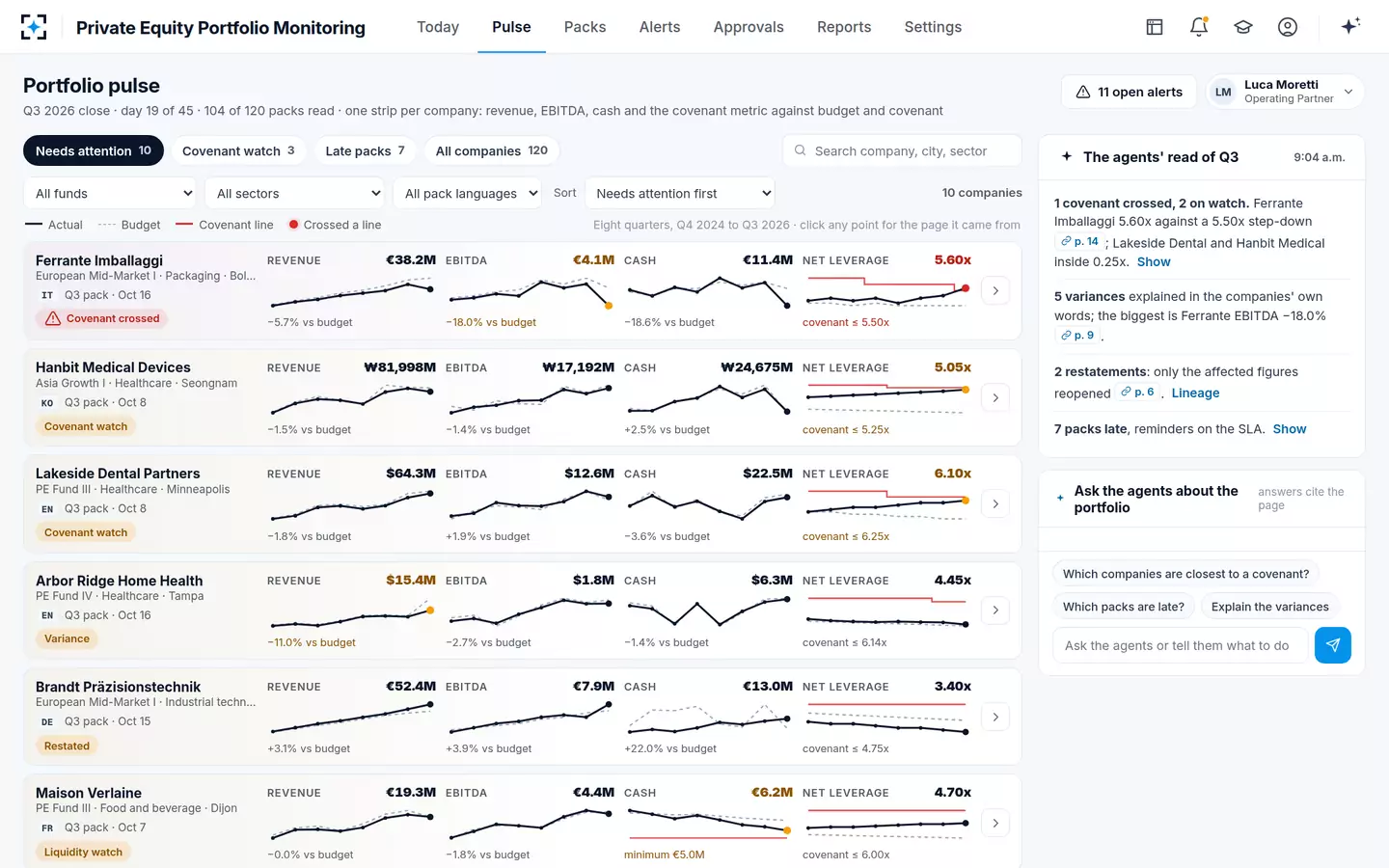
In the sample week, four companies' reports arrived with a problem each. Ferrante Imballaggi sent a 24-page Italian report in which EBITDA appears twice, €4.1M reported and €4.5M adjusted, and whose leverage of 5.60x had crossed a covenant that stepped down to 5.50x that quarter. Brandt Präzisionstechnik sent a German report whose income statement and segment note disagreed on revenue by €0.3M, and which restated the prior quarter's EBITDA from €7.6M to €7.3M. Seoyeon Smart Factory's Korean report switched from thousands to millions between pages. Jinhai Pet Products sent a report covering August only.
One sample week: keyed approaches against Private Equity Portfolio Monitoring, case by case
Keyed by hand: spreadsheet or portal: Depends on which line the analyst or the company's finance team types into the single EBITDA cell.
Agents, with a second reading: Both lines read and kept apart; the adjusted line, read at 93% confidence, went to the analyst to confirm.
Keyed by hand: spreadsheet or portal: Whichever total is typed; the other is never seen.
Agents, with a second reading: Two readings disagreed by €0.3M; both pages shown; the analyst chose the figure after eliminations.
Keyed by hand: spreadsheet or portal: Spreadsheet: overwritten or missed. Portal: a new submission replaces the old with no trace of what used it.
Agents, with a second reading: Flagged above the 1% threshold, traced to the KPI set, the valuation input and an investor report page; those reopened.
Keyed by hand: spreadsheet or portal: Caught if the analyst notices the scale; a portal accepts what is typed.
Agents, with a second reading: Raised as an exception; no value written until a person resolves it.
Keyed by hand: spreadsheet or portal: Easy to key as the quarter.
Agents, with a second reading: Raised as an exception: period does not match.
Keyed by hand: spreadsheet or portal: Found when someone runs the covenant workbook, often near the certificate date.
Agents, with a second reading: Tested on the agreement's definitions the day the report arrived, 29 days before the certificate.
The pattern is that keyed approaches fail in the same places, because the failure happens before the figure reaches the software. A portal moves the keying from the sponsor's analyst to the company's finance team, which knows its own numbers better but does not know the sponsor's definitions, and has no reason to flag that the prior quarter changed. The software then stores a clean-looking number with no page behind it.
Is Excel enough for portfolio monitoring?
Excel is enough for portfolio monitoring when the portfolio is small, the reporting standard and the covenants loose; it stops being enough when the team cannot show, for any figure, where it came from and who checked it. The spreadsheet itself is rarely the problem. The trail is.
For a registered adviser the trail is a legal requirement where the figures feed performance it presents. Rule 204-2 requires that the working papers behind any presented performance be kept, and that electronic copies be organised and indexed so that any single record can be found and pulled quickly, with "a legible, true, and complete copy" provided promptly when examiners ask (17 CFR 275.204-2(a)(16), (g)). A folder of quarterly workbooks with overwritten cells satisfies the first half with difficulty and the second rarely.
Supervisors have also described the cost of patchwork systems more generally. In its October 2026 review of conflicts management in private markets, the FCA found: "Firms with weaker fragmented arrangements used different systems for handling particular conflicts, or manual records combined with spreadsheets." These firms, it added, "typically reviewed how well their conflicts were managed less frequently and in less depth" (FCA, Conflicts of interest and fair customer treatment in private markets). The finding is about conflicts, not monitoring, but the mechanism is the same: what is hard to see is checked less often.
Portfolio monitoring software vs a data-collection portal
A data-collection portal asks each company to enter its figures into the sponsor's template online; portfolio monitoring software, in the fuller sense, takes in the company's own report and produces the template itself. The portal standardises the format at the cost of a second keying step, done by people outside the sponsor.
Portals solve a real problem, which is gathering the figures: one place, one deadline, one format. They make chasing easier and comparisons faster. What they cannot do is verify, because the only evidence for a portal entry is the entry. Ask a portal-based tool for the page behind a figure and the honest answer is the attachment the company uploaded, if it uploaded one. For a sponsor whose companies report in their own languages and standards, the portal also shifts translation and mapping onto company finance teams, who often send the template late or not at all and attach their own management report instead.
Private Equity Portfolio Monitoring draws every company against budget and covenant, each point opening its page
Agents with a second reading: what changes, and what does not
With agents, the company sends whatever it already produces, and the software does the reading, mapping and checking; the analyst confirms what the agents are unsure of and the operating partner approves. What changes is where the evidence sits: every value carries its page, its confidence, its second reading and its approver. What does not change is who decides.
The second reading is what makes the approach safe rather than merely fast. An AI system that reads a report once can be confidently wrong; one that derives each figure a second way, without seeing the first answer, and sends every disagreement to a person, fails loudly instead. In the sample week, the second reading is how Brandt's €0.3M revenue gap surfaced: the first agent read the income statement, the second added up the segment note, and neither settled the difference.
Agents bring their own risk to manage, and examiners have said they will look at it. The SEC's fiscal 2027 priorities say the Division will look at the risks of firms' growing reliance on outside providers and shared technology, and at how well those risks are managed (SEC Division of Examinations, Oct. 23, 2026). A GP buying an AI monitoring tool should be able to show how it tested the tool, who approves changes to it, and where the companies' data is held. The task-by-task split of what moves to agents is in the guide to portfolio monitoring tools.
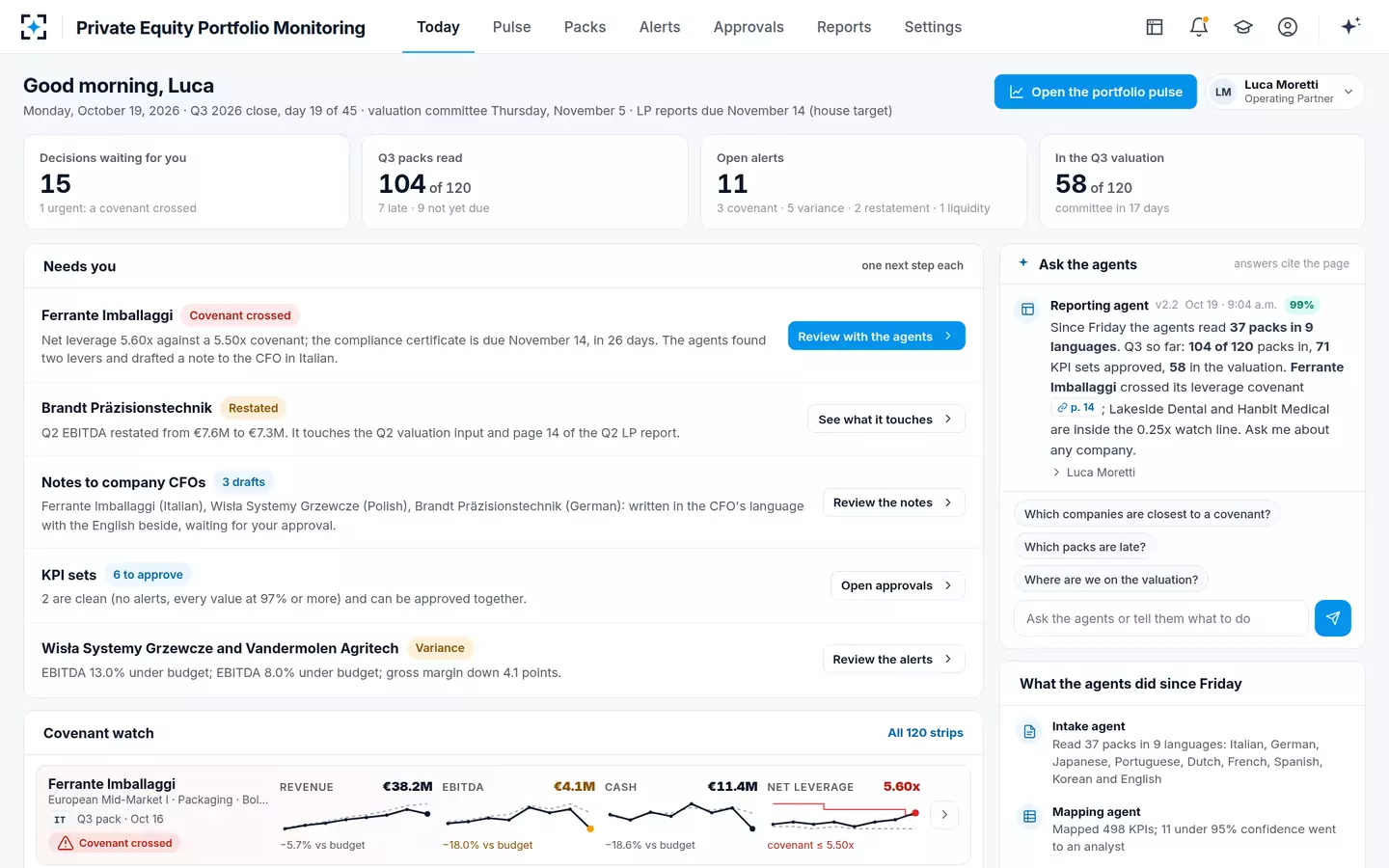
Day 19 of the quarter: the close is a queue of states, not a sheet of numbers
Can portfolio monitoring software feed the valuation?
It should feed the valuation only with figures that have been approved, and it should lock them once the valuation team accepts them. The valuation model stays where it is; what the monitoring software supplies is inputs with lineage, such as trailing twelve-month EBITDA and net debt, each traced to its page and approver.
The test is what happens when an input changes after acceptance. In the sample, Brandt's restated second quarter moved its trailing EBITDA from €28.8M to €28.5M, a figure already in the second-quarter valuation. The software traced it to that input and to page 14 of a published investor report, reopened those two and nothing else, and left the decision to the operating partner and the Head of Valuation. A tool that silently updates the valuation feed is worse than one that does not feed it at all. The valuation itself belongs to Botminds' Private Markets Valuation; what its private equity valuation software does with an accepted input is a separate guide.
What does portfolio monitoring software cost?
Vendors do not publish prices, and no regulator or independent study tracks them, so price it against what it replaces: the analyst days it releases and the errors it prevents. The first is measurable from public wage data and your own day counts, as set out in the portfolio monitoring process guide; the second is harder to price but shows up as rework, late covenant warnings and corrected investor reports.
Ask each vendor for a price on your company count, reporting frequency and number of languages, and for what is included: connections to your fund accounting, valuation model and investor portal; the covenant library; testing changes before release. A cheap portal that leaves the mapping with your team may cost more in analyst time than a more expensive tool that takes it.
How long does portfolio monitoring software take to implement?
It takes as long as building and proving each company's map, which is why the honest implementation plan is measured in quarters of evidence rather than weeks of configuration. The work is the same for any approach: collect the fund KPI template, the facility agreements and a sample of each company's past reporting; map each company; and run a past quarter beside the team before anyone relies on the output.
That last step, a shadow quarter, is the one to insist on. In the sample, the agents re-ran a past quarter's reporting beside the team: 2,571 of 2,594 values matched the team's approved figures, and each of the 23 differences was explained before anyone relied on the output. A vendor unwilling to run your last quarter beside your team is asking you to take its accuracy on trust.
What the operating partner opens on day 19
What should I ask a portfolio monitoring software vendor?
Questions for any private equity portfolio monitoring software vendor
- Who keys the figures?
Your analysts, the companies, or the software from the companies' own reports? Everything else follows from the answer.
- Show me the page behind this figure
Pick any value in the demo. The original page, in its language, with the line highlighted, or a file to search?
- What happens when two readings disagree?
A person chooses with both pages, or the software picks one. Ask to see a disagreement.
- How is a restated prior quarter handled?
Detected, traced to what it touches, and reopened only by a person, or overwritten.
- Are covenant tests run on each agreement's own definitions?
With step-downs, add-back caps and cure arithmetic, and the clause cited for each.
- Can the software approve, send or publish anything?
The right answer is no. Ask for the permission matrix and the log of blocked attempts.
- How do you test a change before it reaches us?
Versioned agents, evaluated on past reporting, and approval by our Chief Compliance Officer.
- Will you run our last quarter beside our team?
And explain every difference before we go live.
Where Botminds' Private Equity Portfolio Monitoring does not fit is worth saying too. It does not replace a fund accounting system, a valuation model or an investor portal; it connects to them. It does not calculate fees, mark investments or publish reports. And for a small portfolio reporting in one language into a template the companies actually use, a well-kept workbook with a second reviewer may be the better buy.
Questions people ask
Do portfolio companies need to change how they report?
Not with an approach that reads their own reports. Companies keep sending what they already produce, in their own language and format; the map from their lines to the sponsor's template is kept on the sponsor's side. With a portal, companies must re-key into the sponsor's template each period.
Can portfolio monitoring software handle monthly and quarterly reporting?
It should handle both, plus annual audited accounts, from the same company map. In the sample, 120 companies send 1,412 monthly, quarterly and annual reports a year, which is the volume that makes keying by hand expensive.
Is portfolio monitoring software the same as fund administration software?
No. Fund administration software keeps the fund's books: capital accounts, NAV, fees and investor allocations. Portfolio monitoring software works one level down, on the portfolio companies' own results and covenants. The two meet at the valuation and the investor report.
Where is portfolio company data stored?
Ask each vendor and put the answer in the contract. In the solution, each company's reporting is processed and stored in its region, the EU, the United States or Singapore; deal teams see only their own funds' companies; and no company's reporting is used to train a model.
How do you compare portfolio monitoring vendors fairly?
Give each the same past quarter of your own companies' reporting, with the figures your team approved, and count the differences and how each was explained. A demo on the vendor's own sample data shows the screens; your own quarter shows the accuracy.