Private equity valuation software is any system that helps a manager turn portfolio company results, market data and transaction history into quarterly fair value marks: model templates, peer and market data feeds, valuation workflow and approval tools, and, newer, AI agents that read the source documents and compute the methods themselves. The question a buyer has to answer is not which tool computes fastest but which decisions it takes, because regulators assign the fair value judgement to a manager's people, independent of the deal team, and expect a record of how each judgement was made. Botminds' Private Markets Valuation is built on that line: seven agents read company reports in their own languages, compute comparables, DCF and calibration independently, argue against every mark and seal the evidence, and they never prepare, check or approve a mark.
The examples come from fictional sample data in the solution: Quillfield Capital marking 304 positions for the quarter ended September 30, 2026. Regulatory statements are linked where they appear.
Private Markets Valuation: what the agents do, and the three decisions only people make
Agent
ReadThe Company Data agent reads each quarterly report in its own language and pins every figure to its page; 296 reports and 3,911 figures in the sample quarter.
Never: changing a figure the company reported
Agent
ComputeComparables, DCF and Calibration agents each compute their method independently from cited inputs; policy weights give a proposed mark.
Never: dropping a peer or inventing a forecast
Agent
ArgueThe Challenger agent argues against every converged mark with plan misses, peer moves, co-investor marks, adviser ranges and exit backtests.
Never: changing a mark, or arguing without a citation
A person decides
PrepareThe valuation analyst answers each challenge and prepares the mark with a reason code.
A person decides
CheckThe head of portfolio valuation checks reasoning and sources; no one checks a mark they prepared.
A person decides
ApproveThe valuation committee approves material marks with quorum, and the chair signs the quarter.
Agent
SealThe Evidence agent seals every input, answer and decision on an append-only trail for auditors and examiners.
What is private equity valuation software?
It is four different kinds of product that share a name, and they divide the work very differently. Before comparing vendors, decide which kind of work you want off your team's desks: keying and gathering, computing, governing the decision, or all three.
Four kinds of private equity valuation software, and what each leaves to people
| Kind | What it does | What stays manual | Where it can fail |
|---|---|---|---|
| Model templates and libraries | Standard workbooks or a model engine for multiples, DCF and waterfalls | Gathering inputs, choosing peers, writing the memo, building the evidence | Inputs typed by hand; versions multiply across analysts |
| Market and peer data feeds | Peer prices, multiples, rates and FX at the measurement date | Everything about the company itself and every judgement | Peer sets chosen once and never revisited |
| Valuation workflow systems | Routing, sign-offs, committee papers and an audit trail | Reading reports and computing the methods | A clean trail around numbers still built in spreadsheets |
| Agents that read, compute and argue | Read source documents, compute each method, challenge the result, draft and seal | Every decision: prepare, check, approve, override | Unclear authority, uncited outputs, unvalidated models |
Regulators have noticed the category. The FCA's 2025 review recorded that "some firms said they had introduced an automated third-party valuation software to improve consistency and reduce the risk of human error", and suggested firms "consider whether they can make investments in technology to improve consistency and reduce the risk of human error in their valuation process" (FCA, Private market valuation practices, March 2025). Consistency and fewer keying errors are the honest benefits to buy for. Faster marks are a by-product.
Can AI value a private company?
AI can do most of the computing in a private company valuation, but no regulator lets it own the result. Agents can read a company's quarterly report in Italian, extract its EBITDA and adjustments, refresh a peer set, roll a DCF and calibrate to the entry price faster and more consistently than an analyst with a spreadsheet. The fair value decision, and the accountability for it, stays with the manager's people.
Regulators frame this as unchanged duties rather than new AI rules. The SEC's examiners record, in their fiscal 2027 priorities, that firms now use generative "super intelligence (SI)" tools, its term, for research, drafting, client communications and portfolio management, and that examiners will check that the duties firms already had are still met, whatever the technology (SEC, Examination Priorities, fiscal year 2027; staff priorities, not a rule). Europe's securities regulator, writing about investment services to retail clients, put the principle in one line: responsibility for a decision stays with the firm's management body, however much an AI tool contributed to it (ESMA public statement, May 30, 2024).
ESMA's statement concerns retail investment services, not private fund valuation, but the logic transfers. For an EU fund manager the AIFM Directive is explicit that "AIFMs are responsible for the proper valuation of AIF assets, the calculation of the net asset value and the publication of that net asset value" (Directive 2011/61/EU, Article 19(10)). Software that decides a mark does not move that responsibility; it hides who exercised it.
Who approves a fair value mark?
A person or committee independent of portfolio management, under the manager's valuation policy. In the EU, valuation is done by an external valuer or by the manager, provided the task is kept functionally separate from portfolio management and pay (Article 19(4)). For US registered funds, the board or its valuation designee determines fair value under Rule 2a-5. For private funds, the fund's documents and the manager's policy say who approves, and the SEC examines whether the manager followed them.
The useful design is three distinct people: one prepares, one checks, a committee approves, and none of them can do another's step on the same mark. In the sample quarter that was the valuation analyst, the head of portfolio valuation and the committee chair with four of five voting members present. Each step carried a reason code, and the software refused a check or approval by the preparer. A tool that lets one user prepare and approve has made segregation optional.
Can the deal team change a mark?
It should not be able to, and good software makes that a fact rather than a policy. The FCA found firms where investment professionals were "proposing changes to comparable asset sets or discount rates", and singled out as weakest those whose valuation committees gave senior investment professionals all or most of the votes (FCA; valuation committee terms of reference covers membership). Its strongest firms kept investment views "segregated and clearly documented", with the independent function in control "of valuation models, including input and assumption changes".
In the solution the deal team sees only its own funds, only after a mark is prepared, and can add information but never set, edit, check or approve a mark. In the sample quarter the partner on one company added a signed customer price increase. The DCF agent quantified it, the analyst used it to answer a challenge, and the committee saw who supplied it. That is the deal team's knowledge in the mark without the deal team's hand on it.
Seven agents, and what each may never do
Every agent in a valuation system should have a written job and written limits, because the limits are what an examiner or auditor will test. The table lists the solution's seven, with the limits built into each.
The seven agents in Private Markets Valuation: their jobs and their limits
| Agent | What it does | What it may never do |
|---|---|---|
| Company Data agent | Reads each company’s quarterly report, accounts, plan and compliance certificate in the original language; extracts LTM revenue, EBITDA, adjustments, net debt and KPIs; pins each figure to its page; requests late reports in the company’s language | Change a figure the company reported; use a figure without a source; proceed below its confidence threshold |
| Comparables agent | Builds and maintains each peer set, pulls multiples from the market data vendor, explains why each peer is in, flags outliers | Drop a peer on its own; exclude a peer except on a confirmed event under the policy |
| DCF agent | Rolls the DCF from the company’s plan, rebuilds WACC, runs sensitivities, tracks plan against actuals | Invent a forecast; it uses the company plan or the analyst’s override with a reason code |
| Calibration agent | Calibrates to the entry price or most recent transaction and rolls the calibrated multiple forward; reads share-class rights for recent rounds | Treat a recent round as fair value without calibration |
| Challenger agent | Argues against every converged mark with last quarter, the peer index, co-investor marks, adviser ranges, plan misses and exit backtests | Change a mark; raise a challenge without a citation; close a challenge without a person’s answer |
| Committee papers agent | Drafts the committee papers by exception, the minutes from the decisions, and the quarter reports | Approve anything; it drafts only |
| Evidence agent | Seals every input, statement and decision with its source and a hash; builds auditor and regulator evidence sets | Edit or delete the trail, which is append-only; release an export without watermarking it to the requester |
An agent whose job is to disagree
The most useful agent in a valuation system is the one that argues. Most valuation errors are not arithmetic; they are a plan nobody haircut, a peer nobody questioned, a calibration nobody refreshed. A challenger that must cite, that cannot change the mark, and whose every challenge needs a person's answer turns those habits into a list someone has to clear.
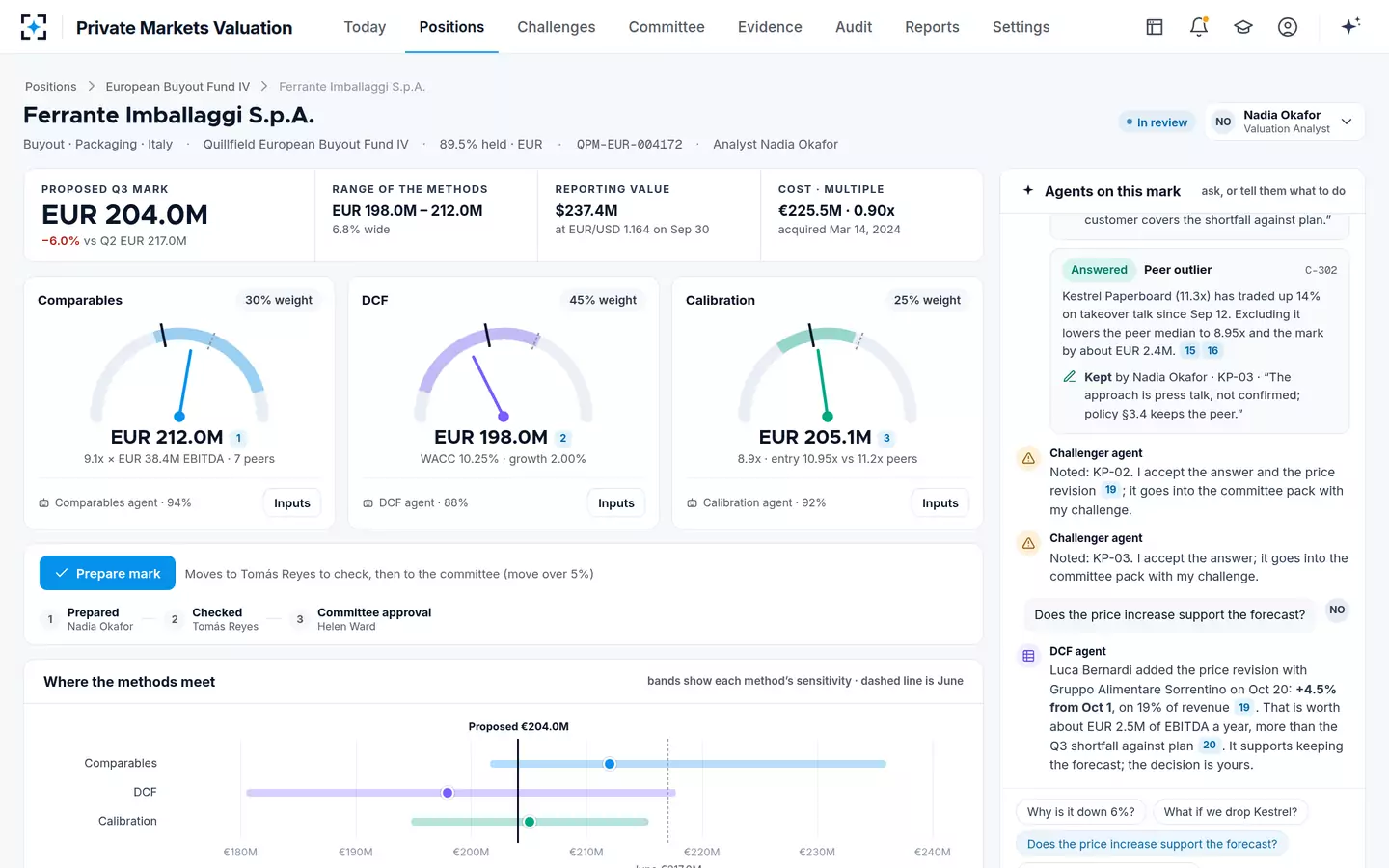
On the sample company, an Italian packaging business marked at EUR 204.0 million, the Challenger agent raised two points. The plan had missed EBITDA three quarters running (−1.8%, −3.4%, −2.1%), and a 2% haircut on forecast cash flow would take the mark to EUR 201.3 million. And one of seven peers, at 11.3 times EBITDA, was trading on takeover talk; without it the median would be 8.95 times and the mark about EUR 2.4 million lower. The analyst kept the forecast, citing a signed price increase, and kept the peer, because the policy excludes a peer only on a confirmed event. Both answers carry reason codes, and the committee saw them.
Answering the challenges in Private Markets Valuation: both kept with reasons, and a cited answer on the forecast
What do auditors see in valuation software?
They should see, for each sampled position, the sources, the methods and inputs, every challenge and answer, the decisions with who made them, and proof that nothing changed afterwards. For registered funds, the SEC set the standard for fair value records as documentation an outsider, its own staff included, could use to check a determination without having to rebuild it from scratch (Rule 2a-5 adopting release, 86 FR 748). Private fund auditors ask for much the same.
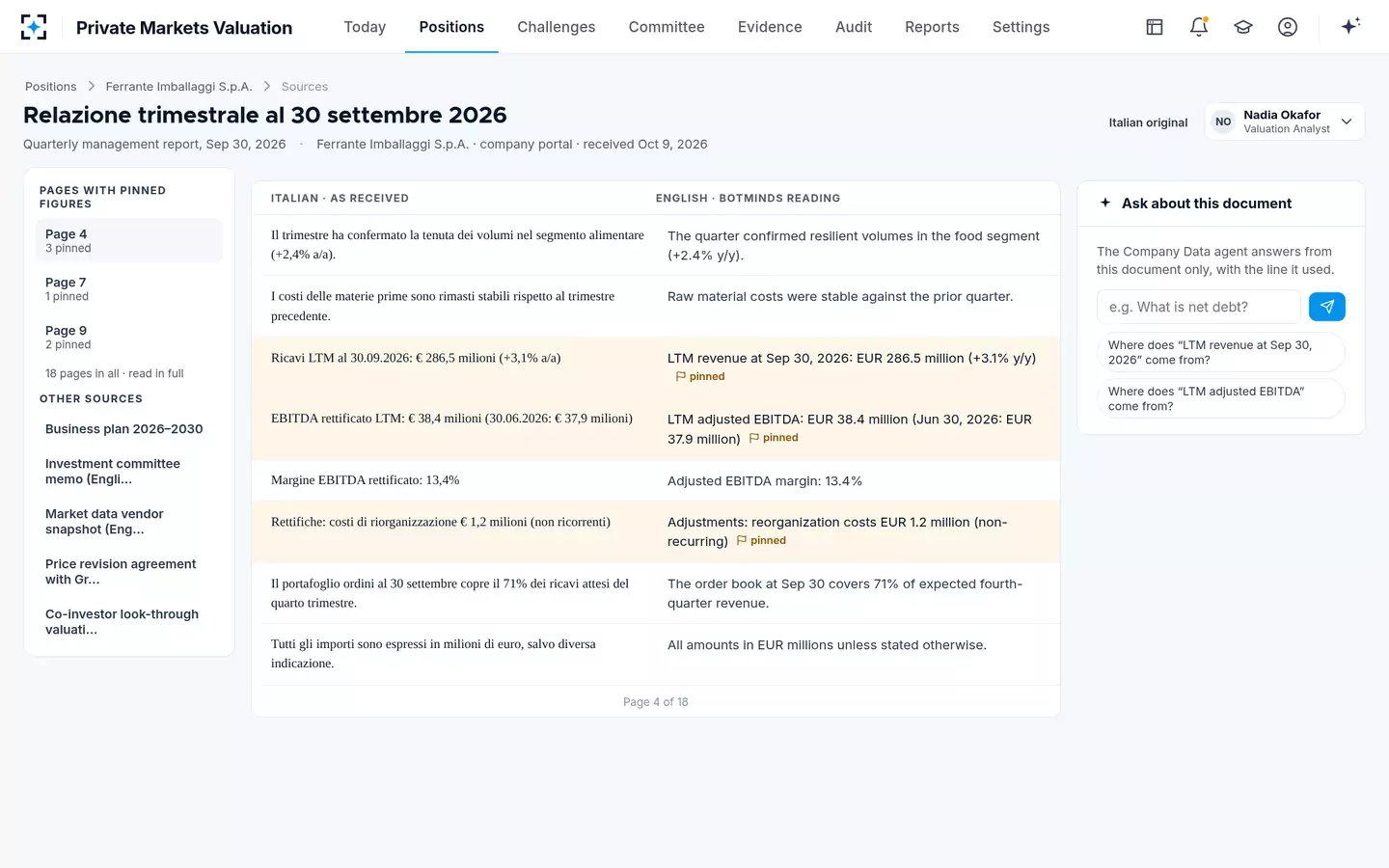
Singapore's regulator found what happens without it: "A few FMCs were unable to provide documentary evidence to support their fair value assessments, approvals, and subsequent communication to third-party service providers" (MAS, May 29, 2026). In the solution the auditor opens a read-only sample (25 positions worth $7.50 billion in the sample quarter) with each mark's original-language sources beside an English reading, and can ask the agents about any figure.
A cited source in Private Markets Valuation: the Italian quarterly report beside its English reading, figures pinned
What should you ask a valuation software vendor?
Ask for proof on your own past quarter, not a demonstration on theirs, and ask questions that can fail. Singapore's regulator expects managers to run "thorough due diligence on any models used in valuation, whether developed internally or sourced externally", covering "data requirements, key model assumptions, and limitations" and "comprehensive model validation" (MAS). That applies to an AI agent as much as to a spreadsheet. And because the SEC has fined advisers for claiming to use AI they did not use (SEC press release 2024-36, March 18, 2024), a manager that describes its valuation process to investors should be able to say precisely what the software does.
Ten questions for a private equity valuation software vendor
- Which decisions does the software take?
The right answer for a mark is none; ask to see where the product prevents it.
- Can one user prepare and approve the same mark?
Ask them to try it in front of you.
- Does every number cite its source page?
Including figures read from reports in other languages.
- What happens below the confidence threshold?
The item should go to a person, visibly, not proceed quietly.
- Who argues against the mark?
Look for challenges a person must answer, not warnings that can be dismissed.
- Where do method weights and thresholds live?
In a versioned policy, changed with a second person’s approval.
- Can the deal team edit anything?
Adding information is useful; editing inputs is a finding waiting to happen.
- How are model and prompt changes controlled?
Versioned, tested on past quarters, approved before they take effect.
- What can the auditor open?
A read-only sample with sources, decisions and a tamper-evident trail.
- Will it run on our last quarter before we sign?
Compared with the marks your committee actually approved.
The last question matters most, and it is the subject of taking a private equity valuation tool live: replay a past quarter against approved marks, run one quarter in parallel, then let the committee rely on it.
Where Private Markets Valuation fits, and where it does not
It fits a manager that marks tens to hundreds of unlisted positions every quarter, from company reports in several languages, under a written valuation policy and a committee, and wants every mark to carry three methods, a challenge and a trail. It replaces spreadsheet assembly, manual peer refreshes, hand-rolled DCFs and evidence rebuilt for the auditor. It works with the systems a valuation quarter already runs on: portfolio monitoring, fund accounting, the market data vendor, document management and the company portal.
It does not replace an external valuer appointed under AIFMD, a third-party adviser's assurance opinion, or a fairness opinion on a continuation fund transfer; it can take an adviser's range as an input to challenge against. It does not compute the fund's NAV, which belongs to fund accounting and to NAV Oversight. And it does not decide which accounting policy, guideline or weighting a manager adopts: those are the manager's settings. What a wrong mark costs, the number to set against a licence fee, is worked through in portfolio valuation reporting software: price the wrong mark first.
Questions people ask
Does valuation software replace a third-party valuation adviser?
No; they answer different needs. An adviser provides an independent valuation or an assurance opinion; software makes the manager's own process consistent and evidenced. The FCA found many firms used advisers "while retaining responsibility for valuation", and an adviser's range is a useful input for an agent to challenge against.
Is there free private equity valuation software?
Spreadsheet templates are free, and many teams start there. What they lack is what supervisors ask about: segregation of preparer and approver, cited inputs, a versioned policy and a tamper-evident trail. The cost of building those around spreadsheets is the honest comparison.
What did the SEC say about super intelligence in its 2027 exam priorities?
It said more and more firms are putting "super intelligence (SI)", the SEC's term, to work, with generative SI tools used in research, drafting, advice and portfolio management. It is examining how those tools influence outcomes and whether firms still meet "existing, technology-neutral obligations"; the priorities are staff views, not a rule.
How is AI valuation software validated?
Like any model: on data requirements, assumptions and limitations, then against outcomes. For valuation that means replaying past quarters against approved marks and checking agent outputs against cited sources. MAS expects "comprehensive model validation" for models "developed internally or sourced externally".
Can valuation software handle company reports in other languages?
Agents can read them in the original and show an English reading beside it, as in the sample quarter, where reports arrived in Italian, German, French, Spanish, Japanese, Portuguese and Swedish. The safeguard is the pin: every figure used links to the line it came from, so a reviewer can check the reading.
What is the difference between portfolio monitoring and valuation software?
Monitoring collects and checks company KPIs each quarter; valuation turns them, with market data and transaction history, into fair value marks. The two connect: monitored figures feed the mark. Monitoring has its own solution, Private Equity Portfolio Monitoring, and one EBITDA figure traced from company report to LP report shows the hand-off.