Portfolio valuation reporting software turns a manager's quarterly fair value marks for unlisted holdings into the figures everyone downstream relies on: the net asset value, management and performance fees, investor statements, marketing track records and lender reports. The way to judge it is not by the hours it saves alone but by the cost of the error it has to prevent, because a wrong mark rarely stays a valuation problem. It becomes a fee refund, a restatement, investors who dealt at the wrong price and, in the worst case, an enforcement order. Botminds' Private Markets Valuation is built to catch errors where they are cheapest, before a mark is prepared: agents compute three methods for every position with each input cited, an agent argues against every mark, and two people and a committee decide.
The enforcement figures on this page come from SEC orders, each read in the order itself; the worked cascade is illustrative arithmetic, and product examples are fictional sample data.
What two SEC valuation-related orders recorded
$32.9M
net write-down of one Level 3 investment when a private fund restated its 2016 statements
4years
of management fees (2016–2019) adjusted after that write-down
$4.69M
returned to funds by one adviser over impairment-based fee calculations, before a $1.5M penalty
What is portfolio valuation reporting?
It is the quarterly process of reporting each holding's fair value and the reasoning behind it, to the valuation committee, to fund accounting for the NAV, to auditors and to investors. A portfolio valuation report typically shows each position's mark, its move on last quarter, the method and key inputs, and the drivers of the change. The FCA saw good practice go further, with performance reported for each asset as well as the fund, and value bridges that separate earnings from multiples (FCA, Private market valuation practices, March 2025).
Whatever the format, the report is only as good as the mark. That is why the software decision is really a decision about error: where errors start, who finds them, and what they cost by the time they are found.
Why does valuation matter for management fees?
Because in many structures the mark is the fee base. The FCA's review set out the range. Closed-ended limited partnerships "typically charge management fees on committed capital, or the amount of initial invested capital, and calculate carried interest on realised performance", which limits the link. Open-ended and evergreen funds were "calculating management fees, and occasionally performance fees, based on the fund's NAV", and listed investment companies "typically calculated management fees based on the fund's NAV" (FCA).
Even the closed-ended case is not clean. The FCA heard managers explain that a write-down "represented a decrease in the value of invested capital and reduced management fees", creating a conflict "that could dissuade them from taking appropriate write-downs". The SEC's Insight Venture Management order shows the mechanics. The funds' agreements removed impaired value from the fee basis, and as the order puts it, "Because a permanent impairment reduced the basis from which Insight calculated its management fees, a permanent impairment also reduced the management fee Insight ultimately charged" (SEC order IA-6332, June 20, 2023). The adviser had applied its impairment test across all its holdings in a company rather than investment by investment as the agreements required; the order found $773,754.41 of excess fees from August 2017 to April 2021.
What happens if a fund overvalues its assets?
Every number computed from the NAV is wrong in the same direction, and someone has to pay it back. The SEC's examiners reported in 2020 that some private fund advisers did not value holdings as their own process or disclosures required, and that in some cases this meant investors paid management fees and carried interest calculated on holdings valued too high (SEC risk alert, June 23, 2020).
The Sciens order shows what unwinding looks like. Sciens charged its largest private fund a management fee of 2% a year on NAV for the share classes offered to outside investors. Its auditors qualified their opinions because they could not obtain sufficient evidence for the fair value of one material Level 3 investment; one later withdrew its opinion; the 2016 statements were restated to write that investment down by a net of about $32.9 million; and Sciens "made retroactive adjustments in 2020 to the management fees charged or accrued" for 2016 to 2019 (SEC order IA-6315, May 24, 2023). On top came a $275,000 penalty and an independent compliance consultant.
Singapore's regulator found the same pattern in private credit: a manager that kept restructuring the same non-performing loans and reclassifying them as performing, "resulting in the fund's NAV being overstated and management fees being overpaid which were subsequently refunded to the fund" (MAS, Valuation Practices for Fund Management Companies, May 29, 2026).
The cost of a wrong mark rises with who finds it
The same error costs minutes or millions depending on who catches it. The cascade below is the frame for any software decision: a tool earns its price by moving the point of discovery up the list.
The cost of one wrong mark, by who finds it
1
The analyst, before the mark is prepared
Minutes
A challenge answered and the input corrected. No figure has left the valuation team.
2
The checker or committee, before the NAV
Hours to days
Re-work across the methods and the committee papers; a mark may move to an adjourned session.
3
The auditor, at year end
Weeks
Requests, a restatement or a qualified opinion; fees and investor reports recalculated for every affected period.
4
Investors, after the NAV is used
Money moved between investors
Fees and performance fees refunded; subscribers and redeemers who dealt at the wrong NAV made whole.
5
An examiner
All of the above, plus a public order
Penalty, disgorgement, an independent consultant, and a finding every future investor can read.
Take an illustrative evergreen fund with a reported NAV of $500 million in which one holding is overvalued by $20 million, so the true NAV is $480 million. At a management fee of 1.5% a year on NAV, the fund pays $300,000 a year too much. If $50 million of subscriptions come in at the overstated NAV, the new investors' units are worth about $48.2 million once the mark is corrected: about $1.8 million has moved from them to the existing investors. If the error inflates a crystallised performance fee, that is refunded too. None of this is a penalty; it is the arithmetic of unwinding, before any examiner arrives.
How are carried interest and valuation linked?
Directly in open-ended funds that charge performance fees on NAV; indirectly, but materially, in closed-ended funds. Carried interest in a closed-ended partnership is usually paid on realised performance, which is why the FCA saw the fee conflict as limited there. Two situations bring unrealised marks back in: transfers of assets between vehicles, and marketing.
On transfers, the FCA wrote that conflicts arise "when the manager's valuation determines the transfer price affecting the interests of buyers, sellers and remaining investors", adding: "This conflict increases if the manager receives carried interest due to the transfer using unrealised performance" (FCA). Firms using continuation funds sought the existing fund's advisory committee's agreement and obtained an independent fairness opinion on the price. On marketing, interim marks shape the next fund: Barber and Yasuda found "Interim performance has large effects on fundraising outcomes" (Journal of Financial Economics, 2017), so a mark that is too high today can raise the next fund on numbers that later fall. The research on marks made during fundraising is set out in private equity valuation techniques, tested against the exit price.
NAV loans, dealing and other places a mark becomes money
Beyond fees, a mark sets borrowing capacity and dealing prices. For NAV-based borrowing, the FCA warned that "valuations could be inflated to attract a greater amount of initial borrowing or avoid breaching an LTV covenant", and reported: "Most firms did not proactively identify and document this potential conflict" (FCA). For funds that deal, investors subscribing or redeeming at a stale or wrong NAV "could be transacting at prices that do not always reflect the value of the fund's investments".
The SEC's fiscal 2027 examination priorities point the same way for private funds: examiners will look at disclosures about fund borrowing and lines of credit, and at whether fees and expenses are calculated accurately for each fund and each investment (SEC, Examination Priorities, fiscal year 2027; staff priorities, not a rule).
What are the SEC penalties for valuation failures?
In settled orders the penalty is usually the smaller part; the refunds and the remediation are larger. The two orders below involve private equity-style funds and valuation-based fees; both were settled without admitting or denying the findings.
In two SEC orders, money returned to funds exceeded the penalties
The amounts are modest beside a large manager's revenue, which is the wrong comparison. The costs that do not appear in the orders are the larger ones: the examination itself, the restated statements and recalculated fees, the consultant's two reviews, and every future due diligence questionnaire that asks whether the firm has been subject to an order.
What should portfolio valuation reporting software prevent?
It should prevent the four failures the cases share: a policy with no method in it, marks not valued as disclosed, fees computed on marks nobody tied to the fee terms, and evidence that cannot be produced. Each is checkable before purchase.
What to require of portfolio valuation reporting software, failure by failure
- Methods named and applied to every position
Sciens’ manual named no technique for its Level 3 assets; a tool should refuse to mark without one.
- Marks valued as the fund discloses
The policy, as versioned settings, applied the same way every quarter.
- Every input cited to its source
So an auditor can verify a mark without rebuilding it.
- A challenge on every material mark
Plan misses, peer moves and adviser ranges raised by something other than the preparer.
- Write-downs visible with their fee effect
The committee should see what each write-down does to the fee basis.
- Separation of preparer, checker and approver
And no edit rights for the deal team.
- A tamper-evident trail and exports for examiners
Every input, answer, override and decision, with who and when.
To price your own exposure, count rather than guess: the analyst-days a quarter takes, the marks moved after the committee in the last two years, the fee true-ups and restatements in the last five, the auditor's requests per year and how long each took. No regulator or independent study publishes these figures for the industry; your own are the ones that matter. The design target for Private Markets Valuation is 15 business days from quarter end to the committee, with three methods and cited inputs for every mark.
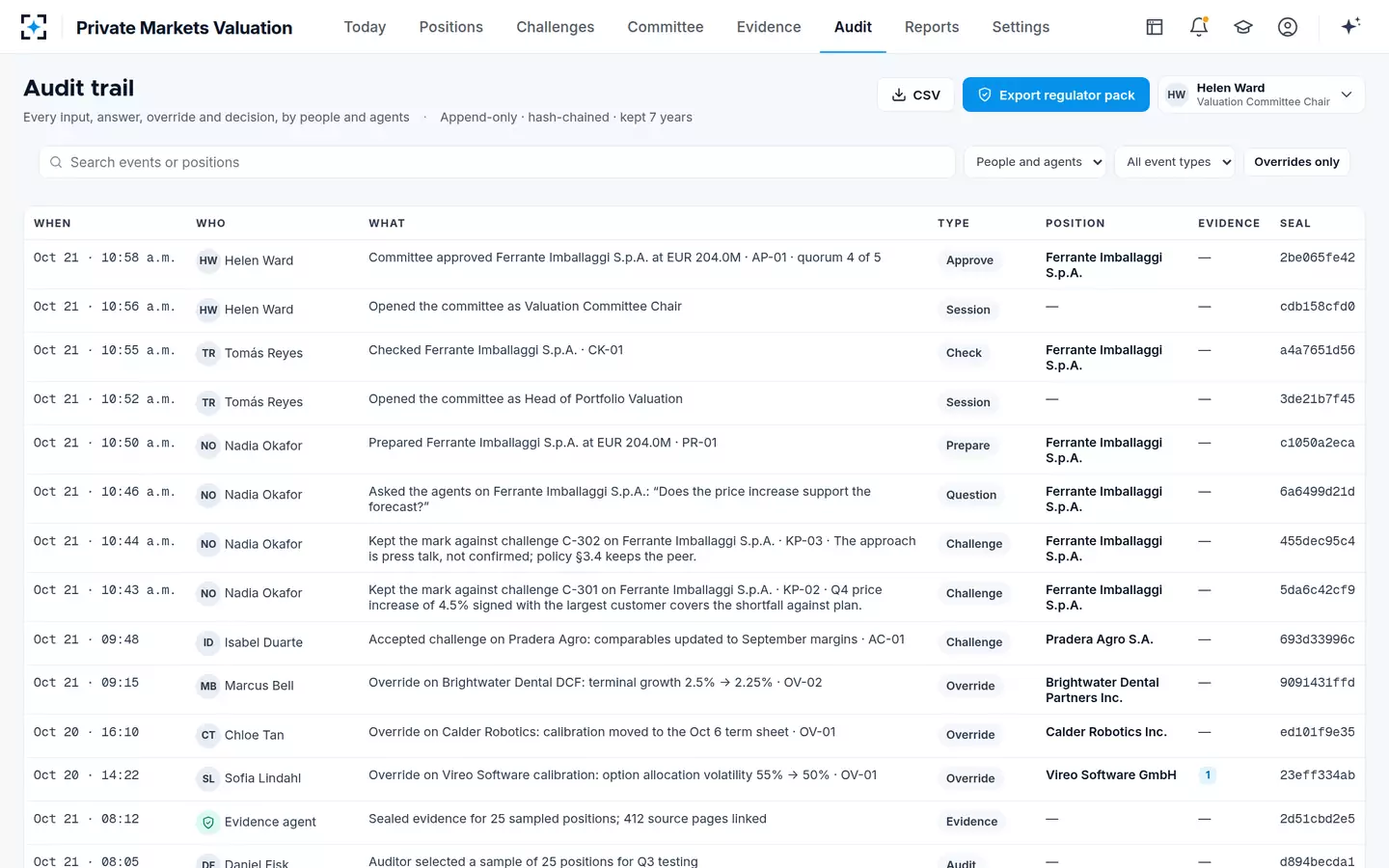
The audit trail in Private Markets Valuation: every input, answer, override and decision, append-only
Where Private Markets Valuation catches the error
At the top of the cascade. In the sample quarter the agent assigned to argue against marks raised 29 challenges on 23 positions overnight, from plan misses to peers trading on takeover talk, and none of those 23 marks could be prepared until a person answered. A mark that moved 5% or more, or $25 million or more, or carried an override or an open challenge went to the committee; 26 of 304 did. Every answer, override and decision sits on an append-only trail kept seven years, and exports carry the requester's watermark.
What the software cannot do is decide that a write-down is warranted, or that a fee term means what the manager reads it to mean; those stay with the valuation team, the committee and, for fees, fund accounting and compliance. It narrows the gap between a mark and its evidence, which is where the cases above began. For what the committee itself should require, see valuation committee terms of reference; for how the agents and people divide the work, private equity valuation software: agents compute, people set the mark.
Questions people ask
What is a portfolio valuation report?
A quarterly report of each holding's fair value, its change, the method and key inputs, and the reasons for the change, prepared for the valuation committee, fund accounting, auditors and investors. Good ones split each move into earnings, multiple and other drivers.
How much does a wrong mark cost?
It depends on who finds it. Found by the analyst, minutes; found after the NAV is used, fee refunds and transfers between investors; found by an examiner, all of that plus a penalty and a public order. In the illustrative fund on this page a $20 million overvaluation costs $300,000 a year in fees alone.
Can management fees be clawed back after a valuation error?
Fees charged on wrong values are typically repaid, as in both SEC orders on this page: Sciens adjusted four years of fees, and Insight reimbursed funds during the SEC's examination and again during the enforcement investigation. MAS reported a private credit manager whose overpaid fees "were subsequently refunded to the fund".
Do private equity funds charge fees on unrealised gains?
Closed-ended partnerships usually charge management fees on committed or invested capital and carried interest on realised gains, the FCA found. Open-ended and evergreen funds and listed investment companies charge on NAV, so their fees move with unrealised marks.
Is portfolio valuation reporting software the same as fund accounting software?
No. Valuation software produces and evidences the marks; fund accounting turns approved marks into the NAV, fees and investor allocations. NAV checks after approval have their own solution, NAV Oversight.
Does valuation software reduce audit fees?
No regulator or independent study measures it, and a manager should not assume it. What it can change is the work around the audit: requests answered from sealed evidence rather than rebuilt from workbooks, and fewer questions about how a mark was reached.