Implementing a private equity valuation tool means four things in order: loading the manager's valuation policy as settings the tool enforces, mapping every fund, position and share class with its cost, ownership and entry terms, replaying a past quarter so the tool's proposed marks can be compared with the marks the committee actually approved, and running one live quarter in parallel before the committee relies on it. Each step should be able to fail, and the go-live decision should be the committee's. It is hard because the information a tool needs is spread across fund accounting, the deal files, the data vendor and analysts' workbooks, and because a replay usually exposes judgement that last quarter's marks never wrote down. Botminds' Private Markets Valuation goes live this way: setup connects the systems, loads the policy, maps funds and positions, and runs the agents in parallel on a past quarter before the first live one.
The examples use fictional sample data from the solution: Quillfield Capital, with 304 positions in 38 funds and a valuation policy at version 7.2. Durations on this page are an illustrative plan, not a measured result.
Five steps to a live private equity valuation tool, each one able to fail
A person decides
Write the policy as settingsMethod weights by strategy, tolerances, committee materiality, peer exclusion, calibration rule, late-data rule; approved by the chair.
Never: a setting nobody can point to in the written policy
Agent
Map funds and positionsFunds, positions, share classes, cost, ownership and entry terms loaded from fund accounting and deal files; gaps listed.
Agent
Replay a past quarterAgents re-run an already-approved quarter from its original reports and market data; every proposed mark compared with the approved one.
A person decides
Explain every disagreementThe head of valuation classifies each difference: reading error, peer set, weights, or undocumented judgement in the approved mark.
A person decides
Shadow one live quarter, then decideThe tool runs beside the usual process; the committee compares both and decides in writing whether to rely on it next quarter.
Never: agents preparing, checking or approving a mark, before or after go-live
What does implementing a private equity valuation tool involve?
It involves less software installation than teams expect and more policy writing. A valuation tool can only enforce what is written, and many valuation policies describe intentions rather than rules. The FCA found that "not all firms provided detail on the rationales for selecting methodologies and their limitations, nor the required inputs and data sources", and that most policies omitted "a description of the safeguards for the functionally independent performance of the valuation task" (FCA, Private market valuation practices, March 2025). Those gaps surface on day one of an implementation, because the tool asks for each one as a setting.
That is the first benefit of doing it, before any mark is computed. The SEC settled with Sciens Investment Management in 2023 over a compliance manual that named no valuation technique at all for its Level 3 investments (SEC order IA-6315, May 24, 2023). A tool configured from a policy cannot run with that gap; the setup forces it closed.
What data do you need for a valuation tool?
You need five sets of data, most of which already exist somewhere in the firm. The work is in finding the authoritative copy of each and in filling the gaps, especially in the entry data that calibration depends on.
The data a private equity valuation tool needs, where it lives, and the usual gap
| Data | Usual source | Used for | Usual gap |
|---|---|---|---|
| Company quarterly reports, accounts and plans, in their original languages | Company portal, document management, portfolio monitoring | Earnings, net debt and KPIs for every method; plan for the DCF | Older reports only as email attachments; plans out of date |
| Peer prices, multiples, rates and FX | Market data vendor | Comparables, DCF inputs, currency translation | Peer sets that exist only in an analyst’s workbook |
| Entry memos, deal files and share agreements | Deal team files, legal | Calibration to the entry price; share-class rights for rounds | Entry multiple and peer median at entry never recorded |
| Last quarter’s approved marks, co-investor marks and adviser ranges | Committee minutes, fund accounting, advisers | The replay; the challenger’s comparisons | Approved marks without the inputs behind them |
| The valuation policy | Compliance, head of valuation | Weights, tolerances, materiality and every rule the tool enforces | Rules described in prose, not values |
The entry data gap deserves time. Calibration needs the multiple paid and the peer median at the time of the deal, and many funds recorded only the price. Rebuilding the peer median at a past date from the data vendor is usually possible; reconstructing why the deal team paid a premium or a discount may not be, and the policy should say what to do then. Late data also needs a rule before go-live: the sample policy treats a company report as late after 15 days, requests it in the company's language, and rolls the last mark forward with market movement, flagged to the committee.
Loading the valuation policy as settings, not prose
Every rule the committee expects to see applied should become a value with an owner and a version. The sample policy holds method weights for five strategies, the tolerance test (a move under 3% and every method within ±7% of the mark), committee materiality (5% or more, or $25 million or more, any override, any open challenge), peer exclusion only on a confirmed event, the calibrated multiple formula, the late-data rule, confidence thresholds below which an agent hands the item to a person (90% for reading reports, 85% for the method agents), and a 24-hour deadline to answer a challenge.
The valuation policy loaded into Private Markets Valuation: versioned, approved, and changed only with a second person
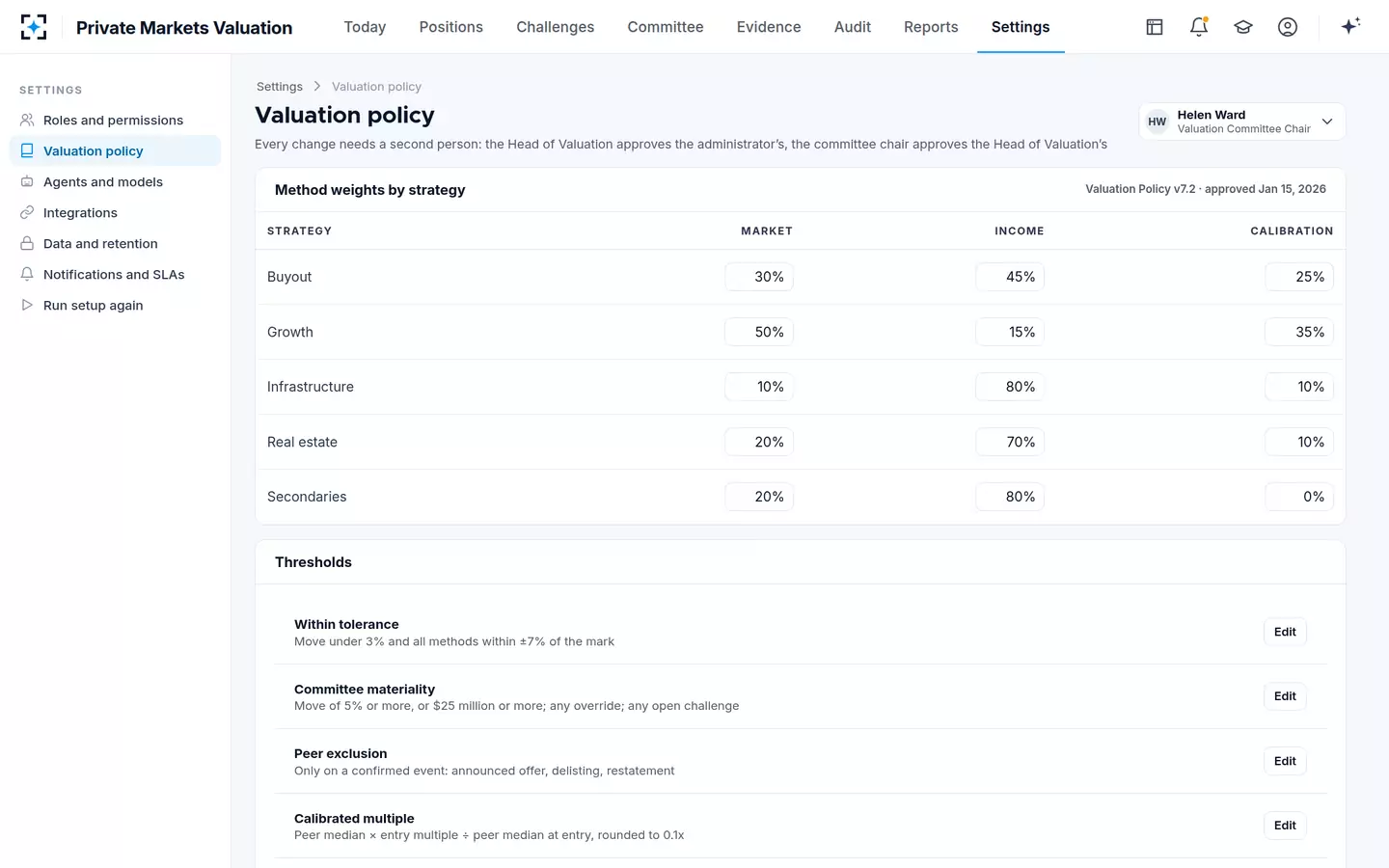
Two practices make this hold up later. First, link each setting to the paragraph of the written policy it implements, so an auditor reading the policy and a user reading the settings see the same rule. Second, require a second person for every change: in the sample, the head of valuation approves an administrator's change and the committee chair approves the head of valuation's. Singapore's regulator expects deviations from policy to be "adequately justified, documented and approved by the designated approving authority" (MAS, May 29, 2026); a tool that versions its settings makes deviations visible by construction.
How do you test a valuation tool on past quarters?
Replay a quarter the committee has already approved: give the tool that quarter's company reports, market data at that measurement date and the policy then in force, let it propose every mark, and compare each with the approved mark. The test is whether the tool reproduces the committee's marks where the committee followed its policy, and explains where it did not.
The logic is the same one the SEC applies to fair value methods for registered funds. Rule 2a-5 requires a board or designee to test whether its chosen fair value methods are appropriate and accurate, naming the tests and how often they run (17 CFR 270.2a-5(a)(3)), and the adopting release expects a board or designee to "investigate the reasons" when a method "consistently over-values or under-values" against observed transactions (86 FR 748). Private funds are not bound by that rule, but a replay is the same discipline applied to the tool: a test with a defined method, a defined tolerance and an investigation of every miss.
Reading the replay: four kinds of disagreement
Every difference between a replayed mark and an approved one falls into one of four kinds; the tool is to blame for just one. Classifying each is the head of valuation's job, and the classification is the replay's real output.
What a difference between a replayed mark and an approved mark usually means
| Kind of difference | Typical cause | What to do |
|---|---|---|
| Reading error | A figure read from the wrong line, period or currency | Fix the extraction; check whether the agent should have handed the item to a person below its threshold |
| Peer set | The approved mark used a peer set that lived in an analyst’s workbook | Load that peer set with reasons for each peer, or change it with the analyst’s decision recorded |
| Policy setting | The approved mark used different weights or a different calibration rule from the written policy | Decide which is right; amend the policy or accept that the approved mark departed from it |
| Undocumented judgement | The approved mark reflected an override nobody recorded | Record it now as an override with a reason, and decide whether it still applies |
The fourth kind is uncomfortable and important. A replay that cannot reproduce last quarter's mark for a company often shows that the mark carried a judgement (a haircut, a peer swapped, a discount widened) that was argued in a meeting and never written down. The FCA found "the recorded rationales given for key assumption changes, such as adjustments in discount rates, were vague" at some firms (FCA). The replay turns each such case into an explicit override with a reason, which is the record the next quarter will need.
What is a shadow quarter?
A shadow quarter is one live valuation cycle in which the tool runs on the new quarter's data beside the team's usual process, and the committee sees both sets of marks before relying on either. It tests what a replay cannot: late reports arriving in real time, peer prices at a fresh measurement date, and the team's ability to answer challenges and prepare marks in the tool under the committee's deadline.
The committee's decision at the end should be written, with criteria set before the quarter starts: what share of marks must agree within tolerance, how every disagreement was resolved, whether every challenge was answered by a person, and whether the evidence the auditor will ask for is complete. If a criterion fails, the honest result is another shadow quarter, not a softened criterion.
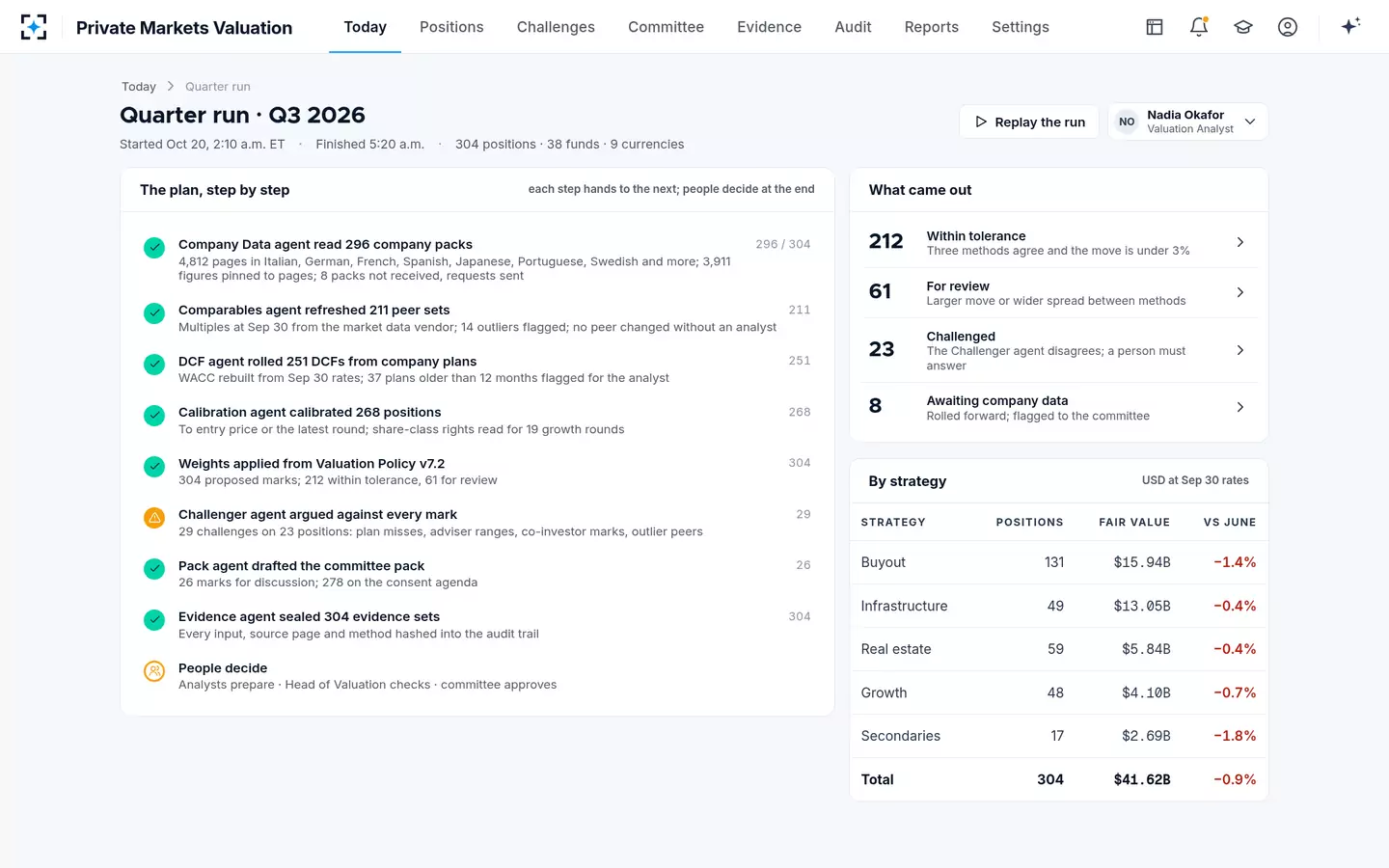
A quarter run in Private Markets Valuation: what each agent did, and what came out for people to decide
How long does it take to implement valuation software?
No regulator or independent study publishes implementation times for valuation software, and vendors' figures depend on what they count. What can be said is what sets the duration: how complete the written policy is, how much entry data must be rebuilt, and the manager's own quarter-end calendar, since a shadow quarter takes one full cycle whatever the tool.
An illustrative plan: setup and replay between quarter ends, then one shadow quarter
- Policy written as settings, approved1 wk
- Funds, positions, entry data mapped; gaps listed1 wk
- Past quarter replayed2 d
- Disagreements settled1.5 wk
- Live quarter run beside the usual processto the committee date
- Committee decides in writing2 d
The longest single task in most plans is the last phase of the first lane, settling disagreements, because each one is a conversation with the analyst who made the original mark. Teams that rush it go live on a tool that agrees with last quarter for the wrong reasons.
Who signs off a valuation tool before go-live?
The valuation committee, on the head of valuation's recommendation, with compliance satisfied that the tool fits the written policy. The checklist below is the evidence the committee should have in front of it.
Go-live tests for a private equity valuation tool, each one able to fail
- Every policy rule is a setting, and every setting is in the policy
With version, approver and date.
- Every position is mapped, with cost, ownership and entry terms
Or a recorded fallback where entry data cannot be rebuilt.
- The replay reproduced the approved marks within tolerance
Where the approved marks followed the policy, with the share stated.
- Every replay disagreement is classified and settled
Reading error fixed, peer set loaded, policy amended or override recorded.
- Segregation works
Tested: a preparer cannot check or approve; the deal team cannot edit.
- The shadow quarter met the criteria set before it began
Without changing the criteria after the results.
- The auditor has seen a sample
Read-only, with sources, decisions and trail, and has said what else it needs.
- The decision is minuted
Including any positions kept outside the tool for now, and why.
What happens to the valuation policy after go-live?
It keeps changing, under control. An SEC-registered adviser's compliance rule, under the heading "Annual review", requires it to review its policies and procedures at least once a year for adequacy (17 CFR 275.206(4)-7(b)), and Singapore's regulator found most managers reviewed valuation policies "at least annually and as and when necessary (e.g. occurrence of trigger events)" (MAS). With the policy held as versioned settings, the annual review becomes a review of every change made in the year, who approved it and what it did to the marks.
The agents change too, and should be treated like a model change. In the solution, agent prompt and model changes are versioned, evaluated on past quarters and take effect only after the head of valuation approves, so a replay becomes a standing test rather than a one-off. Exits feed the same loop: comparing each exit with the last mark, as described in private equity valuation techniques, tested against the exit price, is the evidence for the next change to weights or calibration. What to ask before choosing a tool at all is covered in private equity valuation software: agents compute, people set the mark.
Questions people ask
Should we replay one quarter or several?
Start with the most recent approved quarter, because its people, policy and data are freshest and its disagreements can still be explained. Adding a quarter with a large market move tests how the tool behaves under stress. More quarters add evidence but not much new kind of evidence.
What if the replay disagrees with the committee's approved marks?
That is the point of the replay. Classify each difference as a reading error, a peer set difference, a policy setting difference or undocumented judgement, and settle each. An unexplained disagreement is a reason not to go live yet.
Do we need to clean up our valuation policy first?
You will clean it up during setup, because each rule must become a setting. The FCA found policies often lacked rationales, required inputs and data sources; writing them down is part of the implementation, not a precondition for starting.
Can some positions stay outside the tool?
Yes, if the committee decides so and minutes why: for example a single complex holding with bespoke terms. The positions outside should still be prepared, checked and approved under the same policy, so that the committee's record is complete.
Who should own a valuation tool after go-live?
The head of valuation, as owner of the policy and of agent changes, with the committee chair approving policy changes and compliance reviewing the policy at least yearly. IT owns the connections to fund accounting, the data vendor and the document stores, not the valuation rules.
What does a valuation tool need from fund accounting?
Cost, ownership and share classes for every position, and a way to receive the approved marks for the NAV. The flow should be one way at quarter end: approved marks go to fund accounting, and nothing in fund accounting edits a mark.