Private equity values companies in two different ways for two different purposes. Before buying, the deal team works out the most it can pay and still earn its target return, mostly from multiples of comparable companies, a forecast it has deliberately trimmed, and an assumed exit value. After buying, a valuation team independent of the deal team marks the company every quarter at fair value, the price another market participant would pay at that date, because that number drives the fund's reported performance, its fees and what investors are told. The two answers differ, and should. Botminds' Private Markets Valuation handles the second valuation: agents compute comparables, a DCF and calibration to the entry price for every holding, and the analyst, the head of valuation and the committee decide the mark.
The research figures come from a survey of private equity investors published in a peer-reviewed journal, and from regulators. The deal arithmetic is illustrative; the quarterly example is fictional sample data from the solution.
Two valuations of the same company: the deal price and the quarterly mark
To buy: the deal valuation: What is the most we can pay and still earn our target return?
Every quarter: the fair value mark: What would a market participant pay for this holding at the measurement date?
To buy: the deal valuation: The deal team, approved by the investment committee.
Every quarter: the fair value mark: A valuation function independent of the deal team, approved by a valuation committee.
To buy: the deal valuation: Gross IRR and multiple of money; comparable multiples; a haircut forecast; an assumed exit multiple.
Every quarter: the fair value mark: Peer multiples, a DCF from the company’s plan, calibration to the price paid; weighted by a written policy.
To buy: the deal valuation: The buyer’s own: its leverage, its improvements, its exit.
Every quarter: the fair value mark: Market participants’ assumptions only; the owner’s own synergies are excluded.
To buy: the deal valuation: The price, the debt package and the investment memo.
Every quarter: the fair value mark: The NAV, fees, investor reports and the next fundraise.
How does private equity value companies before buying?
Mostly by working back from a target return. Gompers, Kaplan and Mukharlyamov surveyed 79 private equity investors with over $750 billion under management and found that "Investors rely primarily on IRR and multiples to evaluate investments", while "few PE investors use discounted cash flow or net present value techniques" (Journal of Financial Economics, 2016; quotations from the NBER working paper version). Over 70% also use comparable company multiples; fewer than 20% use a WACC- or APV-based DCF.
How private equity investors say they price a deal
25%
median gross IRR the investors said they target
2.5x
median target multiple of money, about a 20% IRR over five years
20%
median and average discount applied to management’s forecasts (44 investors answering)
<30%
use a growing-perpetuity terminal value; most use comparables for the exit
Two details matter for the second valuation later. Deal teams discount management's numbers: "For the 44 PE investors who answered this question explicitly, the median and average discount is 20%." And for the exit, "PE investors are much more likely to use comparable methods— both publicly traded companies and transactions—than discounted cash flow methods", with some setting the exit multiple equal to the entry multiple (NBER w21133). The deal price is therefore built on a trimmed forecast and a market multiple, the same raw materials the quarterly mark will use, but arranged to answer a different question.
How is the purchase price set in a buyout?
By asking how much equity the fund can put in and still reach its target multiple at exit. A simple illustration shows the logic the survey describes.
An illustrative buyout price, worked back from a 2.5x target
Exit enterprise value
EBITDA in year 5 × exit multiple
$70M (management’s $87.5M less a 20% haircut) × 10.0x = $700M
Deal team; exit multiple set equal to entry
Equity at exit
Exit value − net debt remaining
$700M − $200M = $500M
Deal team and lenders
Most equity the fund can invest
Equity at exit ÷ target multiple
$500M ÷ 2.5 = $200M, about a 20% IRR over five years
Investment committee
Price for the company
Equity + debt raised at entry
$200M + $300M = $500M, or 10.0x today’s $50M EBITDA
Negotiated with the seller
Every line is the buyer's own: its forecast, its leverage, its exit plan, its return target. A seller who accepts $500 million has accepted a price that reflects what this buyer can do with the company. That is a perfectly good price, and it is not, in general, the same thing as fair value.
Why is the deal price not fair value?
Because fair value is an exit price from the point of view of any market participant, not the value to one owner with its own plans. IFRS 13 defines it as what a seller would receive for the asset, or pay to hand over a liability, in an orderly sale between market participants on the measurement date (IFRS Foundation). ASC 820, as the SEC quoted it, is explicit about what to strip out:
A reporting entity shall develop unobservable inputs using the best information available in the circumstances, which might include the reporting entity's own data. In developing unobservable inputs, a reporting entity may begin with its own data, but it shall adjust those data if reasonably available information indicates that other market participants would use different data or there is something particular to the reporting entity that is not available to other market participants (for example, an entity-specific synergy).
ASC 820-10-35-54A, as quoted by the SEC in its order In re Sciens Investment Management, May 24, 2023
In practice the two numbers start together. On the day of an arm's-length purchase, the price paid is usually the best evidence of fair value, which is why a valuation team calibrates its model to it. They then drift apart: the deal model keeps the buyer's plan and target, while the quarterly mark follows peer multiples, actual results and net debt. What calibration in valuation means covers that link in detail.
How is a portfolio company valued after the deal?
Every quarter, by a valuation team using the methods the fund's policy prescribes, typically a peer multiple, a DCF from the company's own plan and calibration to the entry price, weighted and approved by a committee. The FCA found most UK managers used the market approach as their primary method for private equity, with a DCF beside it at about half of them (FCA, Private market valuation practices, March 2025).
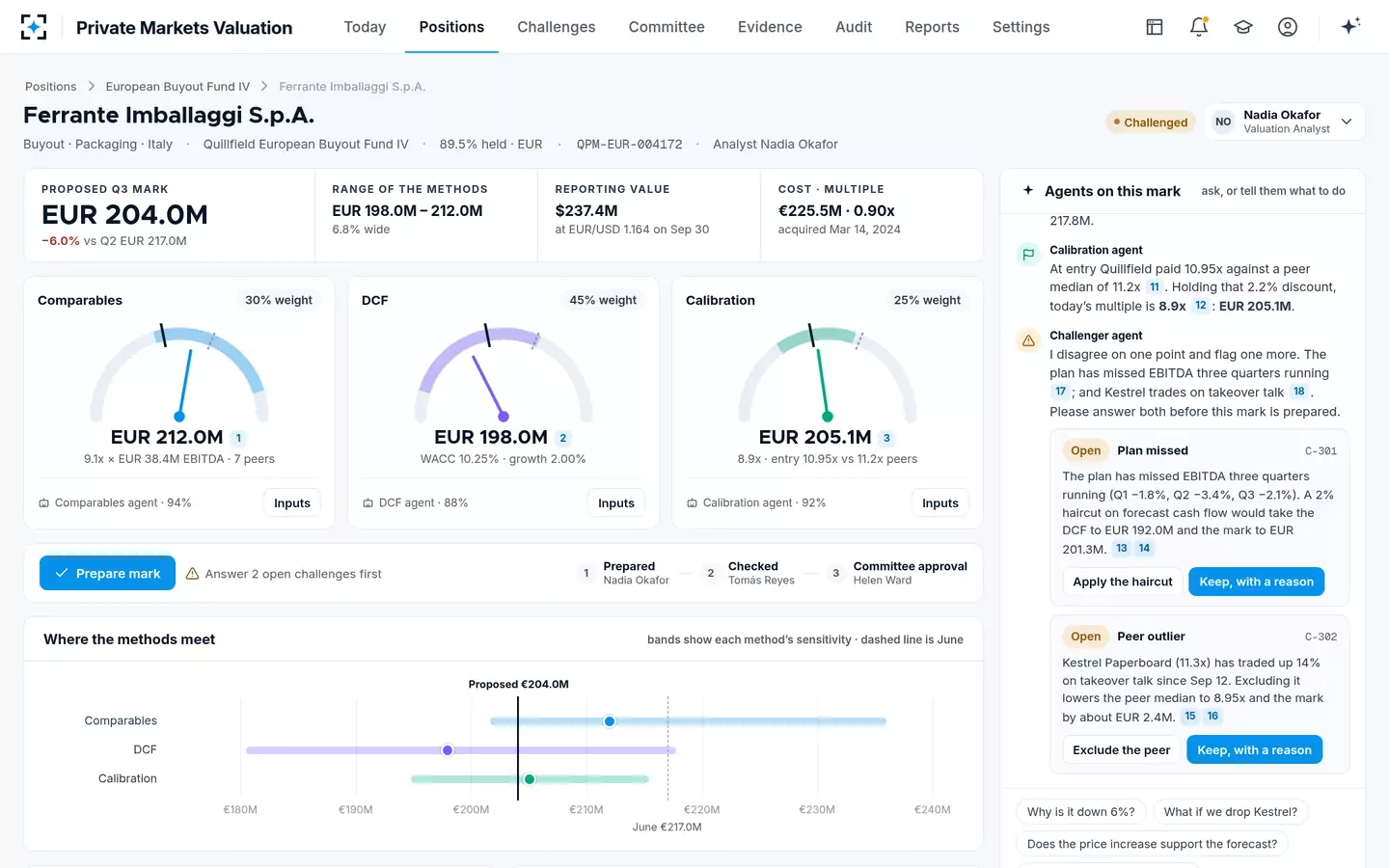
Take a fictional sample holding from the solution's sample quarter. Quillfield European Buyout Fund IV bought 89.5% of Ferrante Imballaggi, an Italian packaging company, on March 14, 2024 for EUR 225.5 million, at 10.95 times EBITDA when listed peers traded at 11.2 times. At September 30, 2026 the peers trade at 9.1 times. The methods give EUR 212.0 million (comparables), EUR 198.0 million (DCF) and EUR 205.1 million (calibration, holding the entry discount), and the policy's weights propose EUR 204.0 million: 0.90 times cost, and 6.0% below June's mark.
Why the sample mark fell from June: the market multiple, not the company
The bridge is the point of having two valuations. The company did better than in June on earnings and debt, and worse than its own plan; its mark fell because listed packaging companies fell. A deal model would show none of that, and an investor reading the fund's report needs all of it. The full three-method mark is worked step by step in private equity valuation methods, worked on one company's mark.
The quarterly mark in Private Markets Valuation: three methods, the range, cost and last quarter on one screen
What multiples do private equity firms pay and mark at?
The multiple paid and the multiple marked are different numbers on different dates. The paid multiple is a negotiated outcome of the buyer's return arithmetic; the mark uses listed peers' multiples at each quarter end, adjusted by the discount or premium implied at entry. The FCA saw managers set that adjustment at acquisition and then change it markedly over time as the peers drifted further from the company or closer to it (FCA), the discipline calibration in valuation explains.
No regulator publishes the multiples private equity firms pay; the published figures come from deal databases. What the regulator data do show is scale: US private equity funds reported $8.5 trillion of net assets on Form PF at the end of 2025, up from $7.3 trillion a year earlier (SEC Private Fund Statistics, 2025 Q4). For funds holding unlisted companies, that total is a sum of managers' own quarterly marks.
Why do private equity marks lag public markets?
Because they are made quarterly from company reports that arrive weeks after the quarter end, and because some managers dampen market moves on purpose. The Bank of England, designing its 2026 stress exercise for private markets, noted that "Infrequent valuations can make it harder for actors across the private market ecosystem to assess risks during a stress, including when comparing to public-market equivalents" (Bank of England, private markets system-wide exploratory scenario).
The FCA saw the dampening directly: "In a few case studies, we observed firms make discount rate adjustments that resulted in limiting the impact of public market movements" (FCA). The research adds nuance rather than a verdict. Jenkinson, Landsman, Rountree and Soonawalla found buyout NAVs showed "little systematic bias" over 1988 to 2016, and that the marks were less accurate in the earlier years of their data, though more conservative then (The Accounting Review, 2020), and Brown, Gredil and Kaplan found that "top-performing funds likely understate their valuations" (Journal of Financial Economics, 2019). A mark that follows its peers, as the sample one did, lags less; a policy that lets judgement smooth the peers out lags more.
What investors see: two valuations, two documents
Investors normally see only the second valuation. The deal model lives in the investment committee memo; the quarterly mark reaches investors through the fund's NAV, its quarterly report and, when the manager raises its next fund, the track record. That last use is where the two can be confused, because unrealised marks are presented beside realised returns.
The FCA singled this out, warning that "using unrealised performance in marketing can create an incentive to present favourable valuations when valuing private assets, especially when firms are fundraising and do not have a track record of realised performance", and it described good practice as "clearly separating unrealised and realised investments in marketing materials, making clear that unrealised performance was based on the firm's approach to valuations, and presenting the components of unrealised value" (FCA). A bridge like the sample one above, splitting a move into multiple, earnings and debt, is exactly such a breakdown.
Where the two valuations meet again: the exit
At exit both valuations are tested against one price. The deal model's exit assumption meets the actual sale, and the last quarterly mark meets the actual proceeds. The first comparison tells the deal team whether its return arithmetic was realistic; the second tells the valuation team whether its methods were biased, and it is the one regulators ask about. The FCA describes backtesting as setting the exit proceeds against the last mark before the sale, and most firms it visited did it (FCA); valuation techniques, backtested shows how.
The exit also closes the loop between the two teams without merging them. A deal team that consistently exits above its own model has learned something about its forecasting; a valuation team that consistently sees exits far above its marks has learned something about its discount to peers. How to run that comparison by technique is set out in private equity valuation techniques, tested against the exit price.
How are venture-backed companies valued?
Mostly from their latest funding round until they have revenue to put a multiple on. The FCA found venture managers usually started from the price of the latest funding round and moved to multiples once a company had revenue to apply them to (FCA). The round price belongs to the newest share class, with its own protections, so the class a fund holds needs to be valued on its own terms. That is the same calibration discipline as a buyout, applied class by class.
Questions people ask
How do private equity firms value a company?
Before buying, by working back from a target return, typically a median 25% gross IRR or 2.5 times money in the survey evidence, using comparable multiples and a trimmed forecast. After buying, at fair value every quarter, using peer multiples, a DCF and calibration to the price paid.
What return do private equity firms target?
The 79 investors surveyed by Gompers, Kaplan and Mukharlyamov said they target a median gross IRR of 25% and a median multiple of 2.5 times their investment. The authors note that 2.5 times over five years implies a gross IRR of about 20%.
Is the price paid for a company its fair value?
On the day of an arm's-length deal it is usually the best evidence of fair value, which is why valuation models are calibrated to it. Afterwards the two diverge, because fair value follows market participants' assumptions while the deal price reflected one buyer's plans.
Why do private equity marks fall when the company is doing well?
Because the market multiple moved. In the sample on this page, earnings rose and debt fell, adding EUR 6.8 million, but lower peer multiples took off EUR 19.8 million. A mark answers what a buyer would pay today, and buyers pay less when listed peers are cheaper.
How often are portfolio companies valued?
Usually every quarter; EU law requires at least once a year for alternative investment funds. Out-of-cycle valuations are used when a market or company event makes the last mark unreliable.
Who values a portfolio company after the deal?
A valuation function independent of the deal team, approved by a valuation committee, sometimes with a third-party adviser's opinion. The deal team should inform the mark but not set it; how that quarter runs is set out in the private equity valuation process at quarter end.