The private equity valuation process is the quarterly cycle in which a manager turns each portfolio company's latest results, market data and transaction history into a fair value mark, has the mark checked by someone independent of the deal team, approves it at a valuation committee, and hands it to fund accounting for the net asset value. It is hard because it is compressed: company reports arrive weeks after quarter end, peer prices move every day, auditors and investors want the evidence behind each number, and the committee date does not move. Botminds' Private Markets Valuation exists to take the gathering, computing and arguing off the critical path: agents read every report and compute three methods for every position, while the analyst, the head of valuation and the committee keep every decision.
The example quarter on this page is fictional sample data: Quillfield Capital, a sample manager, marks 304 positions in 38 funds for the quarter ended September 30, 2026, worth $41.62 billion. The rules and findings come from regulators, linked where they appear.
One sample quarter in Private Markets Valuation, at a glance
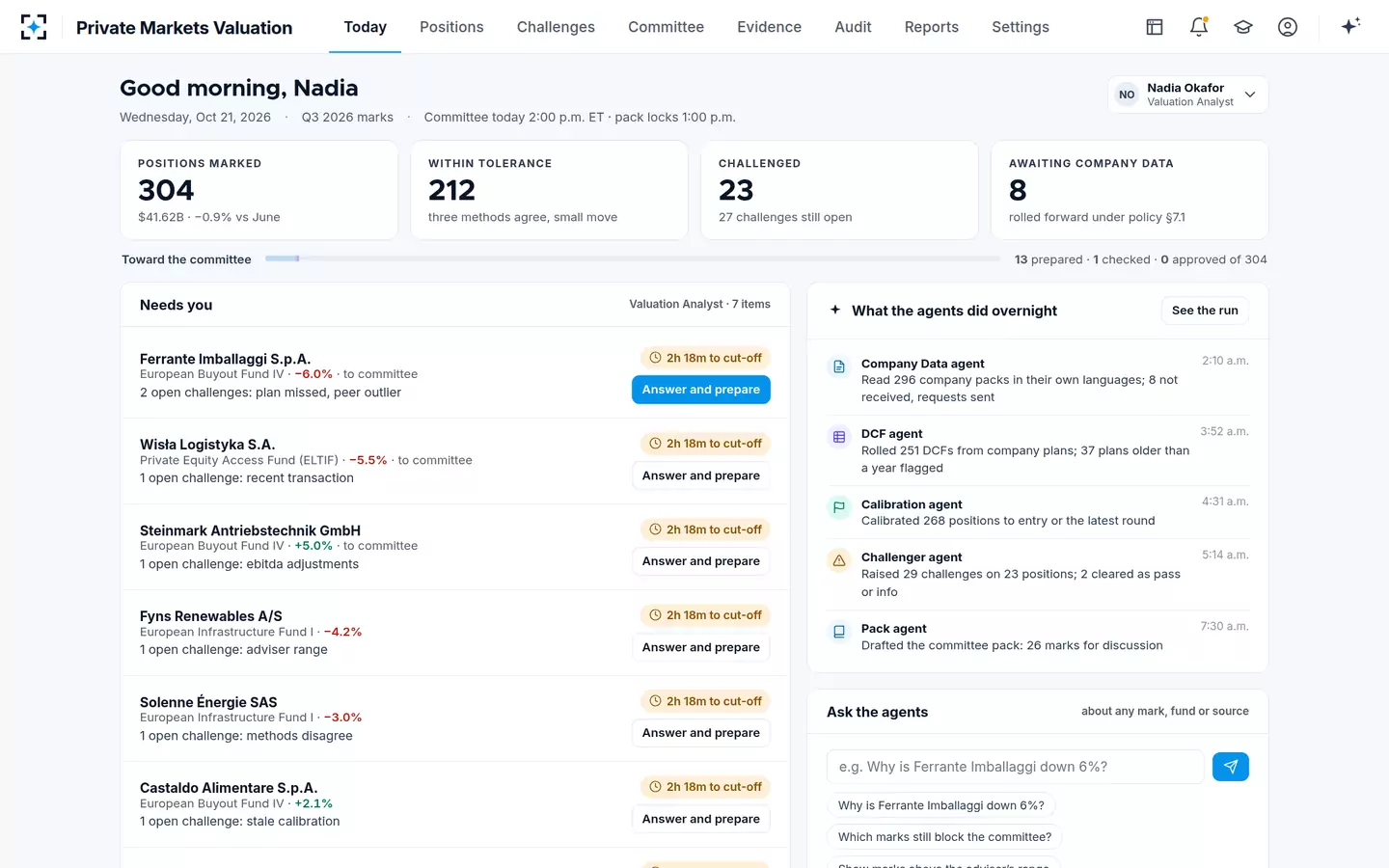
304positions
marked in 38 funds and 9 currencies, $41.62B, −0.9% on June
212
within tolerance: methods agree and the move is under 3%
23
challenged by the agent that argues against every mark; a person must answer
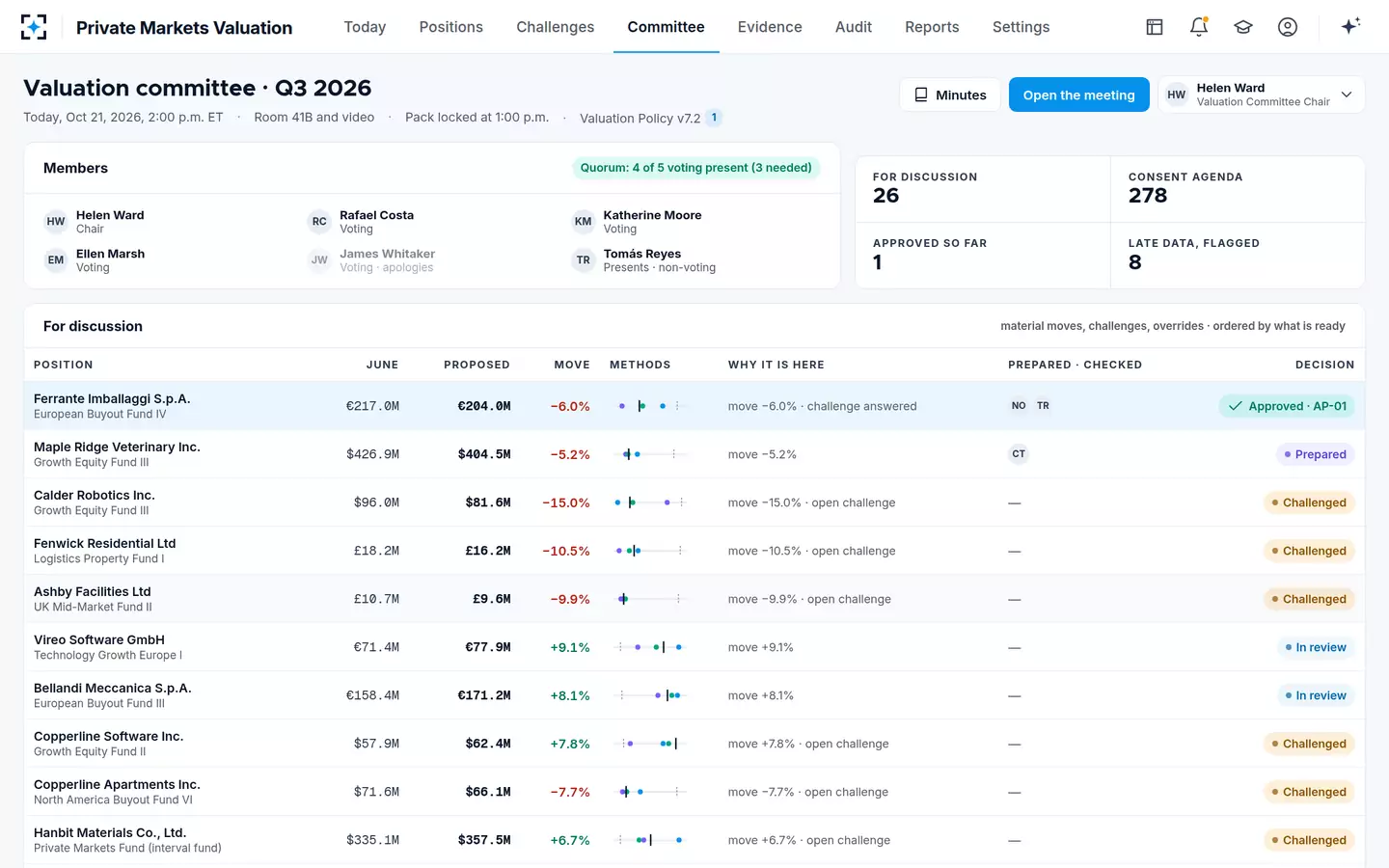
26of 304
marks discussed at committee; the rest approved on a consent agenda
What is the private equity valuation process?
It is a sequence of five steps that repeats every quarter: collect each company's results; compute the methods the valuation policy prescribes; challenge the result; approve it with independence; and seal the evidence for the auditor and the investors. Everything else is detail on how each step is staffed and controlled.
Nearly every manager formalises the approval step in a committee. The FCA, reviewing 36 UK private-markets firms in 2025, reported: "Over 90% of valuation processes in our Phase 1 questionnaire and all Phase 2 firms had valuation committees responsible for valuation decisions", or in some cases for recommendations to another body (FCA, Private market valuation practices, March 2025). It also found that firms whose committees existed only to decide valuations tended to show more independence and oversight, as valuation committee terms of reference explains.
In the US, the expectation runs through examinations rather than a valuation rule for private funds. The SEC's Division of Examinations says its fiscal 2027 reviews of advisers will look at whether they "assessed the reasonableness of their valuation processes and methodologies" (SEC, Examination Priorities, fiscal year 2027; staff priorities, not a rule).
How often are private equity funds valued?
Quarterly in practice, at least annually in EU law. The AIFM Directive requires the assets to be valued, and the NAV per unit worked out, no less than once a year, with more frequent valuation for open-ended funds and for closed-ended funds whenever their capital changes (Directive 2011/61/EU, Article 19). The FCA found managers had settled on quarterly cycles for most private assets, with monthly cycles for some debt.
The quarter matters for money as well as reporting. Brian Daly, the SEC's Director of Investment Management, said in October 2026 that "solid fair value processes by fund managers are and will continue to be an expectation and an examination focus, as those fair values drive internal fund management and performance fee calculations" (remarks, October 16, 2026). A quarter's marks set fees, carried interest accruals, investor statements and, for evergreen funds, the price at which investors come and go.
Who values private equity investments? Five desks, one quarter
A valuation function independent of the deal team values them, and a committee approves. In practice five desks touch every material mark: the analyst who prepares it, the head of valuation who checks it, the committee that approves it, the auditor who tests it and the deal team who knows the company. The process is designed around keeping the last of those at a distance.
Five people who stand behind each mark in a private equity valuation quarter, and the decision each keeps
Today
Turns each company’s quarterly report into a mark in a spreadsheet, refreshes peers by hand and writes the memo the night before the committee.
With agents
Opens each mark with three methods already computed and cited, answers the challenges raised against it, and prepares it with a reason code.
Still theirs: preparing the mark, every peer change and every override.
Today
Checks every prepared mark with the models and evidence spread across analysts’ personal workbooks.
With agents
Checks the reasoning and the sources rather than the arithmetic, and proposes method weights and thresholds for the policy.
Still theirs: checking each mark; proposing policy changes for the chair to approve.
Today
Chairs a committee reading papers assembled overnight, with little sight of who argued against a mark.
With agents
Approves material moves with quorum, sees every challenge and its answer, and signs the quarter.
Still theirs: approving material marks and signing the quarter.
Today
Sends lists of requests and tests sampled positions from screenshots of spreadsheets.
With agents
Opens a read-only sample with sources, methods, decisions and seals, and asks follow-up questions of the evidence.
Still theirs: choosing the sample and forming the audit opinion.
Today
Knows the company better than anyone, which is why the mark has to stay at arm’s length from him.
With agents
Adds information, such as a signed price revision, that the agents cite; cannot set, edit, check or approve a mark.
Still theirs: the information he adds, and nothing else in the mark.
The FCA's description of strong practice reads like a job description for the first two desks: a dedicated function "staffed by people independent of portfolio management with valuation expertise", able to discuss "the challenges in its valuation, key assumption changes – such as comparable asset sets or discount rate changes – and their rationales for recommendations" (FCA). Full-scope UK AIFMs that value in-house must keep the task functionally independent of portfolio management under FUND 3.9.7R.
The sample quarter, from September 30 to the committee
The calendar of a valuation quarter is set by the slowest company report, not by the analysts. In the sample quarter, the Italian packaging company Ferrante Imballaggi sent its quarterly report through the company portal on October 9; eight companies had still not reported when the agents ran on October 20.
The sample quarter's calendar, from quarter end to the signed quarter
| When | What happens | Who decides |
|---|---|---|
| Sep 30 (Wed) | Measurement date. Peer prices, rates and FX are taken from the market data snapshot at this date. | Nobody: the date is fixed by the policy |
| Oct 1 to Oct 19 | Company reports arrive through the portal in their own languages; late ones are chased in the company’s language. | Analysts decide whether a figure is usable |
| Oct 20 (Tue), 2:10 to 5:20 a.m. ET | The agents read 296 reports, refresh 211 peer sets, roll 251 DCFs, calibrate 268 positions and raise 29 challenges on 23 positions. | Nobody yet: everything is a proposal |
| Oct 20 to Oct 21 | Analysts answer challenges and prepare marks; the head of portfolio valuation checks them. Committee papers are drafted by exception. | Analyst prepares, head checks |
| Oct 21 (Wed), 2:00 p.m. ET | Valuation committee: 26 marks for discussion, 278 on the consent agenda, quorum 4 of 5 voting members. | The committee approves; the chair signs the quarter |
| Oct 23 (Fri) | Adjourned session for anything left undecided; approved marks go to fund accounting for the September 30 NAV. | The committee |
The analyst's morning in Private Markets Valuation: four numbers, the marks that need her, and a clock to the committee
How long does quarterly valuation take?
No regulator or independent study publishes how long managers take to value a quarter; the honest way to know is to measure your own last quarter from the measurement date to the signed minutes, and the analyst-days in between. What can be said is where the days go. Botminds' estimate for one analyst covering about 40 positions puts the quarter at 21 working days by hand, and 9.5 days once agents read the reports and compute the methods.
Where one analyst's valuation quarter goes, by hand and with Private Markets Valuation
- Chasing and reading company reports4 d
- Refreshing peer sets and multiples3 d
- Rolling DCFs and calibrating5 d
- Review points and the memo4 d
- Assembling committee papers2 d
- Rebuilding evidence for the auditor3 d
- Reports1.5 d
- Peers1 d
- DCF and calibration2 d
- Review points and memo3 d
- Committee papers1 d
- Auditor evidence1 d
The estimate shows which work shrinks and which does not. Reading reports, refreshing peers, rolling models and rebuilding evidence each fall by 60% or more, because they are mechanical and can be done the night after the data arrives. Answering review points falls least, from four days to three, because it is the judgement the quarter exists for. A process that has not freed that time has automated the wrong part.
What does a valuation committee do at quarter end?
It approves the marks that matter and confirms the rest, and its minutes are the evidence that it did. In the sample quarter the committee takes 26 marks for discussion (moves of 5% or more or $25 million or more, any override, any open challenge) and approves the other 278 on a consent agenda in one resolution once each has been checked.
The FCA's review is the reason to write the minutes carefully: in some firms the minutes did not show how decisions were reached, and members could not give examples when asked, which left the supervisor unable to rely on the committee's oversight (FCA). What the committee's terms should say, from quorum to what the minutes record, is set out in valuation committee terms of reference.
The valuation committee in Private Markets Valuation: quorum, marks for discussion by reason, and the consent agenda
What do auditors test in a private equity valuation?
Auditors test a sample of positions back to source, and spend most of their time on what changed. Firms told the FCA that "external auditors typically reviewed valuations for all assets, while others said auditors would conduct tests on a sample of assets", and that discussions centred on what had changed in the key assumptions and on backtesting (FCA). The firms the FCA rated well brought the auditor into the process, for example by having auditors sit in on valuation committee meetings and put their challenges there.
The quarter-end cost is the evidence. If the sources behind a mark live in personal workbooks and email, the auditor's request list becomes a second project after the committee. In the sample quarter the external auditor drew a sample of 25 positions worth $7.50 billion, and opened each read-only with its methods, cited source pages, decisions and the challenges answered; an open request for backtesting of the last twelve months' exits is the kind of question that should be answerable from the same place.
When a portfolio company reports late, or reports wrong
Late reports are the most common reason a quarter slips, and the valuation policy should decide in advance what happens. The sample policy treats a report as late after 15 days: the agents request it in the company's own language, roll the last mark forward with market movement, and flag it to the committee, which saw eight such positions in the sample quarter.
Reports that arrive can still be wrong. Singapore's regulator found in its 2026 inspections that several fund managers "did not critically assess the veracity of information provided by portfolio companies which serve as inputs for the valuation models", noting "material discrepancies" between audited and unaudited figures that nobody had explained (MAS, Valuation Practices for Fund Management Companies, May 29, 2026). The fix is not more reading but traceable reading: every figure used in a mark pinned to its page, so a later restatement shows exactly which marks it touches.
Can the deal team influence the valuation?
The deal team should inform the valuation and never decide it. The FCA saw both: firms whose valuation function had little power to challenge inputs proposed by investment staff, and stronger ones where views from investment professionals "were segregated and clearly documented, and the independent function maintained control of valuation models, including input and assumption changes" (FCA). It is also following up with firms where senior investment professionals sit as voting committee members.
In the sample quarter the deal partner on Ferrante added one piece of information: a signed price increase of 4.5% from October 1 with the company's largest customer, on 19% of revenue. The DCF agent worked out that it is worth about EUR 2.5 million of EBITDA a year, more than the third-quarter shortfall against plan, and said so with citations; the analyst decided to keep the forecast and recorded why. The partner could not touch the mark, and the committee saw both the information and who supplied it. How those three methods combine into a mark is shown in private equity valuation methods, worked on one company's mark.
Questions people ask
How often are private equity funds valued?
Most are valued quarterly, the cycle the FCA found the industry had converged on; EU law requires at least once a year. Open-ended and evergreen funds value more often because investors deal at net asset value. Material events between quarter ends can justify an out-of-cycle valuation.
Who values private equity funds?
The manager is responsible, usually through a valuation function independent of the deal team and a valuation committee that approves. Some use an external valuer or a third-party valuation adviser for some or all assets; the FCA found most UK firms used advisers while "retaining responsibility for valuation". The auditor tests the result but does not value.
What happens after the valuation committee approves the marks?
The approved marks go to fund accounting for the net asset value, which drives fees, investor statements and, in open-ended funds, dealing prices. In the sample quarter, anything undecided carried to an adjourned session two days later. NAV checks after that point belong to fund accounting's oversight, a separate solution, NAV Oversight.
What is a consent agenda in a valuation committee?
It is a list of marks approved together in one resolution because none meets the committee's materiality test. In the sample policy that means a move under 5% and under $25 million, no override and no open challenge. Each mark on it has still been prepared and checked by two different people.
How do valuation teams handle stale marks?
By defining in the policy when a mark is stale and what triggers an out-of-cycle review. The FCA found that many firms "did not have defined processes or a consistent approach for ad hoc valuations to revalue assets during market or asset-specific events". Moves in the peer set's average multiple and company-specific events were among the triggers it saw used.
Is the private equity valuation process different for private credit?
The governance is the same, but the methods differ: yield analysis and enterprise-value coverage instead of equity multiples. The FCA also noted backtesting is harder because most loans are held to maturity. Private loans have their own guides, starting with private credit valuation methods.