Private credit valuation methods come down to three approaches the accounting standards allow for anything without a quoted price: the market approach, the income approach and the cost approach. For a performing private loan the income approach is the one that matters in practice — the loan is valued by discounting its cash flows at a yield built from comparable spreads, the base rate and a credit premium for the borrower's own risk — while the market approach serves as a cross-check and the cost approach almost never applies. The reason is structural: private credit is lent against enterprise value, not collateral, so the borrower's ability to generate cash is both the source of repayment and the thing being valued. Botminds' Private Credit Valuation runs that yield analysis on every position each quarter and drafts the memo and mark bridge for the committee.
The worked example on this page is the solution's own fictional sample fund: Halberd Lane Capital Corp., 142 positions, $4.99 billion par, one unitranche — Brookhaven Dental Partners, a $186.16M dental-services loan — followed from its last approved mark of 98.50 to its proposed 3Q26 mark of 95.40. The fund, its borrowers and its independent valuation firm are invented. The rules and research are linked where they appear.
What "valuation" means for a loan with no quoted price
Valuation, in the fair-value sense a fund or BDC reports under ASC 820, is the price at which a loan would change hands in an orderly transaction between market participants at the measurement date. Almost no private loan trades in a market you can observe, so there is no price to read off a screen. What exists instead is a contract — a coupon, a maturity, a set of covenants — and a borrower whose ability to pay depends on the enterprise behind it. The valuation methods are the three disciplined ways GAAP lets you turn that contract and that enterprise into a number.
The standard itself is short on ceremony: "Three widely used valuation techniques are the market approach, cost approach, and income approach," and an entity "shall use valuation techniques consistent with one or more of those approaches to measure fair value" (ASC 820-10-35-24A, added by FASB's ASU 2011-04). Nothing in the standard prefers one approach for private loans. Preference comes from the nature of the asset, and for a performing loan the asset is a promise of future cash flows.
The three GAAP approaches: market, income, cost
The three approaches differ in what evidence they start from. The market approach starts from prices of similar things — comparable loans, recent deals, the same loan marked in other funds' public schedules. The income approach starts from the cash flows the loan will pay and discounts them at a yield. The cost approach starts from what it would cost to replace the asset, which is why it fits a building or a machine and not a unique loan agreement.
Market, income and cost: what each approach needs, and where it fits a private loan
What it needs: Quoted prices or recent, observable transactions in identical or comparable instruments, with adjustments for differences.
Where it fits a private loan: The cross-check. Comparable loan spreads and other funds' marks test whether the income number is in line with what the market is doing.
What it needs: The contractual cash flows and a discount rate that reflects current market expectations about them — the yield a buyer would demand.
Where it fits a private loan: The primary method for a performing loan. The yield is built from the last approved mark, moved for spreads, the base rate and the borrower's credit.
What it needs: A replacement cost for the asset — meaningful only where the asset is a physical or replicable thing.
Where it fits a private loan: Almost never. A loan's value is its cash flows, not the cost of writing an equivalent contract.
The income approach has a formal definition in the same standard: it "converts future amounts (for example, cash flows or income and expenses) to a single current (that is, discounted) amount", and the measurement "reflects current market expectations about those future amounts" (ASC 820-10-55-3F). Everything in a private credit valuation reduces to choosing the two halves of that sentence honestly: the future amounts the loan will actually pay, and the discount rate that reflects what buyers currently demand for bearing this risk.
Why performing private loans are priced on enterprise value, not collateral
The yield a direct lender demands is calibrated to the borrower's enterprise, because that is what repays the loan. Research on direct lenders' lending technology makes the point from the other side: "The dramatic rise of direct lenders over the past 20 years is due to their comparative strength in providing enterprise-value based loans to private equity-backed firms in intangible capital industries" (Jang, Kim, Sufi and Chen, NBER Working Paper 34500, 2025). Enterprise value is itself an estimate — an EBITDA figure times a multiple — and supervisors have long treated it as one that must be tested rather than trusted. The 2013 interagency leveraged-lending guidance told each bank to "perform its own discounted cash flow analysis to validate the enterprise value implied by proxy measures such as multiples of cash flow, earnings, or sales" (OCC, Federal Reserve and FDIC). The OCC and FDIC rescinded that guidance in December 2025 as too restrictive on bank lending; the valuation point — test a multiple against cash flows — was not what they objected to.
For valuation the same logic runs in reverse. If enterprise value covers net debt comfortably, the loan performs, and the income approach — yield analysis — is the right method. If coverage fails, the question stops being "what yield prices these cash flows" and becomes "what would a buyer pay for this loan given what the enterprise is worth," which is a recovery analysis. The collateral matters in the recovery case; until then, the enterprise is the credit.
The yield build, driver by driver, from the last mark to the new one
The practical way to value a performing loan each quarter is to start from the yield implied by the last approved mark and move it, driver by driver, for what changed. This keeps the mark anchored to its own history — a bridge any committee can audit — instead of re-deriving a discount rate from scratch. The drivers are three: comparable spreads, the base rate passed through the floating coupon, and a credit-specific premium read from the fund's leverage grid.
The yield build chain: from the last approved mark to the new price
Agent
Last approved mark98.50 at 30 Jun implies a 10.55% required yield on the remaining cash flows — the starting point the whole build is anchored to.
Agent
Comparable spreadsTwo quoted dental term loans widened in the quarter. Add +0.35% to the required yield: −0.77 points of price.
Never: using a comparable without its source and date.
Agent
Base rateThe floating coupon passes rate moves through to the lender. Net effect this quarter: −0.20% of yield, 0.00 points of price.
Agent
Credit premiumNet leverage moved 5.17x to 6.05x; the leverage grid for 6.0–6.5x adds +1.60%: −3.50 points of price.
Agent
Contract changesAmendment 3 added 0.50% of interest, paid in kind. More contractual interest at a 2.19 duration is worth +1.10 points, even though it accrues to principal.
A person decides
The committee decidesShorter remaining life adds +0.07. Price 95.40 against Northfield's 94.75–96.25 range — the head of valuation proposes it with her signature.
Never: the model cannot change the method on its own.
The Brookhaven yield build: 10.55% becomes 12.30%, one driver at a time
Implied by the last approved mark
Yield10.55%
Price98.50
Comparable unitranche spreads, wider
Yield+0.35%
Price−0.77
Base rate through the floating coupon
Yield−0.20%
Price0.00
Leverage grid at 6.0–6.5x
Yield+1.60%
Price−3.50
Amendment 3: +0.50% of coupon, paid in kind (a cash-flow change)
Yield—
Price+1.10
Shorter remaining life (pull to par)
Yield—
Price+0.07
Proposed mark
Yield12.30%
Price95.40
The last row is the answer the committee sees: a 12.30% required yield prices the cash flows at 95.40, a move of −3.10 points, −$5.61M on the position. Because every driver is shown with its own effect, the committee can disagree with one driver — the leverage grid, say — without discarding the whole mark. That driver-by-driver bridge is what fair value hierarchy level 3 disclosure expects to sit behind a mark, and the same bridge, written up for the file, is what turns a number into a defensible one.
The yield screen: the build, a price calculator and the sensitivity grid
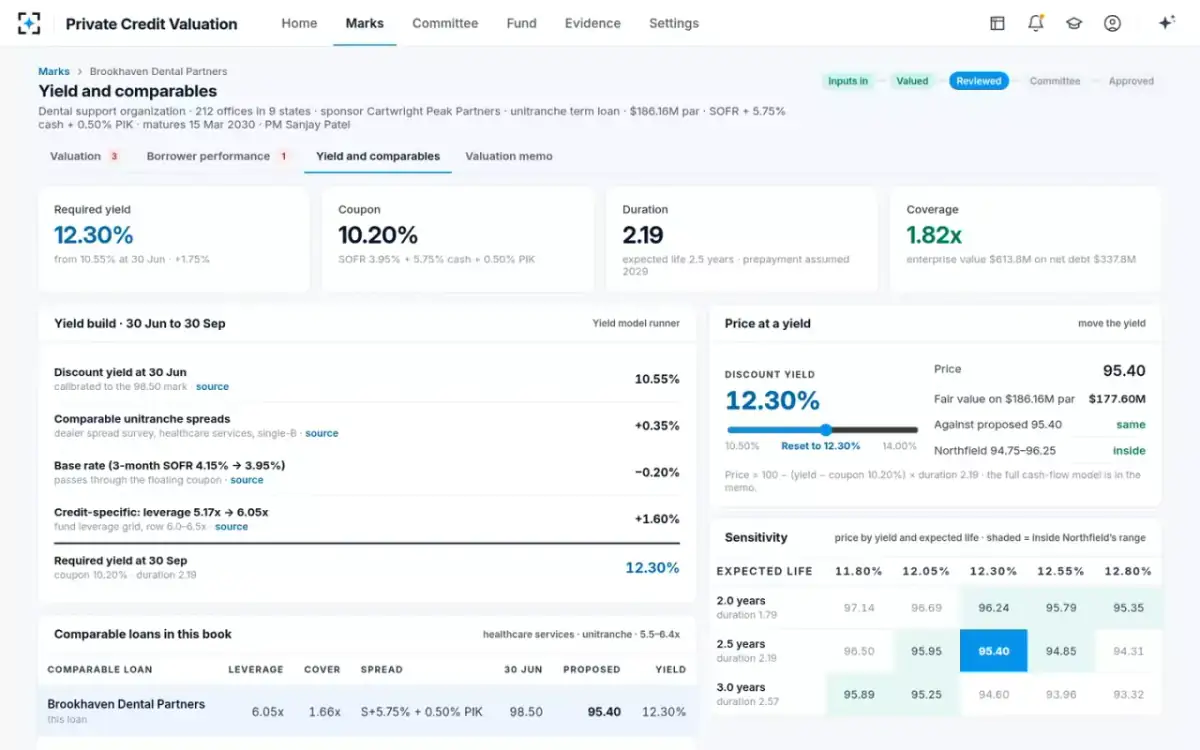
How a market approach cross-checks the income number
The market approach never fully prices a private loan — no comparable is identical, and the same loan's marks in other funds carry their own assumptions — but it answers a different question: is the income number sane? For Brookhaven the market evidence pulled by the comparables analyst lined up around the proposal: the same loan marked in three other funds' public schedules at 98.75, 97.90 and 98.25, six comparable loans in Halberd Lane's own book at a median of 95.93, and a new dental deal priced at S+6.25%.
The market evidence beside the proposed 95.40, one quarter of it
| Evidence | Reading | Against the proposal |
|---|---|---|
| Two quoted dental term loans widened (Bayfront Smile +52 bp, Crescent Orthodontic +44 bp) | The sector repriced in the quarter | Supports a wider yield, not a wider error |
| Summit Oral Surgery, new deal priced at S+6.25% | What the market demands for new dental risk today | Consistent with a required yield above the coupon |
| Six comparable loans in the book, median mark 95.93 | Where sister credits are carried | 0.53 points above the proposal — inside any reasonable band |
| The same loan in three other funds: 98.75, 97.90, 98.25 | How peers carried it at their last dates | Higher, but their marks predate the September package |
| Northfield (independent firm), range 94.75–96.25, point 95.50 | The independent range for this quarter | 95.40 sits inside the range, 0.10 below the point |
Where the market and income approaches disagree, the honest response is not to average them but to explain the disagreement. Other funds carrying the loan two to three points higher are a fact about their valuation dates and their information, not evidence that 95.40 is wrong; when marks between managers diverge, the mark worth keeping is the one that can say why. That is also why the independent range is shown beside every mark and never fitted: a proposal outside Northfield's 94.75–96.25 would move into the range or go to the committee with a reason.
When does a loan move from yield analysis to recovery analysis?
The method changes when the premise stops holding. Yield analysis assumes the cash flows arrive; the moment a buyer would no longer underwrite the borrower's enterprise value at a multiple, the question becomes what the loan recovers in a sale or restructuring. In Halberd Lane's policy the switch is a coverage test: when enterprise value covers net debt below 1.25x — the threshold is a setting, with 1.10x and 1.50x as alternatives — the position moves to recovery analysis, and the mark is built from estimated recovery, not yield.
The same quarter's committee saw the boundary in action. Ridgeline Freight, one of the seven exceptions, went to recovery with non-accrual proposed: its enterprise value no longer covered net debt at any defensible multiple, so the yield method had nothing left to price. Brookhaven, despite a 13.1% fall in EBITDA, still covered net debt 1.82x on an 11.0x multiple — and Elena's downside case, EBITDA a further 10% lower at a 10.0x multiple, still covered 1.49x, above the line. Same method, opposite outcomes, both decided by the coverage arithmetic rather than by judgment about the borrower's story.
What happens to a mark when EBITDA falls but the covenant certificate still passes?
The certificate and the mark can lawfully disagree, and the quarter's finding is the cleanest illustration. Brookhaven's compliance certificate added back $6.1M for fourteen planned de novo offices — five open, nine under lease and not yet open — taking certified leverage to 5.46x with a 19% cushion to its 6.75x covenant. On reported EBITDA, leverage was 6.05x and the cushion 10%. For covenant testing the certified figure governs: the certificate passes. For valuation, the fund's policy excludes the add-back, because a buyer of the loan would not pay today for offices that have not opened — the covenant number and the valuation number diverge by design, and the leverage grid prices the loan off 6.05x. A covenant pass is evidence about a contract; a mark is a price. Conflating the two is how a fund ends up carrying a loan at last quarter's yield after its credit changed.
Which inputs move the number most — and how often should they be re-run?
Two drivers do most of the moving in a performing loan's mark: the comparable-spread read and the borrower's leverage. In the Brookhaven build, the leverage grid alone was −3.50 points against the spreads' −0.77. That ordering is what you would expect whenever the news is about one borrower — the credit-specific premium is where idiosyncratic news lives, while spreads move whole sectors together. The base rate mostly passes through a floating coupon and nets near zero, and time effects are small. A valuation method should be re-run on every new input, not on a calendar: the solution re-proposes a mark the night a September package and compliance certificate arrive, which is why 141 of Halberd Lane's 142 positions were proposed before Elena Marchetti opened the peer map on Monday morning.
One quarter's proposed marks across the sample book
142
positions in the book, $4.99B par
141
marks proposed by the six agents over the weekend run
108
proposed down this quarter
22
proposed up, 11 unchanged — each unchanged one still needs its reason
The position valuation: proposed mark, independent range and every agent step
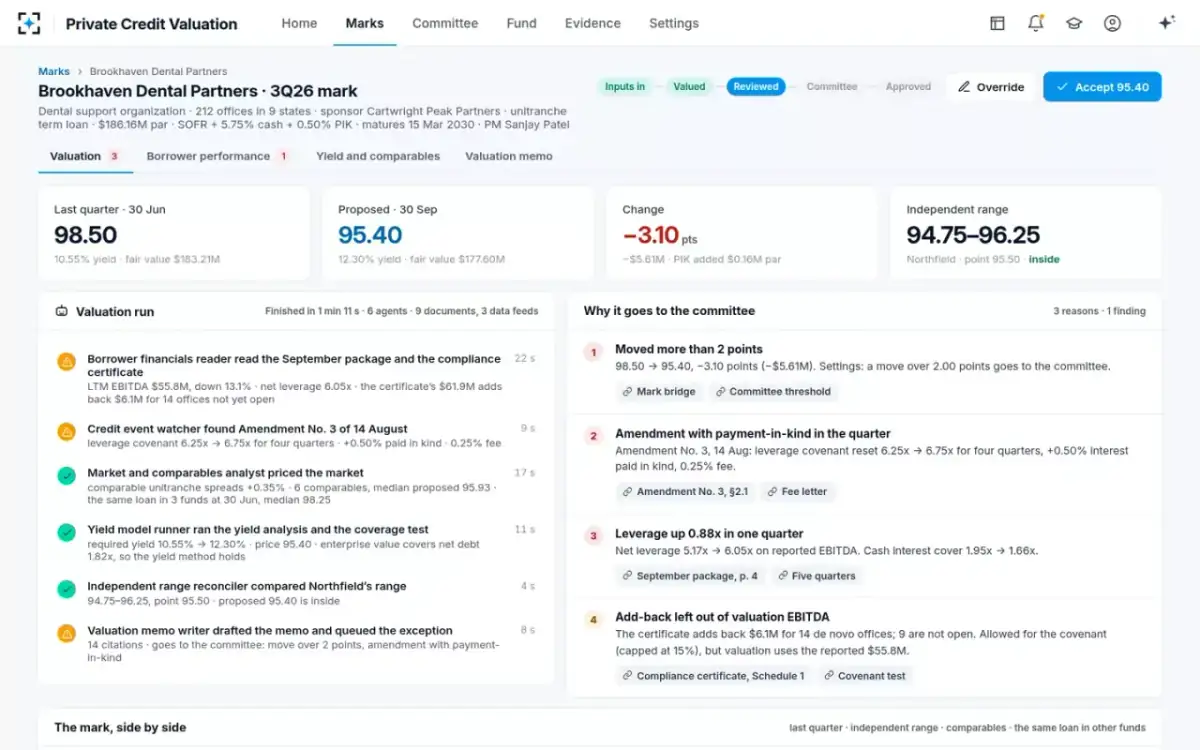
A mark unchanged is not a mark unexamined. With marks falling across the market in 3Q26 — 108 of the 141 proposals were down — a position that holds still while comparable spreads widen earns a question, which is why the book's stale-mark rule sends any loan unchanged for two quarters while spreads move more than 0.25% to the committee with its reason on the file. To see the full sequence from package intake to committee, start from Private Credit Valuation.
Questions people ask
What are private credit valuation methods?
The three approaches GAAP allows for an asset with no quoted price: the market approach (evidence from comparable loans and recent deals), the income approach (discounting the loan's cash flows at a market yield) and the cost approach (replacement cost, which almost never fits a loan). For a performing private loan the income approach is the primary method and the market approach the cross-check.
How is a private loan valued?
For a performing loan, by yield analysis: take the yield implied by the last approved mark, add the change in comparable spreads, the base-rate effect and a credit premium from the fund's leverage grid, then price the contractual cash flows at that yield. If enterprise value covers net debt below the policy threshold — 1.25x by default — the method switches to recovery analysis.
What is the income approach to valuation?
The approach that converts future amounts — a loan's coupon and principal — to a single present amount by discounting. ASC 820 defines it exactly that way. In private credit it takes the form of yield analysis: the discount rate is built from observable market pieces plus a credit-specific premium.
Why do private loans use enterprise value instead of collateral?
Because the enterprise generates the cash that repays the loan; collateral only matters if the enterprise fails. While enterprise value covers net debt comfortably, the loan performs and its price is a yield question. Below the coverage line the method changes to recovery analysis, where collateral and sale value take over.
When does a loan move from yield analysis to recovery analysis?
When the coverage test fails — in the sample fund's policy, when enterprise value covers net debt below 1.25x. The threshold is a setting. The method change itself requires the head of valuation's approval; the model cannot switch methods on its own.
What is a mark bridge?
The line-by-line walk from the last approved mark to the new one, with each driver's price effect shown separately — comparable spreads −0.77, the leverage grid −3.50, the payment-in-kind amendment +1.10, and so on down to the proposed 95.40. It is the part of the memo an auditor or committee member reads first.