Private credit valuation software is any tool a valuation team uses to set and document a quarter's fair value marks — and the term covers three very different things. At one end is the shared workbook the team already has: flexible, familiar, and entirely manual. In the middle sit pricing and valuation platforms that automate the market data — spreads, comparables, dealer runs — but leave the borrower's own documents to the humans. At the other end is the agentic approach, where software reads the monthly packages, the compliance certificates and the credit agreements themselves, and drafts the support a committee can test. This guide runs one real-shaped loan through all three — the sample fund's Brookhaven Dental reset, with a genuine add-back and a genuine amendment in the file — so the comparison turns on what each approach actually reads, not on feature lists.
The people, fund and borrower are the solution's fictional sample data; the regulatory anchors are the SEC's Rule 2a-5 release, FASB's fair value standard, the 2014 interagency leveraged-lending FAQs and a 2025 NBER study, linked where they appear.
Three ways to run a quarter's marks, compared on one loan
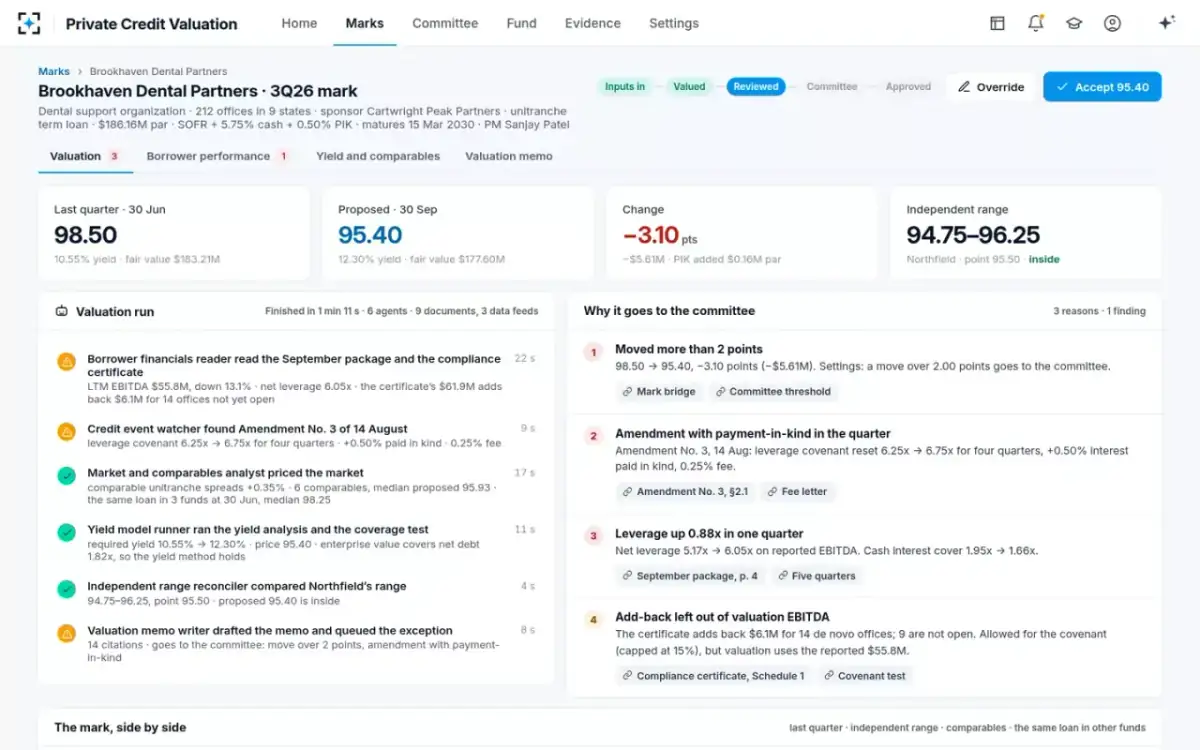
Brookhaven Dental Partners is a $186.16M unitranche in the sample fund's 142-position book. Its third-quarter file contains two things a valuation process has to catch: a compliance certificate that adds back $6.1M of EBITDA for fourteen offices, nine of them not yet open, and Amendment No. 3, which added half a point of interest paid in kind. Last quarter's approved mark was 98.50. The defensible mark is 95.40. The three approaches differ in whether they find the reasons.
One loan's quarterly reset, run three ways: what each approach catches, and what it misses
What the approach reads: Whatever the analyst types into it. It ties out arithmetic faithfully once the numbers are in it, and organizes a yield build well.
What Brookhaven's file needed: Catches nothing by itself. The add-back arrives typed in as certified EBITDA; the amendment arrives, if at all, as a note in the file. The 95.40 case has to be built entirely by hand — about an evening for this one loan, and fifteen working days for the whole book.
What the approach reads: Market data: comparable spreads, dealer runs, transaction multiples, sometimes peer marks from public schedules. Good feeds, fast refreshes.
What Brookhaven's file needed: Catches the market half of the story — quoted dental loans widened, and the platform would show that. Still blind to the certificate and the amendment: the covenant re-computation and the add-back decision stay manual, and the platform writes no memo and queues no exception.
What the approach reads: The documents themselves: the package, the certificate, the credit agreement and its amendments, the market feeds and other funds’ schedules — with a citation on every extracted value.
What Brookhaven's file needed: Catches both: the add-back flagged as claimed-versus-reported with the certificate’s page cited, the amendment applied to the covenant test, the yield run from the last approved mark, the range reconciled, the memo drafted, the exception queued with three reasons and the finding.
The one-sentence version: the workbook reads nothing, the platform reads the market, and the agentic approach reads the file. Since the file is where the risks live — from 2014 until the OCC and FDIC rescinded the guidance in December 2025, bank examiners were told to criticize EBITDA definitions that allow "enhancements to EBITDA without reasonable support" — the difference in what gets read is the difference in what gets caught.
The shared workbook: what it catches, and what it cannot
The workbook earns its keep on arithmetic and loses it on intake. As a calculation surface it is fine: the yield build from 10.55% to 12.30%, the coverage test at 1.82x, the mark bridge from 98.50 to 95.40 — all of that is spreadsheet work, and a careful analyst's workbook does it correctly. The failure is upstream. Every input arrives by hand: the certificate's EBITDA transcribed, the amendment noticed by whoever opens the mail, the comparable spreads pulled one screen at a time. On Brookhaven, the workbook version of the quarter contains the add-back as typed — $61.9M certified EBITDA — and nothing in the sheet itself asks whether a buyer of the loan would pay for offices that have not opened.
Its second failure is scale-invisible. One loan's evening is manageable; a 142-position book's fifteen working days is a quarter eaten whole, and the work that disappears first under deadline pressure is exactly the reading. The workbook also writes nothing the committee can use directly: the memo is a separate document, the reasons live in email, and the evidence trail is whatever the analyst remembered to save. Where a valuation analyst's hours actually go is, in most funds, the story of this workbook.
A pricing or valuation platform: closer, but still blind to the credit agreement
The platform fixes the data intake problem it was built to fix. Comparable spreads arrive refreshed; dealer runs land in one place; a new issue like Summit Oral Surgery at S+6.25% is in the comparables set the day it prices. For the market half of Brookhaven's file — quoted dental loans widening 52 and 44 basis points — the platform would have the evidence on screen before the analyst finished coffee. Any team choosing between platforms should choose on feed quality, depth of history and how openly each one explains its methodology.
What the platform cannot see is the other half of every mark. The certificate is a PDF in an inbox; the platform does not read it. Amendment No. 3 changes which covenant test applies this quarter; the platform does not know it exists. The independent firm's range letter arrives as a spreadsheet attachment; the platform does not reconcile against it, because reconciliation is a decision, not a data feed. And when the quarter closes, the platform has no memo, no bridge, no exception queue — the committee's file still has to be assembled by hand around the platform's screenshots. The analyst's judgment is still load-bearing everywhere, with less time left for it.
What an agentic solution adds: reading the actual documents
The agentic approach begins where the intake problem actually is: the documents. On Brookhaven, the borrower financials reader extracted five quarters of revenue, EBITDA, leverage and liquidity from the September package, re-computed the covenant under the agreement as amended by Amendment No. 3, and flagged the certificate's $6.1M add-back against the fourteen-office schedule — five open, nine under lease and not open — citing the certificate's page and line. The market analyst pulled the same loan's marks in three other funds' public schedules, the two quoted dental loans, the new issue and the six in-book comparables. The yield model runner rebuilt the required yield from the last approved mark, driver by driver. The reconciler set the proposal beside Northfield's 94.75–96.25 range. The memo writer drafted the memo in the policy's order with a citation on every number, and queued the exception.
The evidence rail in Private Credit Valuation: the mark beside every line of its support
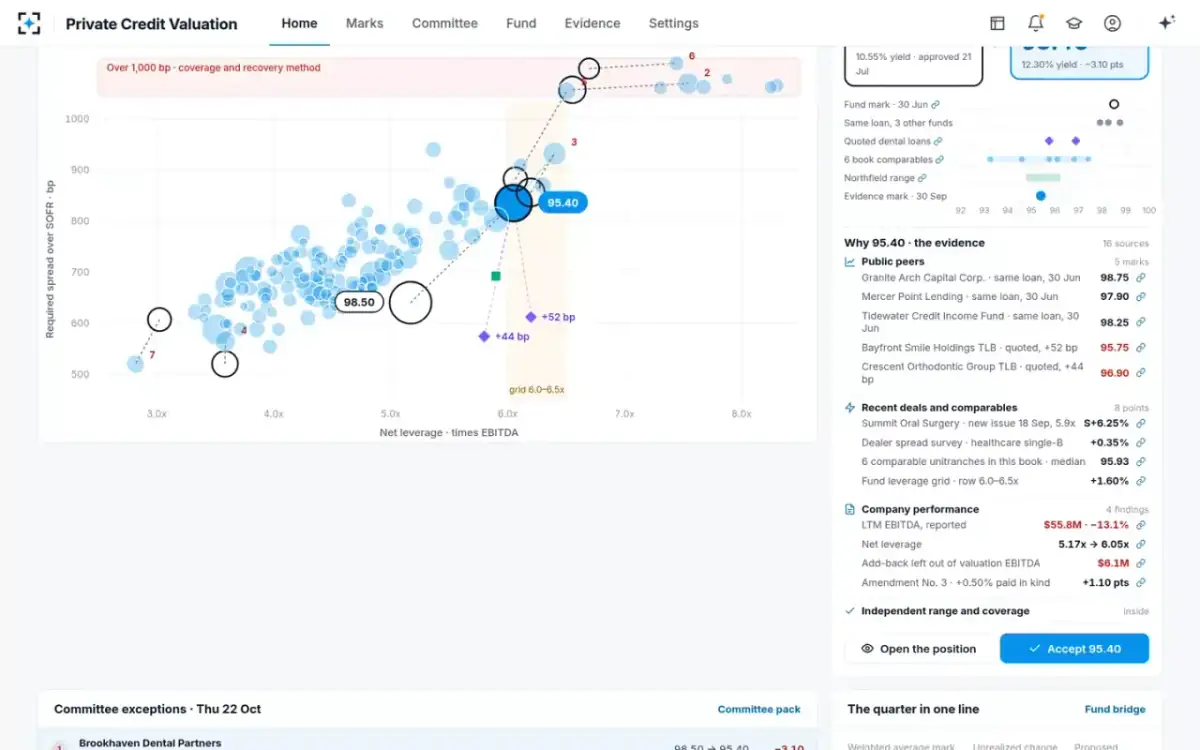
The research keeps pointing at why document-reading matters more than data-feed breadth. A 2025 NBER study of direct lenders found they "write collateral claims more focused on the continuation value of firms after default, especially when the firms operate in intangible capital industries" — the recoverable value of a private loan lives in the documents and the borrower's specific assets, not in a spread surface. A platform prices the market; a mark is defended from the file.
What none of the three approaches should ever do automatically
The comparison so far is about capability; this row is about restraint, and it applies to all three. A mark should never be set or approved by the tool that drafts the memo — the SEC wrote segregation of duties into Rule 2a-5's requirements for a valuation designee, alongside the duty to "select, apply and test fair value methodologies". No approach should move a mark into the independent firm's range to make it fit. None should change a valuation method without a named person's approval — ASC 820 requires that "valuation techniques used to measure fair value shall be applied consistently", allowing a change only where it gives a measurement "equally or more representative of fair value", which is a judgment someone has to own. And none should print a number it cannot source.
The difference is what each approach makes easy. The workbook leaves every restraint to the analyst's discipline; the platform's defaults simply never address these questions; the agentic system on this site encodes the refusals and shows them. The six agents and the limits none of them may cross sets the standard a buyer should hold any agentic vendor to — ask for the never-list in the vendor's own words, and be wary of a vendor who has never written one down.
How to test this on your own last quarter, not a vendor's demo
Every approach will look good on a prepared example; the test that discriminates is your own history. Take last quarter's already-approved marks and the documents that supported them, and replay the quarter. For the workbook there is nothing to test — it is the baseline. For a platform, ask how its comparables and spread history would have priced three positions the committee argued about, and how much of the memo it would have drafted. For an agentic solution, run the whole book and compare position by position: where the proposal differs from the approved mark, the disagreement is data, not error — either the old file lacked something the system read, or the system's reading needs correction, and both directions are the evaluation.
Brookhaven's reset through the three approaches: the same file, three workloads
- Re-key the package and certificate1.5 h
- Pull spreads and comparables by hand1 h
- Yield build from the last mark1 h
- Memo, bridge and reasons in email1.5 h
- Re-key the package and certificate1.5 h
- Check the feeds0.5 h
- Yield build from the last mark1 h
- Memo, bridge and reasons in email1.5 h
- Agents read, price, run and draft71 s
- Analyst review, downside case, signature~1 h
The honest difference across the whole book, in minutes per position per quarter
What to ask a vendor about how it handles the independent range
The independent valuation firm question separates marketing from design, because it has one honest answer and several dishonest ones. The honest answer, from this site's own FAQ: no — the software does not replace the independent firm. The firm uploads its range letters; every proposed mark is set beside the range and point; a mark outside the range moves into it or goes to the committee with a written reason; and the system never moves a mark to make it fit. A vendor who claims their tool replaces the independent review is selling a compliance problem; a vendor who cannot show the range beside every mark has not thought about how valuations actually get challenged.
Questions that discriminate, whatever approach you are weighing
- Show the mark beside its independent range, on screen, for any position
Not in a report — in the working screen the committee will actually use.
- Open any number back to its document
Click the EBITDA in the memo and land on the certificate page it came from. If the demo cannot do this live, the evidence story is aspiration.
- What does the system refuse to do?
Ask for the never-list in the vendor’s own words: never set a mark, never decide a non-accrual, never fit the range. A vendor without one is describing automation, not assistance.
- How are overrides handled?
They should carry a reason, be visible in the memo and to the committee, and sit on the audit trail — not vanish into the number.
- Does it read the credit agreement and its amendments?
Covenant definitions change with amendments. If the system prices the borrower but not the agreement, the covenant math is still yours.
- Run it on our last quarter, in front of us
Replays of already-approved marks are the only demo a vendor cannot stage. Differences are data to investigate, in both directions.
Two of those answers are legal-shaped, not technical. The segregation and methodology-testing duties sit with a board or its valuation designee under Rule 2a-5; software that obscures them — by auto-approving, by hiding overrides, by fitting the range — does not simplify the workflow, it re-creates the finding. And the hours case for all of this, priced rather than asserted, is on the cost of a quarter's valuation.
The position valuation screen: what the committee reads before it asks anything
Is "AI-assisted" the same as "agentic"?
No, and the difference is worth pinning down before a demo, because vendors use the words interchangeably. AI-assisted tools use a model inside a feature: a summary box, a drafting helper, a chat bolted onto a database. The human still drives every step, and the tool waits to be asked. An agentic system divides a whole workflow among agents that each own a step — reading, watching, pricing, running, reconciling, drafting — run end to end on the quarter's real inputs, and each carrying written refusals about what it may never decide. The test is behavioural, not lexical: does the system, unprompted, produce a complete proposed valuation with citations, limits and a queue of exceptions — or does it wait for instructions and autocomplete them?
The distinction matters because the risks differ. AI-assisted features fail by omission: nobody asked, so nothing happened. Agentic systems fail by commission if their limits are wrong: they acted, at scale, before anyone looked. That is why the never-list, the citations and the replay-on-your-own-quarter test are not garnish on the buying process — they are the buying process. And it is why the implementation path matters as much as the choice: how this solution goes live, week by week, starts with the replay and ends with the committee trusting a live run. To see all three approaches against your own book, start from Private Credit Valuation.
Questions people ask
What is private credit valuation software?
Software that helps a credit fund or BDC adviser set a fair value mark for every loan each quarter and document why: the inputs, the method, the independent range and who approved it. The term spans three real categories — shared workbooks, pricing and valuation platforms, and agentic solutions that read the underlying documents themselves.
Spreadsheets vs valuation software for private credit: which wins?
For arithmetic, the spreadsheet is fine and always will be. It loses on intake and evidence: every input is typed by hand, nothing asks where a number came from, and the committee file assembles separately. Software wins when it removes the reading and the reconciliation, not when it re-skins the spreadsheet with better charts.
What should valuation software catch that a workbook can't?
Three things, all document problems: an EBITDA add-back the certificate claims but the file cannot support, shown against the reported figure with its citation; an amendment that changed the covenant test or added payment-in-kind interest; and the same loan's marks in other funds' public schedules. On the sample loan in this guide, excluding the add-back is worth −3.50 points and the amendment's paid-in-kind interest +1.10.
Does valuation software replace the independent valuation firm?
No — and be sceptical of any vendor who says otherwise. The independent firm uploads its range letters; the software sets every proposed mark beside the range and point, and a mark outside the range moves into it or goes to the committee with a written reason. The firm keeps its independence; the software removes the manual reconciliation around it.
What questions should I ask a valuation software vendor?
The discriminating ones: show the mark beside its independent range live; open any number back to its source document; state what the system refuses to do, in the vendor's own words; explain how overrides carry their reasons; confirm it reads credit agreements and amendments, not just market data; and run your own last quarter in front of you.
How do you test valuation software before buying it?
Replay last quarter. Load the already-approved marks and the documents that supported them, run the whole book, and compare position by position. Where the proposal differs from the approved mark, investigate the difference as data — the old file may have missed something, or the system may have misread something — and judge the vendor by how openly those disagreements can be examined.