Fair value hierarchy level 3 is the bucket a measurement lands in when it relies on an input the market does not publish — and for a private credit loan, that is nearly always. Level 1 is a quoted price in an active market; Level 2 is an observable input that is not quite a quote; Level 3 is everything left, which is where the whole of a direct-lending book usually sits. That placement says nothing about whether the mark is good. It says who has to prove it: with no quoted price to point at, the fund's own support — the inputs, the method, the sensitivity and a reconciliation a stranger can follow — is the entire evidence, and the audit and disclosure burden that other asset classes delegate to the market, a private credit fund carries itself. Private Credit Valuation builds that file position by position, every quarter.
The examples below come from the solution's fictional sample fund, Halberd Lane Capital Corp.: 142 positions, $4.99 billion par, an independent valuation firm called Northfield, and a valuation committee that meets on 22 October to approve the 3Q26 marks. The fund and its people are invented; the accounting rules and the SEC release are linked where they appear.
What "Level 1, 2, 3" actually sorts
The hierarchy sorts inputs, not assets and not valuation firms. An input is Level 1 if it is a quoted price in an active market for the identical thing: a listed share, an on-the-run Treasury. It is Level 2 if it is observable but not a quote — a comparable bond's yield, a swap curve, a recent private print. It is Level 3 if it is unobservable: the credit premium in a yield build, the EBITDA multiple behind an enterprise value, the recovery assumption on a distressed loan. The standard's own sentences are worth keeping verbatim, because auditors test a classification against them:
Level 1 inputs are quoted prices (unadjusted) in active markets for identical assets or liabilities … Level 2 inputs are inputs other than quoted prices included within Level 1 that are observable for the asset or liability, either directly or indirectly … Level 3 inputs are unobservable inputs for the asset or liability.
FASB, ASU 2011-04 (ASC 820-10-35-40, 35-47, 35-52)
Notice what is absent: any mention of risk, quality or difficulty. A Level 3 measurement can be rigorous and a Level 1 price can be stale. The sort answers one question only — how much of this number did the market hand us, and how much did we assume — because the answer decides how much disclosure the reader needs.
The three-level ladder, with a private-loan example at each rung
Level 1 · quoted
A price in an active market for the identical asset, unadjusted.
Private-credit analogue: almost none. A fund's listed equities would qualify; its loans do not trade on an exchange.
Level 2 · observable
An input read from the market that is not a quote on this exact asset: comparable spreads, base rates, swap curves.
Used inside a loan valuation — the comparable-spread move in a yield build is a Level 2 piece — but never sufficient alone to price a specific private loan.
Level 3 · unobservable
An input the fund must assume: the credit-specific premium, the EBITDA multiple, the recovery estimate.
Where every performing private loan lives: the yield build needs the leverage grid, which is the fund's own unobservable estimate of the premium this borrower commands.
Why almost every private loan lands in Level 3
A private loan fails the first two rungs on arrival. It has no exchange and no screen price, so Level 1 is out. Its cash flows are specific to one borrower — one dental-services roll-up, one freight carrier — so no observable input prices the loan itself; comparables inform the yield but cannot substitute for the credit-specific premium a buyer would charge this borrower, this quarter. That premium is unobservable by definition, and the moment it enters the measurement the whole mark is Level 3.
Regulators assume as much in practice. The SEC's 2020 release adopting Rule 2a-5 — the fund-pricing rule written precisely for portfolios of hard-to-value instruments — frames a fund's obligations around the people who must "select, apply and test fair value methodologies". You do not write that sentence for Level 1 assets; you write it for books where the methodology is the measurement. Halberd Lane's 142 positions are all Level 3, all in the same disclosure class, and all dependent on the same discipline: a method chosen in policy, tested against coverage, and documented for every position.
The rule in one sentence, and what it does not say
The rule in one sentence: if a relevant observable input exists, use it, and only when relevant observable inputs are not available may you measure with unobservable ones. The standard is explicit that this is a normal state of affairs rather than an exception: unobservable inputs "shall be used to measure fair value to the extent that relevant observable inputs are not available, thereby allowing for situations in which there is little, if any, market activity for the asset or liability at the measurement date" (ASC 820-10-35-53, in ASU 2011-04).
What the rule does not say matters just as much. It does not say Level 3 is a last resort to be avoided, does not say an unobservable input is a guess, and does not say a third-party price would be better than a documented model. An unobservable input must still reflect "what market participants would use", in the standard's framing — it is constrained by everything observable around it, which is exactly why a yield build starts from observable spread moves and isolates the unobservable part into one visible line.
What has to be disclosed for a Level 3 fair value measurement?
The disclosure package for recurring Level 3 measurements has a recognisable skeleton: the inputs and how they interrelate, the sensitivity of the mark to changes in those inputs, and a reconciliation of the opening balance to the closing balance, with each class of movement — purchases, sales, paydowns, realised and unrealised gains — shown separately. The method pages of this series show what those inputs look like in practice; the disclosure is where a reader tests whether the fund actually knows them.
What a Level 3 file has to hold, position by position
- The inputs, named and sourced
Comparable spreads with their dealer run and date, the base rate, the leverage-grid premium, the multiple behind enterprise value. Every value cited to its document.
- The method and why it applies
Yield analysis for a performing loan; recovery analysis below the coverage line. A method change needs the head of valuation's approval and a versioned policy.
- The sensitivity, stated
What a quarter-point of yield, a turn of leverage, or a point off the multiple does to the mark — the number an assistant could quote.
- The reconciliation, movement by movement
Opening mark to closing mark with purchases, sales, paydowns, realised and unrealised shown separately, so a stranger can walk it.
- The independent range beside the mark
The valuation firm's range and point, shown, never fitted — a mark outside it moves into it or goes to the committee with a reason.
- Who approved it
The proposer's signature with its meaning, the committee's approval, portfolio managers recused on their own credits — all kept six years.
Why one unobservable adjustment can drag a Level 2 input into Level 3
The hierarchy classifies the whole measurement by its least observable significant input: it is categorised "in its entirety in the same level of the fair value hierarchy as the lowest level input that is significant to the entire measurement" (ASC 820-10-35-37). The standard draws the line for adjustments with unusual precision. If an observable input needs an unobservable adjustment, and that adjustment moves the measurement significantly, the result is Level 3 — full stop: "If an observable input requires an adjustment using an unobservable input and that adjustment results in a significantly higher or lower fair value measurement, the resulting measurement would be categorized within Level 3 of the fair value hierarchy" (ASC 820-10-35-38A).
One unobservable adjustment is enough: a worked example
Without the adjustment: Two quoted dental term loans widened: Bayfront Smile +52 bp, Crescent Orthodontic +44 bp.
With the adjustment: The same spread move, used as far as it goes.
Without the adjustment: None — but a sector spread is not a price for this borrower.
With the adjustment: The fund's leverage grid prices borrower-specific risk: net leverage moved 5.17x to 6.05x, adding +1.60% of yield.
Without the adjustment: Not computable: the spread move alone prices a sector, not a loan.
With the adjustment: 12.30% yield, price 95.40 — and because the grid is unobservable, the whole measurement is Level 3.
The practical consequence is that a fund cannot launder an unobservable input through observable ones. Marking Brookhaven from comparable spreads alone, then nudging the result "for credit", is the same Level 3 measurement with worse documentation — the nudge is the input, and the file has to name it, justify it and show its sensitivity like any other unobservable input.
What examiners and auditors look for in a Level 3 reconciliation
An auditor sampling a Level 3 book does not reprice the loans; they walk the file. For each position they ask for the inputs and where they came from, the method and why it applies, the independent range, the memo and the approval. The fictional sample fund's interim audit shows the shape of a clean answer: the auditor's 25-position sample reads in one place — inputs, method and model, independent range, memo and approval per loan — with 18 of 25 positions complete, 7 waiting only on the committee, and 412 documents already in the file.
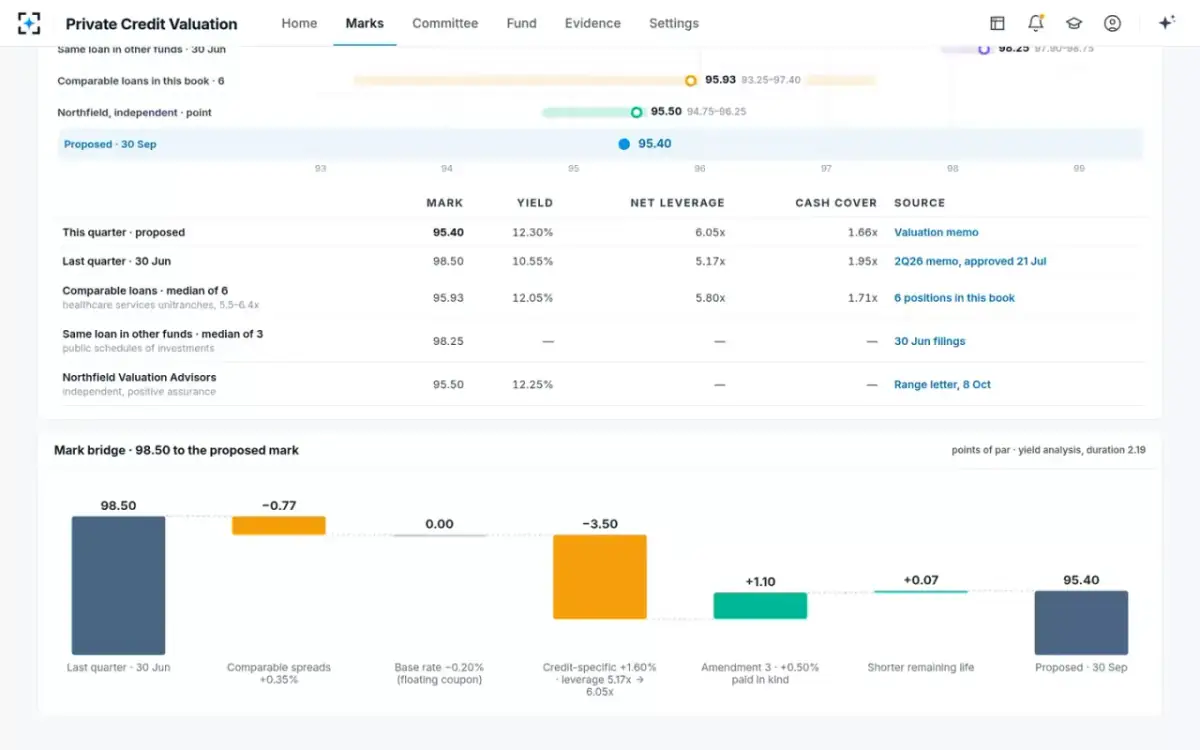
The mark bridge as a miniature Level 3 reconciliation: 98.50 walks to 95.40
| Movement | Driver | Points |
|---|---|---|
| Opening balance, 30 Jun | Last quarter's approved mark | 98.50 |
| Unrealised — comparable spreads | +0.35% of yield on the sector reprice | −0.77 |
| Unrealised — base rate | Passed through the floating coupon | 0.00 |
| Unrealised — credit-specific | Leverage grid at 6.0–6.5x after the September package | −3.50 |
| Unrealised — contract change | Amendment 3 payment-in-kind coupon | +1.10 |
| Unrealised — time | Shorter remaining life | +0.07 |
| Closing balance, 30 Sep | Proposed; committee meets 22 Oct | 95.40 |
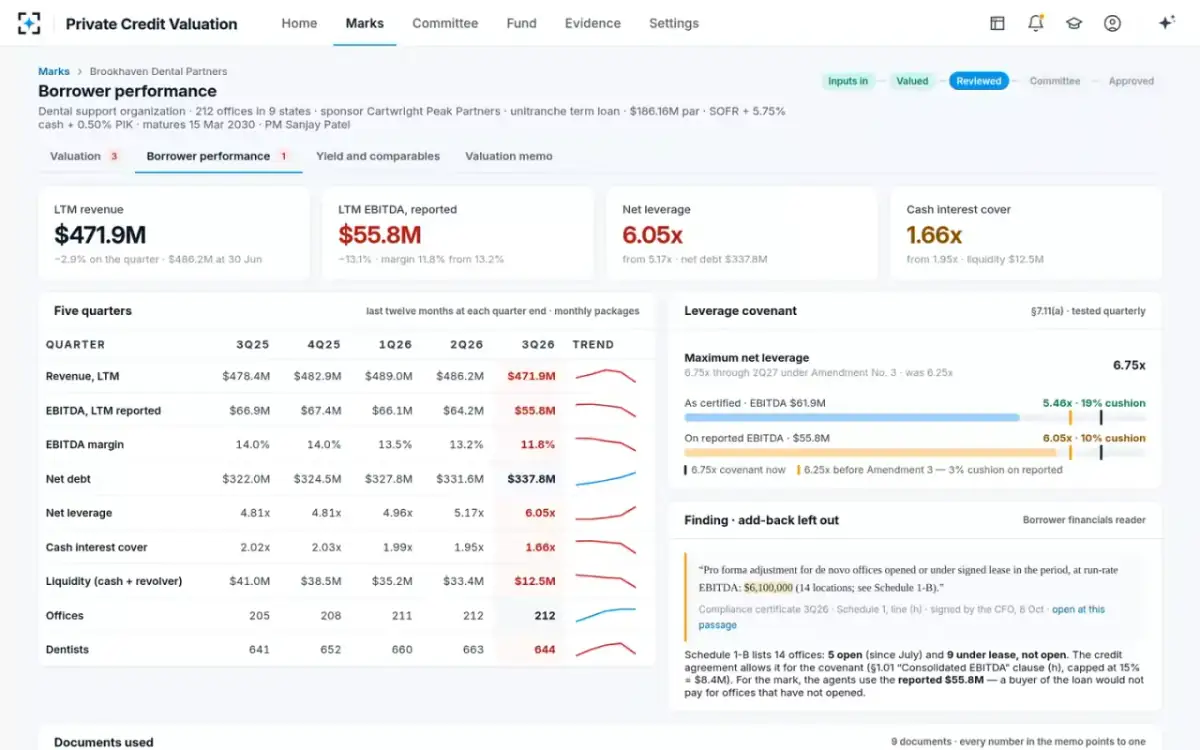
The walk has to survive a stranger's questions: why did credit-specific movement dominate? Because EBITDA fell 13.1% to $55.8M and net leverage rose nearly a full turn, from 5.17x to 6.05x — the certificate's add-back was excluded from valuation EBITDA, and the grid priced the reported number. Why did the payment-in-kind amendment add value back? Amendment 3 added 0.50% of interest, paid in kind; more contractual interest on a 2.19-duration loan is worth about 1.10 points, even though it accrues to principal instead of arriving in cash. Every line in a defensible reconciliation has an answer of that shape.
The mark bridge: every point of the move, explained beside its evidence
Is a lender's own model enough for Level 3, or do you need a third party too?
Both, in different jobs. ASC 820 places the measurement on the fund's own shoulders — it is the fund that must select the methodology, estimate the unobservable inputs and document the result. An independent valuation firm adds the control the standard cannot supply: a range and a point from someone paid to disagree. In the sample fund's policy the two are braided rather than alternated: Northfield reviews 25% of the book each quarter so every position is independently reviewed within a year, and certain positions always — moves over two points, marks below 85, anything proposed for non-accrual.
One position in 3Q26 shows the braid working. Solstice Home Health was proposed at 93.25 against Northfield's range of 91.00–92.50; the independent reconciler flagged it, and policy sent it to the committee with its reason rather than letting the mark drift toward the range. The third-party number did not set the mark — the committee did, with both numbers on the table. That is the division of labour a Level 3 book needs: the fund owns the measurement, the independent firm owns the challenge, and the file shows both.
Borrower performance: the inputs behind the unobservable premium, cited to the package
Does being Level 3 mean the mark is unreliable?
No — it means the mark is unsupported by a market price, which is a statement about the asset's liquidity, not about the fund's competence. The reliability of a Level 3 mark is decided by the file: were the inputs the best available, is the method in policy, does the sensitivity show the fund knows where the estimate is soft, did an independent firm challenge it, and does the reconciliation walk? A fund that answers those questions has a mark as defensible as any quoted price; a fund that cannot is unreliable at every level of the hierarchy.
The distinction matters commercially as well as technically. Investors in private credit have learned to ask for the file, not the label — which is why the audit-trail habit, six years of signatures, memo versions and policy changes, is the quiet centre of the whole exercise. To see how the file is built quarter by quarter, start from Private Credit Valuation.
Questions people ask
What is fair value hierarchy level 3?
The lowest rung of the fair value hierarchy in ASC 820: measurements that rely on unobservable inputs — assumptions about what market participants would use that the market does not publish. It classifies the inputs, not the quality of the measurement.
What are examples of level 3 assets?
Private loans and private equity, distressed debt, real estate held at fair value, and most derivatives that cannot be marked from observable curves. In a private credit fund the whole performing book is typically Level 3, because the credit-specific premium in every yield build is unobservable.
What is the difference between Level 1, Level 2 and Level 3?
Level 1 inputs are quoted prices in active markets for identical assets. Level 2 inputs are observable without being quotes — comparable spreads, curves, recent prints. Level 3 inputs are unobservable assumptions the measurer must estimate, such as a credit premium or an EBITDA multiple.
Why are private loans level 3?
Because no exchange quotes them (ruling out Level 1) and no observable input prices a specific borrower's risk (keeping Level 2 pieces insufficient). The credit-specific premium any buyer would charge is unobservable, so the measurement is Level 3 the moment it is made honestly.
Can one unobservable input make an asset level 3?
Yes. ASC 820-10-35-38A says that if an observable input requires a significant unobservable adjustment, the whole measurement is categorised as Level 3. The hierarchy grades by the least observable significant input.
Who checks a level 3 valuation?
The fund's own valuation committee approves it, an independent valuation firm challenges it on a rotation plus every large or distressed move, the auditor walks the file for the sampled positions, and the SEC's Rule 2a-5 puts the board, or its valuation designee, on the hook for the methodology throughout.