A valuation designee is the party a fund's board names, under SEC Rule 2a-5 — the fund's investment adviser, or an officer of an internally managed fund — to carry out the board's obligation to determine fair value in good faith — and the rule's requirements fall on the designee, not on whatever tools the designee uses. Adopted in December 2020, the rule requires the designee to assess and manage material risks in fair value determinations, select, apply and test fair value methodologies, and oversee and evaluate any pricing services used, all under active board oversight and with reasonable segregation of duties. An agentic system can read the packages, run the yield analysis and draft the memo; it cannot hold the obligation. Private Credit Valuation is built around that line — every agent step assists the valuation designee, and a named person signs for every mark.
The examples on this page come from the solution's fictional sample fund, Halberd Lane Capital Corp., whose board has designated the fund's adviser as valuation designee; inside the adviser, the head of portfolio valuation runs the process. The fund is invented; the SEC release and the supervisory guidance are linked where they appear.
What Rule 2a-5 actually changed in 2020
Before 2020, a fund board's duty to price its portfolio in good faith was a board duty in the most literal sense: the board itself was expected to act. The 2020 release changed the mechanics without lowering the standard. The SEC's own summary states it flatly: "The rule requires a board or its valuation designee to assess and manage material risks associated with fair value determinations; select, apply and test fair value methodologies; and oversee and evaluate any pricing services used." A board may still make the determinations itself, or hand those functions to a valuation designee — but the designation comes with detailed conditions, specific reporting both periodically and promptly, and recordkeeping obligations that attach to the fund or its adviser.
For private credit the change mattered twice over. A BDC or private debt fund holds almost nothing with a quoted price, so fair value determination is a continuous, methodology-heavy operation rather than an occasional board agenda item; and the people with the expertise to do it sit in the adviser's valuation team, not in the boardroom. Rule 2a-5 legitimised putting the work where the expertise is — and then asked, in return, for evidence that the work is controlled.
The rule establishes requirements for satisfying a fund board's obligation to determine fair value in good faith for purposes of the Investment Company Act.
U.S. Securities and Exchange Commission, press release 2020-302, December 3, 2020
Who can be a "valuation designee," and who cannot
The SEC's release is specific: "The valuation designee may be the fund's investment adviser or, if the fund is internally managed, an officer of the fund." In practice the work then runs through the adviser's valuation committee and its head of valuation, who act for the designee. What the designation may never land on is a process without accountable people at the head of it. The conditions the SEC attached make that plain: clear specification of the titles and functions of the persons responsible for fair value determinations, and reasonable segregation of duties among the valuation designee's personnel.
Software sits outside the category by construction. A model has no title, signs nothing, and cannot be supervised in the personal sense the rule assumes; the 2020 release's list of required functions — assessing risk, selecting and testing methodologies, overseeing pricing services — are verbs performed under accountability. An agentic system changes how much evidence those people can produce, not who owes it. In the sample fund the chain is drawn tightly: Elena Marchetti, head of portfolio valuation at the adviser, is the valuation designee's day-to-day voice; she proposes each mark with an electronic signature that carries a stated meaning; the committee approves; portfolio managers recuse on their own credits.
Where the work flows under Rule 2a-5 — and where a person always stands
A person decides
The boardDesignates the valuation designee, receives reporting periodically and promptly, and oversees the process — oversight the SEC says "must be active".
A person decides
The valuation designee — the adviserOwns the four functions through named people: risk assessment, methodology selection and testing, pricing-service oversight, reporting to the board.
Never: an agent, a model or a software vendor cannot be designated.
Agent
The six agentsRead borrower packages and certificates, watch credit events, price comparables, run the yield analysis, reconcile the independent range, draft the memo and mark bridge.
Never: the memo writer never sets or approves a mark; the event watcher never decides a non-accrual.
A person decides
The head of valuationReviews each proposed mark, may override with a reason, and proposes it to the committee with a signature whose meaning is on file.
A person decides
The valuation committeeApproves the marks — quorum three in the sample fund — and hears the exceptions: moves over two points, marks outside the independent range, stale marks, non-accruals.
The four things a valuation designee must do, mapped to evidence
Each of the rule's functions sounds abstract until you ask what evidence would prove it happened. The designee who can produce the right artifact for each function is a designee in substance, not just on paper; the one who cannot has a title without a control. The mapping below is the sample fund's version — the evidence column is what Private Credit Valuation keeps for each.
Rule 2a-5's functions, and the evidence that proves each one ran
Assess and manage material risks associated with fair value determinations
A risk note per cycle: which positions carry estimation risk, which inputs are stale, which marks moved most. This quarter: 7 exceptions, $460.4M of fair value under review, each with its reason.
Select, apply and test fair value methodologies
The valuation policy as versioned settings — yield analysis for performing loans, recovery analysis below a 1.25x coverage line, a price cap at the call — plus the coverage arithmetic that tests which method applies, position by position.
Oversee and evaluate any pricing services used
Every comparable quote and peer mark carried with its source and date; the independent firm's ranges uploaded as letters; a rotation — 25% of the book reviewed each quarter — and every large move reviewed regardless.
Report to the board, periodically and promptly
The committee pack: fund bridge, exceptions with memos, the independent firm's letter — and the audit trail of signatures, memo versions and policy changes, kept six years.
Notice that none of this evidence requires new judgment calls at quarter-end: it accrues during the quarter because the workflow writes it down as it goes. That is the practical difference the rule was written to force — the designee's work product is a file, not a memory.
Can software — or an AI agent — act as the valuation designee?
No — and the distinction to hold is between performing a function and being accountable for it. An agent can do almost every concrete act inside the four functions: it can read every compliance certificate, recompute every covenant by each agreement's definitions, run the yield model, compare the proposal with the independent range, and draft a memo with a citation on every number. What it cannot do is be the party whose people, whose responsibility and whose signatures make the determination "in good faith". The SEC's conditions point at people throughout: the fact sheet asks for "clear specification of the titles and functions of the persons responsible for fair value determinations".
Where AI genuinely helps the designee is in the word "test". Banking supervisors' model-risk guidance — written for supervised banks, not for funds, but the most developed statement of the discipline — describes the habit precisely: "Outcomes analysis compares model outputs to corresponding real-world outcomes to assess model performance relative to model objectives and business use" (Federal Reserve SR 26-2, April 2026, issued with the OCC and FDIC). A valuation methodology is a model in exactly this sense: it maps inputs to a number, and its honesty can be checked by comparing what it proposed with what the market later cleared at. The sample fund's version of outcomes analysis is the mark bridge audited across quarters — every driver of every proposed move, kept until the realised answer exists.
Why does segregation of duties still matter in fair valuation when agents draft the memo?
The rule requires "reasonable segregation of duties among the valuation designee's personnel" because the classic failure mode in pricing is concentration: the same person who chooses the inputs writes the memo that justifies them, and the mark becomes whatever its author wanted. Automation does not remove that risk — it industrialises it. If one prompt, one model or one operator both generates the number and writes its justification, the segregation question has merely moved from people to pipeline.
The sample fund's answer is to segregate by construction, not by org chart. Six agents divide the work the way a team does: the financials reader only reads and flags, never adjusting a reported figure; the market analyst prices comparables, never using a quote without its source and date; the yield runner executes the model but cannot change the method without the head of valuation's approval; the independent-range reconciler compares but never moves a mark to make it fit; the memo writer drafts but never sets or approves a mark. The person who proposes — Elena — did not produce any of the inputs she signs for. Every separation a reviewer would ask about is a property of the system, visible rather than promised.
What does the board have to see about the valuation designee, and how often?
The SEC's fact sheet lists the conditions plainly, beginning with "Board oversight of the valuation designee" and "periodic and prompt reporting to the board"; the release adds that "a board's effective oversight of this process must be active." In substance the board needs enough, regularly enough, to notice when the process drifts — the methodology changes and why, the exceptions and how they were resolved, the results of the designee's own testing, and any material pricing-service issues, promptly when they happen rather than at the next quarterly meeting.
A year in the designee's reporting life, sample fund
- Marks proposed, memos and bridges drafted by the agents2 wks
- Exceptions to the committee with reasons; approvals signed3 wks → committee
- Independent firm reviews a quarter of the book36 positions
- Always reviewed: moves > 2 pts, marks < 85, non-accruals+ any
- Method change — versioned, approved, reportedmethod
- Override by the head of valuation, with reasonoverride
- Mark outside the independent rangeoutside range
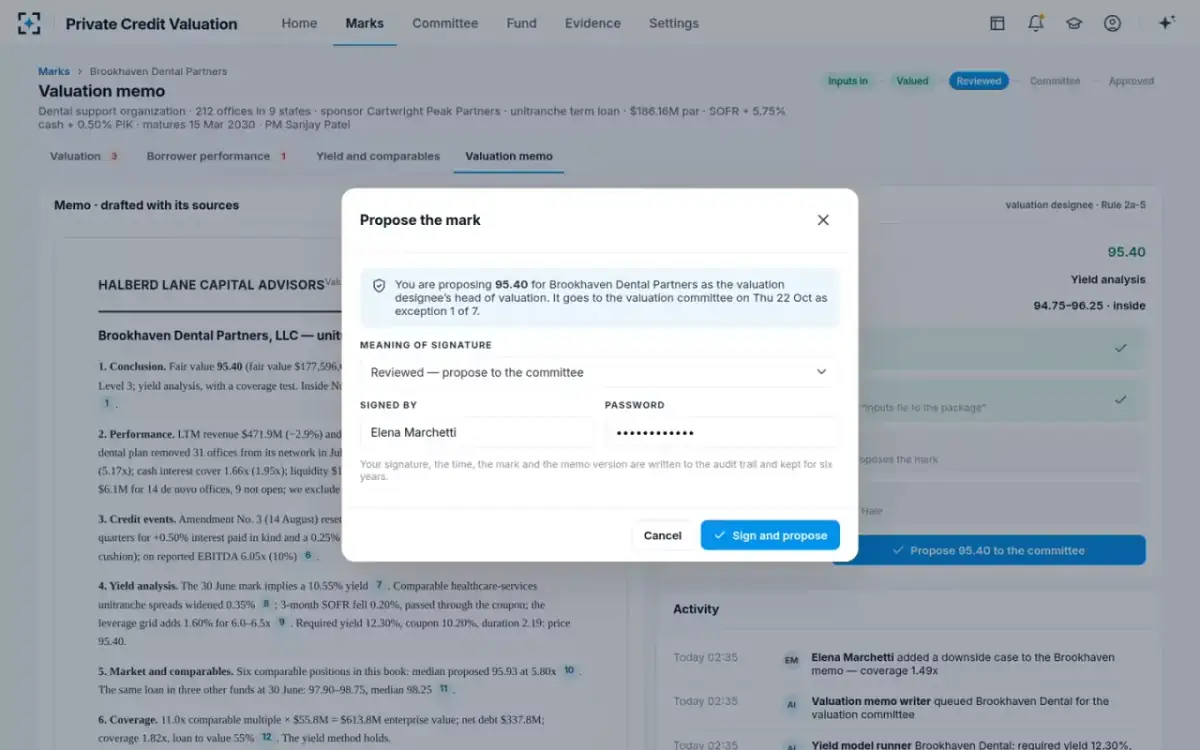
The audit trail is what makes the reporting credible. Every signature carries its meaning — "Reviewed — propose to the committee" — with name, time, mark and memo version, kept six years; policy changes are versioned and reported to the board as they happen. A designee who can show that history to the board in one file has answered the oversight requirement with evidence rather than assurance.
The signature: what the designee's name on a mark actually says
Where does an independent pricing service fit beside the designee?
Rule 2a-5 names pricing services explicitly because funds use them at two different depths, and the designee's duty differs accordingly. A pricing service that supplies raw inputs — dealer runs, comparable spreads — is a data vendor: the designee evaluates its coverage and reliability and decides how its numbers enter the methodology. An independent valuation firm that supplies ranges and points is closer to a subcontracted judgment: the designee oversees its work, loads its letters, and treats its range as a challenge to be answered, not a number to be adopted.
The sample fund's independent firm, Northfield, is the second kind, and the workflow keeps the roles clean. Northfield uploads range letters as a guest; the independent-range reconciler sets every proposed mark beside the range and point; a mark outside the range moves into it or goes to the committee with a reason. In 3Q26 that braid caught one position — Solstice Home Health, proposed at 93.25 against a range of 91.00–92.50 — and the committee saw both numbers with the disagreement explained. The designee used the service the way the rule intends: as oversight input, with the determination still their own.
What happens if the valuation designee's process cannot show its work?
The failure is found by someone else, later, and priced accordingly. In the near term the fund's auditor expands the sample into whatever cannot be evidenced; the SEC's companion recordkeeping rule, Rule 31a-4, requires funds or their advisers "to maintain appropriate documentation to support fair value determinations", so a missing file is a compliance gap in its own right, whether or not the marks were right. In a market where the standing criticism of private credit is discretionary marks, a designee without a file has handed the critic the story: the marks may be honest, but the fund cannot demonstrate that they are.
It is worth stating the positive version plainly, because this is where an agentic architecture earns its keep: a process that writes its evidence as it runs — inputs cited to documents, methods versioned in policy, overrides carrying reasons, signatures with meanings, six years of trail — turns the rule's obligations from a quarter-end scramble into a by-product of doing the work. The designee's question shifts from "can we reconstruct the file before the audit?" to "here is the file; ask it anything." To see the whole quarter run that way, start from Private Credit Valuation.
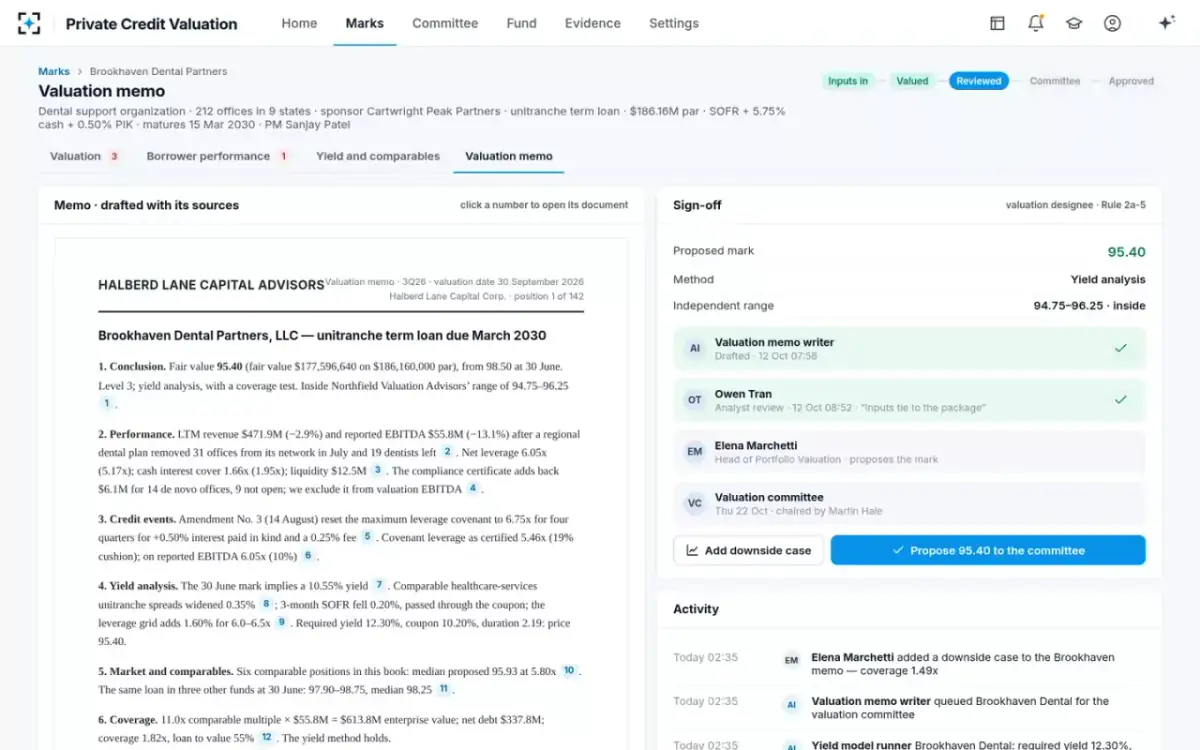
The memo: the designee's evidence, drafted in the policy's order
Questions people ask
What is Rule 2a-5?
An SEC rule adopted in December 2020 under the Investment Company Act that sets how a fund board satisfies its obligation to determine fair value in good faith. It lets the board delegate the work to a valuation designee, subject to conditions on risk assessment, methodology, pricing-service oversight, reporting and recordkeeping.
Who can be a valuation designee?
The fund's investment adviser or, for an internally managed fund, an officer of the fund; the board can also keep the determinations itself. Inside the designee the work runs through people with specified titles and functions, usually a valuation committee and a head of valuation. A system, model or software vendor cannot be designated.
What does a valuation designee have to do?
Four things: assess and manage material risks in fair value determinations; select, apply and test fair value methodologies; oversee and evaluate any pricing services used; and report to the board periodically and promptly — under an active board oversight the SEC release says "must be active".
Can software be a valuation designee?
No. The rule's conditions are framed around persons — their titles, functions, supervision and segregation. Software can perform nearly every concrete task inside the four functions, but the accountability for the determination has to sit with a named person who signs.
What is segregation of duties in fair valuation?
The rule's requirement that the designee's personnel be arranged so no one both produces a number and solely justifies it. In an agentic workflow the analogue is architectural: the agents that read inputs, run the model and draft the memo are different agents, and none of them may set or approve a mark.
How often does the board have to review the valuation designee?
Continuously in effect: the designee must report to the board periodically — riding the fund's quarterly valuation cycle — and promptly when a trigger fires, such as a methodology change, an override, or a material pricing-service problem. The board's oversight duty itself is ongoing and, in the SEC's words, must be active.