Can AI value a loan? Not on its own — not because the arithmetic is too hard, but because a fair value mark is a decision someone has to own. What AI agents can already do is everything around that decision: read the monthly package and the compliance certificate, find the amendment that changed the covenant, price comparable spreads and the same loan in other funds' schedules, run the yield analysis from the last approved mark, set the proposal beside the independent firm's range, and draft the memo with a citation on every number. Botminds' Private Credit Valuation is built around that division — six agents do the reading, the pricing and the drafting, and named people keep every decision, which is why each agent's list of things it may never do is the most important part of its specification.
The examples on this page are the solution's fictional sample fund, Halberd Lane Capital Corp., and its 142-position book; the regulatory references are the SEC's Rule 2a-5 release and the Federal Reserve's revised model-risk guidance, linked where they appear.
How an agentic valuation actually divides the work
A valuation team already divides the quarter this way, which is the tell that the agent split is sound. In most funds one person reads the borrower reporting, another watches for amendments and waivers, someone prices the market, the senior analyst runs the yield model, the independent range gets reconciled, and the memo gets drafted and queued for the committee. The agents in Private Credit Valuation take exactly those seats: a borrower financials reader, a credit event watcher, a market and comparables analyst, a yield model runner, an independent range reconciler and a valuation memo writer. The committee, the head of valuation's signature and the override stay with people.
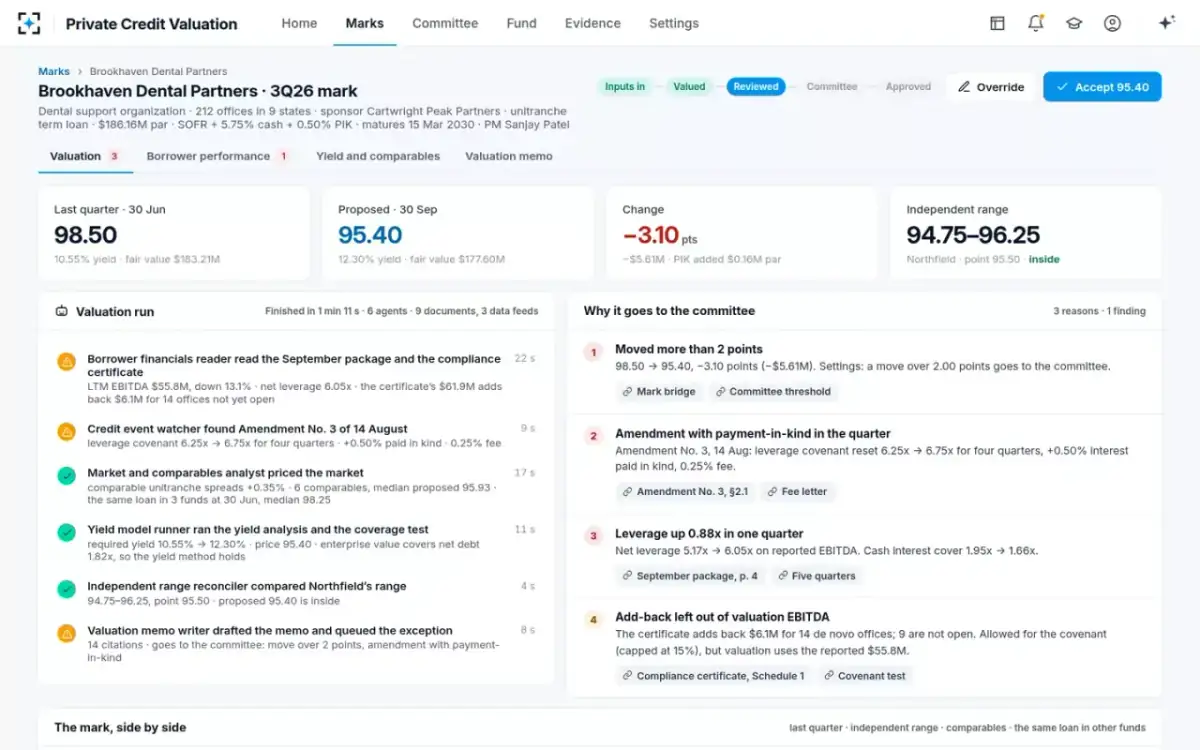
On the sample fund's Brookhaven Dental position the whole chain ran in one minute eleven seconds over the weekend: nine documents and three data feeds read, six agent steps listed in order, a proposed mark of 95.40 with a three-point move bridged driver by driver, and one finding — an add-back the certificate claimed but the file could not support — flagged for a person. Speed is not the argument for the division, though. The argument is that each of those steps now ends in something a reviewer can check, instead of something a reviewer has to redo.
The six agents in Private Credit Valuation, and the two decisions that stay with people
Agent
Borrower financials readerReads monthly packages and compliance certificates; re-computes leverage, cover and covenants by each credit agreement’s definitions.
Never: adjusts a reported figure — it flags add-backs and shows the difference instead
Agent
Credit event watcherFinds amendments, waivers, payment-in-kind switches, rating moves and non-accrual triggers in the quarter.
Never: decides a non-accrual
Agent
Market and comparables analystPrices comparable loan spreads, transaction multiples and the same loan’s marks in other funds’ public schedules.
Never: uses a quote without its source and date
Agent
Yield model runnerRuns the yield analysis calibrated to the last approved mark, the coverage test and sensitivities; recovery analysis when coverage fails.
Never: changes a method without the head of valuation’s approval; no mark above the call price
Agent
Independent range reconcilerCompares every proposed mark with the independent valuation firm’s range and point.
Never: moves a mark into the range to make it fit
Agent
Valuation memo writerDrafts the memo and the mark bridge for every position, and queues the exceptions for the committee.
Never: sets or approves a mark; every number cited
A person decides
Head of Portfolio ValuationReviews the proposal, adds cases, overrides with a reason or proposes the mark with a signed meaning — "Reviewed — propose to the committee".
A person decides
Valuation committeeApproves the marks; portfolio managers recuse on their own credits; the approval is minuted.
What each of the six agents does, and what none may do
Every agent in the system carries two lists: a job and a set of refusals. The refusals are not marketing — they are enforced behaviours, and they mirror the limits a human team already observes informally. The financials reader may not touch a reported figure; if the certificate adds back $6.1M for offices that have not opened, the reader shows both EBITDA numbers and leaves the choice to the mark. The reconciler may not nudge a proposal toward the independent range; a mark outside the range either moves there on the head of valuation's instruction or goes to the committee with a written reason.
The limits matrix: what each agent may never do, in the system’s own words
Borrower financials reader
Its jobRead the packages and certificates; re-compute covenants by each agreement’s definitions
It may neverAdjust a reported figure — it flags add-backs and shows the difference
Credit event watcher
Its jobFind amendments, waivers, payment-in-kind switches, rating moves, non-accrual triggers
It may neverDecide a non-accrual
Market and comparables analyst
Its jobPrice comparable spreads, multiples and the same loan in other funds’ schedules
It may neverUse a quote without its source and date
Yield model runner
Its jobRun the yield build from the last approved mark; the coverage test; recovery when coverage fails
It may neverChange a method without the head of valuation’s approval; cap marks at the call price
Independent range reconciler
Its jobSet every proposed mark beside the independent firm’s range and point
It may neverMove a mark into the range to make it fit
Valuation memo writer
Its jobDraft the memo and mark bridge; queue the committee exceptions
It may neverSet or approve a mark; every number cited
The refusals share one shape: an agent may narrow what a person has to look at, never widen what a person has to defend. That is the design line that separates assistance from automation in this workflow, and it is why the memo writer — the agent whose output most closely resembles a decision — is the one barred from making one.
Can AI value a loan, or only assemble the evidence for one?
Only the evidence, and the distinction is not philosophical. A fair value measurement under GAAP is the fund's own determination: ASC 820 asks the reporting entity to use its own judgment about market participant assumptions, and the SEC's Rule 2a-5 makes the ownership explicit by requiring a board — or a valuation designee it appoints and oversees — to "select, apply and test fair value methodologies". Software can do the selecting's homework, the applying's arithmetic and the testing's data assembly; it cannot carry the accountability those verbs imply, because accountability is attached to a named role, not a tool.
So the honest product answer to "can AI value a loan" is: it can produce a proposed value with every line of its support attached, faster and more completely than a person working by hand, and it can defend that proposal line by line against an auditor's sample. What it cannot do is carry the accountability when the number is challenged. The proposal is a starting point a professional can challenge, not a conclusion they inherit.
Why the mark is never set by the agent that drafts the memo
This is the segregation the SEC wrote into Rule 2a-5: a valuation designee's operation must maintain "reasonable segregation of duties among the designee's personnel", under "board oversight of the valuation designee". Drafting the case and deciding the number are different duties in every well-run valuation team, because the person who builds the argument should not be the person who ratifies it. An agent system that let its memo writer set marks would collapse the two duties into one process — precisely what the rule's segregation language exists to prevent.
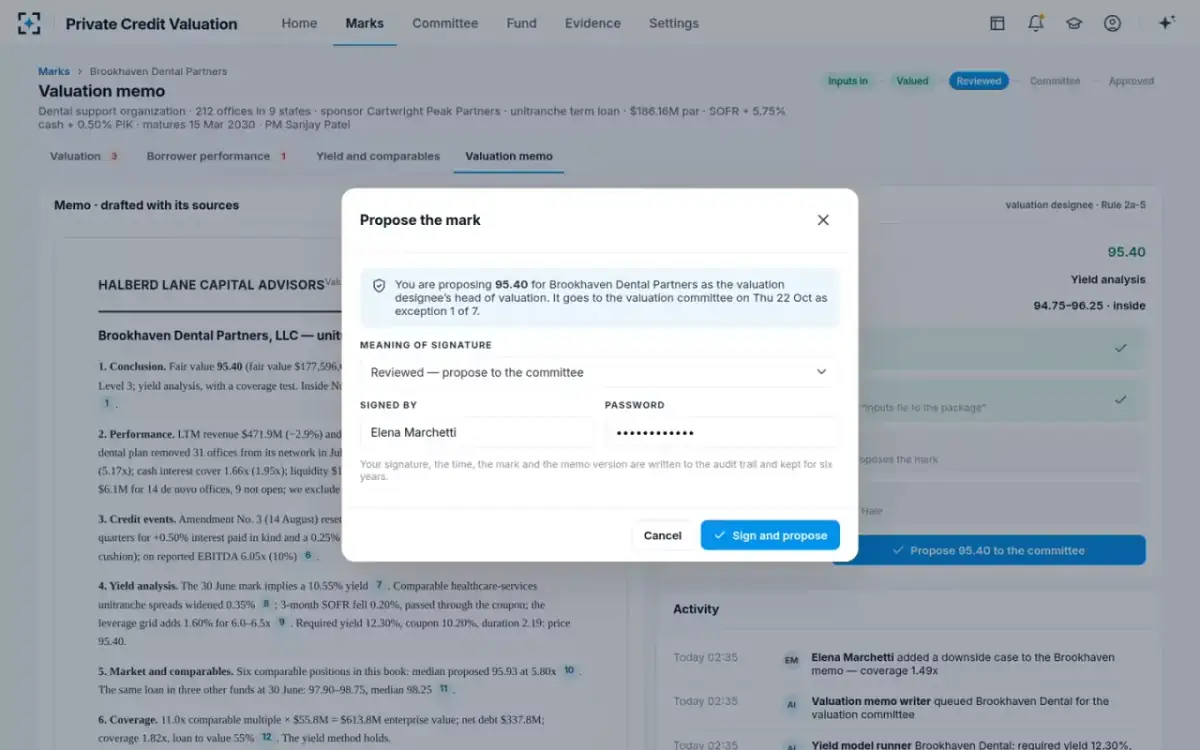
The sample fund shows the shape of the separation. The memo writer drafts Brookhaven's memo and queues it as an exception; Elena Marchetti, the head of portfolio valuation, reads it, adds a downside case of her own, and proposes the mark with the meaning of her signature — "Reviewed — propose to the committee" — plus her name and password. She could instead have overridden the proposal; either way, the system writes the signature, the time, the mark and the memo version to the audit trail. The agent's draft and the human's decision are different objects in the file, and they stay different in the history.
What the agents propose in Private Credit Valuation, and what the head of valuation decides
What an agent may produce: A proposed price with its bridge, evidence and method — e.g. 95.40, −3.10 points, each driver cited.
What stays with a person: Proposing it, overriding it, or sending it back. The proposal alone changes nothing.
What an agent may produce: Surface it: Solstice Home Health proposed 93.25 against a 91.00–92.50 range, with the reason the gap exists.
What stays with a person: Move into the range, or take it to the committee with a written reason. The agents never move a mark to make it fit.
What an agent may produce: Flag when coverage fails the threshold — below 1.25x the yield method no longer applies — and prepare the recovery case.
What stays with a person: Approve any change of method. The yield model cannot switch on its own.
What an agent may produce: Spot every trigger: Ridgeline Freight’s coverage at 0.94x, its June financials 104 days old.
What stays with a person: Decide it. The event watcher may never call a non-accrual, only argue for one.
What an agent may produce: A full draft in the policy’s order, a citation on every number, the exception queued.
What stays with a person: The review note, the added case, the signature with its stated meaning.
Where a person has to decide, every single quarter
Three decision points repeat every quarter, and none of them can be delegated to a model without changing what the fund is. First, the exceptions: in the sample fund, seven of 142 positions reach the committee, each with its memo, its independent range and its reason — a move over two points, an amendment with payment-in-kind, a mark outside the range, a stale unchanged mark. Second, the judgment calls inside files: whether an add-back deserves exclusion from valuation EBITDA, whether a borrower's explanation for late financials changes the stale-input flag. Third, the signature: every proposed mark leaves the building with a named person's signed meaning attached to it.
Notice that all three are smaller than "the valuation." Agents that propose and people that decide can run a whole book overnight; what they cannot run is the seven-exception committee meeting, because the committee is where the fund's judgment is exercised, not just reported. What a valuation designee owes the board under Rule 2a-5 sets out why the rule was written to keep exactly these points human.
What happens when the source does not say — does the agent guess?
No. The system is built to be silent in a specific, useful way: it reports what the documents say, flags what they do not, and cites the difference. When Harbor & Pine Restaurant Group's file rests on June financials — 104 days old at the valuation date — the screen says so and the position rides to the committee with that reason, rather than letting the model quietly extrapolate a fresher-looking quarter. When a quote lacks a source and date, the market analyst does not use it. When the certificate claims an add-back, the financials reader shows the certificate's version and the reported version side by side and stops there.
That behaviour is a design choice with a name in the file: every agent limit that starts with "never" is a place where guessing would be easy and the system refuses anyway. For a reviewer the practical test is simple — open any number on the screen and ask where it came from. In the sample fund each one links to its document, page and date, and the one that cannot be sourced is the one the system will not print.
"Generative AI and agentic AI models are novel and rapidly evolving. As such, they are not within the scope of this guidance."
Board of Governors of the Federal Reserve System, SR 26-2, April 2026
Is this a "model" under bank AI guidance, and does that guidance even reach a fund?
The most-cited frame for AI governance in finance is model-risk management — the discipline the Federal Reserve, OCC and FDIC updated in April 2026 with SR 26-2, which supersedes the long-standing SR 11-7. Two facts usually get lost when vendor marketing cites it. First, the letter says in a footnote to its scope that generative and agentic AI models "are not within the scope of this guidance" — the supervisors deliberately left the agentic case to a later framework. Second, the guidance binds banking organizations supervised by those agencies; an SEC-registered fund adviser or BDC is not one, so SR 26-2 does not reach a valuation desk like the sample fund's directly.
None of that makes the discipline useless — it makes it an analogy, and a good one. The core practice in the guidance is outcomes analysis: "Outcomes analysis compares model outputs to corresponding real-world outcomes to assess model performance relative to model objectives and business use." Translated to valuation: run the system on last quarter's already-approved marks and compare. A fund that replays its committee's decisions against the agents' proposals every quarter is doing outcomes analysis whether or not a supervisor ever asks, and the implementation path for Private Credit Valuation starts with exactly that replay. Treat SR 26-2 as sound practice to borrow, not a rule the solution must meet — and treat any vendor who claims their agentic product "complies with SR 26-2" with the scepticism that conflation deserves.
What would make you not trust an agent's proposed mark?
The healthy version of the question, and the one a technical evaluator should bring to any demo. A proposed mark deserves suspicion when any of these hold: the number cannot be opened back to its source document; the independent range sits nowhere on the screen; the vendor cannot state what the system refuses to do, in one sentence each; overrides are possible but invisible; the memo reads confidently about inputs the file does not contain; or the system cannot be run against your own last quarter, only against a prepared example.
Each of those tests has a passing shape in the sample fund. The proposed mark opens into the evidence rail — sixteen sources for Brookhaven, each line linked. Northfield's range sits beside every mark it reviews. The refusals are printed in the limits matrix above and enforced in the run. Overrides carry a reason into the memo and to the committee. Stale inputs are flagged, not smoothed over. And the first thing the team does with a new fund's book is replay its own last quarter — the test a vendor's demo cannot fake.
One position's valuation run in Private Credit Valuation: six agent steps, each with what it found
The decision the agents cannot make: proposing the mark, signed
The limits are the feature, not the caveat. A system whose agents can do anything is one whose output a committee must re-derive from scratch; a system whose agents refuse the right things is one whose proposals a committee can actually start from. Why an unsupported or stale mark becomes an audit adjustment or an exam finding is the other half of the trust question. To see the limits on a live book, start from Private Credit Valuation.
Questions people ask
Can AI value a loan?
It can assemble everything a valuation needs — read the documents, re-compute covenants, price the market, run the yield analysis and draft the memo — and propose a mark with full citations. It cannot own the decision: under GAAP and SEC Rule 2a-5 the methodology is selected, applied, tested and overseen by the board or its valuation designee, so the deciding stays with named people.
How do AI agents work in loan valuation?
The way a team already divides the quarter. One agent reads borrower reporting, one watches for credit events, one prices the market and comparables, one runs the yield model, one reconciles the independent firm's range, and one drafts the memo and the mark bridge. Each carries a written set of refusals — the things it may never do — and every proposal waits for a person.
What can an AI agent never decide in a valuation?
In the system on this page: never set or approve a mark, never decide a non-accrual, never change a valuation method without the head of valuation's approval, never adjust a reported figure, never use a quote without its source and date, and never move a mark into the independent range to make it fit. Those refusals are enforced, not aspirational.
Does AI hallucinate financial numbers?
A system that cites its sources makes the failure mode checkable: every number links to the document, page and date it came from, so a reviewer can verify rather than trust. The deeper protection is behavioural — an agent that may not print a number it cannot source, and that flags stale or missing inputs instead of filling the gap, cannot quietly invent the input in the first place.
What happens when an agent can't find the answer?
It says so, specifically. Financials older than the policy's staleness threshold are flagged and the position goes forward with that reason; a quote without a source is not used; an add-back is shown as the certificate's claim against the reported figure, with the difference visible. Silence about a gap is treated as a defect, and the gap itself is surfaced to a person.
Who checks the agent's proposed mark?
The head of valuation reviews the proposal, can add cases, can override with a reason that is shown in the memo and to the committee, and proposes the mark with a signed meaning. The valuation committee then approves it. Portfolio managers recuse on their own credits, and the whole chain — drafts, reviews, signatures — is kept on the audit trail for six years.