How long does private credit valuation software implementation take? About one quarter, and the quarter is the point: the only proof a valuation committee should accept is a full cycle on the fund's own book, ending with a live run it has already watched once in parallel. The shape is consistent whatever the vendor — build from your own valuation policy, replay last quarter's already-approved marks, run beside the team, then go live — and the rest of this page is that shape made concrete, the way Botminds runs it for Private Credit Valuation: your valuation policy, your leverage grid, your memo template and a sample of your own positions, walked through on your own book before anything is trusted.
The plan below follows the sample fund's calendar — valuation date 30 September, committee 22 October — because a pilot that ignores the valuation calendar will always wait for it; the regulatory anchors are Rule 2a-5 and, as an analogy for sound testing practice, the banking agencies' revised model-risk guidance.
What you bring to start: a policy, a leverage grid, and one quarter's files
Nothing exotic. The pilot runs on the artefacts a valuation team already produces, because those artefacts are the requirements: the valuation policy document, the leverage grid that maps net leverage to credit-premium add-ons, the memo template the committee is used to reading, and one quarter's positions with their supporting documents — borrower packages, compliance certificates, the credit agreements and amendments, the independent firm's range letters, and the approved marks. If a fund runs several funds or tranches, one representative book is enough to start.
The day-one checklist: what the pilot is configured from
- The valuation policy document
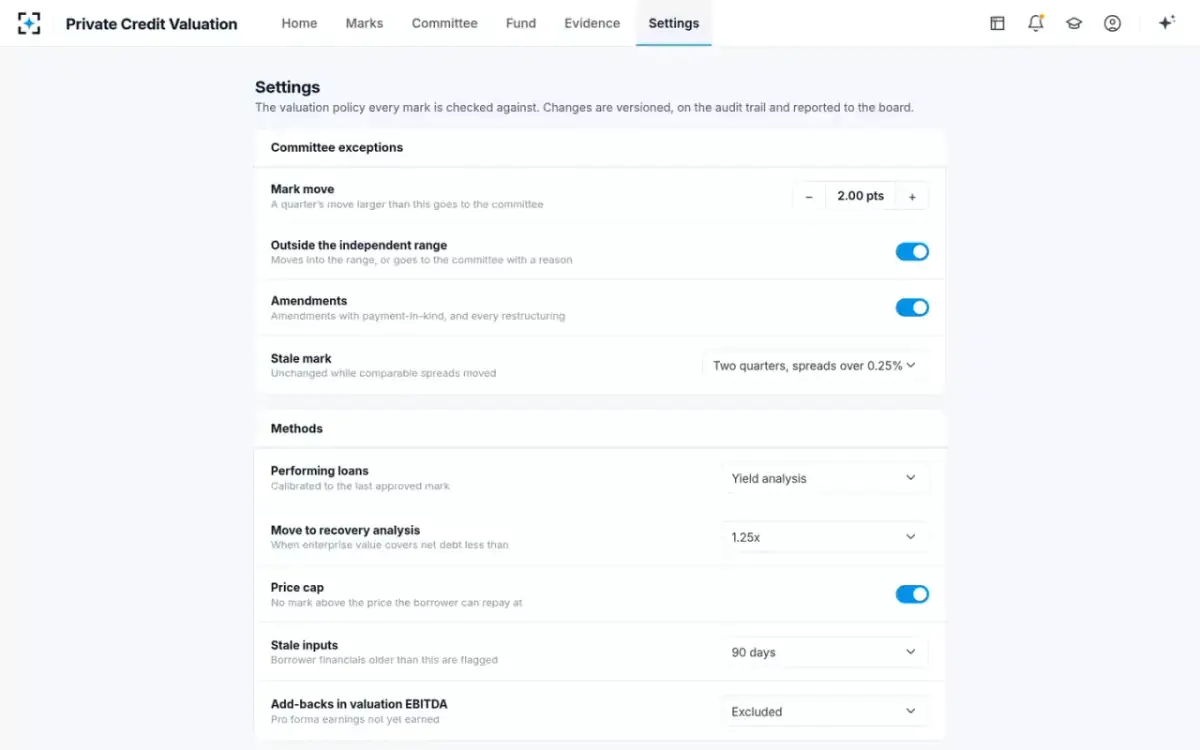
Committee thresholds, the stale-mark rule, method switches and the price cap become settings — versioned, on the audit trail, reported to the board.
- The leverage grid
The credit-premium add-on per leverage band (in the sample fund, +1.60% for 6.0–6.5x) is your own pricing of risk, and the yield build uses it driver by driver.
- The memo template
The agents draft in your policy’s order — conclusion, performance, credit events, yield, market, coverage, committee — so the committee reads what it already trusts.
- One quarter’s positions and documents
Last quarter’s approved marks plus the packages, certificates, agreements, amendments and range letters behind them. This is both the configuration sample and the replay corpus.
- The independent firm’s range letters
Uploaded by the firm as a guest; every proposed mark is set beside its range and point from the first replay run.
- A named pilot owner
Head of valuation or their delegate — the person who will eventually sign the marks owns the pilot’s acceptance.
Two things are deliberately absent from that list: IT infrastructure and data-cleaning projects. The documents arrive as they already do — PDFs, spreadsheets, letters — and the reading is the system's job. The pilot's calendar is spent proving the reading, not preparing it.
Week one: replaying last quarter's already-approved marks
The first run is on history, because history is the only ground truth either side can agree on. The system runs the full book from last quarter's documents and proposes a mark for every position; the team lines those proposals up against the marks the committee actually approved. This is back-testing in the plain sense the banking agencies describe: "Outcomes analysis can take many forms, including testing conducted during model development, reports or analysis performed as part of ongoing monitoring, or standalone activities such as back-testing or outlier analysis." The quote is from supervisory guidance aimed at banks, not at a fund adviser — but the practice it names is universal: compare outputs against real outcomes before trusting the outputs.
The replay does three jobs at once. It validates the document reading: did the system extract the same EBITDA, the same covenant definitions, the same amendment terms the team used? It validates the pricing: does the leverage grid and spread build reproduce the approved marks on the boring positions, the 135 that never needed the committee? And it surfaces the disagreements — the positions where the system's proposal and the committee's mark differ materially — which are the actual pilot.
What counts as a pass, and what counts as a disagreement to investigate
Set the pass criteria before the replay runs, or everything will look like a pass. A sensible starting set, all expressed in the fund's own vocabulary: every number in the replayed memos traces to a document and page; the covenant re-computations match the agreements as amended; on positions the committee moved less than its exception threshold, the proposed mark lands within a small, stated distance of the approved one; and every position outside that distance arrives with the reasons isolated — this input, this amendment, this spread move — not with a shrug.
The pass test for a replay, stated before the run — and what fails look like
Passes when
- Every memo number opens to its source document
- Covenant re-computations tie to the agreements as amended
- Proposals within the fund’s tolerance of the approved mark on routine positions
- Every disagreement outside tolerance carries its isolated reasons
Investigate when
- A position differs by more than the committee threshold — the old file may have missed an input, or the system may have misread one; both directions are data
- The system’s evidence includes a document the team never used — often the replay’s highest-value finding
- The team cannot reproduce a system input by hand — a citation problem, fixed before shadow running
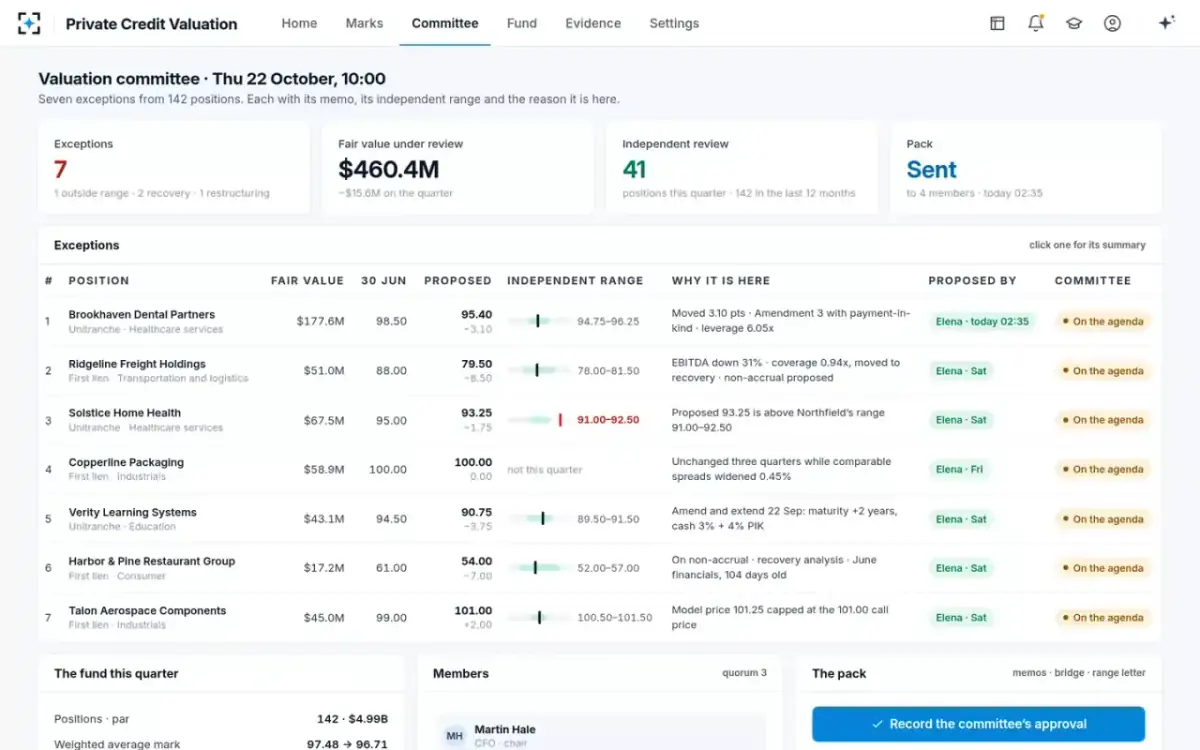
Expect disagreements, and distrust a replay without any. On the sample book the interesting cases were Copperline Packaging — unchanged at 100.00 for three quarters while comparable spreads widened 0.45%, exactly the stale-mark pattern the policy says goes to the committee — and Talon Aerospace, where a model price of 101.25 collides with the 101.00 call price the borrower can repay at. A replay that surfaces those is working; a replay that agrees with everything has probably not read very much.
Week by week: from replay, to running beside the team, to live
The middle phase is a shadow quarter: the system runs the live calendar in parallel with the team's normal process, and the two produce their own packs. The team keeps working exactly as before; nothing the system proposes touches the official marks. What changes is that every draft the team writes can be compared, position by position, against a proposal with citations — and by the end of the quarter the committee has watched the system work on the book it actually owns, including at least one late certificate, one amendment and one argument.
The pilot as a quarter: replay, shadow, committee, live
- Configure from policy, grid and template3 d
- Run the replay, compare every position4 d
- Investigate disagreements, tune settings3 d
- Parallel run on the real calendarthe quarter
- Weekly comparison of drafts and proposalsweekly
- Committee reviews both packs, sets go-live criteria2 wk
- Agents propose; team reviews and signsongoing
- Board reporting on the audit trailper quarter
What the valuation committee should see before it trusts a live run
The committee's trust is earned with artefacts, not assurances. Before go-live it should see: the replay's comparison table for the whole book, disagreements included; the shadow quarter's two packs side by side, with the differences explained; the evidence file as the auditor will see it — inputs, method, independent range, memo and approval for each sampled position; and the settings screen that shows the policy it approved, versioned, with the audit trail beneath. Rule 2a-5 gives the board-side duties their shape: "periodic and prompt reporting to the board" is a requirement of the rule, and a pilot that ends with the committee having seen exactly that reporting is a pilot that ends well.
One design choice deserves the committee's explicit attention: overrides. The head of valuation can override any proposed mark, and the override with its reason is shown in the memo and to the committee. A committee should test that path during the shadow quarter — override something on purpose, watch the reason travel — because the trust question is never whether the system is right; it is whether the people stay visibly in charge when it is wrong.
The committee screen the pilot ends with: seven exceptions, each with its reason
How the independent firm's range gets loaded in
The independent valuation firm joins as a guest and uploads its range letters; from then on, every proposed mark the system produces is set beside the firm's range and point for that position, with the letter as the cited source. The fund's review-rotation setting decides which positions carry a range each quarter — in the sample fund, 25% on rotation, every position within a year, plus always the ones with moves over two points, marks below 85, or a non-accrual. When the system's proposal lands outside the range, the rule is fixed: the mark moves into the range, or it goes to the committee with a written reason; the system never moves a mark to make it fit.
Keep the oversight duty attached to a person while this is set up. Rule 2a-5 requires a designee to keep "overseeing and evaluating any pricing services used" — the independent firm included. Practically that means the head of valuation reviews the reconciliation pattern each quarter: how many proposals landed outside the range, what reasons carried them, whether one sector or one analyst's credits cluster there. The range letters are inputs with a source and a date, not verdicts, and the pilot should treat disagreements between the system and the firm the same way it treats disagreements between the system and last quarter: as evidence to read.
What should not go live until it has been tested first?
Three workflows carry real decision weight and deserve their own dress rehearsals during the shadow quarter, not their first live appearance. First, method switches: when coverage of net debt by enterprise value falls below the policy threshold — 1.25x in the sample fund — the loan moves from yield analysis to recovery analysis, and that transition changes everything downstream. The 2013 interagency leveraged-lending guidance told banks to stress-test enterprise values at origination and "periodically thereafter" — the OCC and FDIC rescinded it in December 2025, but the habit is sound — and a fund should watch the same assumption by running the downside case on at least one position per band before trusting the switch. Second, the non-accrual path: the system proposes, a person decides, and the committee should see a rehearsal of that proposal before a real one arrives. Third, settings changes: every policy change is versioned and reported to the board, and the committee should watch one travel that path in the pilot so a later change is routine rather than alarming.
The go-live decision in Private Credit Valuation: every step a person, every artefact on the trail
A person decides
Replay acceptedThe head of valuation signs off the comparison against last quarter’s approved marks, disagreements investigated and settings tuned.
A person decides
Shadow pack reviewedThe committee compares the parallel pack with the official one and sets the go-live criteria in writing.
Agent
Agents propose, people decideFrom the next valuation date, proposals start the quarter; the head reviews, overrides with a reason or signs; the committee approves.
Never: the agents never set or approve a mark — that does not change at go-live
A person decides
Board reporting beginsPolicy versions, approvals and the audit trail report to the board on the new cadence.
How long does it really take, compared with a workbook migration?
Shorter in elapsed time and fundamentally different in kind. A workbook migration — consolidating the fund's valuation spreadsheets into one cleaned, linked master — is an IT project that reproduces the same manual process in a new container: it takes a quarter or two of someone's calendar, delivers tidier versions of the same fifteen-day round, and changes nothing about what gets read. The pilot above takes one quarter because the proof must span a real committee, but the quarter is mostly the fund's own calendar running while the system watches it; the team's hands-on time in the pilot is the replay week, the weekly comparisons and the committee sessions. What comes out the other end is not a tidier workbook but a different division of the quarter: agents reading and proposing, people reviewing and deciding, and the hours case already measured on the fund's own numbers.
The comparison that matters is not with a migration but with doing nothing, which costs the same fifteen days next quarter and the one after. If the fund is also weighing tools against each other, run the selection first — the three-approach comparison and the questions to ask are written for exactly that meeting — and bring the winner to the pilot with this page's checklist. To start the walkthrough on your own book, begin from Private Credit Valuation.
The settings screen: the pilot's configuration, versioned and on the audit trail
Questions people ask
How long does it take to implement valuation software?
Plan for one quarter. The configuration takes days — the fund's policy, leverage grid, memo template and last quarter's positions — but the proof is a full cycle: replay last quarter, shadow the live quarter, and let the committee set the go-live criteria at a meeting where it has watched the system work. A monthly NAV shop compresses this; a quarterly committee sets the pace.
What do you need to start a private credit valuation pilot?
The artefacts the team already produces: the valuation policy, the leverage grid that prices leverage bands, the memo template, one quarter's positions with their documents — packages, certificates, agreements, amendments — the independent firm's range letters, and a named owner, usually the head of valuation. No infrastructure project and no data cleaning come first.
How do you test valuation software on your own loans?
Replay: run the system on last quarter's already-approved marks and compare position by position. Then shadow: run it in parallel through the live quarter and compare drafts weekly. Where the system's proposal differs from the approved or drafted mark, investigate the difference as data — the old file may have missed an input, or the system may have misread one.
What counts as a passing result in a valuation pilot?
Criteria set before the replay runs: every memo number traces to a document; covenant re-computations tie to the agreements as amended; routine positions land within the fund's stated tolerance of the approved marks; and every larger disagreement arrives with its reasons isolated. Expect some disagreements — a replay that agrees with everything has probably not read much.
How does the independent valuation firm's range get loaded in?
The firm uploads its range letters as a guest, and every proposed mark is set beside the range and point with the letter cited. A mark outside the range moves into it or goes to the committee with a written reason — the system never moves a mark to make it fit. The head of valuation reviews the reconciliation pattern each quarter as part of overseeing pricing services.
What should go live last in a valuation rollout?
The workflows that carry real decision weight: the yield-to-recovery method switch, which should be rehearsed with downside cases on one position per leverage band; the non-accrual path, proposed by the system but always decided by a person; and settings changes, which travel versioned to the board so that by go-live a policy change is routine rather than alarming.