An EBITDA add-back in a fair value mark is a genuine tension in private credit valuation: the same adjustment — say, $6.1M for offices a borrower plans to open — can be valid for testing the borrower's covenant and still wrong for pricing the loan. Bank examiners were told from 2014 to criticize add-backs that enhance EBITDA without reasonable support, and research from the Federal Reserve system links heavier add-back use to higher delinquency, default and downgrade rates. A defensible mark therefore prices what a buyer would pay for, which is reported performance, even when the certificate passes. That is the divide Private Credit Valuation enforces by policy: the agents read the add-back, show it beside the reported number, and run the yield model on the reported one.
The worked example is the fictional sample fund in the solution — Halberd Lane Capital Corp. — and its 3Q26 finding on Brookhaven Dental Partners, a $186.16M unitranche. The fund, borrower and independent firm are invented. The supervisory language and the research are linked where they appear.
What an EBITDA add-back is, in a borrower's own words
EBITDA is supposed to measure what a business earned before interest, tax, depreciation and amortisation. Real businesses, however, report quarters lumpy with one-off events — a restructuring, a litigation settlement, a new-store opening programme — and loan documents define "EBITDA" to add those items back, restoring the number management says represents ongoing earnings. An add-back is any line in that restoration: it takes reported EBITDA and returns something to it that the income statement spent or delayed.
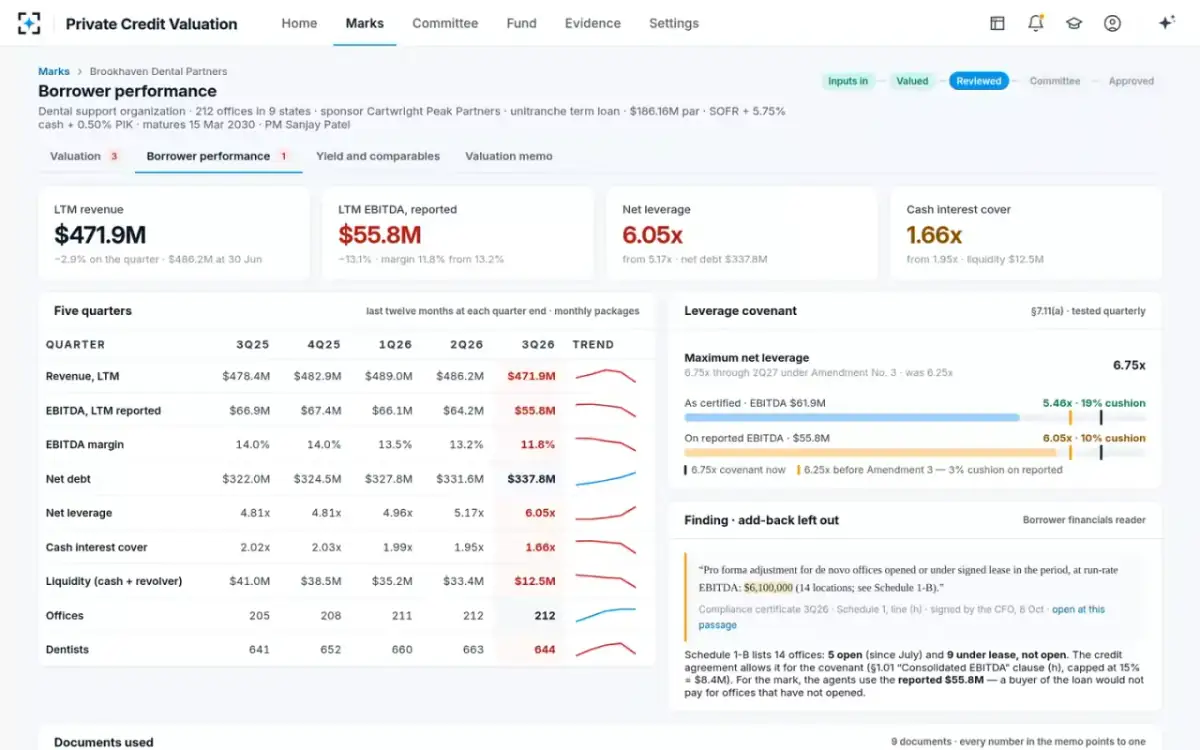
Brookhaven's 3Q26 compliance certificate is a working example. Reported EBITDA for the trailing four quarters was $55.8M, down 13.1% after a dental plan dropped 31 offices. The certificate added back $6.1M for fourteen planned de novo offices — five already open, nine under lease and not yet open — on the logic that their costs are investment, not run-rate. Certified EBITDA: $61.9M. Both numbers are "true" in the sense that the agreement's definition produces the second; the question a valuation has to answer is which one a buyer of the loan would pay for.
Are EBITDA add-backs allowed in a fair value mark?
They are not forbidden — nothing in GAAP bans an add-back from a valuation — but they carry a burden of support that covenant testing does not impose. The covenant question is contractual: does the certificate, computed by the agreement's definitions, pass the test? The valuation question is economic: what cash flows would a buyer underwrite today? ASC 820 frames the income approach as converting future amounts to a present value and says that when it is used, "the fair value measurement reflects current market expectations about those future amounts" (ASC 820-10-55-3F, as amended by ASU 2011-04). A buyer's market expectations are formed from performance that has happened, adjusted for plans with a credible path — not from a certificate's most generous legal definition.
One borrower, two EBITDAs: what each number is for
Certified EBITDA — $61.9M, with the $6.1M add-back: Ongoing earnings as the credit agreement defines them, after permitted add-backs.
Reported EBITDA — $55.8M, as filed: What the business actually earned in the trailing four quarters.
Certified EBITDA — $61.9M, with the $6.1M add-back: The covenant test: leverage 5.46x against a 6.75x maximum — a 19% cushion, certificate passes.
Reported EBITDA — $55.8M, as filed: The economics a buyer of the loan would price: leverage 6.05x, a 10% cushion.
Certified EBITDA — $61.9M, with the $6.1M add-back: The compliance certificate, the covenant certificate, the agent's re-computation of the test.
Reported EBITDA — $55.8M, as filed: The fair value mark, the leverage grid, the enterprise value behind the coverage test.
The sample fund's policy draws the line as a setting: add-backs in valuation EBITDA are excluded, with the alternative — include them up to the agreement's cap — available if a fund's philosophy differs. Either way the policy is versioned, reported to the board, and applied to every position identically, which is what makes it a method rather than a mood.
How do examiners view EBITDA add-backs?
Sceptically, for more than a decade. The 2014 FAQs on the interagency leveraged-lending guidance, issued jointly by the Federal Reserve, FDIC and OCC, warned that "Examiners will criticize situations in which EBITDA is defined in loan documents in ways that allow enhancements to EBITDA without reasonable support." The criticism is aimed at lending practice, but the vocabulary travels: "enhancements without reasonable support" is exactly the phrase an auditor will reach for when a fund's mark leans on the same add-back the examiners would have flagged at origination.
The definition mattered to supervisors because EBITDA decided which loans counted as leveraged at all. The 2013 interagency guidance kept "the EBITDA-based leverage measure presented in the proposed guidance" as "the supervisory measure that may be used as an important factor to be considered in defining leveraged loans". Every dollar of add-back lowers that leverage, so a generous definition could move a loan out of the category the guidance was written for — the reason the FAQs insisted on reasonable support.
That supervisory frame has since changed for banks. On 5 December 2025 the OCC and FDIC rescinded both the 2013 guidance and the 2014 FAQs, calling them "overly restrictive"; the Federal Reserve's own copy, SR 13-3, remains on its site. The rescission changes what bank examiners test, not what a fund's mark must reflect. ASC 820 still asks for the price a buyer would pay, and the research below was never about supervision.
What does the research show about add-backs and default risk?
The strongest published evidence that add-backs deserve scepticism comes from the Federal Reserve Bank of St. Louis. In a working paper on add-backs in debt contracting, Faria e Castro, Gopalan, Pal, Sánchez and Yerramilli find that "these addbacks increase the likelihood of loan delinquency and default, and also increase the likelihood of the borrower experiencing a ratings downgrade" (WP 2022-029, 2022). The size of the effect is not small: in their estimates each additional non-GAAP add-back "increases the probability of ratings downgrade by 37.5% in the 3-year period after loan origination". The authors' explanation is about the lender, not the borrower's honesty: covenants built on customised EBITDA weaken the lead arranger's incentive to monitor and delay corrective action. Their sample is syndicated loans, not direct lending, so the numbers do not transfer one for one; the mechanism — a covenant that stops warning — does.
For a valuation team the finding sets the default. An add-back is a claim about the future made by the party with the most to gain from the claim being believed. Sometimes the claim is sound — genuinely one-off costs with a documented basis — but a mark that absorbs every certified add-back without examination is systematically pricing optimism, and the research says the optimism is correlated with the very outcomes a lender cares about. Pricing reported EBITDA is not conservative ideology; it is the side of the published evidence.
How do you tell a reasonable add-back from an unsupported one?
Reasonableness has recognisable shape, and it is visible in documents rather than intentions. A reasonable add-back names a specific, dated event; its size ties to something verifiable; its effect reverses on a schedule the agreement sets; and the borrower's own history shows similar adjustments coming true. An unsupported one is round, recurring and prospective — savings not yet achieved, revenue not yet won, offices not yet open.
The $6.1M add-back's own support, annotated: what holds and what does not
Named and specific
Fourteen de novo offices, identified in the certificate's schedule with addresses and lease dates.
Holds
Sized to something verifiable
$6.1M ties to the lease obligations and fit-out budgets the borrower disclosed.
Holds
Reverses on a schedule
The credit agreement caps the adjustment's life; the certificate shows the remaining quarters.
Holds
Performance behind the claim
Five offices are open. Nine are under lease and not open — the earnings they will produce are a plan, not a run-rate, and the quarter's reported EBITDA fell 13.1%.
Fails for a buyer
What makes an add-back reasonably supported
- A specific, dated event
Not "initiatives" or "run-rate benefits" — a named occurrence with a date the documents can show.
- A basis a reviewer can re-perform
Invoices, lease terms, severance agreements — the arithmetic should trace to paper.
- A schedule that ends
Permanent add-backs are not adjustments; they are the business model, and should be valued as one.
- A track record of coming true
Prior-year add-backs, measured against what actually happened, are the best single test.
- No overlap between categories
The same cost quietly added back under two headings is the classic tell of an aggressive certificate.
Should valuation EBITDA ever match covenant EBITDA?
Occasionally — and when it does, the reason should be stated as loudly as the exclusion. If every add-back in a certificate is a realised, documented one-off with the bills to show it, reported and certified EBITDA differ by nothing worth arguing about, and pricing the certified number is fine because it is the reported number. The sample fund's setting allows that reading in a controlled form: include add-backs up to the agreement's cap, for funds that want covenant and valuation EBITDA to converge by policy.
What should not happen is convergence by default — carrying the certificate's number into the mark because it arrived in the same package and nobody chose otherwise. The divergence between the two numbers is information: it measures how much of the borrower's story is performance and how much is plan. A valuation process that reports the divergence position by position — the financials reader flags every add-back and shows the difference, citing page and line — turns a spreadsheet habit into a reviewable decision, whatever the fund's policy setting says.
What changes in the mark when an add-back is excluded?
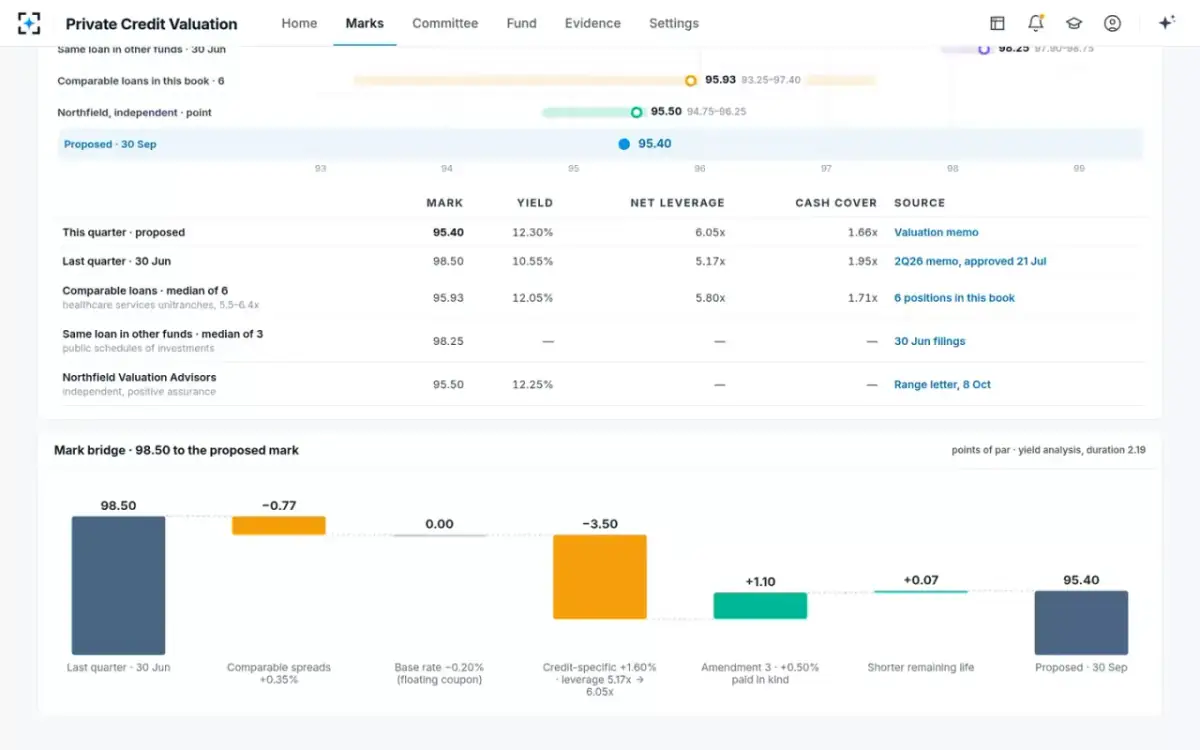
The arithmetic is short and the consequences are not. On Brookhaven, excluding the $6.1M moved net leverage from 5.46x to 6.05x — from the 5.0–5.5x band of the sample fund's leverage grid to the 6.0–6.5x band. The credit premium jumped a full grid step, adding +1.60% of required yield, which at the loan's duration of 2.19 is −3.50 points of price. The add-back was worth more than a point of covenant cushion; it was worth three and a half points of mark.
Same borrower, two leverage numbers: what the add-back was hiding
The covenant test both ways, from the same certificate
| Line | As certified | As reported | Read |
|---|---|---|---|
| LTM EBITDA | $61.9M | $55.8M | The add-back restores $6.1M the income statement never earned |
| Net leverage | 5.46x | 6.05x | One grid step apart — the step that prices the mark |
| Cushion to the 6.75x covenant | 19% | 10% | The certificate passes either way; the risk reading does not |
| Cash interest cover | 1.82x | 1.66x | Cover falls when the earnings behind it are the reported ones |
| Yield grid applied | 5.0–5.5x band | 6.0–6.5x band | +1.60% of yield — −3.50 points of the 98.50 → 95.40 move |
None of this touches the covenant outcome — the certificate passes at 5.46x, and the method pages of this series show why the two numbers legitimately coexist. What changes is the price: 98.50 becomes 95.40, inside Northfield's independent range of 94.75–96.25, with the exclusion itself written into the memo as a reason the committee can accept or reject on the record.
The finding on the performance screen: the add-back shown beside the reported number
Can an add-back make a loan look safer than it is?
That is precisely its function in the covenant, and precisely the risk in the mark. The covenant exists to give the lender an early-warning tripwire; an add-back that widens the cushion narrows the warning. The St. Louis finding closes the loop: add-backs predict the delinquency, default and downgrades a covenant exists to warn about, because they blunt the warning. A valuation process that prices certified EBITDA is not merely adopting a conservative aesthetic — it is declining to let the borrower, at one remove, set the input to their own mark.
The discipline generalises beyond EBITDA. The same logic governs pro-forma revenue, cost synergies and "run-rate" savings of every kind: the certificate may carry them, the mark prices what has happened, and the distance between the two is reported, not smoothed. For how that discipline survives an audit, the Level 3 file shows what the evidence looks like when a stranger has to re-perform it. To see the policy as a working setting on a live book, start from Private Credit Valuation.
The bridge that owns the exclusion: −3.50 of the move is the leverage grid
Questions people ask
What are EBITDA add-backs?
Adjustments a loan agreement permits to be added back to reported EBITDA — restructuring costs, one-off expenses, new-location costs — to show what management calls ongoing earnings. The credit agreement defines them; the covenant test uses the defined number; whether a buyer of the loan should pay for them is a separate question.
Are EBITDA add-backs allowed in a fair value mark?
Nothing forbids them, but a defensible mark carries a burden of support the covenant does not: the measurement must reflect current market expectations about future cash flows, and a buyer prices performance that has occurred over plans that have not. Funds handle it by policy — the sample fund excludes add-backs from valuation EBITDA; including them up to the agreement's cap is the alternative setting.
Do add-backs increase loan default risk?
Research from the Federal Reserve Bank of St. Louis (WP 2022-029) finds they do: add-backs increase the likelihood of delinquency, default and ratings downgrade, with each additional add-back raising the probability of a downgrade within three years by 37.5%. The study covers syndicated loans, and the authors trace the effect to weaker monitoring by lenders.
What is the difference between covenant EBITDA and valuation EBITDA?
Covenant EBITDA is the contractual number — reported EBITDA plus the add-backs the agreement allows, used to test covenants and certificates. Valuation EBITDA is the economic number — what the business earned, used to set leverage in the yield grid and enterprise value in the coverage test. They differ by exactly the add-backs, and the difference is reported, not smoothed.
How do examiners view EBITDA add-backs?
From 2014 the interagency FAQs told examiners to criticize EBITDA definitions that allow enhancements without reasonable support, because EBITDA-based leverage decided which loans counted as leveraged. The OCC and FDIC rescinded that guidance and the FAQs in December 2025; for a fund's fair value mark, ASC 820's buyer's-price test still applies either way.
Can an add-back make a loan look safer than it is?
Yes — widening the covenant cushion while reported performance deteriorates is the pattern the research associates with later defaults. In the sample loan the add-back moved leverage one grid step: 5.46x certified against 6.05x reported, worth three and a half points of price. That is why the mark prices the reported number.