What does a private credit valuation analyst do? They produce the fair value marks for a book of private loans, one per borrower per quarter, each with the documented support an auditor, an examiner or a valuation committee can test: how the borrower performed, how yields moved, where comparable loans sit, and a written reason for every move in the mark. The work is hard because the inputs arrive as documents — monthly packages, compliance certificates, credit agreements and amendments — and every number has to be traced back to its page before anyone will rely on it. Botminds' Private Credit Valuation gives that analyst six agents that read the documents first, so the analyst's quarter becomes review and judgment instead of re-keying.
The examples on this page follow one fictional analyst through the sample fund shown with the solution: Owen Tran, valuation analyst at Halberd Lane Capital Corp., marking a 142-position book between the 30 September valuation date and the 22 October committee. The people, fund and borrowers are invented; the wage figures come from the U.S. Bureau of Labor Statistics, linked where they appear.
The analyst's quarter by the numbers: one person, one book, three weeks of mechanical work
142
positions in the sample book, each needing a mark and a memo line
15days
of hands-on work per quarter, collecting, re-keying, pricing, running yield and writing
$102,740
median annual wage for financial and investment analysts, May 2025 (BLS)
What a valuation analyst does, in one sentence
A private credit valuation analyst reads everything a borrower sent this quarter, converts it into the numbers a fair value mark rests on, and writes the file that proves it. The Bureau of Labor Statistics describes the core duty plainly: analysts "examine a company's financial statements to determine its value and growth prospects", in the Occupational Outlook Handbook's list of duties. In private credit that examination is contractual as much as financial: the leverage that matters is the one the credit agreement defines, not the one the income statement suggests, and the analyst is the person who knows the difference.
O*NET, the Labor Department's occupation database, lists the analyst's task as to "interpret data on price, yield, stability, future investment-risk trends, economic influences, and other factors affecting investment programs". That is the whole quarter in one line: price and yield are the mark itself, stability and risk trends are the reason it moved, and every one of those factors arrives in a different document.
The quarter, start to finish: four weeks, one person
Between the valuation date and the committee, the analyst runs the same relay every quarter. The dates below are the sample fund's calendar for 3Q26; the shape is generic to the job.
One analyst's quarter: from the valuation date to the committee, by hand and with agents reading first
- Collecting packages and certificates3 d
- Re-keying financials, re-computing covenants4 d
- Pricing spreads, comparables, peer marks2 d
- Running yield, reconciling the range3 d
- Writing memos and the committee pack3 d
- Reviewing proposals, findings and queues2 d
- Downside cases and committee pack1 d
The calendar is the quiet tyranny of the job. The valuation date is fixed by the fund's accounting, the committee date is fixed by the board, and everything the analyst produces has to fit between them. A package that arrives late compresses the same work into fewer days; there is no version of the quarter with nothing to do the week of the committee.
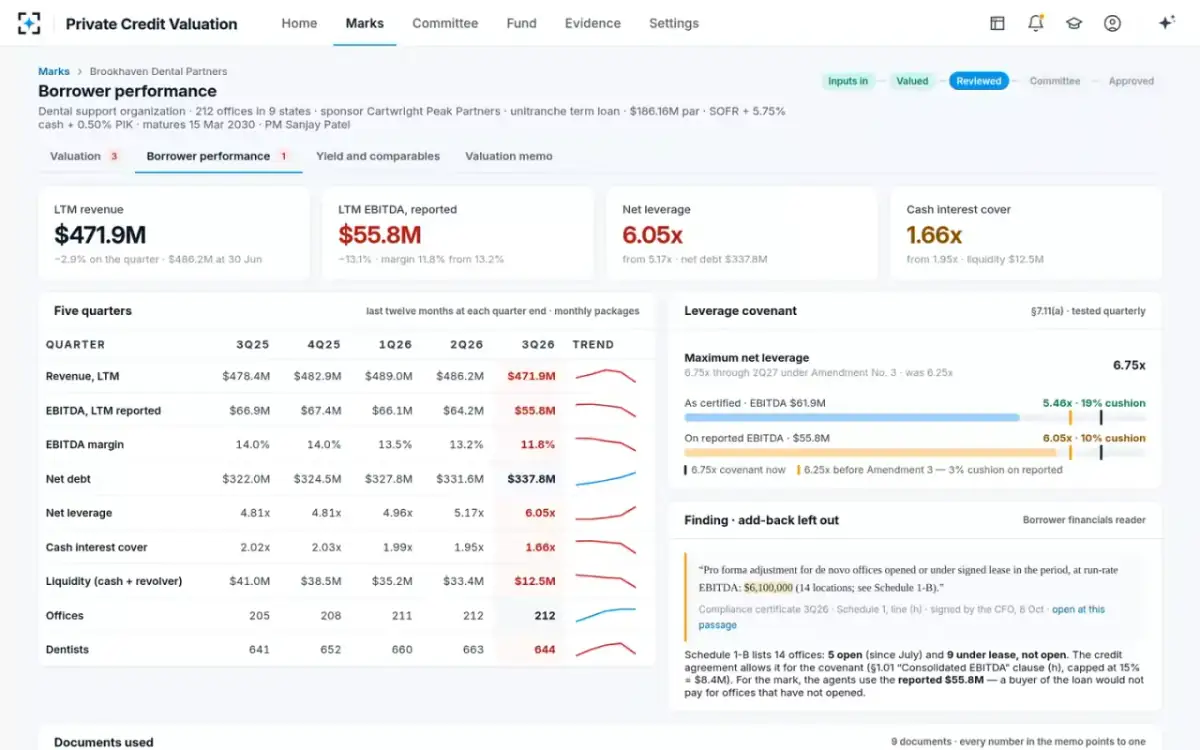
Walk one file through it. Brookhaven Dental Partners, a $186.16M unitranche in the sample fund, sent its September package and compliance certificate on Friday 9 October — nine days into a sixteen-working-day window. By hand, that file alone means an evening of re-keying five quarters of revenue, EBITDA, leverage and liquidity into its workbook, then re-computing the leverage covenant under Amendment No. 3 rather than the agreement as signed. By the morning of 12 October, in the solution, the same file has been read, the covenant re-computed both ways, the add-back flagged and the proposed mark of 95.40 drafted with its bridge — and the analyst's job on it starts there, not the night before.
Where the hours really go: re-keying vs judgment
Ask the analyst what they did all quarter and the honest answer is mostly transcription. In the sample fund the problem statement is blunt: monthly packages get re-keyed into one workbook per loan, and covenants are re-computed by each agreement's own definitions. That is the work of the first two stages — seven of the fifteen days — and it involves no valuation judgment at all. The judgment is squeezed into the margins: the afternoon an add-back looks wrong, the spread print that does not match the story, the borrower whose certificate says one thing and whose financials say another.
The same analyst's hours, before and after the agents take the reading and drafting
Today: 15 days across five kinds of work
- Collecting and chasing packages · 20%
- Re-keying and re-computing covenants · 27%
- Pricing spreads and comparables · 13%
- Running yield and reconciling the range · 20%
- Writing memos and the pack · 20%
With Private Credit Valuation: the same quarter as review work
- Reviewing the analyst queue and findings · 45%
- Checking covenant re-computations · 20%
- Downside cases and judgment calls · 20%
- Committee preparation · 15%
The re-allocation is the point of the job description, not a footnote in it. When the reading, the re-computation and the first draft move to agents that cite a page for every value, the analyst's remaining work is the part that was always most valuable and least staffed: checking the add-back a borrower buried in a certificate. The add-back the sample fund excluded from its mark — $6.1 million claimed for fourteen offices, nine of them not yet open — is exactly the finding an analyst should own, and exactly the finding re-keying leaves no time to find.
Chasing is the hidden sixth stage, and it never shows up in the day split because it borrows from every other stage. Certificates arrive late, in formats that differ borrower by borrower, with schedules that do not tie to the face of the package. Every hour spent reminding a sponsor's controller that the certificate is due is an hour not spent on the one file in the book where the leverage grid should have moved the mark. Experienced analysts learn to triage the chase against the calendar; the calendar always wins, and the triage is usually invisible until an audit sample lands on a file that got the short end of it.
What does a "portfolio valuation analyst" do differently from a business appraiser?
The job title matters because the work is often confused with business valuation, and it is not the same discipline. A business appraiser values a company — for a sale, a dispute, an estate — and their product is an opinion of what the whole enterprise is worth. A portfolio valuation analyst values loans: positions inside a fund, measured under ASC 820 at fair value, on a quarterly clock, against an independent range their firm has to reconcile. The appraiser asks what the business is worth; the analyst asks what this claim on the business is worth today, to this fund, under these documents.
That difference shows up in the daily work. The appraiser builds a model of a business over weeks; the analyst maintains 142 small files under a deadline, each one a legal claim whose value depends on covenants, amendments and market spreads as much as on the borrower's accounts. The analyst's craft is less about projection and more about evidence: where each number came from, why the method fits this loan, and what changed since last quarter. For how the methods themselves differ by position, the guide to the three valuation approaches walks the market, income and cost approaches loan by loan.
The skill that matters most: reading a credit agreement, not just a spreadsheet
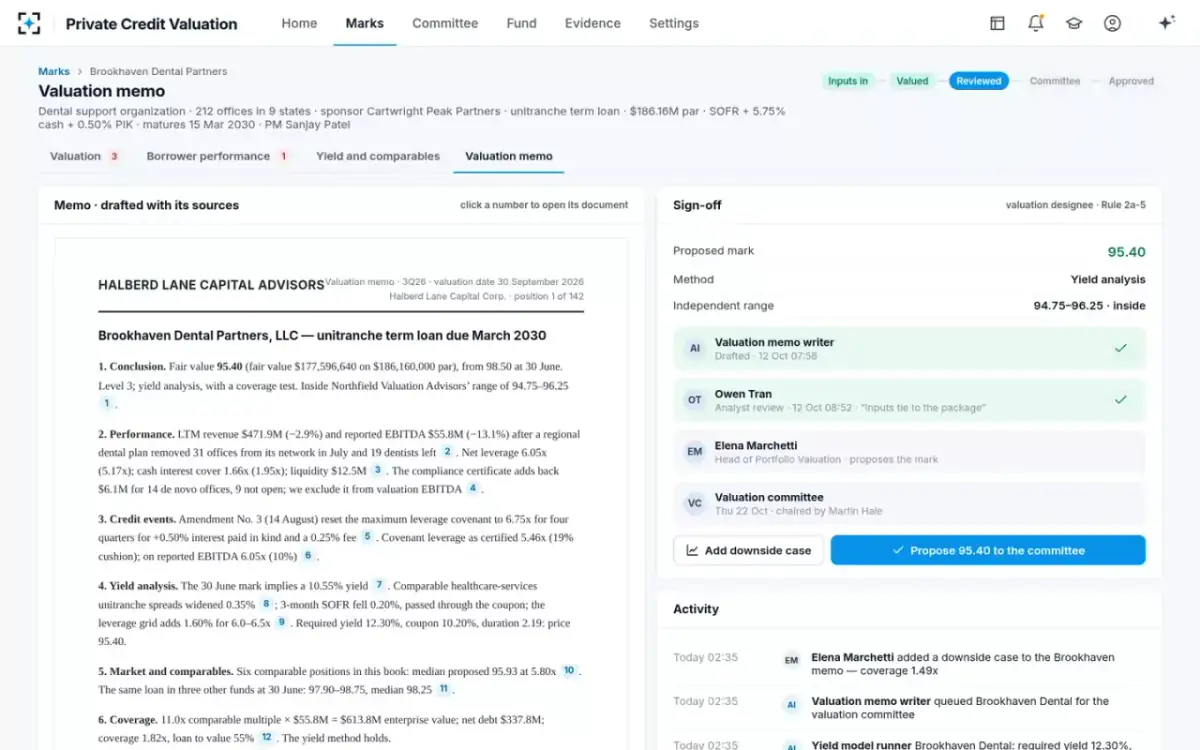
Models can be taught in weeks; reading a credit agreement quickly and sceptically takes years of agreements, and it is the skill the rest of the job depends on. The agreement is where the analyst's numbers live. EBITDA is whatever its definition says — which add-backs count, which leases are debt, which caps apply. The covenant that triggers a default is the one written there, not the one in the term sheet. Amendment No. 3 in the sample book added half a point of interest paid in kind — worth +1.10 points of the mark — and is one of the three reasons Brookhaven goes to the committee; a reader who missed it would price the loan on last quarter's cash flows and never know why the bridge did not tie.
Research keeps confirming how much of lending lives in these definitions. A 2025 National Bureau of Economic Research study of direct lenders found they "write collateral claims more focused on the continuation value of firms after default, especially when the firms operate in intangible capital industries" — in other words, the documents decide what a lender can actually recover, and the documents differ lender by lender. Reading them is not clerical work bolted onto the analysis; for this job, the reading is the analysis.
What a senior valuation analyst reviews that a junior one does not
The senior analyst's review queue is where quality control actually happens, and it is a different kind of reading from producing a mark. In the sample fund, Owen Tran's review note on the Brookhaven Dental memo is five words — "Inputs tie to the package" — but behind those words sit the checks that separate a defensible mark from a plausible one: does every number in the memo trace to a document and page; was the covenant re-computed under the amended agreement; does the yield build start from the last approved mark; is the proposed mark inside the independent firm's range, and if not, is there a written reason.
Two seats, one quarter: what the analyst and the head of valuation each hold today
Today
Re-keys monthly packages into loan workbooks — half his quarter is copy and paste, and the covenants are re-computed agreement by agreement.
With agents
Reviews the analyst queue against financials already read and covenants already re-computed, each value cited to its page.
Still theirs: The judgment calls: the add-back that looks unsupported, the stale certificate, the downside case worth adding before the memo goes out.
Today
Has 142 positions to mark between the valuation date and the committee, with the support rebuilt by hand, and signs every memo.
With agents
Starts from a proposed mark with its bridge, its evidence and its reasons; overrides with a reason or proposes with her signature.
Still theirs: The signature and its meaning. The agents never set or approve a mark; proposing one is hers alone.
The division of labour in that table is deliberate, and it is the answer to the question every analyst eventually asks: if software reads the documents, what is left for me? What is left is the review queue — the one part of the quarter where an experienced reader adds the most value per hour, and the part that hand-work crowds out almost entirely.
The path from analyst to head of valuation
The career runs analyst, senior analyst, head of valuation or valuation designee support, and each step trades production for judgment. The analyst produces marks; the senior analyst reviews them; the head owns the policy, the committee relationship and the answer to the auditor and the board. The skills compound in the same order: reading agreements, then challenging methods, then defending a valuation policy in front of people who are paid to doubt it.
Two experiences accelerate the path more than anything else on a CV. The first is a dispute: a mark an auditor questions, a committee that sends one back, an independent firm whose range sits far from the fund's. Nobody learns valuation from approvals. The second is a restructuring, where coverage fails, the method changes from yield to recovery, and the analyst sees how much of the quarter's work was designed for loans that are performing — the moment a loan stops being an income case is when the file either holds together or does not.
Compensation follows the standard financial-analyst track while the specialization lasts. The BLS puts the median financial and investment analyst at $102,740 in May 2025, and its highest-paid tenth above $180,860; heads of valuation at private credit managers price off the senior end, because the role carries a regulatory signature, not just a deadline. The scarce skill — someone who has read hundreds of credit agreements and remembers what the definitions do — is exactly what the analyst years are for.
Is this a good job to start a credit career in?
Yes, with one caveat. Valuation is the best seat in the house for learning how private credit actually works, because it touches every borrower, every document type and every method in the fund at once, on a forced quarterly cadence that never lets the learning stop. An underwriting analyst sees the deals their team screens; a valuation analyst sees the whole book age — who breached, who amended, whose add-backs survived contact with reality. Two years in the seat is a compressed history of the fund's credit decisions.
The caveat is the burn risk in the manual version of the job. A quarter that is fifteen days of re-keying teaches diligence but not judgment, and it is the reason good analysts leave the seat. That is the trade the agents change. When the six agents take the reading and the first draft, the analyst's quarter becomes the career-building version of the job — review, challenge, downside cases, committee — and the exit from the seat is into judgment work, not out of the discipline. To see what that quarter looks like screen by screen, start from Private Credit Valuation.
The analyst's queue in Private Credit Valuation: findings first, every value cited
The memo the analyst reviews: drafted with a citation on every number
Questions people ask
What does a valuation analyst do day to day?
Mostly: read borrower documents, turn them into valuation inputs, and defend the numbers. On an ordinary day that means working through monthly packages and compliance certificates, re-computing covenant ratios under each credit agreement's definitions, pulling spread and comparable data, running or checking the yield analysis, and writing or reviewing the memo that goes to the committee.
How much does a valuation analyst make?
The U.S. Bureau of Labor Statistics puts the median financial and investment analyst at $102,740 a year as of May 2025, with the highest-paid 10% earning more than $180,860. Portfolio valuation roles at private credit managers and BDC advisers price near the senior end of that range, and heads of valuation above it, because the role carries accountability for marks the auditor and the board will test.
What is the difference between a valuation analyst and a credit analyst?
A credit analyst decides whether to lend, at origination or review; a valuation analyst decides what an existing loan is worth, every quarter, under ASC 820. They read the same documents but ask different questions: the credit analyst asks about default risk over the life of the loan, the valuation analyst asks what the position would fetch today, and must document the method, the inputs and the reason for every change.
What skills does a private credit valuation analyst need?
Three, in order: reading credit agreements closely enough to apply their definitions, not the accounting system's; enough financial modeling to run and challenge a yield analysis; and writing that can carry a number from source to conclusion. The first takes longest to build, because it comes only from reading many agreements.
Is valuation analyst a good entry-level job in finance?
It is one of the best for learning credit, because the analyst sees every borrower and every document type in the fund, quarter after quarter. The risk is the manual version of the role, where re-keying crowds out judgment; teams that have taken the mechanical reading and drafting off the analyst's plate keep the career-building part of the job.