The cost of private credit valuation is, almost entirely, the cost of people's time. Every quarter, every loan in the book needs a supported fair value mark: borrower packages collected, financials re-keyed, covenants re-computed by each agreement's definitions, spreads and peer marks priced, yield models run, independent ranges reconciled, and a memo written for anything that moves. Nobody invoices for this work — it sits inside the valuation team's salary — which is exactly why it is rarely totalled. Botminds' Private Credit Valuation attacks that time directly: six agents read the documents and draft the support, cutting the mechanical part of a quarter's round from about fifteen working days to about three on the sample book this page is built on.
Every figure below is either published (the wage data, from the U.S. Bureau of Labor Statistics) or our own arithmetic on the sample fund's day split, labelled as such. Nothing here is a customer result.
What one quarter's valuation round really costs today
Start with the only honest unit: the hour. A quarter's valuation round on a mid-size direct-lending book — the sample fund here runs 142 positions across 118 borrowers — consumes about fifteen working days of hands-on effort by the valuation team: collecting packages and compliance certificates, re-keying financials and re-computing covenants, pricing spreads and comparables, running yield models and reconciling the independent range, and writing the memos and the committee pack. That is 120 hours a quarter, four times a year, before anyone attends a committee or answers an auditor.
Step outside the quarter and the same effort reappears wherever the marks get reviewed. One manager's portfolio-review preparation — assembling the evidence a board or an LP meeting will ask about — runs two to three weeks by hand on a book like this, against a three-day target once the support exists before the question does. The quarter's round and the review's assembly are the same work, paid twice.
The sample book's valuation round, priced at a published analyst wage
15days
of hands-on work per quarter, by hand — 120 hours of collecting, re-keying, pricing, yield and memos
$102,740
median annual wage for financial and investment analysts, May 2025 (BLS)
~$70/h
a loaded analyst hour: the BLS median (~$49) × 1.4, the BLS benefits load (overhead not added)
~$8,400
one quarter’s mechanical round by hand: 120 hours at that loaded rate — our arithmetic
Annualised, the same arithmetic gives roughly $33,600 a year of mechanical valuation work on this book — about 480 hours, or a quarter of one analyst's working year, before the judgment work that actually needs that analyst. Larger books scale the number linearly at first and worse than linearly once coordination enters; a 500-position book carries three and a half times this book's re-keying before anyone coordinates it. The number stays invisible in most budgets precisely because it never appears as a line: it is spread across salaries, absorbed by deadlines, and mistaken for the normal cost of running a valuation function.
Building the hourly rate: BLS wages, loaded
The defensible wage anchor is the BLS Occupational Outlook Handbook: the median financial and investment analyst earned $102,740 in May 2025. Divided by the standard 2,080-hour year, that is about $49 an hour before benefits, workspace and management overhead. The load has a government anchor too: the BLS employer-cost survey found that in June 2026 "wages and salaries averaged $32.82 and accounted for 70.0 percent of employer costs" for private-industry workers, with benefits the other 30.0 percent. Grossing wages up for benefits alone is therefore a factor of about 1.43; this page rounds to 1.4 and adds nothing for workspace or management overhead, so a fully loaded analyst hour near $70 is a floor. Substitute your own HR figure. Every dollar figure on this page derives from that rate, so the whole model re-computes the moment a CFO replaces any input with their own.
Two honesty notes belong here. The valuation team's senior end prices above the median — the head of valuation's signature hours are the most expensive in the round — so $70 is, if anything, a floor for the hours that matter most. And the BLS category covers financial analysts broadly: its highest-paid tenth earned more than $180,860 in May 2025, and specialist valuation roles are not separated out. Neither point changes the shape of the conclusion, because the hours being priced are the mechanical ones.
Where the days go: collecting, re-keying, pricing, running yield, writing
The sample fund's own estimate of a quarter's days, by stage, shows where the hours concentrate — and it is not the judgment work. Nearly half the round — 47% — is collecting and re-keying: reading documents and transcribing them into workbooks. Writing memos, the stage that looks most like the job's purpose, is a fifth of it.
Where a quarter's valuation days go, by hand and with Private Credit Valuation's agents reading first
By hand: 15 working days per quarter
- Collecting packages and certificates · 20%
- Re-keying financials, re-computing covenants · 27%
- Pricing spreads, comparables, peer marks · 13%
- Running yield, reconciling the range · 20%
- Writing memos and the committee pack · 20%
With the agents: 3 working days of review and drafting
- Collecting and re-keying, now done by the agents · 10%
- Pricing, yield and range, run and cited · 17%
- Reviewing proposals and findings · 40%
- Writing and the committee pack · 33%
The by-hand bar is the cost case in one picture. The two biggest segments are exactly the work an agent does well — reading, extracting, re-computing — and exactly the work that adds the least judgment per hour. A fund paying loaded rates for transcription is not buying accuracy; it is buying the chance of a typo. What the analyst's quarter looks like seat by seat covers the same calendar from the analyst's side.
The return formula: hours recovered times loaded rate times positions
The honest return formula has three inputs and no vendor coefficients: hours recovered per quarter, the loaded rate, and the number of quarters. On the sample book the agents take the round from fifteen days to three — twelve days recovered, ninety-six hours, per quarter. At the loaded rate above that is about $6,700 a quarter, or roughly $27,000 a year, for one book of 142 positions. Per position, the mechanical round falls from about fifty-one minutes to about ten.
The return formula, on one panel — every input replaceable with your own
Hours recovered per quarter
(15 − 3) days × 8 h = 96 hthe by-hand days minus the review days, from the sample fund's split
× Loaded hourly rate
$102,740 ÷ 2,080 × 1.4 ≈ $70 / hBLS median wage, May 2025; benefits load from BLS employer costs, June 2026
× Quarters
96 h × $70 × 4 ≈ $27,000 / yearfor the 142-position sample book — scale by your positions
Plus, unpriced above: the cost of a mark that cannot be defended — audit adjustments, exam findings, LP questions — covered next.
Notice what the formula refuses to do: it claims no percentage improvement from a vendor study, and it prices no soft benefit. It is deliberately the weakest version of the case — if a fund's real days, rates or book size are bigger, every input scales the return up; if smaller, the formula says so before the purchase, not after.
What a wrong mark costs, beyond the hours
The expensive errors in valuation are not the hours wasted but the marks that cannot be defended. The research here is uncomfortable: Federal Reserve Bank of St. Louis work on leveraged lending found that EBITDA add-backs "increase the likelihood of loan delinquency and default, and also increase the likelihood of the borrower experiencing a ratings downgrade". A mark that quietly carried a borrower's unsupported add-back is not just optimistic — it is attached to a loan that is measurably more likely to deteriorate, at a price that said otherwise.
The regulatory frame makes the exposure concrete. Rule 2a-5 obliges a fund's board or its valuation designee to keep "periodically assessing and managing material risks associated with fair value determinations" — a duty whose cost lands when it was never done: an audit adjustment that restates NAV, an examiner's finding, an LP's diligence question that arrives during the next raise. And the 2013 interagency leveraged-lending guidance — which the OCC and FDIC rescinded in December 2025 as "overly restrictive" for banks, though its reasoning about valuation still holds — stated the underlying humility plainly: "Enterprise value estimates derived from even the most rigorous procedures are imprecise and ultimately may not be realized." The defence against that imprecision is not confidence; it is a file that shows the method, the inputs and the reason. An unsupported mark's true cost is paid in the currency of trust, at the moments a fund can least afford to spend it.
How many positions justify the investment?
Scale the hours model and the answer falls out. Assume the sample fund's effort per position — about fifty-one minutes of mechanical work per loan per quarter by hand — and the by-hand cost of a quarter's round grows with the book, while the review-driven version grows far more slowly, because the agents' reading time scales with documents, not with salaries.
The by-hand round's cost per quarter, by book size — the hours a buyer is actually pricing
Even the smallest bar is a person-week per quarter spent reading and re-typing. The break-even question — at what book size does software pay for itself — is the wrong way round; the right question is what else that person-week could produce every quarter, because even a 50-position book has one. Books in the low hundreds, the typical direct-lending mid-market, spend a person-quarter a year on mechanical valuation work. That is the segment the three-approach comparison on this site is written for.
What isn't captured in an hours count?
The hours case is the floor of the value, not the ceiling. Four things it excludes, in ascending order of size. First, deadline risk: a quarter compressed by late certificates does not get more hours — it gets later evenings and thinner review, and the first casualty is always the judgment work. Second, audit preparation: in the sample fund the auditor's evidence file — inputs, method, independent range, memo, approval for each sampled position — exists before she asks; her three requests in a week were answered from documents, not from memory. Third, staff retention: the manual version of this job burns the exact analysts a fund is trying to develop. Fourth, decision quality: an analyst whose quarter is review instead of re-keying catches the add-back the certificate buried, and the mark built on reported EBITDA rather than certified is the difference this page cannot price.
Is "faster" the same as "cheaper," once committee and audit time are included?
Mostly, but the honest answer separates the clocks. The agents compress the reading, the re-computation and the drafting — the parts a committee never sees. Committee time does not shrink: seven exceptions still need seven conversations, and it should. What shrinks is everything around them — the pack arrives assembled, each exception with its memo, its independent range and its reason, and the meeting spends its time on judgment rather than on finding the file. In the sample fund the whole book is proposed over a weekend, seven positions reach the committee, and the pack is sent at half past two in the morning because nothing waits on a person re-typing a spreadsheet.
Audit time behaves the same way: the sample's 25-position audit sample reads in one read-only file, 412 documents already attached. Faster and cheaper diverge only where speed is bought with silence — a quick mark with thin support is neither. The test to run in any evaluation is whether the faster round produces the same evidence the slower one did; on this site, the pilot on your own last quarter's marks is built to answer exactly that before anything goes live.
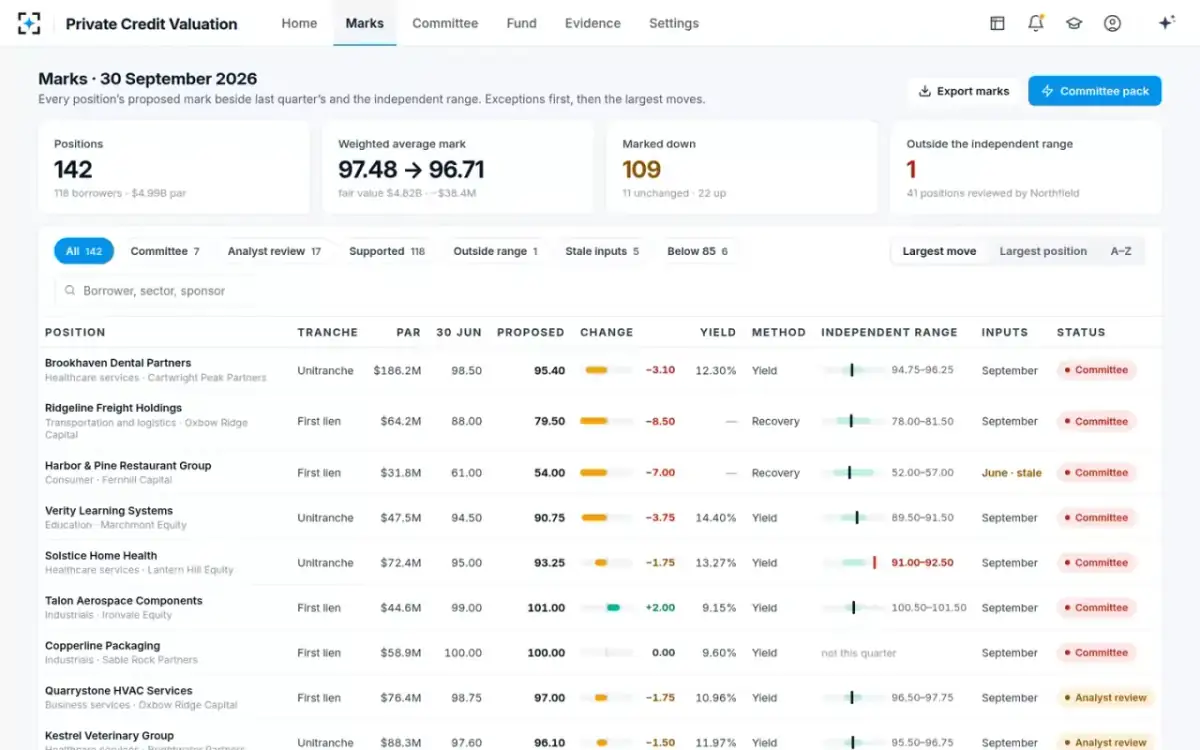
Every mark of the quarter in Private Credit Valuation: 142 positions, the exceptions first
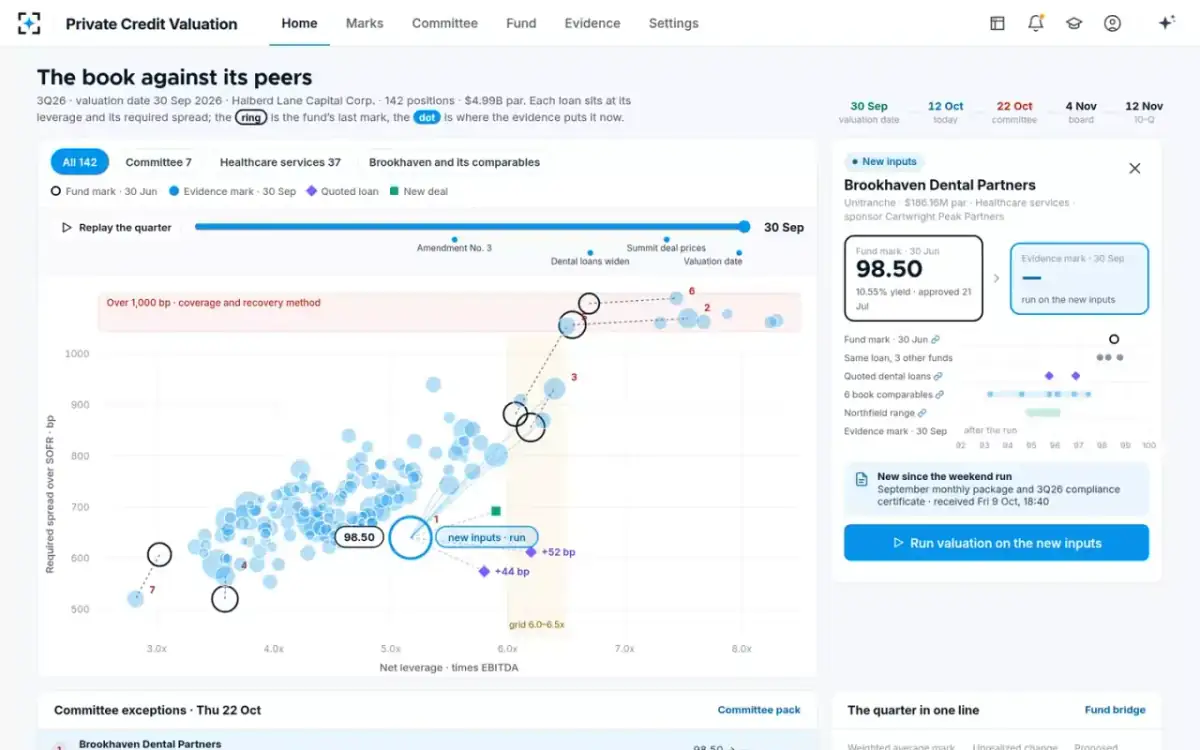
The book against its peers: the weekend run that replaces a week of assembly
None of this needs a buyer's faith: the model on this page is three published or stated inputs and a subtraction. Run it with your own book's numbers, then run the system against your own last quarter and see whether the faster round defends itself. Start from Private Credit Valuation.
Questions people ask
What does private credit valuation cost?
Mostly staff time. On a 142-position book, about fifteen working days a quarter — roughly 120 hours — of collecting packages, re-keying financials, pricing, yield work and memos. Priced at the BLS median analyst wage, loaded, that is on the order of $8,000–8,500 a quarter, before committee and audit time.
How many hours does a quarter's valuation take?
The sample split on this page estimates fifteen working days by hand for a 142-position book, of which seven are collecting and re-keying. With agents reading the documents and drafting first, the team's hands-on time falls to about three days of review. Both figures scale with book size at roughly fifty minutes per position per quarter by hand.
How do you calculate the ROI of valuation software?
Hours recovered per quarter × loaded hourly rate × quarters. Take the by-hand days minus the with-software days, multiply by eight hours and your loaded analyst rate, and annualise. On the sample book: 12 days × 8 h × ~$70 × 4 ≈ $27,000 a year — before any allowance for audit preparation or the cost of a mark that cannot be defended.
What does a wrong mark cost?
More than the hours it took, and mostly not in dollars until it is: research ties EBITDA add-backs to higher delinquency, default and downgrade odds, so an optimistic mark can sit on a loan that is deteriorating. The visible costs are audit adjustments, exam findings and LP diligence questions. Enterprise value estimates are imprecise by nature — the defence is a file that shows method, inputs and reasons.
How many positions justify automating valuation?
Even a 50-position book spends about a person-week per quarter — roughly 42 hours — on mechanical valuation work; books in the low hundreds spend a person-quarter a year. If that time has a better use, and it does, the case closes at any size; larger books just close it with bigger numbers.
What is the loaded cost of a valuation analyst's hour?
The BLS median financial and investment analyst wage was $102,740 in May 2025 — about $49 an hour before benefits and overhead. The BLS employer-cost survey puts wages at 70.0% of private-industry compensation in June 2026, a benefits load of about 1.43×; at 1.4 the loaded hour is about $70 before any overhead. This page shows the arithmetic so a CFO can substitute their own figure.