Private credit's "mark to myth" problem is the charge that the marks in a private credit portfolio are discretionary enough to be fiction: loans that never trade, valued by the managers whose fees depend on the values, smoothed quarter after quarter. The published concern is about discretion rather than fraud — GAAP hands every Level 3 manager real latitude over an illiquid mark, and even academic researchers discount reported net asset values for likely overstatement. The fix is not for every manager to mark everything down; it is for every mark to carry its evidence, its independent range and a stated reason for every move and every non-move, written down before anyone asks. That is the standard Private Credit Valuation holds each of the sample fund's 142 marks to.
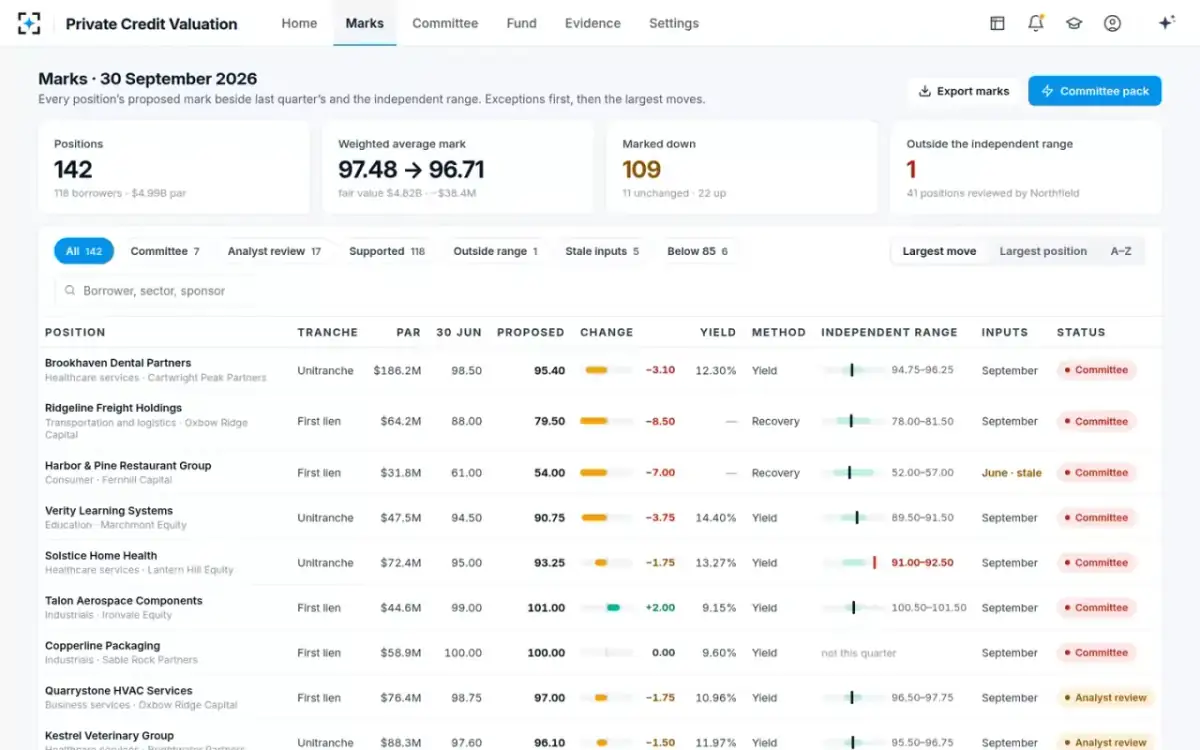
The examples below come from the solution's fictional sample fund, Halberd Lane Capital Corp., in its 3Q26 cycle: 141 marks proposed by the agents over a weekend, seven exceptions to the committee, and an interim audit in progress. The fund is invented. The research and regulatory material are linked where they appear.
What does "mark to myth" actually claim about private credit valuations?
The phrase is a pun on mark-to-market: where a listed asset is repriced by the market continuously, a private loan is marked by its manager's model, and the charge is that some managers' models are built to print stability. What the critique actually claims, at its strongest, has three parts: marks between managers on comparable risk diverge more than differences in information justify; marks move less often and less violently than the credit cycle would predict; and the people setting the marks are the people marketing the fund. What it does not claim — and careful readers should not either — is that every smooth mark is a lie. A performing loan in a quiet sector genuinely does not move; the whole problem is that a reader cannot tell the honest quiet loan from the convenient one without opening the file.
Academic work takes the concern seriously enough to adjust for it. Studying private debt fund returns, Erel, Flanagan and Weisbach build their analysis to withstand inflated valuations, writing that "we discount this final NAV cash flow, at 90%, to account for potentially inflated reported NAVs" (NBER Working Paper 32278, 2024). When researchers assume a ten-percent haircut as a matter of method, the trust problem is no longer rhetorical; it is priced in.
Why discretion over an illiquid mark is built into GAAP, not a loophole
The latitude the critics describe is not an accident of weak enforcement — it is the design of the standard. Fair value for an illiquid asset is defined as an exit price, and where there is little or no market activity, the standard itself says unobservable inputs are how you get there: unobservable inputs "shall be used to measure fair value to the extent that relevant observable inputs are not available, thereby allowing for situations in which there is little, if any, market activity for the asset or liability at the measurement date" (ASC 820-10-35-53, in ASU 2011-04). But the same paragraph fences the discretion: "the fair value measurement objective remains the same, that is, an exit price at the measurement date from the perspective of a market participant". The manager does not get to choose a comforting value; they get to estimate what a buyer would pay, and the estimate must be built like one.
That is why the honest response to "mark to myth" is documentation, not aggression. Enterprise value estimates, the bank supervisors wrote, "derived from even the most rigorous procedures are imprecise and ultimately may not be realized" (the 2013 interagency leveraged-lending guidance, which the OCC and FDIC rescinded in December 2025 as too restrictive for banks — the observation about imprecision was never the part in dispute). Imprecision is the human condition of Level 3; the question a fund can actually answer is whether its estimates are constrained, tested and explained.
What makes a fair value mark defensible?
A defensible mark is one whose file answers an outsider's questions without the author in the room. In practice that means three things, each checkable. First, evidence: every input cited to a document — the borrower's package page, the certificate schedule, the dealer run, the peer fund's schedule of investments — with its date, so a reviewer can re-perform the reading. Second, an independent range: a valuation firm's range and point beside the mark, treated as a challenge to answer, not an anchor to approach. Third, reasons in both directions: a stated reason for every move, and — the part easiest to skip — a stated reason for every non-move.
The defensible-mark file, position by position
- Inputs cited to documents
Package page, certificate schedule, amendment section, range letter — each value with its date, re-performable by a stranger.
- The method named and tested
Yield analysis, with the coverage arithmetic that shows why it still applies — or recovery analysis, with the valuation that says why.
- The independent range shown, never fitted
Outside the range means a reasoned committee decision, never a quiet nudge toward 95.50.
- A reason for every move
The mark bridge: comparable spreads −0.77, the leverage grid −3.50, the payment-in-kind amendment +1.10, down to the proposed 95.40.
- A reason for every non-move
Unchanged while comparables widened is a decision too — it goes to the committee with its reason, by rule.
- The approval chain on the trail
Who proposed, who reviewed, who approved, what was recused — signatures with meanings, kept six years.
How is the independent range supposed to work, and where can it break down?
The independent range is the control built to catch a manager's optimism: a firm paid to disagree produces a range and a point, and the fund must show its mark against it. It works when three conditions hold: the range is genuinely independent — the firm sees the same inputs but owes the fund no number; it is shown, not fitted — a mark outside it is a committee event, not a rounding exercise; and it is specific — a range wide enough to bless anything blesses nothing.
It breaks down in familiar ways. A rotation that never reaches the troubled names breaks the first condition; a policy of "moving into the range" without a reason breaks the second; a range built off the same EBITDA the borrower certified breaks the third. In the sample fund the braid is explicit: Northfield reviews 25% of the book each quarter — every position within a year — plus every move over two points, every mark below 85 and every non-accrual regardless of rotation. In 3Q26 the arrangement caught Solstice Home Health, proposed at 93.25 against a range of 91.00–92.50, and the committee saw the disagreement rather than a fitted number.
Why does a mark unchanged for two quarters need a reason?
Because in a falling market, an unchanged mark is a claim: that nothing about the loan's price changed while its sector repriced. Sometimes the claim is true — a loan at its call price has no upside left to lose; a borrower on a fixed-rate structure can be genuinely insulated. But it is a claim that must be made out loud, in writing, while the quarter is fresh. The sample fund's stale-mark rule makes the claim automatic: any position unchanged for two quarters while comparable spreads move more than 0.25% goes to the committee with its reason. In 3Q26 that rule produced one of the seven exceptions — Copperline Packaging, held at 100.00 for three quarters while comparable spreads widened 0.45%, parked there pending a par refinancing that would justify the price, and said so on the file.
The stale-mark rule: how an unchanged price becomes a committee item
Agent
CompareThe market analyst lines the unchanged mark up against the quarter's comparable-spread move — Copperline: unchanged three quarters, spreads +0.45%.
Agent
Test the ruleTwo quarters unchanged plus spreads over 0.25% — the policy setting fires. A different setting would be one quarter, or spreads over 0.50%.
Agent
Assemble the reasonThe memo writer drafts the non-move bridge: what would justify holding, what would falsify it, and when the question comes up again.
A person decides
Committee decidesThe committee accepts the reason, requires a deeper review, or moves the mark. Either way the reason is on file before an auditor asks.
Never: an unchanged mark is not a pass by default.
The rule has a quiet virtue: it protects the honest unchanged mark. A manager who can show that each quiet quarter was tested, reasoned and approved is the one whose smoothness is discipline rather than myth.
What are regulators watching in private credit right now?
Official attention has moved from the loans to the investors. The Federal Reserve's May 2026 Financial Stability Report describes "some types of private credit vehicles faced increased redemption requests triggered by concerns about reduced returns and the quality of some underlying assets" — and where funds limited redemptions, the report notes, "their managers chose to cap redemptions". The same report sizes the market at about $1.4 trillion of nonfinancial corporate debt, roughly ten percent of the total, and roughly a third of below-investment-grade debt excluding bank loans. A market that large, with marks set by managers and investors now able to knock on the door quarterly, is exactly the environment where a stale file costs more than a wrong number.
As sentiment in private credit markets deteriorated over the past year — reflecting changes in interest rates, some defaults, and other concerns about asset quality — semi-liquid private credit vehicles have faced notable increases in redemption requests.
Board of Governors of the Federal Reserve System, Financial Stability Report, May 2026
For a valuation team the message is practical: the audience for the file has grown. It is no longer only the auditor and the SEC's fair-value rule; it is the fund's own investors, reading the marks against the redemption terms they just exercised. The valuation committee that treats its reasons as first-class output — as publishable as the numbers — is aligned with where supervision is going.
The evidence file an auditor opens: one position, six groups of support
Inputs
September monthly package, 3Q26 compliance certificate, Amendment 3 — each value cited to its page.
Method and model
Yield analysis calibrated to the last approved mark; coverage 1.82x on an 11.0x multiple, so the method holds.
Independent range
Northfield 94.75–96.25, point 95.50; the proposal sits inside, 0.10 below the point.
The bridge
98.50 to 95.40, driver by driver, every point owned by a named cause.
The memo
Drafted in the policy's order, analyst review attached, a downside case added before signature.
The approval
Proposed by the head of valuation, exception 1 of 7, committee 22 October — recusals on file.
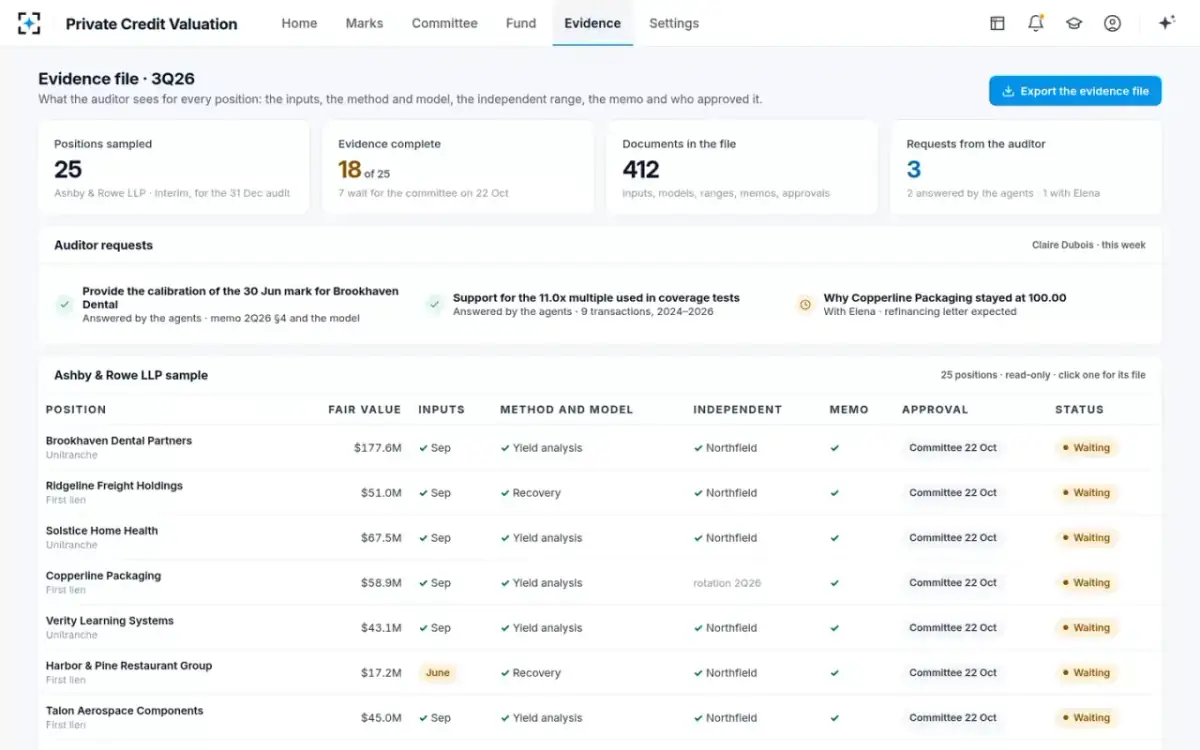
In the sample fund the auditor's 25-position sample reads exactly this way — 18 positions complete, 7 waiting only on the committee, 412 documents — and two of her three questions that week were answered from the file directly. The third, why Copperline stayed at 100.00, is the one the stale-mark rule had already queued for the committee: a question the process generated for itself, which is the strongest form of the answer.
Every mark: the book at a glance, exceptions first
Could your fund's marks survive an outside spot check?
The spot check is the honest test, and it is cheap to rehearse: pick three marks at random — one that moved, one that did not, one the independent firm reviewed — and ask, for each, for the inputs with their sources, the method with its test, the range with the reason, and the approval with its meaning. If the file answers in minutes, the fund is on the right side of the "mark to myth" line whatever its marks did. If the answer is a person explaining from memory, the fund is one adverse article away from the headline. The rehearsal is also the best preparation for the Level 3 disclosure questions any sophisticated LP now asks by default.
Does a bigger markdown mean a more honest manager?
No — depth of markdown measures the estimate, not the ethics. A manager who marks a sound loan to 85 is exactly as unreliable as one who marks a broken loan at par; both are estimates without support. Honesty in valuation shows up in properties of the file: reasons that precede questions, ranges that are shown rather than approached, non-moves that are argued, disagreements with the independent firm that are recorded instead of resolved quietly. A fund can mark down sharply and still be myth-making if the markdown has no file; it can hold a mark steady through a bad quarter and be beyond reproach if the reasons are on file and the committee signed them. The question that matters is never "how big is the move?" but "what would it take to change your mind, and is that written down?" For the quarter-by-quarter discipline of writing it down, start from Private Credit Valuation.
The auditor's evidence file: the sample, read-only, already built
Questions people ask
What does "mark to myth" mean?
A criticism of private credit valuation: because loans do not trade, managers mark them with models, and the charge is that some models are tuned to report stability rather than estimate price. It claims discretion and smoothing are systemic risks, not that any single smooth mark is false.
Why are private credit valuations criticized?
Because the same people who set the marks report the performance the marks produce, and the assets almost never trade to contradict them. Researchers take the concern seriously enough to discount reported NAVs — NBER Working Paper 32278 haircuts final NAV cash flows to 90% for likely overstatement.
Can a fund manager's marks be too smooth?
Yes, and the tell is not smoothness itself but undocumented smoothness: positions unchanged while comparable spreads widen, moves that always round to round numbers, quarters where nothing ever trips a review. The honest defence is a file that shows each quiet quarter was tested and reasoned.
What makes a fair value mark defensible?
Cited inputs, a named and tested method, an independent range shown rather than fitted, a reason for every move and every non-move, and an approval chain on the audit trail. The standard is that a stranger can re-perform the mark from the file without the author present.
Why would a mark stay unchanged for two quarters?
Legitimate reasons exist — a loan capped at its call price, a borrower genuinely insulated from the repriced sector, a par refinancing in progress. The fund's job is to state the reason while the quarter is fresh; the sample fund's stale-mark rule sends any position unchanged two quarters with spreads over 0.25% to the committee automatically.
Is a bigger markdown more honest?
No. A markdown's size says nothing about its support; a deep mark without a file is as much myth as a stale one. Honesty shows in the file — reasons, ranges, recorded disagreements — not in the direction or depth of the move.