Valuation committee terms of reference are the short governing document that says what a valuation committee is for, who sits on it and who votes, how independent its members must be, what quorum it needs, which marks it must see, how challenges are resolved, what its minutes record and how often the terms themselves are reviewed. For a private equity or private credit manager the committee is the last line of independent judgement before a Level 3 mark sets fees, investor statements and dealing prices, so the terms are where a supervisor looks first. Botminds' Private Markets Valuation is built around such a committee: its agents compute, argue and draft, but the analyst prepares, the head of valuation checks and the committee approves, under terms the manager writes.
Two regulators have recently published what they found when they read managers' terms. The UK Financial Conduct Authority reviewed 36 private-markets firms in 2025, and the Monetary Authority of Singapore published findings from thematic valuation inspections in May 2026. Both are quoted below, with the examples drawn from fictional sample data in the solution.
A few FMCs either did not establish any ToR for their dedicated committees, or their existing ToR lacked coverage of key operational areas, such as composition and designation of committee members, meeting frequency and quorum requirements for decision making.
Monetary Authority of Singapore, Valuation Practices for Fund Management Companies, information paper, May 29, 2026
What is a valuation committee?
A valuation committee is the body that approves, or recommends to a board, the fair values a manager reports for assets with no market price. In UK private markets it is near-universal: more than nine in ten valuation processes in the FCA's questionnaire, and every firm it visited in depth, had one (FCA, Private market valuation practices, March 2025).
Having a committee is not the finding that matters; what it is allowed to do is. The FCA noted that committees "dedicated to making valuation decisions tended to demonstrate greater independence and oversight", while some committees only made recommendations to other governance bodies. Singapore's regulator found the dedicated committees it inspected "were typically responsible for approving valuation frameworks (including valuation methodologies), P&Ps, fair value assessments (e.g. challenges in pricing) and exceptions (e.g. deviation from P&Ps, breaches of pricing tolerance levels)" (MAS). The terms should say which of those powers the committee holds outright.
Thin terms of reference against complete ones
Most weak terms of reference are not wrong, they are silent. They name the committee and its chair and stop, leaving every hard question to custom. The comparison below sets the gaps regulators described beside the clause that closes each.
What thin and complete valuation committee terms of reference say on the same eight questions
Thin terms (the gaps regulators found): “The committee comprises senior management.” No list, no voting rights, no alternates.
Complete terms: Named roles, which of them vote, who presents without voting, and how a member is replaced.
Thin terms (the gaps regulators found): Investment professionals vote, sometimes as the majority.
Complete terms: A voting majority independent of portfolio management, with deal-team views heard, minuted and kept separate.
Thin terms (the gaps regulators found): Not stated, or a bare number with no independence test.
Complete terms: A number of voting members, a majority of them independent, and what happens when quorum fails.
Thin terms (the gaps regulators found): “All valuations,” in practice whatever the papers contain.
Complete terms: A materiality test (size of move, overrides, open challenges) and a consent agenda for the rest.
Thin terms (the gaps regulators found): Not mentioned.
Complete terms: How a challenge is raised, answered and escalated, and that the committee sees each answer.
Thin terms (the gaps regulators found): “Minutes will be kept.”
Complete terms: Per material mark: the inputs that changed, the alternatives considered, the reasons, the vote.
Thin terms (the gaps regulators found): Fees and remuneration only.
Complete terms: Fees, asset transfers, subscriptions and redemptions, marketing, secured borrowing, smoothing.
Thin terms (the gaps regulators found): Never revisited; membership changes not reflected.
Complete terms: Reviewed at least yearly and on named triggers, with changes approved and dated.
What should valuation committee terms of reference include?
They should include, at a minimum, the five items Singapore's regulator found in good terms: the committee's "responsibilities, composition, meeting frequency, quorum requirements, and reporting line(s)" (MAS). The FCA's findings add the rest: independence and expertise, conflicts, how decisions are minuted, and how the committee uses the auditor and outside advisers.
Twelve clauses for valuation committee terms of reference
- Purpose and scope
Which funds, which assets (all Level 3? Level 2 overrides?), and whether the committee approves or recommends.
- Authority
Approving the valuation policy and methods, individual marks, overrides and exceptions to the policy.
- Membership and voting
Named roles, who votes, who presents without voting, alternates, and how the chair is chosen.
- Independence and expertise
A voting majority independent of portfolio management, each able to discuss models and assumptions in detail.
- Quorum
A number, a majority of it independent, and the rule when quorum fails: adjourn, never approve.
- Meetings
At least each valuation date, plus out-of-cycle meetings on named market or company events.
- Materiality and consent agenda
Which marks are discussed one by one, and which may be approved together once prepared and checked.
- Challenge and dissent
How challenges are raised and answered, the time allowed, and escalation when unanswered.
- Minutes
What is recorded for each material mark, who drafts, who approves the minutes, and where the evidence lives.
- Conflicts
The conflicts register the committee reads each quarter, and how a conflicted member steps out.
- Advisers and auditors
When third-party valuation advice is obtained, how it is challenged, and when the auditor may observe.
- Reporting and review
Reporting line to the board, annual review of the terms, and review whenever membership changes.
Who should sit on a valuation committee?
People who are independent of the investment decision and expert enough to challenge it. The FCA's strongest firms ensured "the valuation committee's voting membership was made up of independent individuals with sufficient valuation expertise". Its weakest had "senior investment professionals representing all or the majority of valuation committee voting membership", and the FCA said it would follow up with firms where investment professionals vote at all, to understand how that "is consistent with the independence of the decisions made" (FCA).
Singapore's regulator described the same spectrum from the other end. Its better practice was a committee "consisting entirely of senior management members (i) who were independent from portfolio management function, (ii) whose remuneration structures were not tied to funds' performance, and (iii) with sufficient expertise and experience"; at another manager most members were external. Among the committees it inspected, members "had at least 5 years of experience in the relevant functions that they represented" (MAS).
The sample committee in the solution follows that pattern: a chair who is the private-markets CFO, four other voting members, and the head of portfolio valuation presenting without a vote. The deal partner who knows each company is not a member; he can add information to his funds' marks, which the committee sees with his name on it.
How independent must a valuation committee be?
Independent enough that the people paid on a fund's performance cannot set its marks. In the EU the AIFM Directive allows an AIFM to value its own assets only if "the valuation task is functionally independent from the portfolio management and the remuneration policy and other measures ensure that conflicts of interest are mitigated and that undue influence upon the employees is prevented" (Directive 2011/61/EU, Article 19(4)). UK rules carry the same test in FUND 3.9.7R.
US registered funds and business development companies have a parallel rule. Rule 2a-5 requires a valuation designee to wall fair value determinations off from portfolio management: a portfolio manager may not decide a value, nor steer it by "exerting substantial influence" (17 CFR 270.2a-5(b)(2)). Private funds have no such rule, but the wording is a good test for any committee: could an investment professional in effect decide a mark through a vote, a veto or control of the model? That rule and its designee have their own guide, the valuation designee under Rule 2a-5.
Quorum, materiality and the consent agenda
Quorum should count independent voters, not heads. Singapore's regulator found that, among the committees it inspected, quorum for decision-making "comprised a majority of senior management members independent from the portfolio management function" (MAS). The terms should also say what happens without quorum; the safe answer is that the meeting adjourns and no mark is approved.
Materiality decides how the committee spends its time. A committee that discusses every position discusses none properly; one that sees only what the papers put in front of it is governed by whoever writes the papers. In the sample quarter the policy sends a mark to discussion for a move of 5% or more, or $25 million or more, for any override and for any open challenge: 26 of 304 marks. The other 278 are approved on a consent agenda in one resolution, each already prepared by one person and checked by another.
The sample committee's terms in Private Markets Valuation, as settings
| Clause | Sample setting | Who can change it |
|---|---|---|
| Voting members and quorum | 5 voting members; quorum 3; the head of portfolio valuation presents without a vote | Set in the terms of reference, outside the software |
| Materiality for discussion | Move of 5% or more, or $25 million or more; any override; any open challenge | Head of valuation proposes, chair approves |
| Within tolerance | Move under 3% and every method within ±7% of the mark | Head of valuation proposes, chair approves |
| Challenge answer | Within 24 hours; unanswered at the cut-off, escalated to the head of valuation and the chair | Head of valuation proposes, chair approves |
| Segregation | No one may check or approve a mark they prepared | Fixed in the policy |
| Deal team | Sees its own funds after a mark is prepared; may add information; may not set, edit, check or approve | Fixed in the policy |
What should valuation committee minutes record?
Minutes should let a reader who was not in the room see, for each material mark, what changed, what was argued and why the committee decided as it did. That is the clause most terms leave vague, and the one the FCA tested hardest.
However, in some cases the independent committee's minutes failed to record details of how valuation decisions were reached, and when asked, committee members could not describe examples in practice.
FCA, Private market valuation practices, multi-firm review, March 5, 2025
The FCA's own conclusion was that the lack of record-keeping "prevented us from having confidence about effective oversight of valuation decisions", and that auditors and investors' due diligence teams "would also require more detail". The firms it rated well had committees that "had recorded detailed asset-level valuation discussions that demonstrated an understanding of the asset and the valuation task". For US registered funds, the SEC set the documentation bar at records good enough for an outsider to check a determination without rebuilding it (Rule 2a-5 adopting release, 86 FR 748). That is a useful standard for any committee's minutes and the evidence they point to.
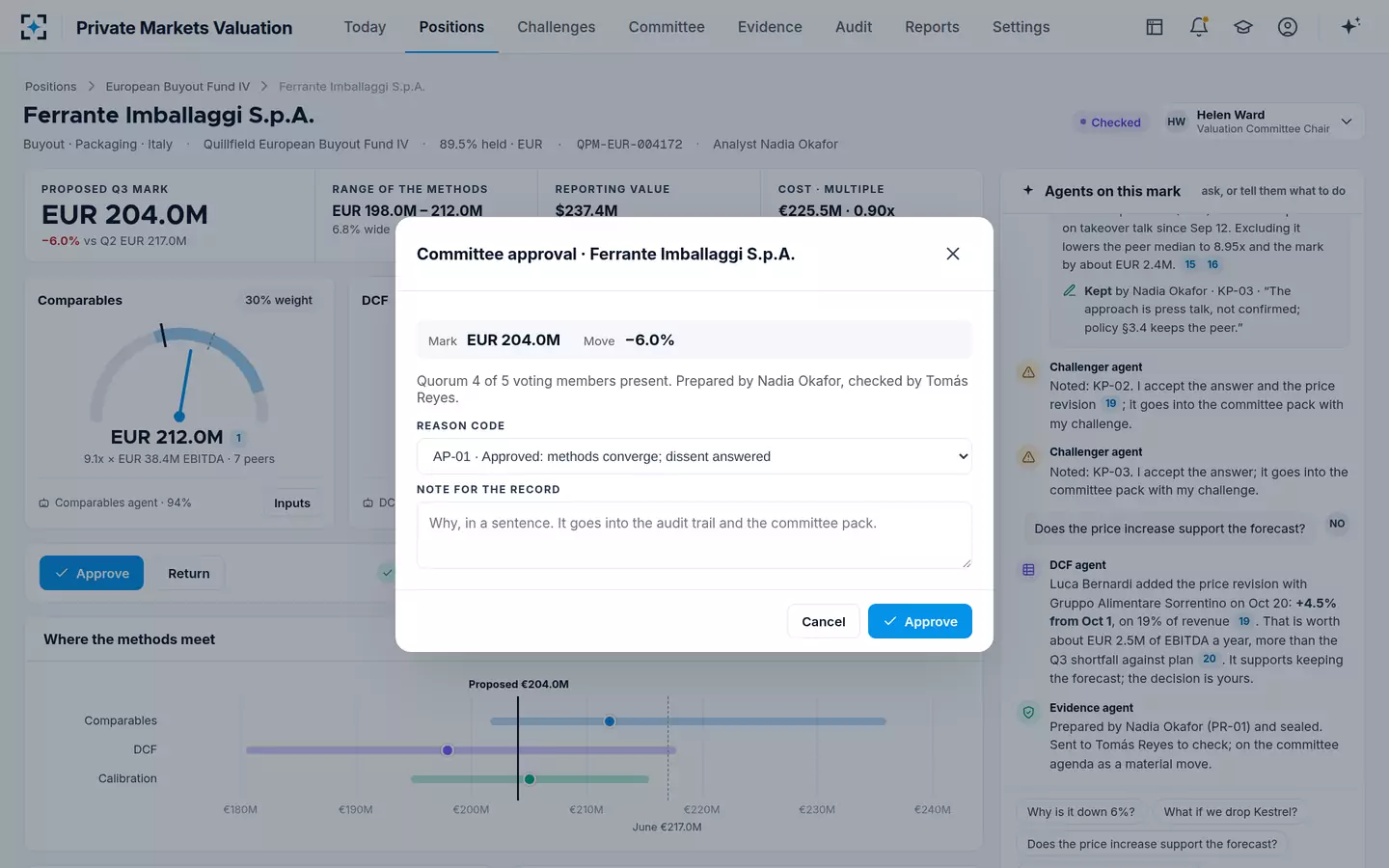
In practice the terms should require, for each mark discussed: the proposed value and last quarter's, the methods and the spread between them, the inputs that changed, every challenge and its answer, any override and its reason, the vote or the chair's decision, and a reference to the evidence. In the solution each of those is captured as it happens, with reason codes, so the minutes are drafted from decisions rather than from memory.
Committee approval in Private Markets Valuation: quorum, preparer and checker on the face of the decision
Which conflicts should the terms of reference name?
All the ways a mark can benefit the manager, not just fees. The FCA found every firm had identified conflicts around fees and remuneration, but other valuation conflicts were "only partly identified and documented", including those around "investor marketing, secured borrowing, asset transfers, redemptions and subscriptions and uplifts and volatility" (FCA).
Even closed-ended funds that charge fees on invested capital have one. The FCA heard managers concede that writing an asset down shrinks invested capital, and with it the fee, a conflict that "could dissuade them from taking appropriate write-downs"; the cost of a wrong mark prices it. The SEC's 2023 order against Insight Venture Management turned on exactly this: the fund agreements reduced the fee basis when an investment was permanently impaired, and the adviser decided when that happened with an undisclosed four-part test, one part of which asked whether a company's holdings were written down by more than half of their cost; it agreed to a $1,500,000 penalty without admitting or denying the findings (SEC order IA-6332, June 20, 2023). A committee that approves write-downs should see, in its papers, what each write-down does to fees.
How often should a valuation committee meet, and when else?
At every valuation date, and whenever a defined event makes the last marks unreliable. Singapore's regulator found committees meeting on a fixed rhythm, monthly or more for funds that deal daily, and again when markets were stressed or disrupted (MAS). The FCA heard of "asset-level triggers, such as significant moves in the comparable set's average multiple or company-specific events, and fund-level triggers, such as moves in a fund's 'unofficial' NAV as tracked by the firm" (FCA). The terms should name the triggers and who may convene the meeting.
The terms themselves need a review clause. Singapore's regulator described a manager that had not set how often its policies were reviewed, with the result that "a change in the composition of its valuation committee in its P&Ps was not updated in a timely manner". Yearly review, and review on any change in membership, closes that gap. How the committee fits in the wider quarter, from company reports to the signed minutes, is followed in the private equity valuation process at quarter end.
Advisers, auditors and observers in the room
Outside advisers and auditors strengthen a committee only if the terms say how they are used. The FCA found many firms used third-party valuation advisers "while retaining responsibility for valuation", and warned that "independence may be limited if a service provider is dependent on the fees from their firm". Singapore's regulator expects managers that rely on outside opinions to keep enough skill in-house to test those opinions and push back on them (MAS).
The auditor is a different case: not a member, but a useful observer. Among the practices the FCA rated well was "inviting auditors to observe valuation committee meetings, raising auditor challenges at those meetings". A clause allowing it, at the chair's discretion, costs nothing and moves the auditor's questions before the quarter is signed rather than after. A committee that also wants its methods tested against exit prices can make backtesting a standing agenda item; how to run one is set out in private equity valuation techniques, tested against the exit price.
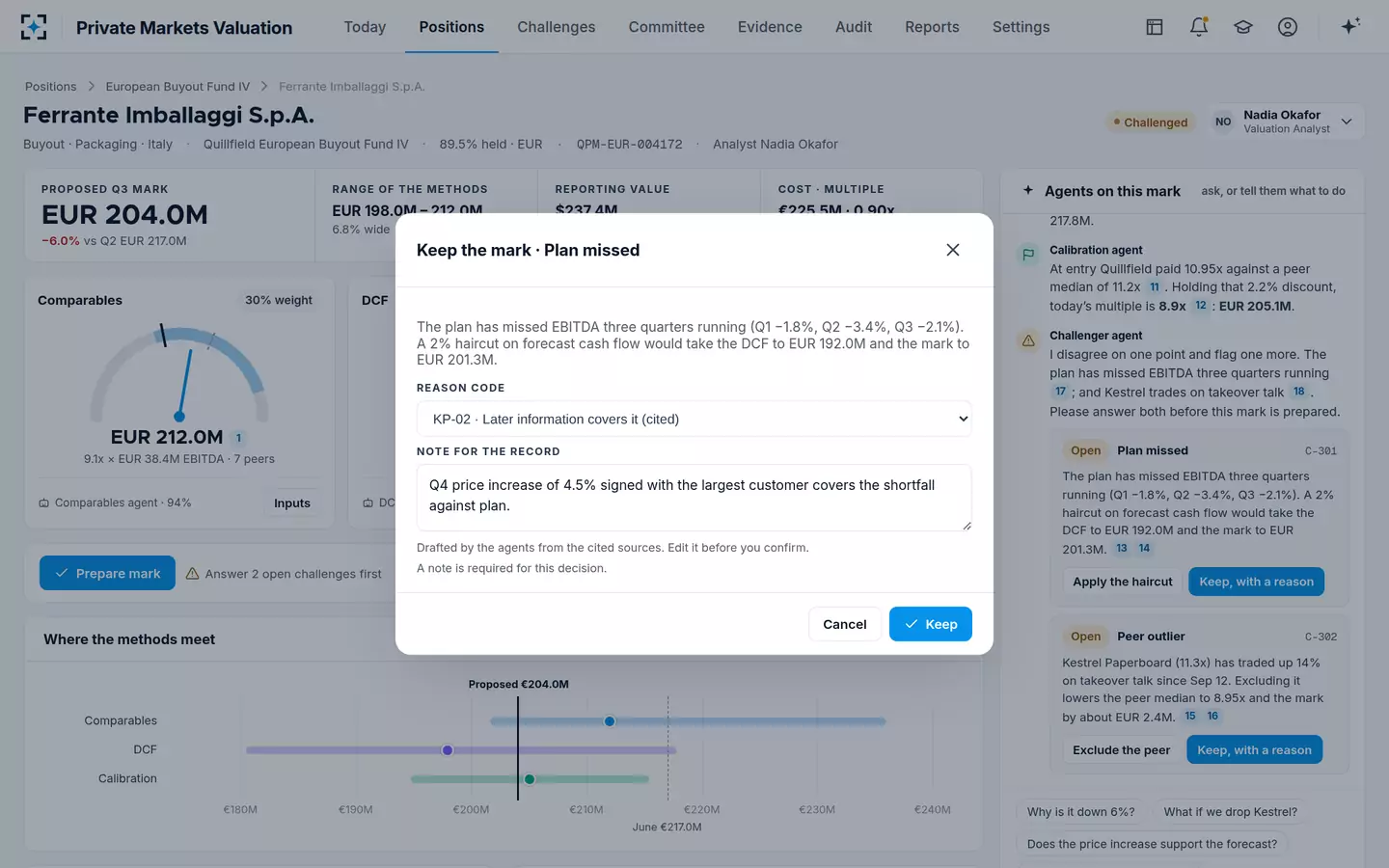
A challenge kept with a reason in Private Markets Valuation: the answer the committee will read
Questions people ask
Is there a valuation committee terms of reference template?
Regulators do not publish one, but they have said what good terms contain. Singapore's MAS lists "responsibilities, composition, meeting frequency, quorum requirements, and reporting line(s)", and the FCA adds independence, expertise, conflicts and minutes. The twelve clauses above cover both.
Should deal partners vote on a valuation committee?
Regulators doubt it. The FCA said firms where senior investment professionals formed all or most of the voting membership did not meet its expectations on independence, and it is following up with firms where they vote at all. Hearing their view, and minuting it, is the safer design.
What is a quorum for a valuation committee?
The minimum number of voting members needed to decide, usually set so that independent members are the majority of it. MAS observed quorums made up of "a majority of senior management members independent from the portfolio management function". The sample committee needs 3 of its 5 voting members.
Who chairs a valuation committee?
Usually a senior executive outside the investment team, often the CFO or chief risk officer. The chair should not be the person who checks the marks, so that approval stays a separate step. In the sample, the private-markets CFO chairs and the head of portfolio valuation presents.
Does a valuation committee replace an external valuer?
No; they do different jobs. Under the AIFM Directive the manager either appoints an external valuer or values in-house with functional independence, and the FCA found external valuers in that formal sense "rare". A committee governs the in-house route and decides how far to rely on advisers' opinions.
How long should valuation committee minutes be?
Long enough for a third party to verify each material decision without recreating it, the standard the SEC used for registered funds' fair value records. That usually means a short paragraph per material mark plus references to the evidence, rather than a transcript.