Private equity valuation methods fall into two families that the accounting standards name, the market approach (a multiple read from comparable listed companies or transactions) and the income approach (a discounted cash flow), and a third discipline that ties both to reality: calibration to the price actually paid at entry. Every quarter a valuation team must turn each unlisted holding into a fair value, the exit price a market participant would pay, without a market price to read. It is hard because every input is a judgement and the people who know the company best are the people paid on the result. Botminds' Private Markets Valuation exists to make each of those judgements visible: its agents compute all three methods independently from cited sources, argue against the result, and leave the mark to an analyst, a head of valuation and a committee.
The worked example on this page is fictional sample data: Quillfield Capital, a sample manager marking 304 positions in 38 funds for the quarter ended September 30, 2026, and one of its holdings, an Italian packaging company called Ferrante Imballaggi. The regulatory and research figures come from regulators and peer-reviewed journals, linked where they appear.
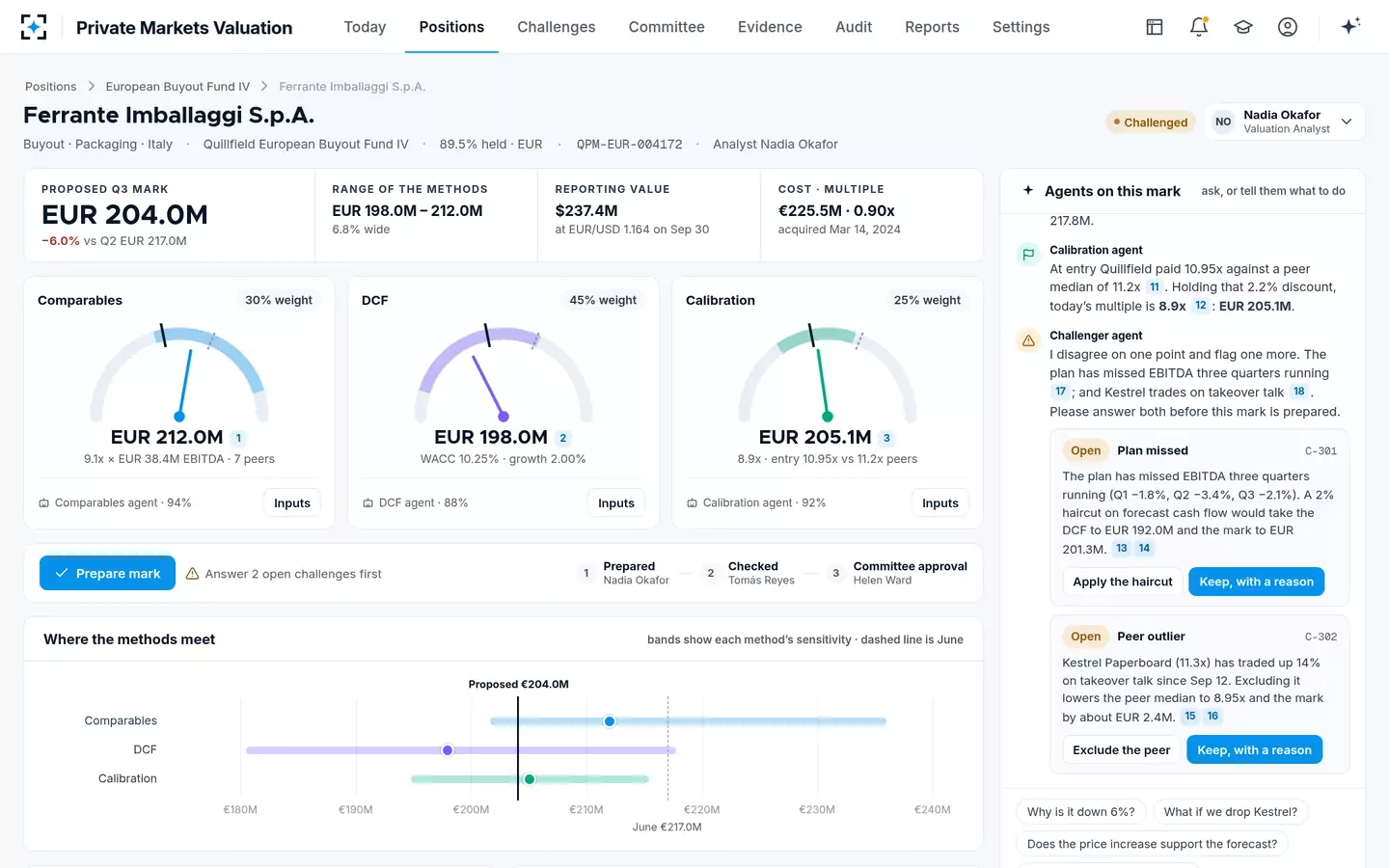
Three private equity valuation methods on one mark: where each lands and what it is made of
Market approach · comparablesweight 30%
EUR 212.0M
7 listed peers, median EV / LTM EBITDA 9.1x × EUR 38.4M EBITDA = EV EUR 349.4M, less net debt EUR 112.6M, × 89.5% held
Income approach · DCFweight 45%
EUR 198.0M
Free cash flow 2027–2031 from the company’s board-approved plan, WACC 10.25%, terminal growth 2.00%
Calibration to entryweight 25%
EUR 205.1M
Paid 10.95x when peers traded at 11.2x; that 2.2% discount held against today’s 9.1x gives 8.9x
Proposed mark−6.0% on June
EUR 204.0M
The methods span EUR 198.0M to EUR 212.0M, a gap of EUR 14.0M. Reported in dollars at EUR/USD 1.164: $237.4M.
What are the methods of private equity valuation?
The methods are the market approach, the income approach and, less often for operating companies, a cost or net-asset approach; calibration is not a fourth method but a test applied to the first two. Under both US GAAP (ASC 820) and IFRS 13 the target is the same exit price: what a seller would receive in an orderly sale between market participants on the measurement date (IFRS Foundation, IFRS 13). Methods are only routes to that one number.
The UK Financial Conduct Authority summarised the two main routes in plain words in its March 2025 review of 36 private-markets managers. The market approach "uses prices and other relevant information that have been generated by market transactions that involve identical or comparable assets", in practice multiples of listed peers or of M&A deals. The income approach discounts expected future cash flows, or income and expenses, to one present value (FCA, Private market valuation practices).
Which route leads depends on the asset. The FCA's questionnaire found a clean split by asset class, and it is a useful default for any valuation policy:
Which valuation method leads, by asset class, in the FCA's 2025 review
| Asset class | Primary method the firms reported | What it means for a policy |
|---|---|---|
| Private equity (buyout) | Most used the market approach as primary; half of those used only the market approach, half added the income approach as joint primary or occasional secondary. Only a few led with income. | Multiples lead; a DCF is the usual second opinion. |
| Venture capital | All firms used the market approach as primary, typically starting from the latest funding round. | The round price is a starting point, not a mark; see calibration. |
| Infrastructure equity | All firms used the income approach as primary; a small number also used the market approach. | Long-dated contracted cash flows suit a DCF. |
| Private debt | Both approaches, which in practice meant an enterprise-value coverage test and a yield analysis. | A different toolkit, covered by credit valuation. |
| Infrastructure debt | All firms used the income approach as primary. | Discounted contractual cash flows. |
The same review found that seven in ten firms said they followed the industry's common convention, the IPEV Guidelines, as private equity valuation guidelines sets out. A convention tells a team which techniques are customary; it does not settle the inputs, and the inputs are where every finding in this guide comes from. Private debt follows a different logic again, and has its own guide to private credit valuation methods.
The market approach: a peer multiple, applied to the right earnings
The market approach values the company at a multiple that listed peers trade on, applied to the company's own earnings, then bridges from enterprise value to the fund's equity. Four choices carry the number: the peer set, the multiple's measure (EV to last-twelve-months EBITDA is the buyout default), the earnings figure, and the bridge.
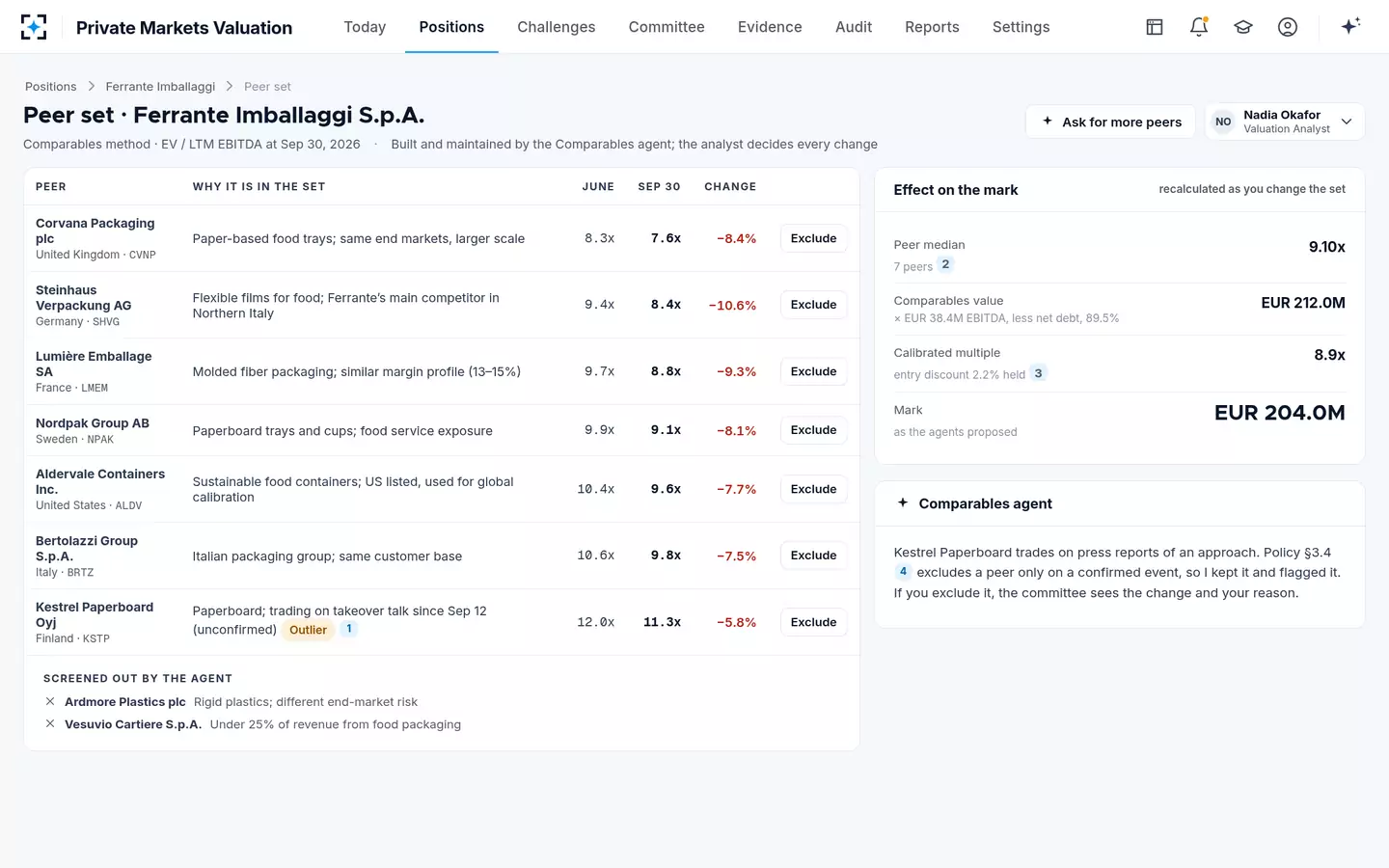
For Ferrante the Comparables agent kept seven listed packaging peers whose median EV/LTM EBITDA fell from 9.9x in June to 9.1x at September 30. Applied to LTM adjusted EBITDA of EUR 38.4 million, that is an enterprise value of EUR 349.4 million; less net debt of EUR 112.6 million, equity of EUR 236.8 million; at Quillfield's 89.5% stake, EUR 212.0 million. Each peer carries its reason to be there (one, Corvana Packaging, is in for paper-based food trays sold into the same end markets at larger scale), and two candidates were screened out with reasons: one for rigid plastics and different end-market risk, one for drawing under a quarter of its revenue from food packaging.
The earnings figure is as much a choice as the multiple. Ferrante's adjusted EBITDA excludes EUR 1.2 million of reorganisation costs that the company itself labelled non-recurring in its Italian quarterly report; the agent took the figure and the label from page 4 and pinned both; whether the label is right is a judgement. That judgement, like the decision to keep or drop a peer, belongs to the analyst. A peer set is also where independence is tested: the FCA saw firms in which "investment professionals appeared to have greater involvement in the valuation task, such as proposing changes to comparable asset sets or discount rates" (FCA).
The peer set behind the market approach in Private Markets Valuation: every peer with a reason, every change the analyst's
When is a DCF used in private equity valuation?
A DCF is used as the primary method where cash flows are long and contracted, as in infrastructure, and as a second opinion on buyouts where a plan exists and can be tested against actuals. Managers disagree about it. In the FCA's words: "Some firms did not use DCF models, arguing it required too much judgement, some occasionally used it for corroboration and others used it as a primary approach, arguing it was more specific in outlining assumptions" (FCA).
Deal teams lean the other way. In a survey of 79 private equity investors, Gompers, Kaplan and Mukharlyamov found that "fewer than 20% use APV or WACC-based DCF methods to evaluate investments", while over 70% use comparable company multiples (Journal of Financial Economics, 2016). A DCF in a quarterly mark is therefore less a deal-team habit than a control: it makes the assumptions explicit enough to be challenged.
Ferrante's DCF rolls the company's own plan, free cash flow rising from EUR 21.0 million in 2027 to EUR 28.6 million in 2031, at a WACC of 10.25% and terminal growth of 2.00%, for EUR 198.0 million. The risk-free rate (2.85%) and unlevered beta (0.92) come from the market data snapshot, the equity risk premium (5.50%) from the valuation policy. Its weakness is plain from one sensitivity:
Half a point of WACC moves the DCF further than the whole gap between the three methods
That is why a DCF rarely stands alone in a private equity mark, and why its inputs need a source each. Moving the WACC slider in the solution is a sensitivity; applying it is an override that records a reason code. The plan itself is tested too: Ferrante has missed its EBITDA plan three quarters running, and the agent assigned to argue against the mark asked for a 2% haircut on forecast cash flow, which would have taken the DCF to EUR 192.0 million.
What is a calibrated multiple?
A calibrated multiple is the peer multiple adjusted by the discount or premium the fund actually paid at entry, so the model starts at the transaction price and moves only with the market. ASC 820's own words, as the SEC quoted them in an enforcement order, are that "calibration ensures that the valuation technique reflects current market conditions, and it helps a reporting entity to determine whether an adjustment to the valuation technique is necessary" (SEC order, In re Sciens Investment Management, 2023).
The calibrated multiple, as the sample policy writes it, worked for Ferrante
Entry discount to peers
10.95x paid ÷ 11.2x peer median at entry
= 0.978, a 2.2% discount
Entry memo, March 2024
Calibrated multiple
9.1x peer median today × 0.978
= 8.9x, rounded to 0.1x by policy
Calibration agent; analyst reviews
Enterprise value
8.9x × EUR 38.4M LTM EBITDA
= EUR 341.8M
Company report, page 4
Fund’s equity
(EUR 341.8M − EUR 112.6M net debt) × 89.5%
= EUR 205.1M
Fund accounting: ownership
The method answers a question the other two cannot: is this company still priced the way the buyer priced it? Ferrante was bought at a slight discount to its peers; holding that discount says the market's view of the gap has not changed. If the company has since improved or deteriorated relative to its peers, the discount itself should move, and the analyst should say why. What calibration in valuation means, and what the SEC staff said about it in September 2026, has its own guide.
How a valuation policy weights three methods
A policy weights the methods by strategy, in writing, so the analyst cannot pick the most convenient result after seeing all three. The sample policy weights a mature buyout 30% market, 45% income and 25% calibration; growth companies lean on the market (50 · 15 · 35); infrastructure on income (10 · 80 · 10); real estate 20 · 70 · 10; and secondaries use secondary bids, adjusted NAV and no calibration (20 · 80 · 0).
Weighting is a choice the FCA would recognise as good practice when it is used to corroborate: firms it rated well "demonstrated use of another established methodology as a sense check" (FCA). The weakness of any fixed weighting is that it can hide disagreement. A blended EUR 204.0 million says nothing about whether the methods agree within a few percent or sit a third apart, which is why the spread matters as much as the mark.
Private Markets Valuation shows the three methods as dials on one scale, with the range they span and the agents' reasoning beside it
Reading the gap between methods
The gap between the highest and lowest method is the first thing a reviewer should read, because it measures how much the mark depends on the weights. The sample policy treats a position as within tolerance only when the move on last quarter is under 3% and every method sits within ±7% of the mark. Ferrante's methods pass the second test (the DCF is 2.9% below the mark, comparables 3.9% above) but not the first: at −6.0% it moves more than 5%, so it goes to the committee.
Three readings of a gap are worth writing down. A market method well above the income method usually means the peers are richer than the company's own plan supports, and the question is which is stale. An income method well above the market method usually means an optimistic plan; the research on deal teams found the typical investor already discounts management forecasts by about a fifth before pricing a deal (Gompers, Kaplan and Mukharlyamov). A calibration result far from the market result means the company's position against its peers has changed since entry, and someone should say why before the mark is signed.
How often are private equity investments valued?
In practice quarterly, though the legal minimum in the EU is once a year. The AIFM Directive requires a valuation and a NAV per unit at least yearly, more often for open-ended funds, and again for closed-ended funds whenever their capital increases or decreases (Directive 2011/61/EU, Article 19). The FCA found that "the industry had converged to quarterly valuation cycles, although debt assets also had monthly valuation cycles" (FCA).
The cadence decides how stale the inputs can be. A quarterly cycle means peer multiples move daily while company accounts arrive weeks after quarter end, so every quarterly mark mixes September 30 market data with a company report received, in Ferrante's case, on October 9. Out-of-cycle revaluations when markets move sharply are a separate discipline, and one the FCA found many firms had not defined.
Where method choice goes wrong: a policy with no methods in it
The most basic failure is a valuation policy that names no method at all. In 2023 the SEC settled with Sciens Investment Management, whose private funds held mostly Level 3 investments and charged a 2% management fee on net asset value. The firm's compliance manual "did not mention any valuation techniques or methodologies applicable to Level 3 Investments", and its policies failed to address how to adjust its own data to other market participants' data, "as was required by the calibration requirement in ASC 820" (SEC order IA-6315, May 24, 2023).
Failure to properly value assets can impact key areas of fund operations and also potentially lead to over or under payment of withdrawal proceeds, incorrect calculation of fees and inaccurate performance reporting, among other things.
SEC order, In re Sciens Investment Management, Release IA-6315, May 24, 2023
The order records that the fund's auditors qualified their opinions because they could not obtain sufficient evidence for the fair value of one material Level 3 investment, that one auditor later withdrew its opinion, and that the 2016 statements were restated to write that investment down by a net of about $32.9 million, with management fees for 2016 to 2019 adjusted after the event. The firm agreed, without admitting or denying the findings, to a $275,000 civil penalty and an independent compliance consultant. The lesson for a methods policy is specific: name the techniques per asset type, the inputs and their sources, how calibration is done, and who may change any of them.
The SEC staff returned to the inputs in September 2026, asking managers to disclose the inputs that matter, discount rates, spreads and comparable deals among them, and warning against boilerplate (SEC staff statement, September 28, 2026; a staff view, not a rule). A method a team cannot explain input by input is a method it cannot disclose. Whether a team's chosen methods actually predict exit prices is a separate question, taken up in private equity valuation techniques, backtested.
Questions people ask
What is the most common private equity valuation method?
For buyouts, the market approach using multiples of comparable listed companies. The FCA's 2025 review found most firms used it as their primary method for private equity, and all firms did for venture capital. A DCF is the usual corroborating method; infrastructure equity reverses the order.
How do you value a portfolio company?
Apply a peer multiple to its last-twelve-months earnings, run a DCF on its own plan, calibrate both to the entry price, then bridge enterprise value to the fund's share of equity. Weight the results by a written policy and explain any gap. For the sample company here that gives EUR 212.0, 198.0 and 205.1 million, and a mark of EUR 204.0 million.
What is the market approach to valuation?
It values an asset from prices of identical or comparable assets in market transactions, usually as a multiple such as EV to EBITDA taken from listed peers or M&A deals. The FCA describes it as using "prices and other relevant information that have been generated by market transactions". The multiple must then be adjusted for differences in size, growth and risk.
Is EBITDA multiple valuation the same as fair value?
No. A multiple is one input to an estimate of fair value, the exit price at the measurement date. The fair value must also reflect the bridge to equity, the fund's stake and the rights of its share class, and it should be calibrated to the price paid at entry.
What is the cost approach in private equity?
Valuing at cost, or at net assets, is used mainly soon after an investment or for asset-rich holdings. The FCA saw firms move off "the initial investment cost or the latest market transaction price" to their designated method as companies reached milestones such as revenue generation. Holding at cost for long needs a reason, because it stops being an exit price.
Can one method be enough?
The rules do not require two, but the FCA singled out firms that used "another established methodology as a sense check". A single method hides how much the mark depends on its own assumptions; a second one exposes it.