Private equity valuation techniques (peer multiples, discounted cash flow, recent transaction prices and calibration to the entry price) all estimate one thing, the price a buyer would pay today, and the only direct test of any of them is the price a buyer eventually did pay. Backtesting compares the realised value at exit with the last mark before it, technique by technique, to find which methods a manager's marks systematically lean on too high or too low. It is hard because exits are few, late and lumpy, and because the mark to compare against must be chosen carefully. Botminds' Private Markets Valuation treats the backtest as evidence like any other: the agent assigned to argue against each mark draws on the manager's own exit history, and people decide what the result means for the policy.
The research figures on this page come from peer-reviewed journals and regulators, linked where they appear. The worked backtest is illustrative arithmetic, not sample data.
What the research says about private equity marks
579funds
384 venture and 195 buyout funds, 1988–2016: buyout NAVs “display little systematic bias”
VC
venture NAVs were “relatively aggressively biased” against buyout, especially since 2000
50%
average gap by which reported unicorn valuations exceeded fair value, from funding-round prices
70%+
of PE investors surveyed use comparable company multiples to price deals; fewer than 20% use DCF
What valuation techniques do private equity firms use?
For quarterly marks, mostly the market approach: a multiple of listed peers or deals applied to the company's earnings. The FCA's 2025 review of 36 UK managers found most used it as their primary method for private equity, half of those alone and half with a DCF beside it, while all venture managers used it, typically starting from the latest round (FCA, Private market valuation practices, March 2025). Singapore's regulator lists the same toolkit for Level 3 private equity and debt: "Valuation models", "Comparable company analysis" and "Recent transactions analysis" (MAS, May 29, 2026).
Deal pricing uses different tools from quarterly marking. Surveying 79 private equity investors, Gompers, Kaplan and Mukharlyamov wrote: "The vast majority of the PE investors rely on gross IRR and MOIC." Over 70% also use comparable multiples, and that fewer than 20% use DCF methods to evaluate investments (Journal of Financial Economics, 2016). The techniques are related but answer different questions, which is the subject of how private equity values a company twice. Backtesting tests the quarterly ones.
What is backtesting in valuation?
Backtesting is the comparison of a realised price with the valuation that preceded it. The FCA defines it as "comparing the realised value of an asset upon exit to the last valuation estimate to assess the accuracy and precision of the valuation process, and identify any limitations of the valuation model and approach" (FCA). For registered funds, the SEC described "disposition analysis" as a "common form of back-testing", which compares "a fair value as determined using a fair value technique with the price obtained for the security upon its disposition by the fund" (Rule 2a-5 adopting release, 86 FR 748, 2021).
Most managers already do it. "Most Phase 2 firms conducted backtesting and found it valuable," the FCA reported, and firms told it their auditors' discussions "would focus on changes to key assumptions and backtesting results". What separated the better firms was use: they described "using the results of backtesting to inform their approach to valuations, such as identifying insights about current market conditions, and potential limitations in models, assumptions and inputs".
How do you backtest a valuation model? Start with the right mark
Compare the exit with the last mark made before the sale process could have influenced it, not the mark at the quarter before closing. Once a signed offer exists, a well-run policy calibrates to it, so a backtest against that mark measures nothing but the time value between signing and closing. The informative comparison is with the last mark built on the technique alone.
A backtest of one exit, term by term
Reference mark
Last quarterly mark before a sale process was known
Usually one or two quarters before signing
Valuation committee minutes
Realised value
Proceeds to the fund, adjusted to the reference date
Strip escrows, earn-outs and costs, roll back cash flows
Fund accounting
Gap
(Realised value ÷ reference mark) − 1
Positive: marked too low; negative: too high
Head of valuation
Attribution
Gap split by technique and by input
Multiple, earnings, net debt, weights, calibration
Analyst, checked by a second person
A worked backtest, by technique
A backtest only becomes useful when the gaps are grouped by the technique that produced the mark. Take six illustrative exits over a year. Together they look reassuring: the fund received $560.3 million against reference marks of $549.0 million, a gap of 2.1%. Split by technique, the picture changes completely.
Six illustrative exits, by the technique behind the last mark
| Exit | Primary technique at the reference mark | Reference mark | Realised value | Gap |
|---|---|---|---|---|
| A · buyout | Market approach, peer multiple | $120.0M | $131.0M | +9.2% |
| B · buyout | Market approach with DCF corroboration | $85.0M | $88.4M | +4.0% |
| C · infrastructure | Income approach, DCF | $210.0M | $205.8M | −2.0% |
| D · growth | Latest funding round, not adjusted for share-class rights | $60.0M | $46.8M | −22.0% |
| E · buyout | Market approach, peer multiple | $44.0M | $49.3M | +12.0% |
| F · buyout | Held at cost for six quarters | $30.0M | $39.0M | +30.0% |
An overall gap of 2.1% hides marks that were 30% too low and 22% too high
Three readings follow, and each is a policy decision rather than a modelling one. The two pure peer-multiple marks came in 9% and 12% low; if that repeats across more exits, the peer discount the policy applies is too deep, or the earnings used are too cautious. The position held at cost for six quarters was the most wrong, which argues for a rule on how long cost can stand. The growth company marked at its last round was the only large overvaluation, which is what the research on funding rounds predicts.
How accurate are private equity valuations?
For buyout funds, reasonably accurate on average; for venture funds, less so. Jenkinson, Landsman, Rountree and Soonawalla tested whether reported NAVs predicted the discounted value of the cash flows that funds later actually returned, for 384 venture and 195 buyout funds from 1988 to 2016. They found that "Buyout funds' NAVs display little systematic bias, but VC funds' NAVs are relatively aggressively biased compared to Buyout funds, especially since 2000." They added: "Accuracy is worse in the first half of the sample period even though NAV estimates generally are more conservative" (The Accounting Review, 2020).
"Little systematic bias" on average is not accuracy for a given fund or company: the average can hide large errors in both directions, as the illustrative backtest above does. It is also a statement about funds that have finished their lives, so it says little about a manager whose last full cycle closed years ago. A manager's own backtest, on its own exits, is the only evidence that speaks to its own marks.
Do private equity funds manipulate reported returns?
Some do, at the moments it pays most, and investors appear to notice. Brown, Gredil and Kaplan, studying a large dataset of buyout and venture funds, found "evidence that some under-performing managers boost reported returns during times when fundraising takes place", but that "those managers are unlikely to raise a next fund, suggesting that investors see through much of the manipulation". They also found the reverse at the top: "top-performing funds likely understate their valuations" (Journal of Financial Economics, 2019).
Barber and Yasuda found the incentive behind it: "Interim performance has large effects on fundraising outcomes", and managers time fundraising to "periods of peak performance" through "exit and fundraise" and "NAV management", the second seen among "low reputation GPs with low realization rates" (Journal of Financial Economics, 2017). For a backtest the lesson is to label each reference mark with the fund's fundraising status, and look separately at marks made while a successor fund was in the market.
Why do private equity exits come in above the last mark?
Partly because managers and investors prefer it. In the FCA's case studies, "many firms discussed the importance of reputation risk and noted that investors often preferred an ‘uplift’ on exit, as well as stable valuations over time", and the FCA saw "conservative adjustments in valuation case studies that provided a less volatile valuation profile over time and/or a better opportunity for an ‘uplift’ upon exit" (FCA).
The FCA did not treat this as harmless. "While conservative valuations limit the risk of overvaluation over time, exaggerating the stability of valuations can also harm investors by obscuring the true level of investment risk and the current value of their investments." A backtest that shows exits consistently above the last mark is therefore not a clean bill of health; it is evidence of a bias, in the direction investors happen to like. Both directions belong in the committee's papers.
Venture rounds: the technique that backtests worst
A funding round is a transaction, but in the class the new investors bought, with protections that older shares lack. Gornall and Strebulaev found reported unicorn valuations averaged 50% above fair value and that common shares, which "lack all such protections", were "58% overvalued" (Journal of Financial Economics, 2020). A policy that marks every class at the latest round price is building in the kind of overvaluation exit D shows. The remedy is calibration to the round class by class, covered in what calibration in valuation means.
Can private credit valuations be backtested?
Rarely in the same way, because most private loans are not sold. The FCA reported that firms that did not backtest "noted its limitations for some asset classes, such as private credit, where most assets are held to maturity rather than sold" (FCA). For loans the useful comparisons are with repayments, refinancings, secondary trades and restructurings, and with observed transaction prices, which is how the SEC described back-testing more broadly: a comparison with "observed transactions or other market information" (86 FR 748).
What should you do when backtesting shows a bias?
Investigate it, record the investigation, and change the policy if the cause is in the policy. The SEC's expectation for registered funds is the clearest statement: "If a specific methodology consistently over-values or under-values one or more fund investments as compared to observed transactions, the board or valuation designee, as applicable, should investigate the reasons for this difference" (Rule 2a-5 adopting release). The same release noted that "calibration and back-testing" can help identify "poor performance or potential conflicts of interest" in methods applied by service providers.
A backtest a valuation committee can act on
- Use every exit, not a selection
Full and partial sales, write-offs and recapitalisations; a write-off is an exit at zero.
- Fix the reference mark by rule
The last mark before a sale process was known, defined in the policy, not chosen afterwards.
- Adjust the realised value
Strip escrows and earn-outs, deduct costs, and roll cash flows back to the reference date.
- Group by technique and strategy
Peer multiple, DCF, round price, cost; buyout, growth, infrastructure.
- Label fundraising periods
Look separately at marks made while a successor fund was raising.
- Attribute each gap
Multiple, earnings, net debt, weights or calibration, so the fix lands on the right input.
- Take the result to committee
With a proposed policy change, or a written reason for making none.
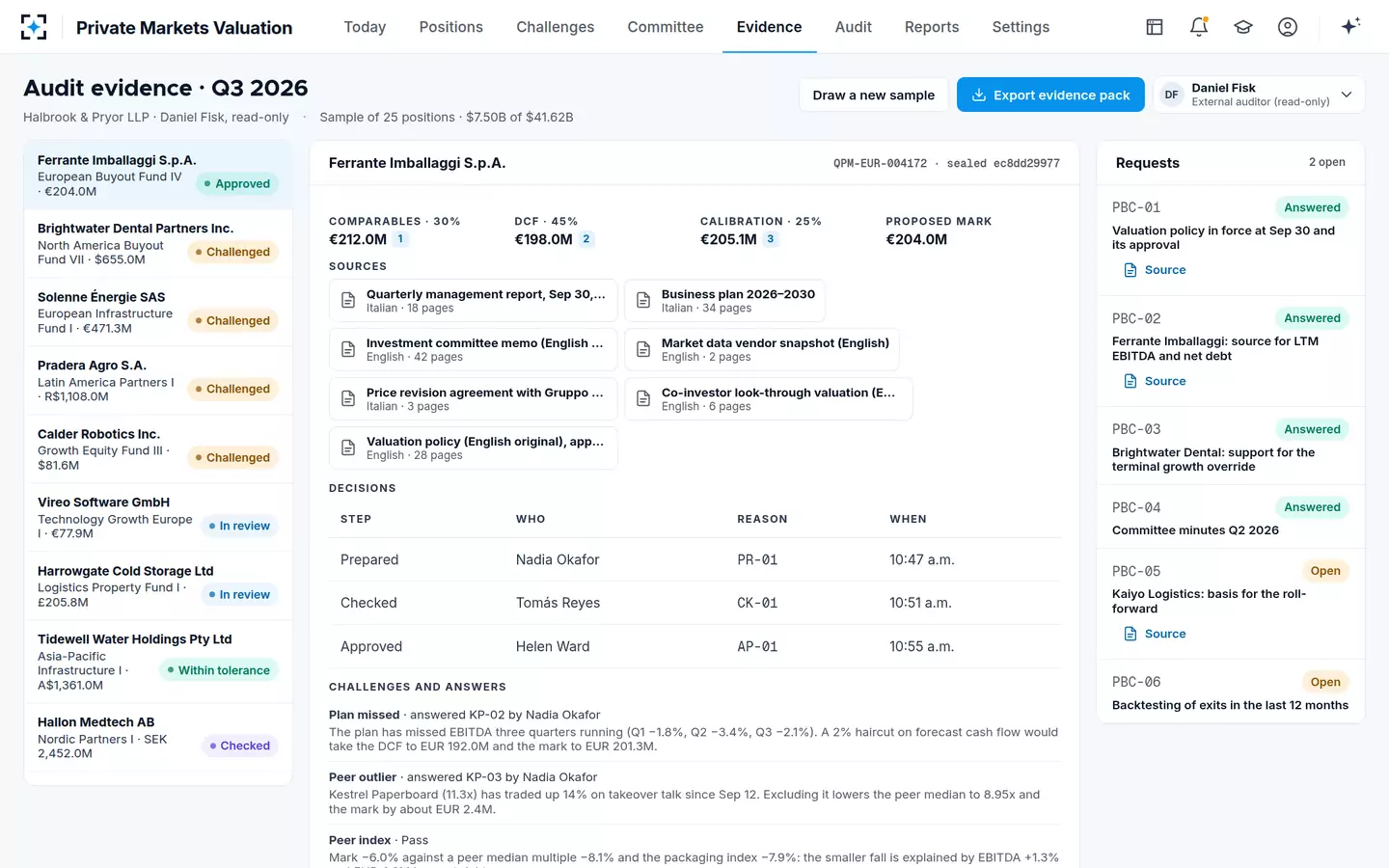
In Private Markets Valuation the backtest is an input to the next quarter, not a report for the drawer. The agent assigned to argue against each mark can cite the backtesting of exits alongside plan misses, peer index moves, co-investor marks and adviser ranges, and every challenge it raises needs a person's answer. In the sample quarter the external auditor had an open request for backtesting of the last twelve months' exits, the kind of question that should be answered from the same evidence rather than rebuilt.
Auditor evidence in Private Markets Valuation: a read-only sample, with a backtesting request open beside it
Questions people ask
What is the difference between backtesting and calibration?
Calibration ties a model to a transaction price at the start; backtesting compares the last mark with the price realised at the end. The SEC's Rule 2a-5 release names both as useful tests of fair value methods. Together they bracket a holding's life.
How many exits do you need for a meaningful backtest?
No regulator sets a number, and a single year's exits are usually too few to separate a method's bias from one company's luck. Pool several years, keep the grouping by technique, and treat a consistent direction across exits as the signal rather than any one gap.
Should a backtest use the mark before signing or before closing?
Before the sale process was known, as a rule fixed in the policy. Marks made after a signed offer are usually calibrated to the offer, so comparing them with the closing price tests almost nothing about the technique.
Is it bad if exits always beat the last mark?
It is a bias, even if investors welcome it. The FCA found investors often preferred an uplift on exit and warned that "exaggerating the stability of valuations" can obscure the true level of risk and the current value of investments.
Do auditors look at backtesting?
Yes. Firms told the FCA their auditors' discussions typically focused on "changes to key assumptions and backtesting results". A backtest that is documented, complete and taken to the committee answers that discussion before it starts.
Which valuation technique is most accurate for private equity?
None is reliably most accurate; the evidence is about bias by context, not a ranking of techniques. Buyout NAVs show little systematic bias on average in the research, while venture marks built on funding rounds tend to run high. A manager's own backtest, grouped by technique, is the only test that applies to its marks.