Private equity valuation guidelines come in three layers. The accounting standards (ASC 820 in the US, IFRS 13 elsewhere) define fair value as an exit price and say how to measure it. The law and the supervisors then say how the process must be run: EU and UK rules on frequency and functional independence, the SEC's anti-fraud and compliance-program rules and its examiners' findings, and since May 2026 Singapore's published expectations. On top sits an industry convention, the International Private Equity and Venture Capital Valuation (IPEV) Guidelines, which 70% of the UK firms the FCA surveyed said they follow but no regulator makes compulsory. The hard part is that the binding layer is scattered across jurisdictions and dates. Botminds' Private Markets Valuation exists to make a manager's own valuation policy, written to whichever of these apply, run the same way on every mark, with the evidence a supervisor asks for.
Several items are still moving, so each is dated where it appears. Examples of how a policy looks in the solution use fictional sample data.
What each regulator expects of a private equity mark, side by side
| Expectation | United States (SEC) | European Union (AIFMD) | United Kingdom (FCA) | Singapore (MAS) |
|---|---|---|---|---|
| Measurement basis | ASC 820 fair value (exit price) for GAAP statements | Law of the fund’s home state and its rules; IFRS 13 where applied | Accounting standards; FCA notes Level 3 inputs under IFRS 13 and ASC 820 | Fair value hierarchy; Level 3 for private equity and debt |
| Written policy | Compliance rule 206(4)-7: policies should include processes to value holdings and assess fees on them | Appropriate and consistent valuation procedures (Art. 19(1)) | FUND 3.9 and AIFMD Level 2 Art. 67: written, documented policies | Comprehensive policies covering every asset class held |
| Independence | No private-fund rule; Rule 2a-5 segregation applies only to registered funds and BDCs | External valuer, or in-house valuation functionally independent of portfolio management (Art. 19(4)) | Functional independence (FUND 3.9.7R); voting membership of committees questioned | Valuation overseen by people independent of portfolio management |
| Frequency | Set by fund documents; examiners test what was disclosed | At least once a year; more for open-ended funds (Art. 19(3)) | NAV at least yearly for full-scope AIFMs; quarterly in practice | Policies set frequency and ad hoc triggers |
| Status today | Staff views and enforcement; 2023 private fund rules vacated | In force; unchanged by AIFMD II | In force; new regime under consultation | Supervisory expectations (May 2026) |
What are the private equity valuation guidelines?
They are the fair value standards plus the regulators' rules and published findings on how marks must be made, governed and disclosed. The standards set the target. IFRS 13 defines fair value as an exit price: what the holder would receive for the asset in an orderly sale between market participants on the measurement date (IFRS Foundation), and the SEC has quoted ASC 820's equivalent definition in its own enforcement orders (SEC order IA-6315, 2023).
Everything else in this guide is about process: who values, how often, how independently, and with what record. That is where the regulators differ and where they agree, and it is also where the findings against managers come from. A valuation can apply the standard correctly and still fail a supervisor's test because no one can show how it was reached.
Are industry valuation guidelines mandatory?
No. Industry guidelines are a convention, widely followed and useful for consistency, but no regulator in this guide makes them compulsory. The FCA found that "70% of firms reported adhering to the International Private Equity and Venture Capital Valuation (IPEV) Guidelines" in its 2025 questionnaire, and its expectation was framed as a suggestion (FCA, Private market valuation practices, March 2025):
Where relevant, firms should consider using industry guidelines to ensure their approach is in line with standard market practice. Firms should also consider whether they should apply secondary methodologies to corroborate their judgement.
FCA, Private market valuation practices, multi-firm review, March 5, 2025
Singapore's regulator said the same in different words: managers "should also consider guidance from international standards setting bodies, such as International Organization of Securities Commissions (IOSCO), and industry bodies, where relevant" (MAS, Valuation Practices for Fund Management Companies, May 29, 2026). The practical consequence is that a policy may adopt a convention, but it is judged against the standard and the regulator, and a finding is never answered by citing the convention.
What binds a private equity mark, and what only informs it
Binding: ASC 820 and IFRS 13, through the fund’s financial statements and its documents.
Informing: Industry guidelines’ interpretations of how to apply them to private companies.
Binding: AIFMD Article 19 and UK FUND 3.9; the SEC compliance and anti-fraud rules; the fund’s own disclosed policy.
Informing: Supervisors’ published findings and good practice (FCA 2025, MAS 2026).
Binding: Whether the manager valued as it told investors it would, and charged fees on those values correctly.
Informing: SEC examination priorities and staff statements, which say they are not rules but show where reviews go.
Binding: The SEC’s 2023 private fund adviser rules were vacated in 2024; none of them applies.
Informing: Commentary written before the vacatur that assumes they do.
What does the SEC require for private fund valuation?
The SEC has no valuation rule for private funds; it relies on the adviser's fiduciary duty, the anti-fraud rule for pooled vehicles and the compliance-program rule, enforced through examinations and settled orders. The compliance rule is where valuation lands. In its 2023 order against Sciens Investment Management, the Commission repeated what it had said since 2003: that an adviser's policies and procedures, "at a minimum", "should include processes to value client holdings and assess fees based on those valuations" (SEC order IA-6315, May 24, 2023). Sciens agreed, without admitting or denying the findings, to a $275,000 penalty for policies that named no method for its Level 3 assets.
Examiners test whether the manager did what it said. The 2020 risk alert on private funds reported advisers that valued client assets neither as their own valuation processes said nor as they had told clients, for example by promising GAAP values and not delivering them (SEC Division of Examinations risk alert, June 23, 2020). The fiscal 2027 priorities, announced October 23, 2026, say reviews will consider whether advisers "assessed the reasonableness of their valuation processes and methodologies" (SEC, Examination Priorities, fiscal year 2027). Both are staff documents, not rules.
One body of rules does not apply. The SEC's 2023 private fund adviser rules (quarterly statements, mandatory audits, adviser-led secondaries and the rest) were vacated by the Fifth Circuit on June 5, 2024, which held that "no part of it can stand" (National Association of Private Fund Managers v. SEC), and the text was removed from the Code of Federal Regulations in November 2024 (89 FR 91252). Any guideline that relies on them is out of date.
Does Rule 2a-5 apply to private funds?
No. Rule 2a-5 governs registered investment companies and business development companies; the rule defines "fund" as "a registered investment company or business development company" (17 CFR 270.2a-5(e)(1)). It is still worth reading for a private equity manager for two reasons. Many managers run interval funds, tender-offer funds or BDCs that hold the same assets as their private funds. And its four required functions (assess valuation risks, establish and apply methods, test them, oversee pricing services) are the most precise statement any US regulator has made of what a fair value process does.
The SEC staff's September 2026 statement sits between the two worlds. It names "registered closed-end funds, interval funds, tender offer funds, business development companies" among the vehicles holding private assets, rests on ASC 820, and asks for calibration to the transaction price and for disclosure that avoids "“boilerplate” language" (SEC staff statement, September 28, 2026). A private fund reporting under US GAAP applies the same standard. The rule and its valuation designee have their own guide, the valuation designee under Rule 2a-5, and calibration has a guide of its own.
What did the FCA find on private market valuations?
The FCA found the basics in place and the harder controls patchy: committees almost everywhere, but conflicts beyond fees only "partly identified and documented", uneven independence, and ad hoc valuation processes that many firms had not defined. The review covered 36 firms with around £3 trillion of global private assets under management, across private equity, venture capital, private debt and infrastructure (FCA).
Four expectations close the review: better governance of the process, conflicts identified and documented, functional independence, and "defined processes for ad hoc valuations". The FCA tested all firms against its Principles for Businesses, and UK AIFMs also against FUND 3.9 and Articles 67 to 74 of the AIFMD Level 2 Regulation. It said it would follow up with outlier firms, and that it would use the findings as it reviews the UK's inherited AIFMD law. That review is now a consultation: on July 14, 2026 the FCA proposed a new UK AIFM regime, with implementation "currently envisaged" for 2028 (FCA CP26/28). Until then FUND 3.9 applies.
How often must an AIF value its assets?
At least once a year under EU law, and more often for open-ended funds and on capital changes. Article 19 of the AIFM Directive requires that "the assets are valued and the net asset value per unit or share is calculated at least once a year"; open-ended funds must value at a frequency "appropriate to the assets held by the AIF and its issuance and redemption frequency", and closed-ended funds also "in case of an increase or decrease of the capital" (Directive 2011/61/EU, Article 19(3)).
The same article sets independence: the valuation is done either by an external valuer or by the manager itself, provided the valuation task is kept functionally separate from portfolio management and from the pay policy, as valuation committee terms of reference put into practice. It also keeps responsibility with the manager even when an external valuer is used: the AIFM's "liability towards the AIF and its investors shall, therefore, not be affected by the fact that the AIFM has appointed an external valuer". AIFMD II (Directive (EU) 2024/927), which member states apply from April 16, 2026, amends delegation, liquidity management, reporting, depositary rules and loan origination; it does not amend Article 19.
The private equity valuation guidelines that matter, in date order
8 Jun 2011EU
AIFM Directive 2011/61/EU adopted. Article 19 sets valuation frequency and independence for EU fund managers.
In force
23 Jun 2020US
SEC exam staff risk alert on private funds names valuation among its findings.
Staff views
8 Mar 2021US
Rule 2a-5 on fair value takes effect for registered funds and BDCs, not private funds.
In force
5 Jun 2024US
Fifth Circuit vacates the SEC’s 2023 private fund adviser rules in full; removed from the CFR in November 2024.
Vacated
5 Mar 2025UK
FCA publishes its multi-firm review of private market valuation practices.
Supervisory findings
16 Apr 2026EU
AIFMD II applies; it amends delegation, liquidity, reporting and loan origination, and leaves Article 19 as it was.
In force
29 May 2026Singapore
MAS publishes its information paper on valuation practices for fund managers.
Supervisory expectations
14 Jul 2026UK
FCA consults on a new UK AIFM regime; implementation is envisaged for 2028.
Consultation
28 Sep 2026US
SEC staff statement on fair value measurement and disclosure for private assets.
Staff views
23 Oct 2026US
SEC fiscal 2027 examination priorities: advisers’ valuation processes and methodologies.
Staff views
What does MAS expect on fund valuation?
Singapore's regulator expects independent valuation under governance that a board can see, with written policies, price checks and documented fair value assessments. Its May 2026 paper draws on thematic inspections of managers running "equity funds, fixed income funds, hedge funds, private credit funds, and fund-of-funds", some carried out by external auditors it appointed (MAS).
For private equity and private credit its findings are pointed. It observes that, given "the complexity and subjectivity of Level 3 assets, such as private equity and private credit, portfolio managers were often involved in the valuation process", and that some managers answered the conflict by engaging external valuers or obtaining a "negative assurance opinion". Among its failures: a private credit manager that reclassified restructured non-performing loans as performing, overstating the fund's NAV and overcharging fees it later had to refund; and several managers that did not test portfolio companies' figures despite gaps between audited and unaudited accounts. It expects managers to diligence every valuation model they use, built in-house or bought, which covers software as much as spreadsheets.
Where the rulebooks agree: a common core for a valuation policy
Across the US, the EU, the UK and Singapore, seven expectations recur, and a policy that meets them will be close to compliant anywhere. They are also the parts of a policy that software can enforce rather than merely describe.
Seven expectations every regulator in this guide shares
- A written policy that names the methods and inputs
Per asset type, with the reasons for each method; Sciens was sanctioned for a policy that named none.
- Valuation independent of portfolio management
AIFMD Article 19(4), FUND 3.9.7R, MAS governance, and Rule 2a-5’s segregation for registered funds.
- A body that approves, with a record
Committee minutes that show how each material decision was reached.
- Conflicts identified beyond fees
Transfers, dealing, marketing, borrowing and smoothing, per the FCA’s list.
- A defined frequency and out-of-cycle triggers
At least annual in EU law; quarterly in practice; named events in between.
- Methods tested
Calibration to transactions and backtesting against exits, which the SEC and the FCA both describe.
- Valuation as disclosed, fees on those values
The SEC’s exam findings start with marks and fees that did not follow the fund’s own documents.
How Private Markets Valuation maps to these guidelines
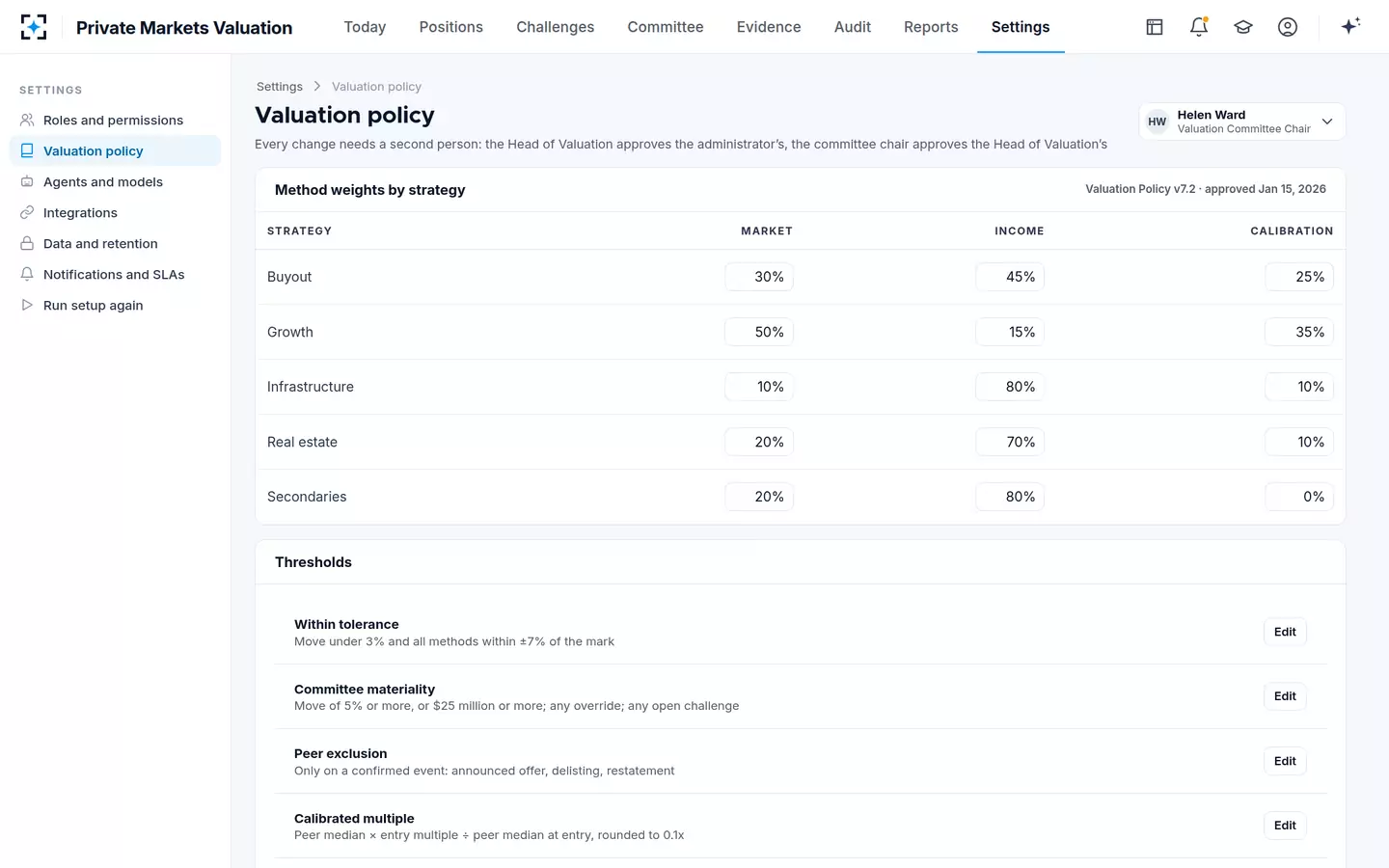
The solution does not choose a regime; it runs the manager's own valuation policy and records that it was run. Method weights, tolerances and committee materiality are settings in a versioned policy, and every change needs a second person. Agents compute every method for every position with each input cited to its page, so "methods named and applied consistently" is a property of the system rather than a statement in a manual. The analyst prepares, the head of portfolio valuation checks and the committee approves; no one may check or approve a mark they prepared, and the deal team can add information but never edit a mark.
A valuation policy as versioned settings in Private Markets Valuation: method weights by strategy and the committee's thresholds
What it does not do matters as much. It does not replace an external valuer under AIFMD, sign a fairness opinion, or decide which accounting standard a fund follows. It does not make a registered fund's board or valuation designee compliant with Rule 2a-5 on its own; it supplies the testing evidence and the trail. Its role is the evidence regulators ask for: methods, inputs, challenges, decisions and who made them. For the price of getting that wrong, see what a wrong mark costs.
Questions people ask
Are the IPEV guidelines a regulatory requirement?
No. They are an industry convention; the FCA found 70% of the firms it surveyed in 2025 adhered to them and suggested firms "consider using industry guidelines". Regulators judge marks against the accounting standard and their own rules.
Are the SEC private fund adviser rules in force?
No. The Fifth Circuit vacated the 2023 rules in full on June 5, 2024, and the SEC removed them from the Code of Federal Regulations that November. Private fund valuation in the US rests on fiduciary duty, the anti-fraud rule for pooled vehicles and the compliance-program rule.
What does ASC 820 require for private equity?
A fair value at each measurement date equal to the exit price a market participant would pay, using techniques that maximise observable inputs. Most private equity holdings are Level 3 because their key inputs are unobservable, which brings extra disclosure. The SEC staff asked in 2026 for disclosures tailored to each fund rather than boilerplate.
Does the FCA require an external valuer?
Only where a full-scope UK AIFM does not perform the valuation itself; otherwise the in-house valuation must be functionally independent. The FCA found formal external valuers "rare", with many firms using third-party advisers while keeping responsibility.
How often must private equity funds be valued in the UK?
Full-scope UK AIFMs must calculate the NAV at least once a year and whenever units are issued or redeemed, under the onshored AIFMD Level 2 rules the FCA cited. In practice the FCA found managers value quarterly.
Do Singapore's valuation expectations apply to private equity?
Yes, where the manager is MAS-licensed: the May 2026 paper covers valuation of all funds' assets and names private equity and private credit as Level 3 assets needing independent oversight. It is framed as supervisory expectations, to be applied proportionately to a manager's size and complexity.