Calibration in valuation is the practice of setting a valuation model's unobservable inputs so that, at the date of a transaction, the model returns the transaction price, and then carrying those settings forward so that later changes in fair value come from changes in market data or in the company, not from a quietly different model. For a private equity or private credit holding, the transaction is usually the fund's own purchase, a later funding round or a partial sale. Calibration matters because a Level 3 mark has no market price to check against; the price actually paid is the one hard observation a valuation team will ever have, and every quarter that passes makes it easier to drift from. Botminds' Private Markets Valuation gives calibration its own agent and its own weight in every mark, so the link to the entry price is computed, cited and visible to the people who sign.
calibrate the valuation technique so that, at initial recognition, the result of the valuation technique equals the transaction price.
SEC staff statement on fair value measurement and disclosure considerations for private assets, Kurt Hohl and Brian Daly, September 28, 2026
That sentence comes from a statement by the SEC's Chief Accountant and the Director of its Division of Investment Management. It is a staff view: the statement says of itself that "It is not a rule, regulation, or statement of the Commission." It is still the clearest recent signal of what examiners and auditors will look for, and it adds two expectations beyond the day of the deal. "Subsequent changes in fair value should be driven by changes in the assumptions or valuation techniques," the staff write, and they look for "robust calibration practices, including periodic reassessment of whether model outputs remain consistent".
What is calibration in valuation, in the standards' own words?
Calibration is written into the fair value standard, not invented by examiners. ASC 820's paragraph on it, as the SEC quoted it in a 2023 enforcement order, reads: "After initial recognition, when measuring fair value using a valuation technique or techniques that use unobservable inputs, a reporting entity shall ensure that those valuation techniques reflect observable market data (for example, the price for a similar asset or liability) at the measurement date" (SEC order, In re Sciens Investment Management, 2023, quoting ASC 820-10-35-24C).
The SEC used a narrower, testable definition when it adopted Rule 2a-5 for registered funds in 2020. There, calibration "is the process for monitoring and evaluating whether there are material differences between the actual price the fund paid to acquire portfolio holdings that received a fair value under the Act and the prices calculated for those holdings by the fund's fair value methodology at the time of acquisition" (Good Faith Determinations of Fair Value, 86 FR 748, January 6, 2021). Rule 2a-5 governs registered funds and business development companies, not private funds, but its definition is the plainest statement of the idea: run your model on the day you bought, and see whether it gives you the price you paid.
The two definitions describe two uses. The first is a starting point: the model is set up so that it reproduces the price. The second is a test: if the model, run on the purchase date, does not reproduce the price, something in the model is wrong or the price was not a fair value. A good valuation policy uses both.
Calibration to the transaction price, step by step
Calibration to the transaction price works in three steps: find what the price implies about the unobservable input, hold that implied input, and roll it forward with observable data. In a multiple-based mark the unobservable input is usually the discount or premium to listed peers; in a DCF it is often a company-specific risk premium.
Take a fictional sample holding from the solution's sample quarter: Quillfield European Buyout Fund IV bought 89.5% of Ferrante Imballaggi, an Italian packaging company, in March 2024 at 10.95 times EBITDA, when its listed peers traded at a median of 11.2 times. At September 30, 2026 the peers trade at 9.1 times. The EBITDA under an entry multiple matters as much as the multiple, and it should be the buyer's diligence-adjusted figure rather than management's, which is why the add-backs that survive a buyer's test also decide where calibration starts.
Calibration in Private Markets Valuation: from the price paid to this quarter's calibrated value
Agent
Read the transactionThe Calibration agent reads the entry memo: 10.95x paid in March 2024 against a peer median of 11.2x, with the page cited.
Agent
Imply the input10.95 ÷ 11.2 = 0.978: the buyer paid a 2.2% discount to peers. That discount is the calibrated input.
Agent
Roll it forwardToday’s peer median 9.1x × 0.978 = 8.9x; × EUR 38.4M EBITDA, less EUR 112.6M net debt, × 89.5% = EUR 205.1M.
Never: taking a recent round or entry price as fair value without this step
A person decides
Judge the discountThe analyst decides whether a 2.2% discount still describes Ferrante against its peers, and says why if not.
A person decides
Check and approveThe head of portfolio valuation checks the reasoning; a move of 5% or more goes to the valuation committee.
The arithmetic is simple; the judgement in step four is not. Holding the entry discount assumes the company's standing against its peers has not changed. If Ferrante has since won share and its margins have widened, the discount may have shrunk or turned into a premium; if it has missed its plan for three quarters, as it has in the sample, the discount may have grown. The FCA saw exactly this in its review of UK managers: "We often saw significant changes in how they applied a discount, or premium, to a multiple. Firms calibrated this at acquisition, and then adjusted based on the similarity of the comparable set" (FCA, Private market valuation practices, March 2025). Each such adjustment is a decision, and it should carry a reason a reviewer can test.
What did the SEC say about private asset valuation in 2026?
On September 28, 2026 the SEC staff told managers that calibration, input disclosure and reassessment are where they expect rigour, because private assets now sit in funds sold to a wider public. The statement observes that "private credit investment within registered fund portfolios has grown nearly 60%, from $170 billion in December 2020 to $270 billion in December 2025" (SEC staff statement, September 28, 2026).
It treats the price paid as the anchor. In the staff's words, "an investment's transaction price, when it represents fair value, provides a critical reference point for management's future measurements", and calibration "facilitates an evaluation of any difference between the transaction price and the model's indication of fair value". For the quarters that follow, it describes reassessment against "comparable transactions, public market equivalents, secondary market indications, or relevant credit indices".
On disclosure, the staff ask managers to explain significant inputs, "such as discount rates, credit spreads, or comparable transaction data", and to say how changes in them might produce "a significantly different fair value at the reporting date"; they criticise disclosures that are not tailored and "use “boilerplate” language". Three weeks later the Director of Investment Management told a Stanford roundtable that sound fair value processes will stay both an expectation and an examination focus, because those values drive fund management and performance fees (Brian Daly, remarks, October 16, 2026); the valuation process at quarter end shows where that bites.
Is a recent funding round fair value?
Not by itself. A funding round prices the newest class of shares, with whatever protections the new investors negotiated, and those protections are worth something that older and common shares do not have. A round is a transaction to calibrate to, class by class, not a mark to copy across the cap table.
Gornall and Strebulaev measured the gap on 135 US venture-backed companies with reported valuations above $1 billion. Valuing each share class from the terms in legal filings, they found the "reported unicorn post-money valuation average 50% above fair value", because "Reported valuations assume all shares are as valuable as the most recently issued preferred shares" (Journal of Financial Economics, 2020).
Why a headline round price overstates what older shares are worth
50%
average amount by which reported post-money valuations exceeded fair value, across 135 US unicorns
58%
overvaluation of common shares, which lack the newest investors’ protections
65of 135
companies that fell below a $1 billion value once the protective terms were priced
The practical rule follows. When a portfolio company raises a round, the valuation team should read the new class's rights (liquidation preference, seniority, conversion terms), value the class the fund actually holds, and calibrate to that. In the sample quarter the Calibration agent read the share-class rights for 19 growth-company rounds before using any of them. The FCA found venture managers "typically used the last available transaction price, typically from recent funding rounds, as the basis for valuation" until companies reached revenue (FCA): a reasonable start, provided the price is adjusted for the class held.
Calibrated and uncalibrated marks side by side
The difference shows less on the day of the deal than four quarters later, when a reviewer asks why the mark moved. An uncalibrated model can produce a defensible-looking number at every date while its starting point was never tied to anything real.
What calibration changes in a quarterly mark
Model not calibrated: The model gives a value that may differ from the price paid; nobody measures the gap.
Model calibrated to the transaction price: The model is set so it returns the price paid; any gap that remains is investigated before the first quarter end.
Model not calibrated: Changes in data, plus unexplained changes in the model’s own assumptions.
Model calibrated to the transaction price: Changes in peer multiples, earnings, net debt and rates, each traceable; a change in the calibrated input needs a reason.
Model not calibrated: Whether the arithmetic is right.
Model calibrated to the transaction price: Whether the input implied by the deal still holds, against peers, later rounds and secondary indications.
Model not calibrated: The round price is often copied across, or ignored.
Model calibrated to the transaction price: The model is recalibrated to the new transaction, class by class, and the change is explained.
Model not calibrated: Generic wording about “market participant assumptions”.
Model calibrated to the transaction price: The significant inputs and what moving them would do, which is what the SEC staff asked for in 2026.
Calibration as a test, not only a starting point
Calibration also tests the method itself. Run on the purchase date, a method that cannot reproduce the price paid is telling the team something about its peer set, its discount rate or the deal. When it adopted Rule 2a-5, the SEC called "calibration and back-testing" "particularly useful testing methods to identify trends in certain circumstances", and added that a method which keeps landing above or below the prices of real transactions should be investigated by the board or valuation designee (86 FR 748).
The same release stopped short of a mandate: "the final rule does not require calibration and back-testing", nor does it stop funds from using other appropriate tests. For private funds there is no equivalent rule at all, which leaves calibration where ASC 820 puts it and where the staff statement now points. Backtesting, the mirror image that compares the exit price with the last mark, is covered in private equity valuation techniques, tested against the exit price.
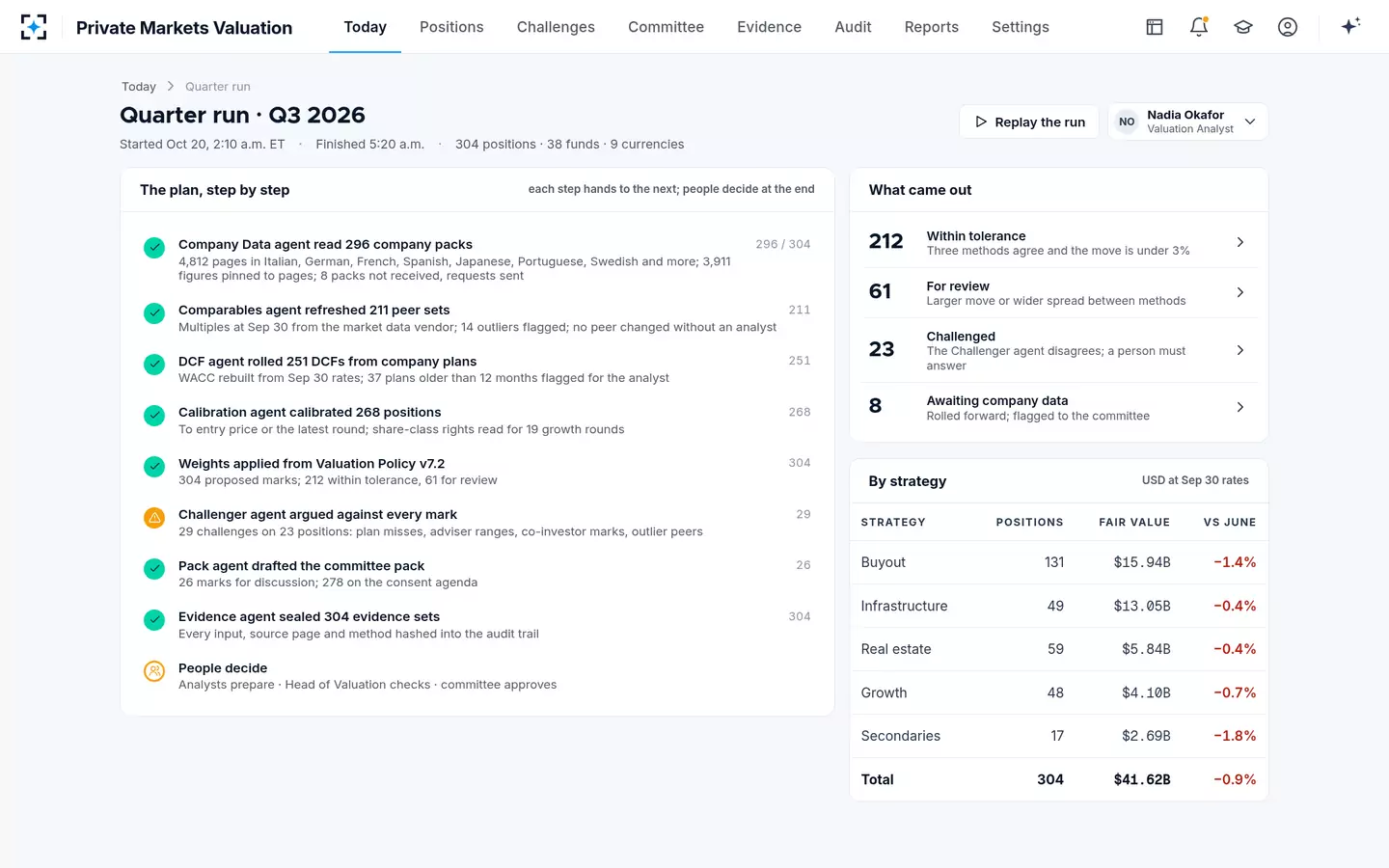
Private Markets Valuation's quarter run: 268 positions calibrated, with share-class rights read before any round was used
When to recalibrate
Recalibrate whenever a new, relevant transaction happens: a follow-on round, a partial sale, a secondary trade in the fund's own interest, a binding offer, or a refinancing that reprices the debt. Each is fresh evidence of what a buyer pays, and an old calibration that contradicts it is stale.
The sample quarter has examples of each kind of event. One growth company's calibration was moved to a term sheet dated October 6, as an override with its own reason code. Another holding in the buyout fund was flagged by the agent assigned to argue against marks, with a challenge named "stale calibration" that a person had to answer before the mark could be prepared. The rule the sample policy follows is that a calibration is only as current as the transaction behind it, and the policy names which events reset it.
Events that should reset a calibration, and what to calibrate to
| Event | Calibrate to | Watch for |
|---|---|---|
| Follow-on funding round | The price of the class the fund holds, derived from the round | Liquidation preferences and seniority that make the new class worth more than older ones |
| Partial sale or secondary trade | The traded price, adjusted for size and terms | Forced or related-party sales, which may not be fair value |
| Binding offer for the company | The offer, discounted for the chance and timing of completion | Press talk and rumoured approaches are not offers |
| Refinancing | The new debt pricing, for the income method’s discount rate | Fees and covenants that change the effective cost |
| No transaction for several quarters | Keep the entry calibration, but test it against peers and secondary indications | A growing gap between the calibrated result and the market method |
What is the NAV practical expedient, and how is it different?
The NAV practical expedient lets an investor in another fund measure that holding at the net asset value the underlying manager reports, instead of building its own fair value. It is a measurement shortcut, not calibration, and the SEC staff were blunt about its limits: it is "a practical expedient that permits management to estimate the fair value of an investment in another entity using NAV", but "utilizing NAV as a practical expedient may result in a measurement that differs from the fair value", and "its application is optional on an investment-by-investment basis" (SEC staff statement).
For a fund of funds or a secondaries vehicle that means a choice for each holding: take the manager's NAV, or value the interest as a buyer would, which may mean calibrating to the secondary price paid. The sample policy's secondaries weighting (secondary bids 20%, adjusted NAV 80%, calibration 0%) is one answer; a policy that never asks the question is not.
Why calibration matters more as Level 3 holdings grow
Calibration matters most where unobservable inputs dominate, and that is a growing part of funds sold to the public. The SEC staff note that private assets in registered funds are "typically categorized as Level 3 within the fair value hierarchy". The staff's own fund statistics show where: in registered closed-end funds, Level 3 holdings in multi-asset funds rose from $40 billion in April 2025 to $60 billion in March 2026, and in taxable bond funds from $85 billion to $100 billion (SEC Division of Investment Management, Registered Fund Statistics, period ending March 2026).
Those are registered funds valued under Rule 2a-5, a regime with its own guide to the valuation designee under Rule 2a-5. But the marks often come from the same managers and the same models as their private funds. A calibration discipline that holds in one should hold in the other. How the three methods, calibration among them, are combined into one mark is worked through in private equity valuation methods, worked on one company's mark.
Questions people ask
What is calibration to the transaction price?
It means setting the model's unobservable inputs so that, on the transaction date, the model returns the price actually paid. The SEC staff put it as calibrating the valuation technique so that "at initial recognition, the result of the valuation technique equals the transaction price". Later marks then move only as the inputs move.
Is calibration required under ASC 820?
ASC 820 requires that, when unobservable inputs are used, the technique reflects observable market data at each measurement date, and the SEC cited "the calibration requirement in ASC 820" in its 2023 Sciens order. For registered funds, the Rule 2a-5 adopting release recommends calibration as a test of methodologies but does not require it.
What is the difference between calibration and backtesting?
Calibration looks forward from the purchase price: does the model reproduce what was paid, and does it stay consistent with market evidence? Backtesting looks back from the sale: how close was the last mark to the price received at exit? The Rule 2a-5 release names both as useful tests.
How often should a valuation be recalibrated?
Whenever a new relevant transaction happens, such as a round, partial sale, secondary trade or binding offer; otherwise, reassess it every quarter against peers and secondary indications. The SEC staff asked in 2026 for "periodic reassessment of whether model outputs remain consistent".
Can the entry price be the fair value for long?
Only while nothing material has changed, and a team should show that each quarter. Holding a cost or entry price for many quarters stops being an exit price at the measurement date; calibration keeps the entry price's information while letting the market move the mark.
Does calibration apply to private credit?
Yes: the calibrated input is usually the spread or yield implied by the loan's issue price, rolled forward with credit indices. The SEC staff named "relevant credit indices" as reassessment evidence. Private loans have their own guide to private credit valuation methods.