EBITDA add-back examples fall into a handful of families: owner and family compensation above market, litigation settlements and legal fees for a specific dispute, restructuring and severance, system implementations, relocations, bad debts from a single customer failure, transaction costs, and pro forma items such as savings from a headcount cut or a new contract's run-rate. Whether any of them survives a buyer's quality of earnings test depends less on its family than on its evidence: is every general-ledger entry behind it vouched, does the cost really not recur, is it historical rather than hoped-for, and has a person signed the ruling with a reason. Botminds' Quality of Earnings Analysis scores each add-back on those tests, and the examples below are the rulings it produced on one sample deal.
The sample is fictional: Project Lantern, Quillfield Capital Partners IV's purchase of Halvorsen Industrial Services, whose management claims fourteen add-backs worth $11.0 million on reported LTM EBITDA of $18.19 million. Rules and research are quoted from the SEC and peer-reviewed journals, linked where they appear. How to calculate the bridge from reported to adjusted EBITDA is worked in how EBITDA add-backs are calculated, from a lender's side; this page is about which add-backs hold up.
Fourteen add-backs claimed; less than half of their value survived
$11.0M
of add-backs claimed by management on the sample deal
sample deal
$5.78M
accepted or allowed after testing, including four small ones still awaiting signature
sample deal
$5.22M
rejected or cut back: recurring, pro forma or above the evidence
sample deal
3
add-backs ruled recurring or pro forma took $3.91M off EBITDA between them
sample deal
What are EBITDA add-backs?
An EBITDA add-back is an expense, already in reported earnings, that the seller says a buyer will not bear in future and should therefore be removed before the multiple is applied. Each one raises adjusted EBITDA, and at a 10x multiple each $100,000 of add-backs is $1 million of price. In the SEC's terms the result is a non-GAAP measure, and the agency's staff have said where the line sits for public companies: a non-GAAP measure that strips out the normal, recurring cash costs of running the business can mislead (SEC non-GAAP C&DI 100.01).
The same interpretation, updated in December 2022, defines recurring broadly: an expense that comes back, even occasionally or at irregular intervals, is recurring, a test the recurrence test applies line by line. A private target is not bound by SEC guidance, but no buyer should accept a looser test than the regulator applies to listed companies. The rule behind it, Item 10(e) of Regulation S-K, bars labelling an item non-recurring when a similar charge occurred "within the prior two years" or is "reasonably likely to recur within two years" (17 CFR 229.10(e)).
Common EBITDA add-back examples, scored
The table scores the add-backs that come up most often, using the sample deal's rulings where it has one. The reason code is the one the QoE lead signed; the test is the one that decided it.
EBITDA add-back examples and the test that decided each
| Add-back | Claimed → allowed | Test that decided it | Ruling |
|---|---|---|---|
| Founder CEO pay above market | $1,150K → $820K | Market rate for a replacement CEO, from compensation benchmark data | Adjusted · market-rate normalization |
| Founder's family on payroll | $310K → $310K | Accepted on payroll evidence, two sources | Accepted |
| Litigation settlement, one supplier dispute | $950K → $950K | One settled dispute, vouched to three sources | Accepted |
| ERP implementation | $720K → $540K | Allowed to the amount the ERP invoices support | Adjusted to evidence |
| Plant relocation | $1,340K → $1,100K | Allowed to the amount the lease and invoices support | Adjusted to evidence |
| "One-time" strategic consulting | $1,800K → $0 | Same vendor billed every quarter for 11 quarters; contract renews | Rejected · recurring |
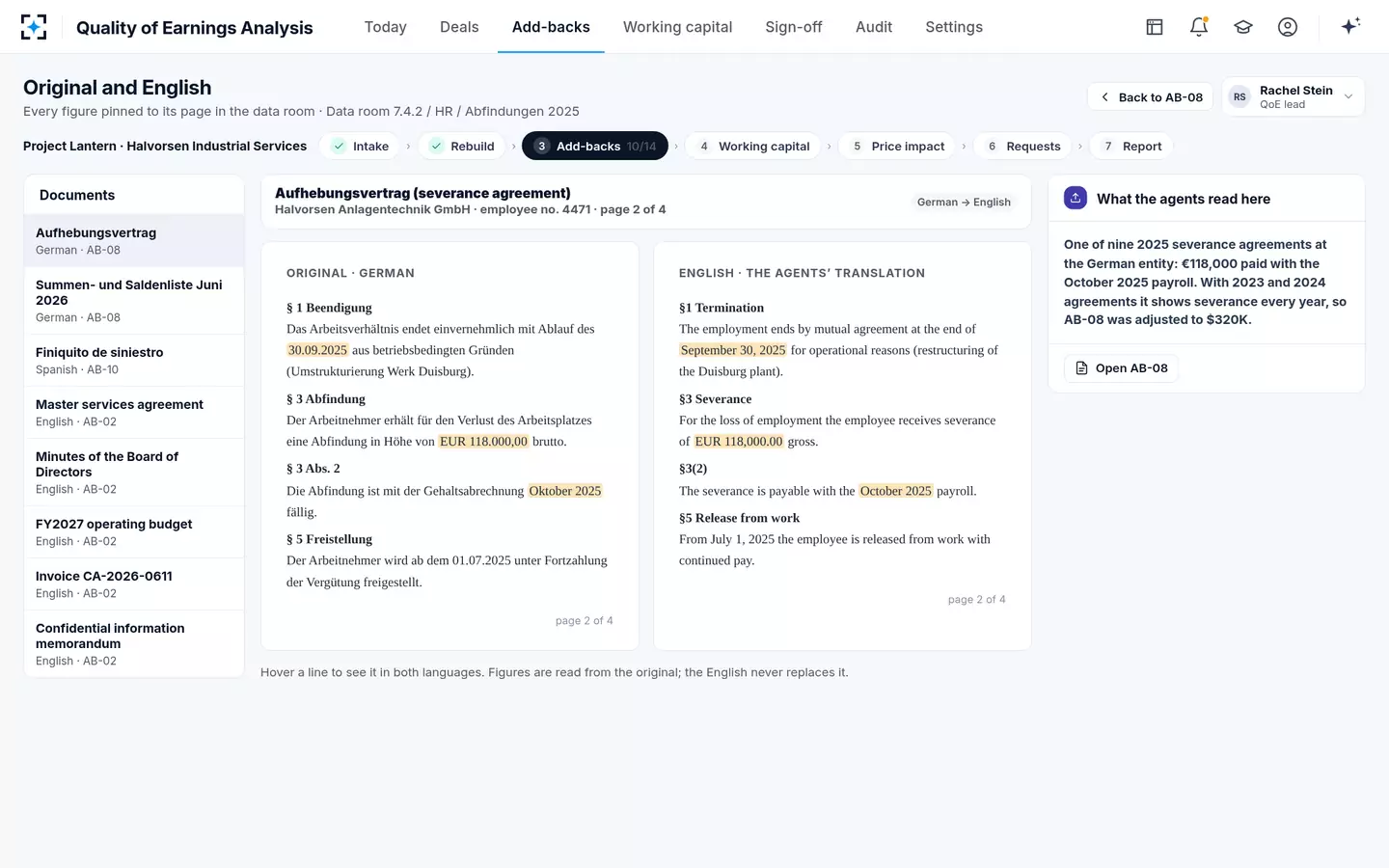
| Severance, 2025 restructuring (Germany) | $640K → $320K | Severance paid every year; only the excess over the normal level is one-time | Adjusted · normal level kept |
| Planned headcount reduction | $1,250K → $0 | Roles ended after the LTM: a real saving, but pro forma | Rejected · pro forma, not historical |
| New contract run-rate | $860K → $0 | Earnings not yet in the period | Rejected · pro forma, not historical |
| Trade shows | rejected | Held every spring | Rejected · recurring |
| Bad debt from one customer's bankruptcy | proposed accepted | One customer failure, vouched | Accepted, awaiting signature |
Three patterns stand out; what each is worth at a 10x multiple is the arithmetic in what a quality of earnings report costs. Every add-back that failed did so on recurrence or timing, not on arithmetic: the invoices were real. Every adjustment between zero and the full claim kept a normal level of a cost that the business will keep paying. And the two pro forma items, the headcount cut and the new contract, were not dismissed: they moved from the historical bridge to the buyer's model as run-rate items, where they belong.
What each ruling took off adjusted EBITDA
Is owner salary an add-back?
Only the part above what the business would pay someone else to do the job. A founder who pays herself $1.5 million to run a company that a hired CEO would run for $500,000 has $1 million of genuine add-back; a founder who pays herself $150,000 has a negative one, because the buyer will have to pay more. The test is a market rate for the role, documented, not the seller's view of it.
On the sample deal management claimed $1,150,000 for the founder CEO's pay above market. The agents ruled it against compensation benchmark data and allowed $820,000, a market-rate normalization signed under its own reason code. The SBA's 2026 rule for acquisition loans names the same item, requiring QoE reports to document "above- or below-market owner compensation" (SBA SOP 50 10 8.1); the "below" matters as much as the "above".
Family members on the payroll are the same test from the other side. If they do not work in the business, their pay and the payroll taxes on it are an add-back; if they do, the question is again whether they are paid at market. On the sample deal $310,000 for the founder's family members was accepted on two sources of payroll evidence.
Are one-time legal fees and settlements an add-back?
A settlement of a single, closed dispute usually is; a legal budget usually is not. The sample deal's $950,000 settlement of one dispute with a supplier, Ridgeline Supply, was accepted in full on three sources. Legal fees are harder, because most businesses have some every year. The add-back is the excess over the normal level, measured across the period, attributable to a dispute that has ended.
The SEC staff's December 2022 wording is the right test: an expense that "occurs repeatedly or occasionally, including at irregular intervals" is recurring (C&DI 100.01). A company that settles a different supplier dispute every eighteen months has a recurring cost of doing business, however unique each dispute looks.
Does EBITDA add back payroll taxes?
No, not as such. The taxes in EBITDA are income taxes; the SEC staff note that the release they rely on describes EBITDA as "earnings before interest, taxes, depreciation and amortization," with earnings meaning net income under GAAP (C&DI 103.01). Employer payroll taxes are part of the cost of employing people and stay in EBITDA.
They come out only alongside an add-back they belong to. If the buyer accepts $820,000 of excess founder pay, the employer taxes and benefits on that $820,000 go with it; if a family member's salary is added back, so are the payroll taxes on it. A schedule that adds back the salary but leaves the taxes in, or adds back taxes on pay that stays, is wrong in the same direction every time.
What add-backs do buyers reject?
Buyers reject four kinds, and the sample deal has an example of each. Costs that recur under a one-time label, like the consulting contract billed in eleven straight quarters. Savings that have not happened yet, like the headcount reduction and the new contract's run-rate. Normal levels of a cost that the business always incurs, like the base level of German severance, paid in 2023, 2024 and 2025. And claims the evidence does not support in full, like the portions of the ERP and relocation add-backs that the invoices and lease did not cover.
Pro forma savings deserve a separate word, because they are often real. When roles are eliminated after the period, the saving will show up in future earnings, and the seller is right that the buyer will benefit. The SEC's own rules for pro forma statements keep such items apart: "Management's Adjustments depicting synergies and dis-synergies" may be shown only under conditions that begin: "There is a reasonable basis for each such adjustment" (17 CFR 210.11-02(a)(7)). A buyer's QoE does the same: the $1.25 million headcount saving stays out of historical adjusted EBITDA and goes into the deal model as a run-rate item, where the buyer decides how much to pay for it.
An add-back that fails rarely fails on arithmetic. It fails on recurrence, on timing, or on evidence that covers only part of the claim.
Normalized EBITDA vs adjusted EBITDA
The terms overlap and are often used interchangeably. Where a distinction is drawn, normalized EBITDA removes items that are not part of the business's normal operations, such as one-time costs and owner-related items, while adjusted EBITDA may also include pro forma items such as synergies and run-rate savings. A buyer should insist that the two are shown separately, because one is history and the other is a forecast.
Lenders have their own definitions. The EBITDA in a credit agreement is whatever the agreement says it is, and research suggests the generous versions carry a cost. Research from the Federal Reserve Bank of St. Louis concludes that "covenants based on customized measures of EBITDA hurt loan performance by worsening lead arrangers' incentives to monitor borrowers and by hampering their ability to take timely corrective actions" (Faria e Castro et al., working paper 2022-029). The same paper argues that the 2013 interagency leveraged lending guidance led to more add-backs; that guidance, which the OCC and FDIC withdrew on December 5, 2025, is gone, and banks are expected to manage such lending "consistent with general principles for safe and sound lending" (OCC Bulletin 2025-44).
Academic work on public companies points the same way. Studying exclusions after the SEC's intervention in non-GAAP reporting, Kolev, Marquardt and McVay found exclusions became "more transitory" on average, but that the quality of special items fell, "which suggests that managers adapted to the new disclosure environment by shifting more recurring expenses into special items" (The Accounting Review, 2008). Labels adapt to whatever test is applied to them. Evidence does not.
The evidence file a defensible add-back needs
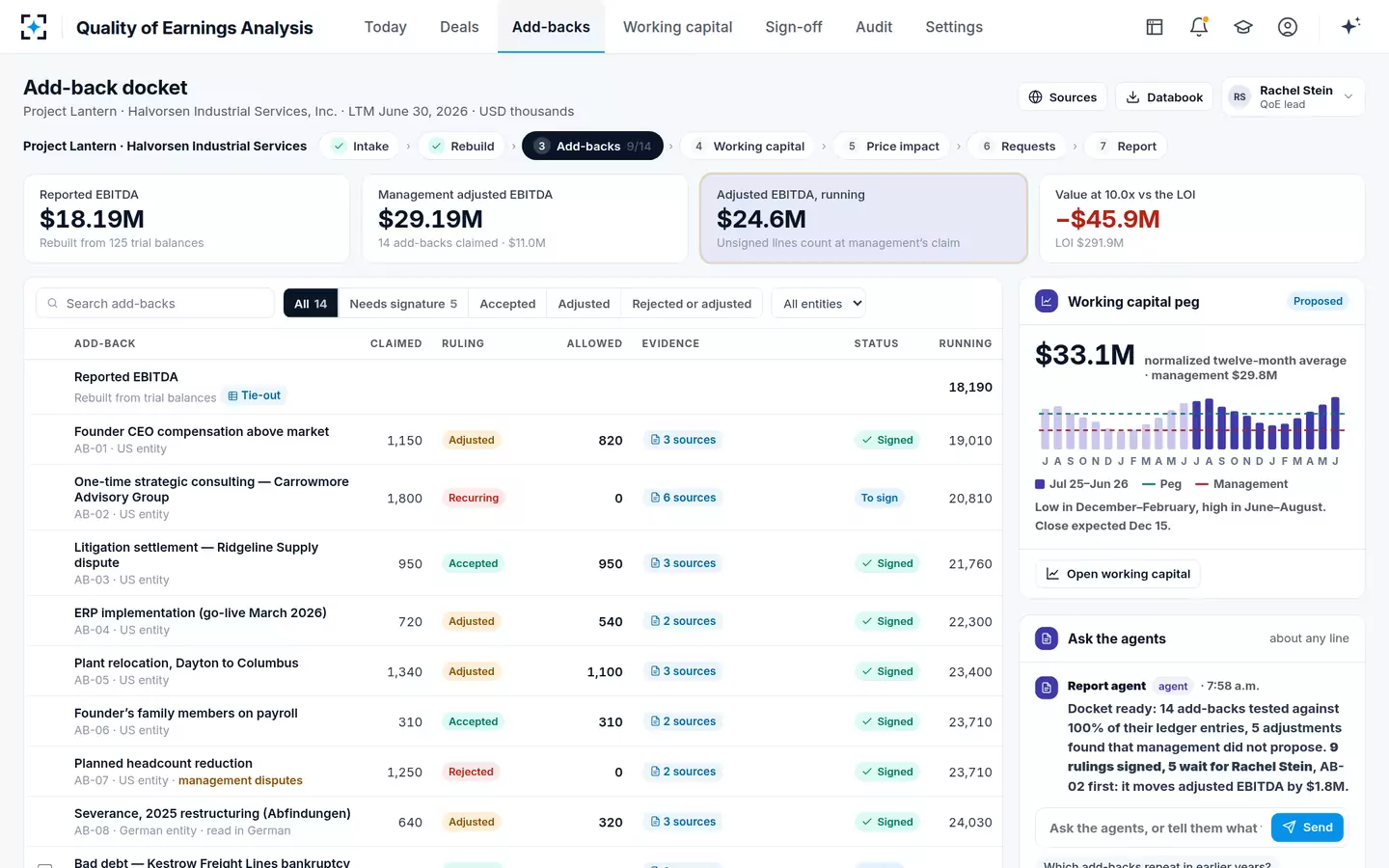
A defensible add-back has an evidence file that would let another analyst reach the same ruling without asking anyone. On the sample deal each line of the add-back docket links to its sources, from three to six per add-back, and a ruling cannot be signed by the person who proposed it.
Fourteen add-backs, one line each, with the evidence count beside every ruling
Six things a defensible add-back file contains
- Every general-ledger entry behind the claim
Not a sample: all of them, matched to invoices, with duplicates and credit notes checked.
- The contract or agreement
Term, renewal and termination clauses read, because they decide whether the cost recurs.
- A recurrence test over the whole period
Same account, same vendor and similar narratives across every month available, at least two years either side of the claim where possible.
- Forward evidence
Board minutes and next year's budget, which say whether management plans to keep paying.
- A normal level, where the cost is partly recurring
Severance, legal and repairs usually have one; only the excess is one-time.
- A signed ruling with a reason code
Proposed by one person, signed by another, with the counter-argument recorded.
The forward evidence is the step most often skipped, and it decided the largest ruling on the sample deal. The consulting agreement's statement of work ended on December 31, 2026, which supported management's claim. The master services agreement renewed automatically each October 1, the board had approved the program through FY2027 and the FY2027 budget carried $1.86 million for it. The challenge, the evidence and the signature are traced step by step in the AI quality of earnings review and its recurrence test.
Severance read in German: the normal level stays, the excess is allowed
Questions people ask
What are acceptable EBITDA add-backs?
Ones that are vouched to the general ledger, do not recur, are historical and are signed by someone who did not propose them. On the sample deal that described a single settled lawsuit, family payroll for people without a role, the evidenced part of an ERP implementation and a relocation, and the excess of founder pay over market.
Is restructuring an add-back?
Partly, if the business does not restructure every year. The sample deal's German entity paid severance in 2023, 2024 and 2025, so only the 2025 excess over the normal level, $320,000 of the $640,000 claimed, was allowed.
Are transaction costs an add-back?
Fees for the sale itself, such as the seller's bankers, lawyers and sell-side QoE, are usually added back because the business will not incur them under the buyer. They need invoices and engagement letters that tie them to the transaction, and a check that they are not disguised recurring advisory fees.
Is stock-based compensation an add-back?
It is a non-cash expense, so many adjusted EBITDA definitions exclude it, but it is a cost of paying people. A buyer that will replace equity awards with cash pay should not add it back, because the cost will reappear in cash.
How many add-backs is too many?
There is no number, but the trend is a warning. On the sample deal management's add-backs grew from 47% of reported EBITDA in FY2023 to 60% in the LTM, a pattern that suggests recurring costs being relabelled rather than a run of bad luck.