A quality of earnings report is usually performed by accountants working in a transaction advisory or financial due diligence team, engaged by whoever needs the answer: the buyer, to price the deal; the seller, to defend its adjusted EBITDA before marketing the business; or a lender, to size the loan. Some buyers also build a first cut themselves, with their own associates doing the analysis and a QoE lead signing the conclusions. Whoever performs it, a QoE carries no opinion, and the most important design choice inside the team is that the person who proposes a ruling on an add-back is not the person who signs it. Botminds' Quality of Earnings Analysis builds that rule in: agents prepare every add-back, the associate proposes, and the QoE lead signs.
The roles below are those of a fictional sample deal as it runs through the solution: Project Lantern, in which Quillfield Capital Partners IV is buying Halvorsen Industrial Services. The rules quoted are the SBA's 2026 lending rulebook, which is unusual in saying who may perform a QoE; occupational figures are from the Bureau of Labor Statistics.
Five people on one quality of earnings review, and what each keeps
Today
Runs four QoE reviews at once and waits weeks for a sampled databook while the LOI sits on management's EBITDA.
With agents
Opens each add-back with the agents' work, the counter-argument and every source, then signs with a reason code.
Still theirs: the signature on every ruling and the peg
Today
Pulls general-ledger detail and samples four quarters of an account, because nobody has time to read 42 months.
With agents
Asks the agents in plain words, reads what they found across the whole general ledger and proposes each ruling.
Still theirs: the proposal, never the signature on it
Today
Prices the deal and briefs the committee on a databook that arrives late in exclusivity.
With agents
Sees the price at signed numbers only, with the rulings that move it most.
Still theirs: the price and the committee recommendation
Today
Receives summaries and spreadsheets, then rebuilds the trail back to source for the final report.
With agents
Reads the originals beside the English, every figure pinned to its page, with comment-only access to one deal.
Still theirs: the adviser's own final report
Today
Reconstructs how a marketed EBITDA was supported from email and databook versions.
With agents
Filters one audit trail by ruling, agent, request or access and exports the evidence.
Still theirs: oversight; reads everything, changes nothing
Who performs a quality of earnings report?
In a private equity buyout the buyer's QoE is usually performed by an outside transaction advisory team, most often accountants, engaged by the buyer after the letter of intent. The team rebuilds earnings, tests add-backs, measures working capital and debt-like items, and writes the report and databook. The buyer's own deal team works alongside it, and on many deals does a first pass of its own.
The SBA's lending rulebook is the clearest public statement of who may do the work, for the loans it covers. Effective October 1, 2026, a QoE on a 7(a) change-of-ownership loan of $3 million or more must be the work of an experienced professional who is independent of the seller and engaged for the lender, and "must not be prepared by or for the seller" (SBA SOP 50 10 8.1). Independence from the seller and service to the party relying on the numbers are the two principles; both carry over to a buyer's QoE.
Does a CPA have to do a quality of earnings?
Not by any rule this guide could find for private deals. A QoE is not an audit or other attest engagement, and it ends in findings rather than an opinion. The SBA's rule is telling: for business valuations, the same rulebook requires a "Qualified Source" accredited by one of five named bodies, including the American Society of Appraisers and the American Institute of Certified Public Accountants; for the QoE, it names no credential at all, only an "independent, experienced financial professional" (SOP 50 10 8.1).
In practice most QoE practitioners are accountants, because the work is accounting: reading trial balances, judging accruals, mapping charts of accounts, understanding how revenue recognition and reserves move earnings. The occupation is large and well paid, and its wages set the floor for what the work costs.
The occupation that does most QoE work
$83,680
median annual wage of accountants and auditors, May 2025
$40.23
median hourly pay, before benefits and firm overhead
5%
projected employment growth 2025–35, faster than average
Who prepares a QoE for a buyer, a seller or a lender?
Each of the three commissions its own, for its own question, and each reads the others' with care. The table sets out who prepares each kind and whose interest it serves.
Three kinds of quality of earnings report, three clients
| Kind | Commissioned by | Question it answers | How the other side reads it |
|---|---|---|---|
| Sell-side QoE | The seller, before marketing | Which add-backs can we defend, and what will buyers find? | As the seller's case: useful for data, tested for conclusions |
| Buy-side QoE | The buyer, usually after the LOI | What is diligence-adjusted EBITDA, the peg and the debt-like list? | As a negotiating document, ruling by ruling |
| Lender QoE | The lender, or reviewed for it | What earnings support the debt? | For SBA 7(a) acquisitions, the earnings go into debt service coverage |
| In-house first cut | The buyer's own deal team | Which add-backs are in dispute before the price hardens? | Internal; the adviser can rely on its evidence trail |
The lender's position is the most precisely written. Under the SBA rule a lender may rely on another party's QoE only after one of its vendors has reviewed it, and a buyer's own report may be reviewed rather than redone (SOP 50 10 8.1). The same logic applies informally to every party: a QoE is relied on to the extent that the reader trusts who performed it and for whom.
The rule says why it allows that: buyers sometimes commission a QoE as part of their own diligence before they look for a loan, and a review by an approved vendor saves paying for the work twice (SOP 50 10 8.1, Appendix 15).
Who pays for a quality of earnings report?
Whoever commissions it. The buyer pays for a buy-side QoE and usually treats it as a deal cost, which it bears even if the deal fails. The seller pays for a sell-side QoE. A lender's own QoE may be paid by the lender or passed to the borrower under the loan terms; the SBA's provision for reviewing a buyer's existing report exists, in the rule's words, "to help mitigate costs". What a QoE costs, and how to set the fee against what it protects, is the subject of quality of earnings report cost.
Inside a QoE team: proposer, checker, partner
Inside any QoE team, the work splits three ways. Someone prepares the analysis of each add-back. Someone senior reviews it and decides. Someone who owns the price uses the decision. In an advisory firm these are the staff, the manager and the engagement partner; in a buyer's in-house first cut, the associate, the QoE lead and the deal partner.
How one ruling moves from evidence to the price
Agent
Test and Recurrence agentsVouch the add-back to every general-ledger entry, invoice and contract, and read its history across all 42 months.
Never: signs a ruling.
Agent
Challenger agentArgues management's side; rulings over $1M of EBITDA effect need its concurrence or a written override.
Never: approves a ruling.
A person decides
Associate proposesReads the evidence and the challenge, and proposes a ruling with a reason code.
A person decides
QoE lead signsChecks the proposal against the evidence and signs, or returns it. Never signs a ruling she proposed.
Agent
Report agentPushes the signed number to the deal model as a new version and into the report draft.
Never: releases a number nobody has signed.
A person decides
Deal partnerSees the price at signed numbers, and takes it to the investment committee.
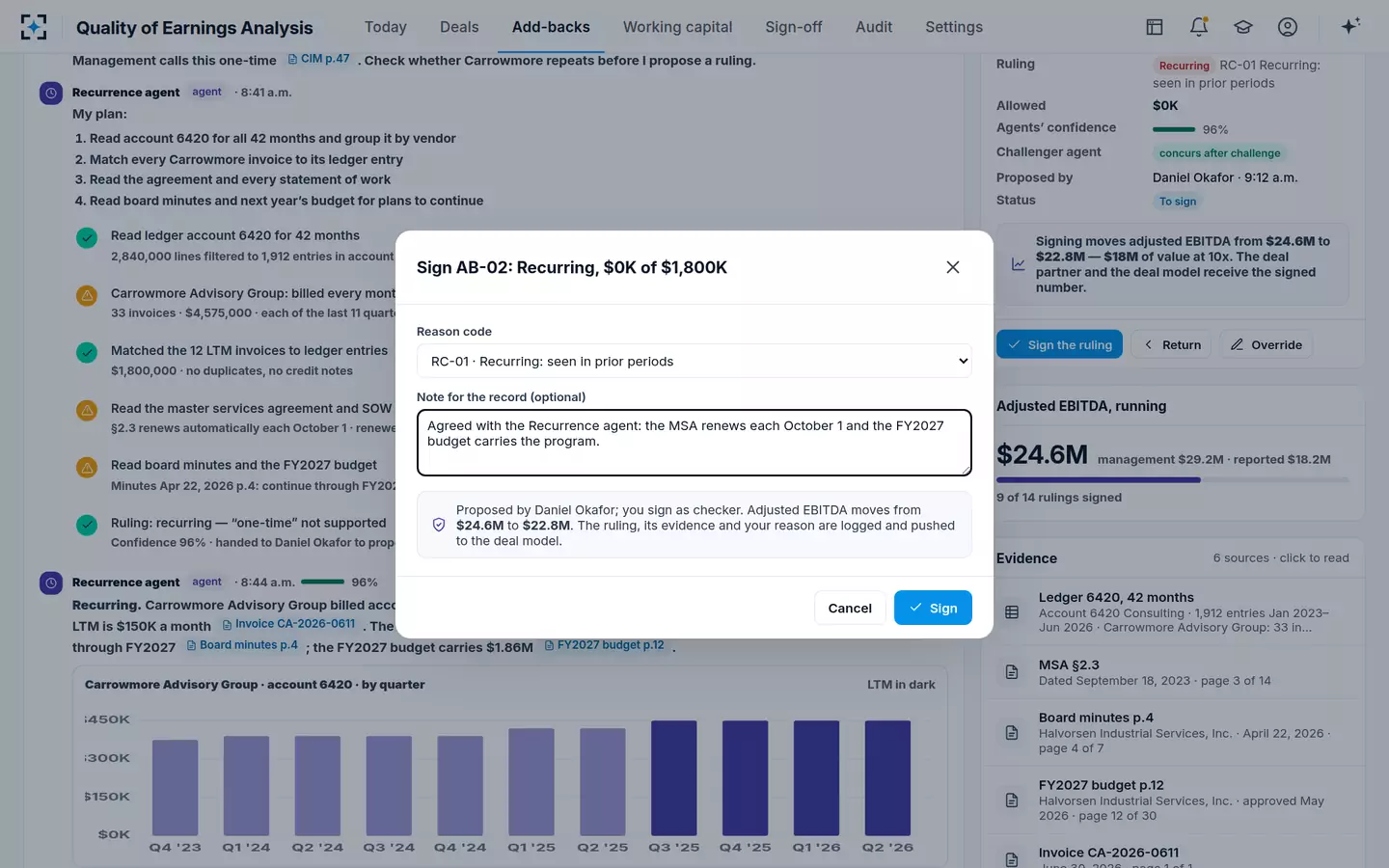
On the sample deal the largest ruling followed exactly that path. The Recurrence agent found the "one-time" consulting add-back billed in each of the last eleven quarters. The Challenger argued that the statement of work ends in December 2026 and concurred once shown the renewal clause and the FY2027 budget. The associate, Daniel Okafor, proposed rejecting it as recurring at 9:12 a.m.; the QoE lead, Rachel Stein, signed it with reason code RC-01 at 9:21 a.m., and adjusted EBITDA moved from $24.6 million to $22.8 million, $18 million of value at 10x.
The checker signs: proposed by one person, signed by another
Why the proposer never signs
Because a QoE's rulings are judgements made under pressure, and the person who did the analysis is the person least able to see what it missed. The associate who spent a morning on an add-back has a view; the checker's job is to ask whether the evidence supports it. Separating the two is the oldest control in accounting, and it matters more when the stakes are a multiple of every dollar.
It also protects against the opposite failure: a ruling softened because the analyst knows the deal partner wants the deal. Research on public companies shows how readily earnings labels adapt to scrutiny. After the SEC stepped up oversight of non-GAAP reporting, Kolev, Marquardt and McVay found exclusions became more transitory on average, but the quality of special items fell, suggesting managers shifted more recurring expenses into them (The Accounting Review, 2008). Labels respond to who is looking. A two-person rule makes sure someone with no stake in the proposal looks at each one.
The control has a cost, and the solution's settings manage it. Accepted rulings under $750,000 that the Challenger concurs with can be signed in bulk; rulings over $1 million of EBITDA effect need the Challenger's concurrence or a written override; a sign-off is due within two business days of a proposal. The thresholds are the firm's, changed only by a proposal the head of private equity operations approves.
Can the buyer do its own QoE?
Yes, and the SBA's rule recognises that buyers do, before they ever approach a lender. What a buyer gains by doing a first cut itself is time and leverage: it knows which add-backs are in dispute while the price is still moving, and it asks the seller for evidence in the first week rather than the fourth. Skaife and Wangerin's study of public deals found that low-quality target reporting "increases the likelihood of deal renegotiation" (Contemporary Accounting Research, 2013); a buyer that sees the problem early renegotiates from evidence rather than from a late report.
What a buyer gives up is independence. An in-house QoE is the buyer's case, as a sell-side QoE is the seller's, and lenders, insurers and co-investors may want an outside report. That is why the sample deal's adviser, Priya Raman of a fictional firm, Larchmont Transaction Advisory, has comment-only access to the deal until December 31, 2026: she can read every source and comment on every ruling, cannot sign, export or see other deals, and writes her own final report from the same evidence. How to divide the work between an outside provider and an in-house team is covered in quality of earnings providers or in-house.
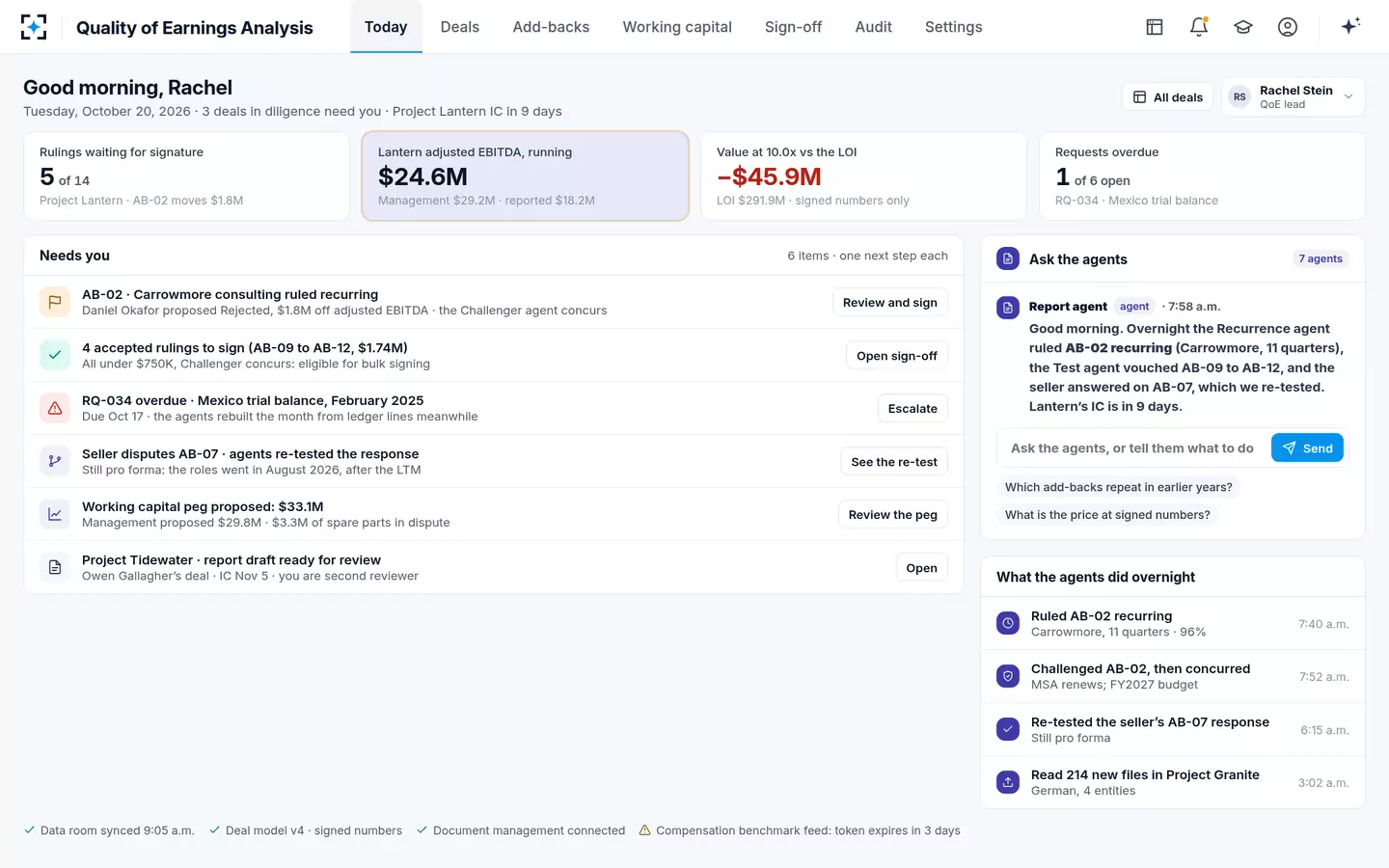
The QoE lead's morning: what needs her signature, and why
What qualifications a QoE provider needs
Accounting depth, independence, and the capacity to read everything that matters. Accounting depth because the hard rulings turn on accruals, reserves and revenue recognition, not on spreadsheets. Independence because a QoE prepared by or for the seller is the seller's case, whatever its quality. Capacity because a multi-entity target can mean millions of general-ledger lines in several languages and charts of accounts: on the sample deal, 2.84 million lines across US, German and Mexican books.
Ask any provider, internal or external, four questions. Who will sign each ruling, and did they do the analysis? How much of each add-back's general ledger will be read, and over how many periods? Can every figure in the databook be traced to a source? And when will the first rulings arrive relative to the LOI and the committee date? The answers say more about a QoE than the firm's name on its cover.
Questions people ask
Who signs a quality of earnings report?
An outside report is issued by the advisory firm as findings, not an opinion. Inside a buyer's own QoE each ruling should be signed by someone other than the person who proposed it; on the sample deal the associate proposes and the QoE lead signs with a reason code.
Does the seller's auditor perform the QoE?
Not for the buyer. The target's auditor works for the target, and a buyer's QoE should be independent of the seller; the SBA's rule for its loans says the report "must not be prepared by or for the seller". The auditor's work is an input: the audited year is what the QoE rebuild ties to.
Can a QoE be done without the seller's cooperation?
Only partly. A QoE needs trial balances, general-ledger detail, invoices and contracts, which only the seller can provide. Without them a buyer can analyse the CIM's figures but cannot vouch or test recurrence.
How many people work on a QoE?
No public source counts them. On the sample deal five people touch the work: an associate, a QoE lead, a deal partner, an outside adviser with comment-only access and a compliance reviewer who reads everything and changes nothing.
Who reads a QoE report after the deal?
Compliance and, if asked, examiners or investors who want to know how a marketed EBITDA was supported. On the sample deal the audit trail of every action, by people and agents, is kept for seven years and can be exported for auditors.