Quality of earnings providers are mostly accounting and transaction advisory firms that a buyer, seller or lender engages to test a target's earnings and write an independent report; choosing one comes down to independence, the depth of testing each add-back gets, who signs the conclusions, and when the first findings arrive relative to the letter of intent. The alternative is not to replace them but to stop waiting for them: a deal team can run its own first cut, with agents reading the whole general ledger and people signing each ruling, and hand the adviser an evidenced docket instead of a data room. Botminds' Quality of Earnings Analysis is built for that second job; the adviser keeps the independent report.
The comparison below runs one fictional sample deal three ways: Project Lantern, Quillfield Capital Partners IV's purchase of Halvorsen Industrial Services, with the LOI signed on September 24, 2026 and the investment committee on October 29. No regulator or independent study publishes provider rankings or fees, so this page gives criteria and a test you can run yourself.
Three ways to run the same docket, measured from the LOI
- No data room11 d
- Intake and rebuild9 d
- Rulings signed6 d
- Peg and review9 d
- No data room11 d
- 25 working days by hand35 d
What quality of earnings providers do
A provider does the work a QoE requires and puts its name to the findings. For a buyer that means rebuilding earnings from the trial balances, testing the add-backs, finding adjustments the seller did not propose, measuring working capital and debt-like items, and writing a report and databook. The report gives no opinion, but it is independent of the seller, and that independence is what lenders and other parties rely on.
The SBA's 2026 rule for its acquisition loans shows how far that reliance goes. A lender cannot rely on someone else's QoE until one of its own vendors has reviewed it, and the report "must not be prepared by or for the seller" (SBA SOP 50 10 8.1). An in-house first cut cannot be that independent report. It can make the independent report faster and better aimed.
How do you choose a quality of earnings provider?
Choose on how the provider will do the work, not on its name. Four questions separate providers more than any league table: who signs each conclusion and whether they did the analysis; how much of each add-back's general ledger will be read, over how many periods; whether every figure in the databook can be traced to a source; and when the first findings will arrive relative to the LOI and the committee date.
Questions to ask quality of earnings providers before engaging one
- Independence
No engagement for the seller or the target in the period; no fee contingent on the deal closing.
- Coverage of each add-back
Sampled or every entry, and over how many periods? Ask for the count of entries read per add-back in the databook.
- Recurrence method
Account, vendor and narrative across the whole period, plus contracts, minutes and budgets.
- Who signs, and who did the work
The reviewer of each conclusion should not be its preparer.
- Multi-entity and language capacity
Foreign charts of accounts mapped and documents read in the original.
- Traceability
Every databook cell linked to a source page or general-ledger query.
- Timing
Date of first findings and of the draft, against your LOI and committee dates.
- Reliance
Whether lenders and other parties can rely on the report, and on what terms.
- Working with your first cut
Will the provider start from your docket and evidence, or from the data room?
Coverage is the question most quotes leave vague. Auditors are explicit about the difference: sampling means applying a procedure to only part of an account's items, not all of them (PCAOB AS 2315.01). A QoE scoped as a sample of each add-back's entries is a reasonable cost choice, but a buyer should know it is making it, because the add-backs that fail usually fail on history that a sample of the trailing twelve months never reads.
Three ways to run the same add-back docket
The same fourteen add-backs, $11.0 million of claims on reported LTM EBITDA of $18.19 million, can be worked three ways. Each produces a docket; they differ in what they read, when they finish and who can rely on the result.
One docket, three operating models
| Adviser on a sample | In-house spreadsheet | Agents on the full general ledger, people signing | |
|---|---|---|---|
| Starts | After engagement, usually in exclusivity | When the deal team has time | The day the data room opens |
| Reads | Sampled entries and periods, as scoped | What an associate can pull and read | Every entry behind each add-back, every month available |
| Recurrence | Within the sample | Usually the LTM and one prior year | Account, vendor and narrative across all 42 months, plus contracts, minutes, budget |
| Foreign entities | Local teams or translation | Often deferred | Read in the original, mapped with a confidence score |
| Who signs | The adviser's reviewer | Often the person who built it | Associate proposes, QoE lead signs; never the same person |
| Who can rely on it | Buyer, lenders, others by agreement | The deal team | The deal team; the adviser reuses the evidence |
| First findings | Weeks after the data room, by estimate | Varies | On the sample deal, ten days after the data room opened |
The table is not an argument for dropping the adviser. It is an argument for changing what the adviser receives. On the sample deal the adviser, at a fictional firm, Larchmont Transaction Advisory, has comment-only access to the deal until December 31, 2026, reads the German and Spanish originals beside the English, and was asked on October 19 to review the docket before the report draft. Her final report relies on the same evidence; she cannot sign, export or see other deals.
The rebuild an adviser can start from, tied three ways
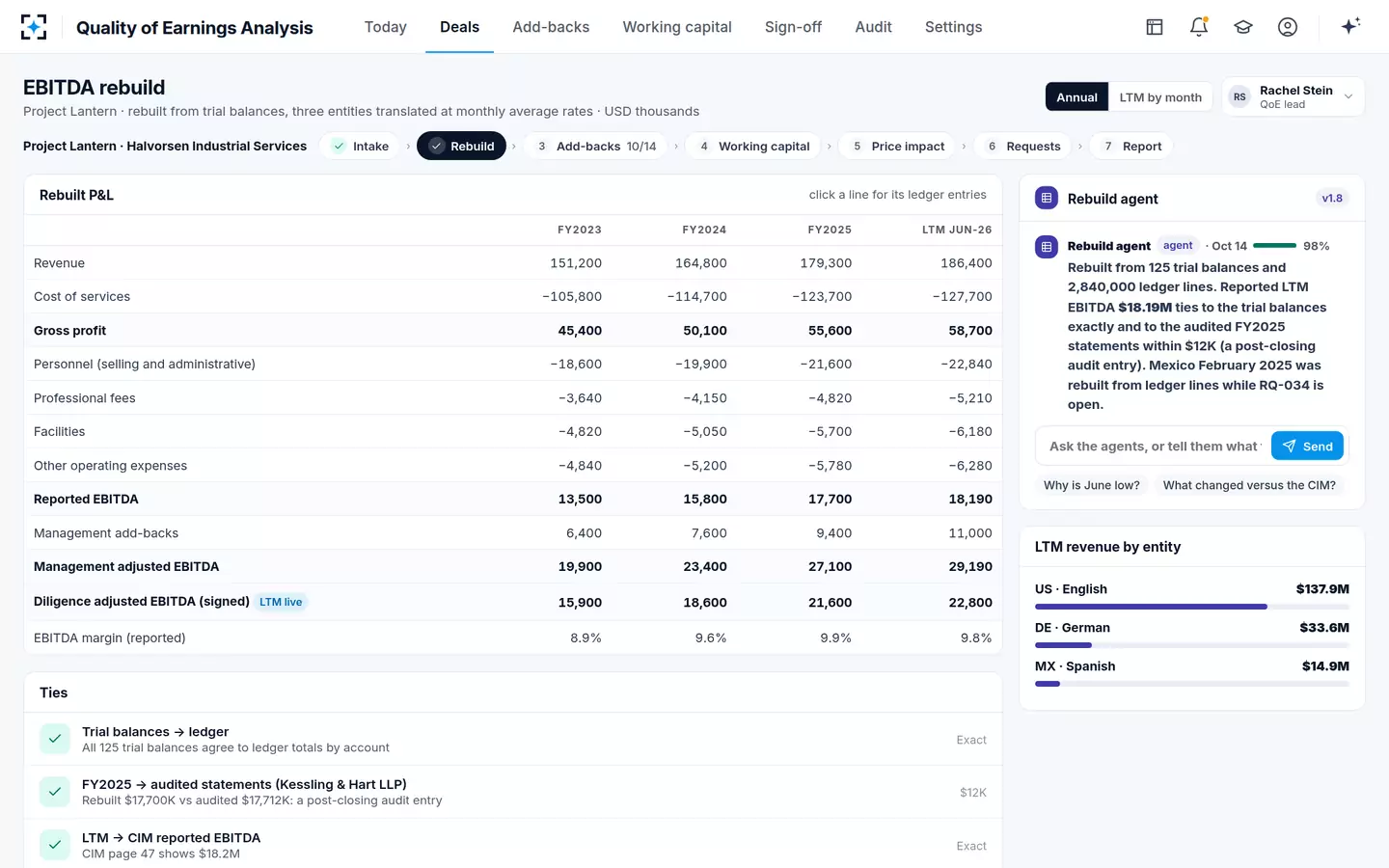
When each approach delivers, relative to the LOI
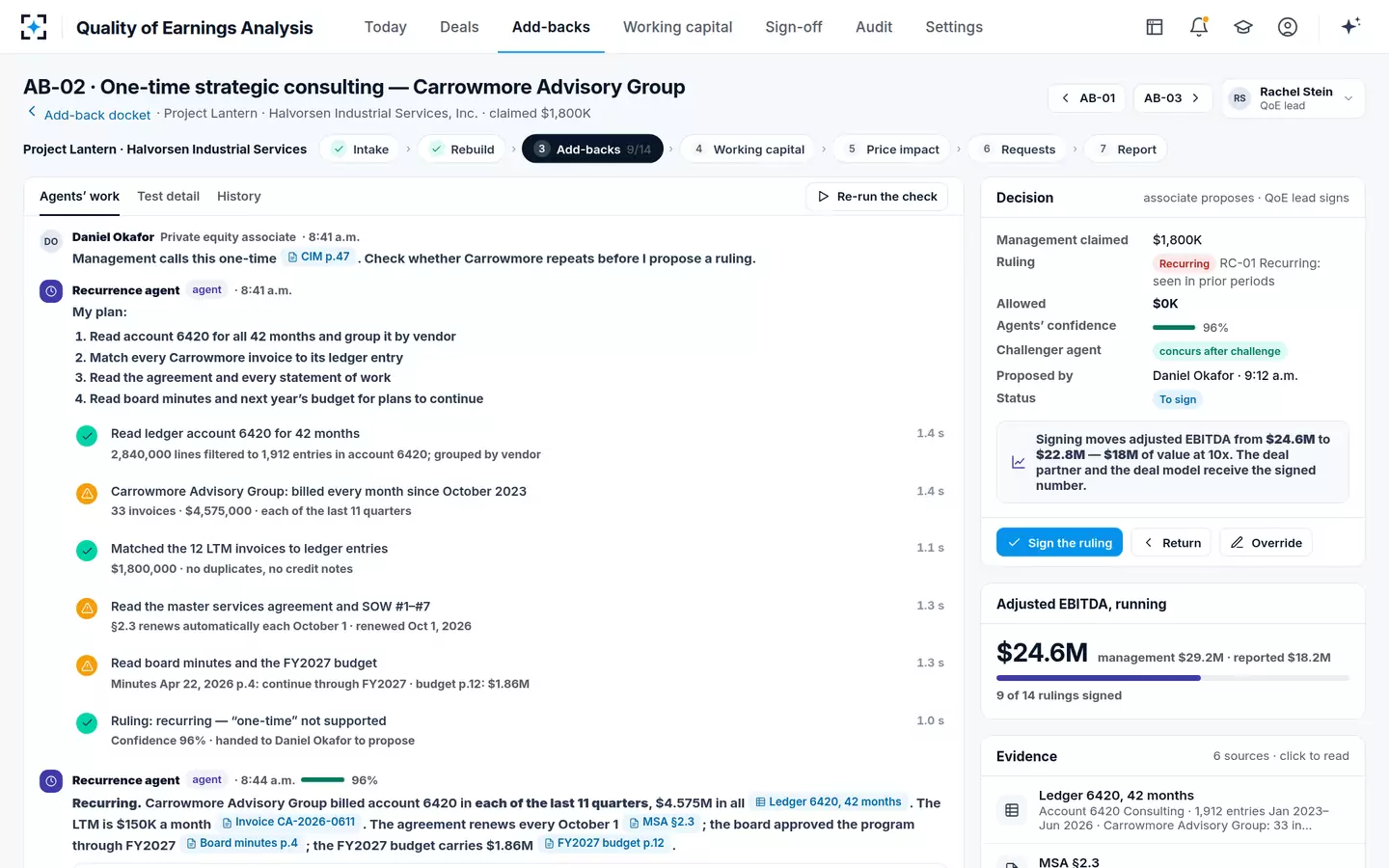
Timing is the criterion that decides most of the value. On the sample deal the LOI was signed on management's $29.19 million at 10.0x; the data room opened eleven days later; the investment committee met 35 days after the LOI. With agents reading the general ledger and people signing, the largest ruling, $1.8 million of "one-time" consulting found recurring, was signed on day 26. A first cut by hand, on Botminds' estimate of 25 working days, would have arrived around day 46, after the committee.
A finding that arrives after the investment committee has not lowered the price. It has only explained why the deal looks worse than it did.
Research on public acquisitions points the same way. Wangerin, measuring due diligence by the time acquirers take to negotiate and close, finds that less of it goes with weaker profitability and more goodwill impairments after the deal (Contemporary Accounting Research, 2019). Time spent is a proxy for evidence gathered; the aim of an in-house first cut is to gather more evidence in the same calendar, not to spend less time on diligence.
Should a buyer do its own QoE?
A buyer should do its own first cut, and usually still engage a provider for the independent report. The first cut is about speed and leverage: the deal team knows which add-backs are in dispute while the price is still moving and asks the seller for evidence in the first week. The provider's report is about independence and reliance: lenders, co-investors and others can rely on it in a way they cannot rely on the buyer's own work.
The SBA's rule recognises the combination for its loans: a buyer may commission its own QoE before it approaches a lender, and the lender may have that report reviewed by an approved vendor rather than commissioning a new one (SOP 50 10 8.1). The same logic works in a buyout: an evidenced first cut lets the provider review and extend rather than start from scratch.
What an in-house first cut changes, and what it does not
Changes: Findings while the price can still move
Does not change: The provider's own timetable for the final report
Changes: Every entry behind each add-back, every month available
Does not change: What the seller has not provided
Changes: Disputes argued from invoices, clauses and minutes
Does not change: Who negotiates: people do
Changes: Internal rulings, proposed and signed by different people
Does not change: The need for an independent report others can rely on
Changes: None; a first cut is not an audit
Does not change: None; neither is the provider's QoE
What AI quality of earnings software changes, and what it does not
It changes the cost of reading. Mapping three charts of accounts, rebuilding 42 months from 2.84 million general-ledger lines and reading every invoice behind fourteen add-backs is days of work by hand and, on Botminds' estimate, a fraction of that for agents. It does not change who decides. On the sample deal no agent signs, changes a reported number or contacts the seller; a ruling over $1 million of EBITDA effect needs the Challenger agent's concurrence or a written override; and unsigned rulings count at management's claim in every number the deal partner sees.
It also changes what can be asked of the history. The SEC bars listed companies from calling a charge non-recurring if a similar one occurred "within the prior two years" (17 CFR 229.10(e)). Applying a test like that to every add-back by hand means reading years of each account; with agents it becomes a default. How the recurrence test runs on one add-back, step by step, is shown in the AI quality of earnings review.
Recurrence across 42 months, with the counter-argument and the decision panel
What to write into a provider's engagement letter
Once a first cut exists, the engagement letter should say what the provider will do with it. Without that, a provider will reasonably start from the data room, and the buyer pays twice for the reading. Four terms do most of the work.
First, the starting point: the provider receives the deal team's rebuild, add-back docket and evidence, and its scope is to review, re-perform where it chooses, and extend. Second, the coverage it will add: the add-backs, entities or periods it will test beyond the first cut, and whether its testing of those is sampled or complete. Third, the disagreements: where the provider's view of a ruling differs from the signed internal ruling, the report should show both and the evidence for each, so that the deal team decides with the difference in view. Fourth, the dates: the first findings and the draft, set against the committee date, not against the closing.
On the sample deal those terms are visible in the access the adviser was given. She can comment on every ruling and read every source in the original language, but she cannot sign, export or see other deals, and her access ends on December 31, 2026. The deal team's rulings stay the deal team's; her report stays hers. Neither one can quietly overwrite the other, which is what makes it possible for each to rely on the other's evidence.
Two terms are worth leaving out. A fee contingent on closing gives the provider a stake in the answer, which the independence it is selling cannot carry. And a scope that is silent on foreign entities invites the most expensive surprise in a multi-entity deal: on the sample deal, the German and Mexican subsidiaries produced the severance and inventory reserve findings, both from books kept in German and Spanish.
Switching: run one past deal three ways
The safest way to choose an operating model is to test it on a deal you have already closed, where the answer is known. Take the data room and the adviser's final report from one past deal, and run the first cut again with the new approach, without looking at the report. Then compare.
A past-deal test for any change of QoE operating model
- Pick a closed deal with a disputed add-back
Ideally multi-entity, with a known outcome on price.
- Start the clock at the data room date
Measure days to the first proposed ruling and to the last.
- Count coverage
Entries read per add-back and periods covered, against the adviser's scope.
- Match findings
Which of the adviser's adjustments the first cut found, missed, or found and the adviser did not.
- Count false flags
Add-backs flagged as recurring that the evidence did not support.
- Check traceability
Pick ten databook figures at random and trace each to its source.
- Put the dates on the deal calendar
Which findings would have arrived before the LOI, the committee and the signing?
The switch itself can be gradual. A team can keep its provider, add an in-house first cut on new deals, and change the provider's scope once the first cut has proved itself: review and extend, rather than rebuild from the data room. The final report and its independence stay with the provider throughout. The economics of that division are worked in quality of earnings report cost.
Questions people ask
Who are the best quality of earnings providers?
No regulator or independent study ranks them. Judge providers on independence, coverage of each add-back, who signs, traceability of the databook and the date of first findings against your LOI.
What does a QoE provider do after the LOI?
In many buyouts that is when the full engagement runs: the data room opens, the provider rebuilds earnings, tests add-backs, measures the peg and debt-like items, and drafts the report before the purchase agreement is signed. On the sample deal the adviser reviewed an existing docket instead of starting from the data room.
How long do quality of earnings providers take?
Providers do not publish standard timelines. Botminds' estimate for a first cut by hand on a three-entity mid-market buyout is about 25 working days from the data room; on the sample deal with agents, the largest ruling was signed fifteen days after the data room opened.
Are quality of earnings vendors and providers the same?
People use both words. Providers usually means firms that perform the QoE and write the report; vendors can also mean software used by deal teams or providers. Under the SBA's rule, "vendors" are the firms a lender approves to review a QoE on its behalf.
Can one firm do the sell-side and buy-side QoE?
Not for the same deal without losing the independence that gives the buy-side report its value. The SBA's rule for its loans requires that the QoE not be prepared by or for the seller.