Debt-like items are obligations that are not borrowings but will cost the buyer cash after closing, so they are deducted from enterprise value, like debt, on the way to the equity price. Common examples are customer deposits and deferred revenue for work not yet performed, accrued bonuses and commissions earned before closing but paid after it, unpaid income taxes and tax exposures, deferred capital expenditure and maintenance, provisions for claims and restructuring, unpaid transaction costs, and, depending on the agreement, lease liabilities. They matter because they sit outside EBITDA: a quality of earnings report that stops at adjusted EBITDA has priced the business but not the cheque. Botminds' Quality of Earnings Analysis builds them from the general ledger and the contracts and lists each one, with its source, for the equity bridge.
The example figures come from a fictional sample deal as it runs through the solution: Project Lantern, the purchase of Halvorsen Industrial Services, where the agents list five debt-like items worth $6.8 million. The accounting definitions are quoted from the IFRS Foundation and the SBA, linked where they appear.
From enterprise value to the equity price, term by term
Enterprise value
Multiple × diligence-adjusted EBITDA
Sample: 10.0 × $22.8M = $228.0M
Set by the buyer on the QoE
Debt
Borrowings, accrued interest, breakage costs
Repaid at closing from the price
Set by the loan payoff letters
Debt-like items
Obligations that will cost cash after closing
Sample: five items, $6.8M
Listed in the QoE, agreed in the purchase agreement
Cash and working capital true-up
+ cash left in the business, ± closing working capital against the peg
Settled after closing on the agreement's definitions
Set by the closing balance sheet
What are debt-like items?
A debt-like item is anything the buyer will have to pay for, in cash, because of something that happened before closing, and that the price does not already reflect. The test has two halves. Is it a claim on future cash? And has the value of the business already been reduced for it, either in EBITDA or in the working capital peg? If yes and no, it belongs in the bridge.
The second half explains why lists differ between deals. An accrued bonus counted in the working capital peg has already been priced; deducting it again as debt-like would double-count it. A bonus accrued below what will actually be paid has been under-priced twice: once in EBITDA, where the expense is too low, and once in the balance sheet. On the sample deal an under-accrued 2025 bonus was one of the five adjustments management did not propose, which corrected EBITDA; the unpaid balance at closing is a separate, balance-sheet question.
How do debt-like items affect the purchase price?
Dollar for dollar, at the equity level, and without the multiple. That is the asymmetry that makes them easy to underrate. An add-back of $1 million moves enterprise value by $10 million at 10x. A debt-like item of $1 million moves the equity price by $1 million. So deal teams spend their time on add-backs, and debt-like items get a schedule at the back of the report.
But a debt-like item is certain in a way an add-back is not. The add-back argument is about what next year will look like; the customer deposit is cash already received for work the buyer will have to do. On the sample deal the signed numbers reduced enterprise value by $63.9 million against the letter of intent, and the debt-like items took another $6.8 million off equity, for a total effect of $70.7 million: about a tenth of the price movement, and the least disputable part.
An add-back is an argument about next year. A customer deposit is cash the seller has already collected for work the buyer will have to do.
Debt-like items examples, by family
The families below cover most of what appears in buyout purchase agreements. Whether each is debt-like on a given deal depends on the agreement's definition and on how the peg treats it.
Debt-like items examples, the accounting behind them and where to find them
| Family | Examples | Accounting basis | Where it hides |
|---|---|---|---|
| Customer deposits and deferred revenue | Deposits on service contracts, prepaid maintenance, annual subscriptions billed in advance | Cash received before the performance obligation is satisfied (IFRS 15) | Deposit schedules, contract terms, unearned revenue accounts |
| Unpaid compensation | Bonuses and commissions earned before closing, transaction bonuses, unpaid severance | Accrued liabilities, if accrued at all | Payroll registers, bonus plans, board minutes, severance agreements |
| Taxes | Income taxes for pre-closing periods, payroll tax arrears, open audits | Current tax liabilities and uncertain tax positions | Tax returns, notices, correspondence with authorities |
| Provisions and claims | Litigation, warranty above the normal level, environmental clean-up, onerous contracts | Provisions: "a liability of uncertain timing or amount" (IAS 37) | Legal letters, claims registers, board minutes |
| Deferred capex and maintenance | Repairs and replacements postponed before the sale | Often not on the balance sheet at all | Capex history against budget, asset registers, site visits |
| Leases and financing-like terms | Lease liabilities, deferred purchase consideration, earn-outs from past acquisitions | Lease liabilities (IFRS 16); contingent consideration | Lease schedules, prior acquisition agreements |
| Transaction costs unpaid at closing | Bankers', lawyers' and advisers' fees for the sale | Accrued or invoiced after closing | Engagement letters, the closing funds flow |
| Related-party balances | Amounts owed to or by the founder and affiliates | Related-party payables and receivables | Intercompany accounts, the general ledger by counterparty |
Is deferred revenue a debt-like item?
Often yes, and it is one of the most argued lines in a purchase agreement. Deferred revenue, a contract liability, arises when a customer pays before the business has delivered. Under IFRS 15 an entity recognises revenue "to depict the transfer of promised goods or services to the customer" (IFRS Foundation, IFRS 15), so cash received in advance waits on the balance sheet until the work is done. The seller has the cash; the buyer inherits the obligation to do the work.
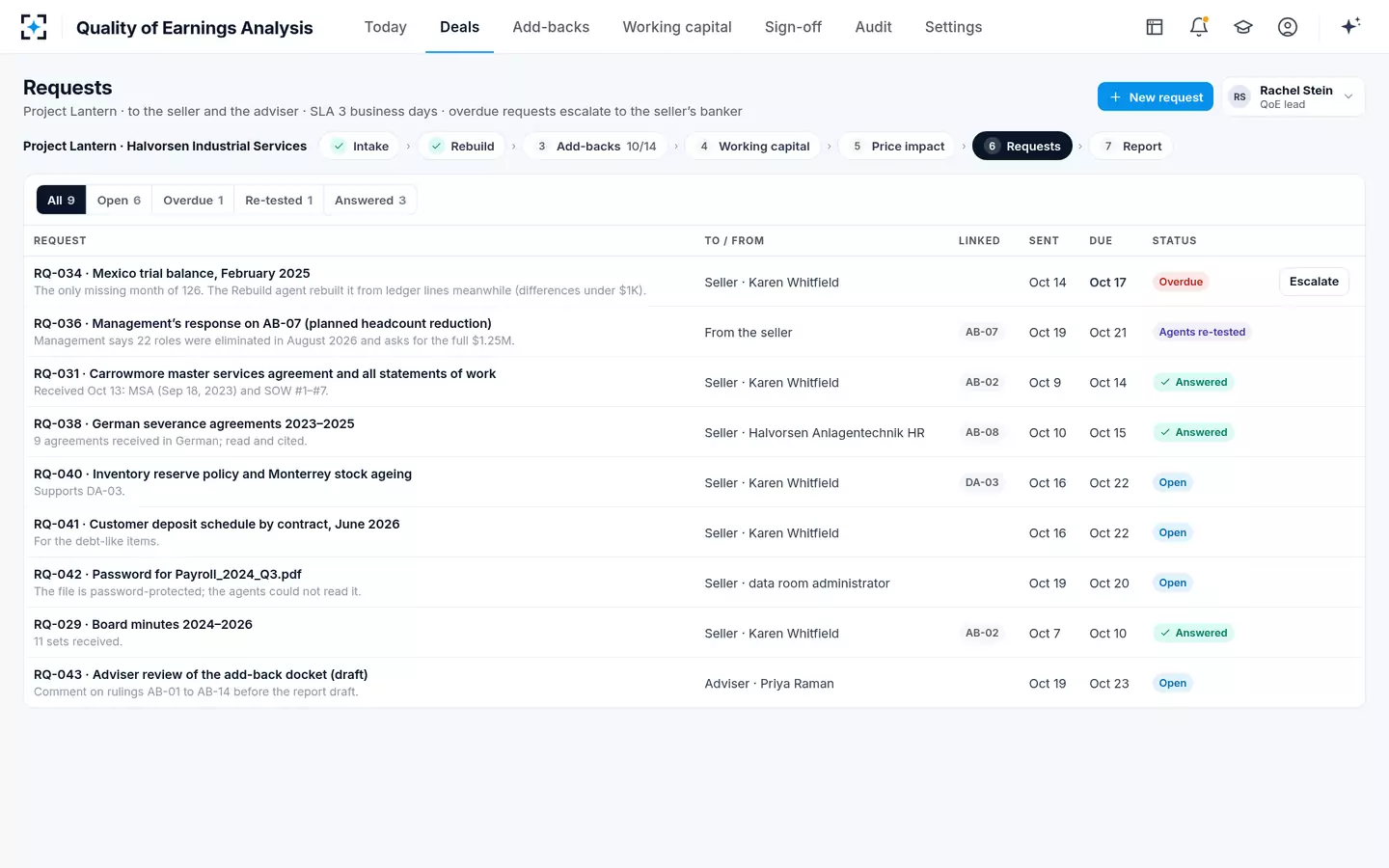
The seller's argument is that the obligation costs less than its face value: a subscription paid in advance may cost much less than its price to serve. The buyer's argument is that it will pay the full cost of delivery with none of the cash. One compromise deducts the cost to fulfil rather than the revenue amount, but that requires a measured margin on the service, which the QoE can supply. On the sample deal, $2.1 million of customer deposits on service contracts is the largest debt-like item, and the agents requested a deposit schedule by contract (RQ-041) to support it.
Are provisions debt-like items?
Some are, and the accounting definition is the starting point. IAS 37 defines a provision as "a liability of uncertain timing or amount" and gives as examples "warranty obligations; legal or constructive obligations to clean up contaminated land or restore facilities; and obligations caused by a retailer's policy to make refunds to customers" (IFRS Foundation, IAS 37). A provision for a specific lawsuit or clean-up is a claim on future cash created before closing; it is debt-like. A routine warranty provision that rises and falls with sales is closer to working capital.
The harder cases are the provisions that were never booked. IAS 37 allows a restructuring provision only "when the entity has a constructive obligation"; a restructuring that was planned but not yet announced will have none. If the seller has decided to close a site and the buyer will pay the severance, the obligation is economically debt-like even though the balance sheet shows nothing. The quality of earnings work finds these in board minutes, budgets and severance agreements, not in the trial balance.
Leases, deposits and unpaid bills: the boundary with working capital
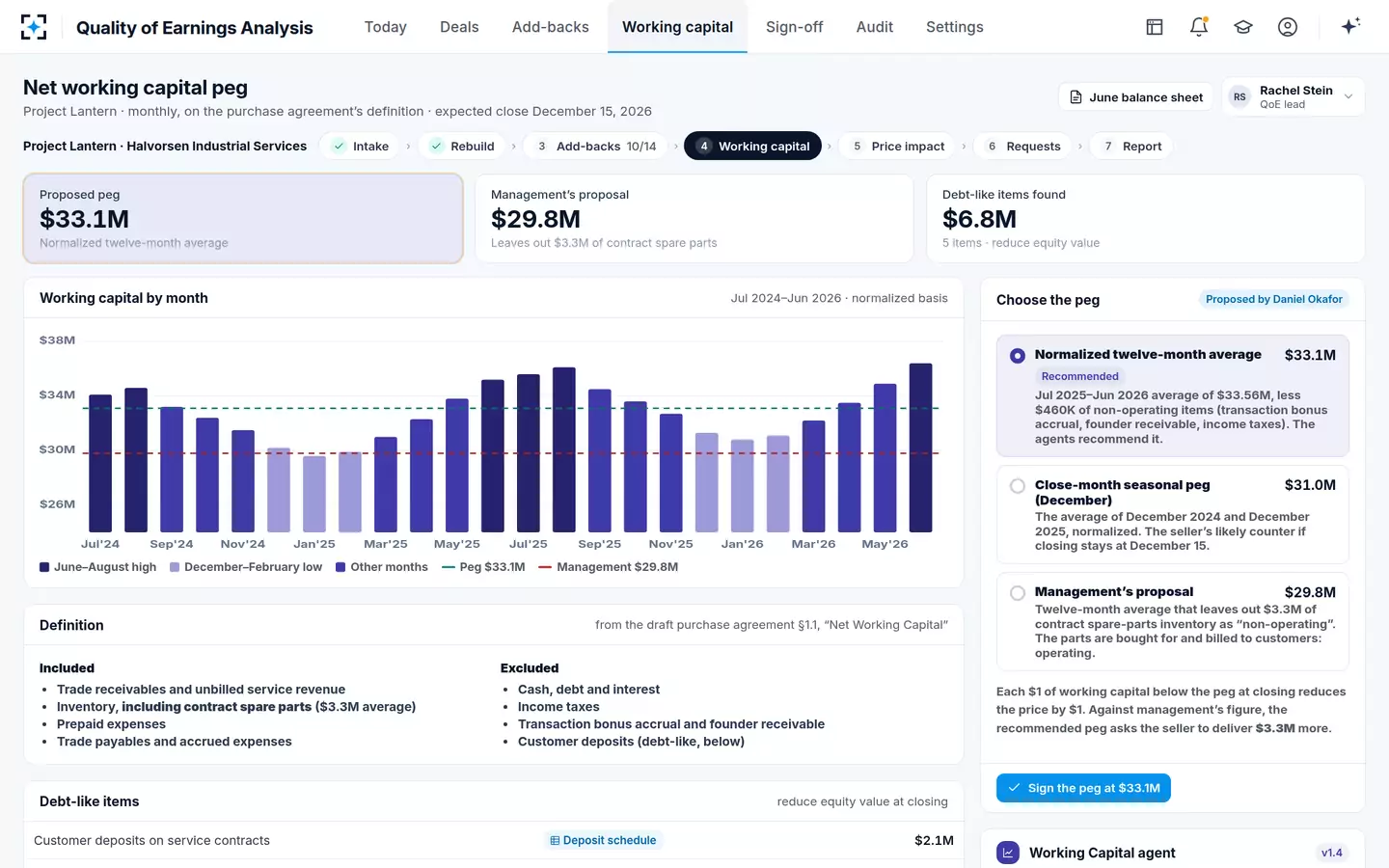
Every debt-like item has a twin in the peg, and the agreement has to pick one home for each. Customer deposits are current liabilities; left in working capital, they lower the peg, and the seller delivers less working capital. Moved to debt-like, they come off the price instead. The money is the same; counting it in both places, or neither, is the error.
On the sample deal the draft purchase agreement's definition excludes from working capital the items it treats elsewhere: cash, debt and interest, income taxes, a transaction bonus accrual, a receivable from the founder, and customer deposits, which it lists as debt-like. The Working Capital agent built the peg and the debt-like list from the same mapping, so an item can sit in only one of them. The peg's side of that boundary is worked through in how a net working capital peg is calculated.
Leases are a matter of convention and agreement. IFRS 16 requires a lessee to recognise "a lease liability representing its obligation to make lease payments" for leases longer than twelve months (IFRS Foundation, IFRS 16), which puts most leases on the balance sheet looking like debt. A buyout agreement may exclude operating leases from debt because rent is already in EBITDA; deducting the liability as well would count the same payments twice. Whatever the convention, the bridge and the EBITDA definition have to agree.
Working capital and debt-like items built from one mapping
Debt-like items in financial due diligence: where to find them
They are found by reading what the trial balance does not say. A trial balance shows what was accrued; debt-like items are often what was not. The search runs through contracts, minutes, correspondence and the general ledger by counterparty, and it is one place where a full read of the documents beats a sample by a wide margin, because a single unbooked obligation can be worth more than every booked one.
Where a QoE team looks for debt-like items
- Unearned revenue and customer deposit accounts
Then the contracts behind them, to see what must still be delivered.
- Bonus and commission plans against the accruals
An accrual below the plan's formula is a gap in EBITDA and in the bridge.
- Board minutes and budgets
Decisions to restructure, close sites or settle claims that have not reached the books.
- Capital expenditure against budget and depreciation
Years of spending below depreciation can mean deferred maintenance.
- Tax returns, notices and audit correspondence
Pre-closing tax the buyer could inherit.
- The general ledger by counterparty
Balances with the founder, affiliates and former owners.
- Prior acquisition agreements
Earn-outs and deferred consideration still owed.
- Engagement letters for the sale
Transaction fees that will be invoiced after closing.
The SBA's 2026 rule makes two of these explicit. A QoE on its 7(a) acquisition loans must document adjustments that include related-party dealings, deferred maintenance and any switch between cash and accrual accounting (SBA SOP 50 10 8.1). A cash-basis company has no accruals at all, so every unpaid bill and every unearned deposit has to be built from the documents before the bridge can be drawn.
Related-party balances deserve their own pass. Auditors are required to determine whether related parties and their transactions "have been properly identified, accounted for, and disclosed" (PCAOB AS 2410.02); a buyer has a narrower question, which is whether any of those balances will be settled with the buyer's cash. On the sample deal a receivable from the founder sits outside working capital, on its own line.
A debt-like item needs its own evidence request
How big are debt-like items, and why the share matters
There is no published benchmark for debt-like items as a share of price; they depend on the business model. A subscription or service business with annual billing can carry deferred revenue worth months of sales, while a distributor may have almost none. The useful comparison is internal: debt-like items against diligence-adjusted EBITDA, and against the price movement from add-backs.
The sample deal's $6.8M of debt-like items
Debt-like items, $6.8M
- Customer deposits on service contracts, $2.1M · 31%
- Four other items, $4.7M · 69%
On the sample deal $6.8 million of debt-like items is about 30% of diligence-adjusted EBITDA of $22.8 million, between three and four months of earnings: small against the $63.9 million that the add-back rulings moved at 10x, but every dollar of it is cash. A buyer who negotiates the add-backs hard and the bridge lightly leaves money on the table in the one place where the seller has the weakest argument.
Who decides which items are debt-like
The purchase agreement decides, and the quality of earnings work tells the negotiators what to ask for. The buyer's first draft often carries a broad definition of indebtedness that names debt-like categories; the seller narrows it. Each item on the QoE's list should therefore come with its evidence and its amount, so that the lawyers drafting the definition know what each word is worth.
In Quality of Earnings Analysis the Working Capital agent lists debt-like items with their sources; the QoE lead signs the numbers that go into the bridge, as with every ruling. The Report agent puts only signed items into the bridge and the deal model, so a draft item never moves the equity price. How the list fits into the whole report is set out in the quality of earnings report, section by section.
Questions people ask
What is the equity bridge?
The arithmetic from enterprise value to the price paid for the shares: enterprise value less debt and debt-like items, plus cash, plus or minus the working capital true-up. On the sample deal, debt-like items took $6.8 million off equity after the add-back rulings had set enterprise value.
Are customer deposits debt-like?
Usually, because the seller keeps the cash and the buyer performs the work. They can instead sit in working capital, lowering the peg; what matters is that the agreement puts them in one place only. The sample deal's definition treats $2.1 million of deposits as debt-like.
Are accrued bonuses debt-like?
Bonuses earned before closing and paid after it are commonly treated as debt-like if they are not in the peg. A bonus accrued below what the plan will pay is also an EBITDA adjustment; on the sample deal an under-accrued 2025 bonus was one of five adjustments management did not propose.
Is deferred capex a debt-like item?
It can be, if the seller postponed spending the business needs and the buyer will have to make it up. It rarely appears on a balance sheet, so it is found by comparing capital spending with depreciation and budgets over several years.
Are leases debt-like items?
Finance leases usually are. Operating leases depend on the agreement: IFRS 16 puts a lease liability on the balance sheet, but where rent is already deducted in EBITDA, deducting the liability too would count the same payments twice.