A net working capital peg is the target amount of working capital a business must have on its balance sheet at closing, set in the purchase agreement; if actual working capital at closing is below the peg, the price falls dollar for dollar, and if it is above, the price usually rises. It is calculated as a normalised average of monthly net working capital, measured on the purchase agreement's own definition, typically over the trailing twelve months and with non-operating items removed. The hard part is not the arithmetic but the choices: which accounts count, which months are averaged, and how seasonality around the closing date is handled. Botminds' Quality of Earnings Analysis builds monthly working capital from the trial balances, sets out the candidate pegs with their reasoning, and leaves the choice to a person who signs it.
The figures below come from a fictional sample deal as it runs through the solution: Project Lantern, the purchase of Halvorsen Industrial Services, an Ohio field-services business with German and Mexican subsidiaries, expected to close on December 15, 2026. No regulator sets a formula for the peg; the definition is contractual, so the method below is how practitioners build it, applied to one business.
One business, three defensible pegs, $3.3M apart
$33.1M
normalised twelve-month average, the agents' recommendation
sample deal
$31.0M
close-month seasonal peg: the December average
sample deal
$29.8M
management's proposal, leaving out contract spare parts
sample deal
$1 = $1
each dollar of working capital below the peg at closing reduces the price by a dollar
What is a net working capital peg?
The peg is the buyer's protection against a seller who runs down working capital before closing. A buyer pays a price for a business on the assumption that it comes with the receivables, inventory and payables it normally runs on. If the seller collects receivables early, lets inventory fall or stretches payables in the weeks before closing, cash leaves with the seller and the buyer has to refill it. The peg sets the normal level; the closing adjustment trues the actual level up or down to it.
It is sometimes called the working capital target, and the adjustment the working capital true-up. Whatever the name, three things define it: the accounts included, the measurement method for each, and the level. The first two are written into the purchase agreement; the third is negotiated, and it is where the quality of earnings report earns its fee.
How does a net working capital peg work at closing?
At closing the buyer pays a price based on an estimate of closing working capital; within a set period afterwards, the actual closing balance sheet is prepared on the agreement's definition, and the difference from the peg is settled in cash. On the sample deal the draft agreement's definition, §1.1 "Net Working Capital", includes trade receivables and unbilled service revenue, inventory including contract spare parts, prepaid expenses, and trade payables and accrued expenses. It excludes cash, debt and interest, income taxes, a transaction bonus accrual and a receivable from the founder, and customer deposits, which are treated as debt-like.
The arithmetic is symmetric and unforgiving. Suppose closing working capital comes in at $31.0 million. Against a $33.1 million peg the seller owes the buyer $2.1 million. Against management's proposed $29.8 million the buyer owes the seller $1.2 million. The same balance sheet, measured the same way, produces a $3.3 million swing depending on the peg alone.
The peg is the one number in a quality of earnings report that the purchase agreement turns directly into cash, dollar for dollar, months after the price was agreed.
How do you calculate a working capital peg?
You calculate it in four steps. Build working capital for each month on the agreement's definition, not the balance sheet's captions. Remove items that are not part of normal operations. Choose the months to average. Then test the result against the expected closing month to see what the true-up will look like.
The recommended peg on the sample deal, term by term
Twelve-month average
Average of monthly net working capital, July 2025 to June 2026
$33.56M on the agreement's definition, from the rebuilt trial balances
Working Capital agent builds it
Non-operating items
Transaction bonus accrual, founder receivable, income taxes
−$0.46M: items the buyer will not run the business on
Working Capital agent lists them
Proposed peg
$33.56M − $0.46M
$33.1M, the normalised twelve-month average
Associate proposes; QoE lead signs
Step one is where most errors start. Balance sheet captions bundle operating and non-operating items: "other receivables" may hold a loan to the founder, "accrued expenses" may hold a transaction bonus that the buyer will never pay out of operations, and "inventory" may hold parts that management would rather call something else. Each account has to be mapped to the definition, month by month, and on a multi-entity business that means mapping each entity's chart of accounts first. On the sample deal that meant the German books on DATEV SKR04 and the Mexican books on the SAT code list, translated at monthly rates.
Measurement matters as much as inclusion. If the agreement says working capital is measured "consistent with past practice", a closing balance sheet that suddenly reserves more for doubtful debts or obsolete stock changes the number without anything changing in the business. The SBA's 2026 rule for QoE reports on its acquisition loans names one version of this, requiring reports to document "accounting methodology differences between cash-basis and accrual-basis reporting" (SBA SOP 50 10 8.1). A peg built on one basis and a closing balance sheet on another will disagree by the size of the accruals.
Three candidate pegs on one business
On the sample deal the Working Capital agent set out three options, each with its reasoning, and recommended one. The figure shows them beside the unadjusted average, so the effect of each choice is visible.
Candidate working capital pegs on the sample deal
Management's $29.8 million is the easiest to rule on, because it rests on a definition argument, not an averaging one. It treats $3.3 million of contract spare parts as "non-operating" inventory. The parts are bought for customers' equipment and billed to them; they are as operating as inventory gets. Leaving them out of the peg would let the seller deliver $3.3 million less working capital than the business runs on, and collect for it.
The real argument is between the normalised twelve-month average and the December peg. The twelve-month average describes the business across a year. The December peg describes it in the month the deal is expected to close, when this business's working capital is at its seasonal low. Each is defensible, and the difference, $2.1 million, is larger than most single add-backs on the deal.
Why seasonality matters for the peg
Because a peg that ignores seasonality turns the closing date into a price term. The sample business's working capital is low from December to February and high from June to August. A twelve-month average sits between the two. If the deal closes on December 15, actual working capital will almost certainly come in below a twelve-month peg, and the true-up will take money from the seller for a shortfall that is only the calendar.
That is why the seller's likely counter is the December peg. The buyer's answer is that the average is the level the business needs over a year, and that a December closing hands the buyer a business at its seasonal low, which it will have to fund up through the summer. Both arguments are about the same months; the quality of earnings work is to show them clearly, so that the negotiation is about a choice and not about the data.
Working capital by month, with the definition and the three pegs
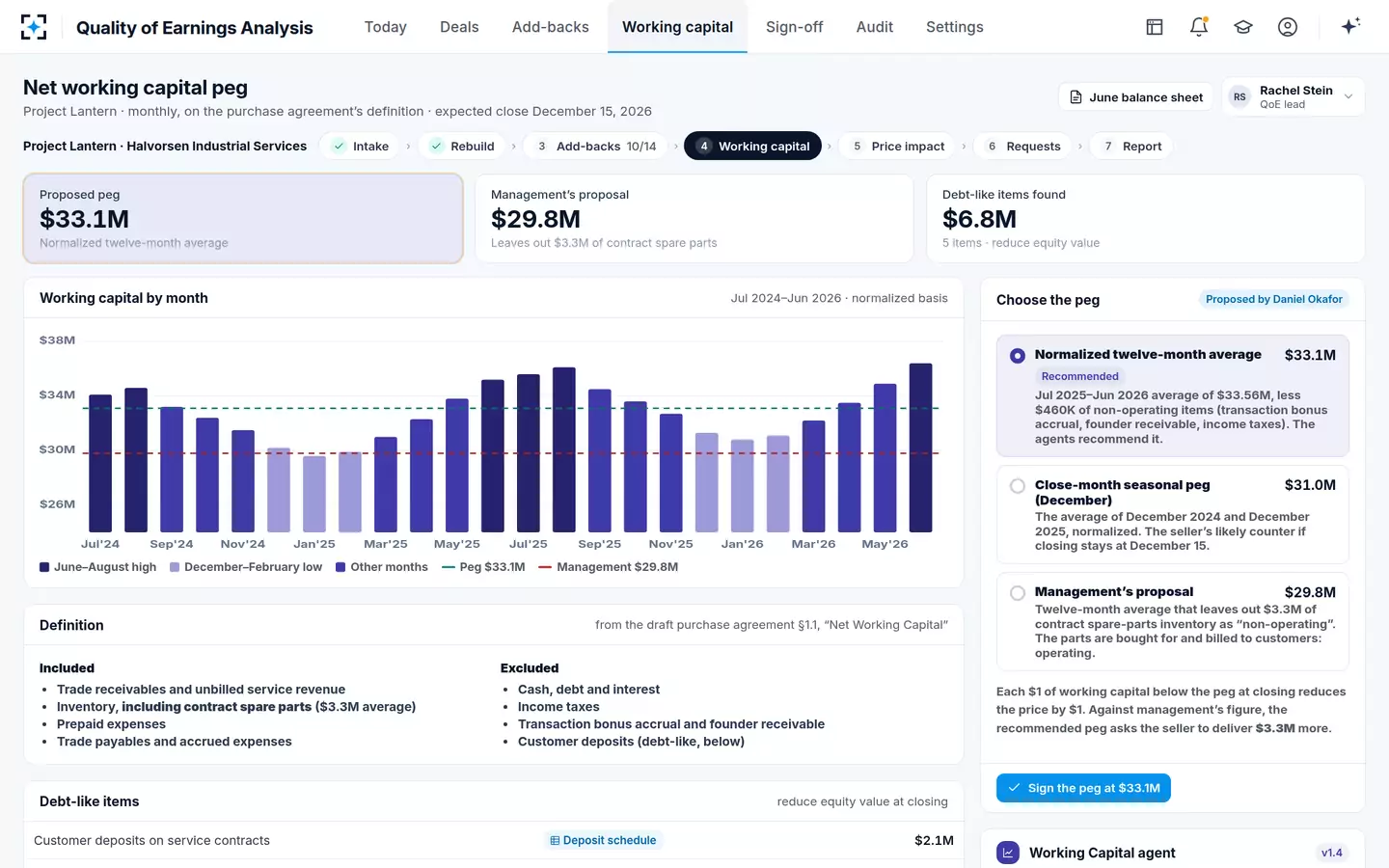
Seasonality also decides how many months to average. Twelve is the usual answer because it covers one full cycle. Fewer than twelve over-weights a season; more than twelve can blend in a period when the business was smaller or run differently. Where the business is growing fast, a twelve-month average understates what it will need at closing, and some buyers adjust the average for growth; the agreement should say which method applies.
What belongs in net working capital, and what does not
Operating current assets and liabilities belong in; financing, tax and one-off items stay out. The table sets out the usual treatment, with the sample deal's definition as the example.
Net working capital, in and out, on the sample deal's definition
| Item | Treatment | Why |
|---|---|---|
| Trade receivables and unbilled service revenue | In | Operating: revenue earned and not yet collected or invoiced |
| Inventory, including contract spare parts ($3.3M average) | In | Operating: bought for and billed to customers |
| Prepaid expenses | In | Operating: paid in advance for the business's own costs |
| Trade payables and accrued expenses | In | Operating: the business's normal credit from suppliers and staff |
| Cash, debt and interest | Out | Settled in the price through the cash-free, debt-free mechanism |
| Income taxes | Out | Usually handled by a tax indemnity or as debt-like |
| Transaction bonus accrual and founder receivable | Out | Caused by the sale or the owner, not by operations |
| Customer deposits on service contracts | Out, as debt-like | Cash received for work the buyer will have to perform |
Two accounting concepts sit behind the harder lines. Unbilled revenue is revenue recognised under IFRS 15 as goods or services pass to the customer (IFRS Foundation, IFRS 15), before an invoice exists; it is a current operating asset and belongs in the peg. Provisions, which IAS 37 defines as "a liability of uncertain timing or amount" (IFRS Foundation, IAS 37), need case-by-case treatment: a routine warranty provision is operating, a provision for a lawsuit is closer to debt.
Customer deposits are the classic boundary case. They are current liabilities, so a balance sheet definition would put them in working capital, where they would lower the peg. The sample deal's definition treats them instead as debt-like, because the buyer will have to perform the work without receiving the cash. Either treatment can be right if it is applied consistently to both the peg and the closing balance; switching between them is how a $2.1 million item gets counted twice or not at all. The equity bridge side of that boundary is worked through in debt-like items examples.
Who sets the working capital peg?
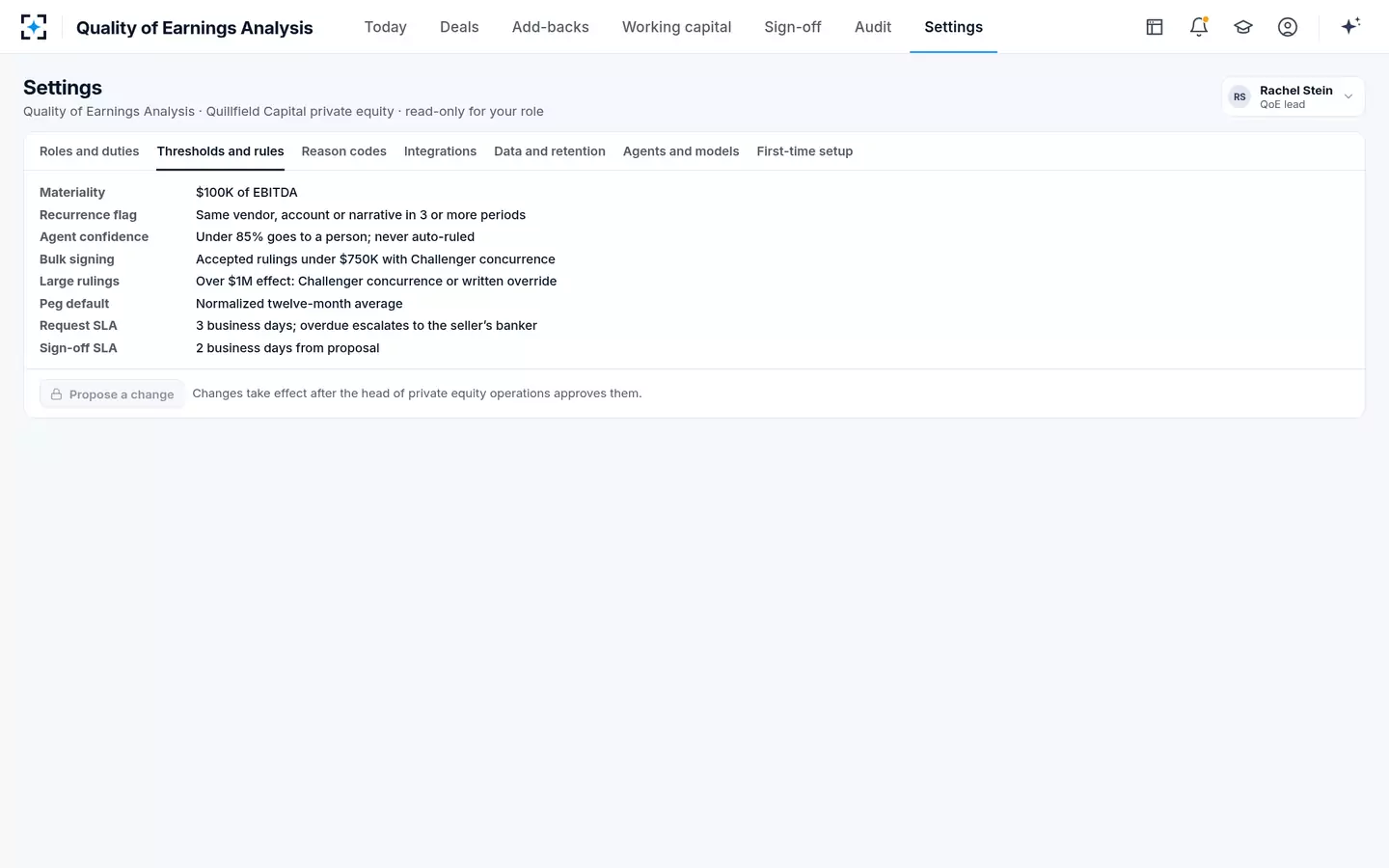
The buyer proposes it, the seller counters, and the purchase agreement fixes it. Inside the buyer, the peg should be proposed by whoever built the monthly analysis and signed by someone senior who did not, because it is worth as much as several add-backs together. In Quality of Earnings Analysis the Working Capital agent proposes options, the associate proposes one, and the QoE lead signs it; the firm's default method, a normalised twelve-month average, is a setting the head of private equity operations approves, and a deal can depart from it with a reason.
The peg default is a firm setting, changed only by approval
The seller's side will have its own analysis, often in a sell-side QoE. When the two disagree, the disagreement can be about one of three things: an account's inclusion, as with the spare parts; the averaging window, as with December; or a normalisation, such as whether a one-off spike in payables during a supplier dispute should be smoothed. A buyer whose proposal shows each month and each mapping can settle the first and third with documents, and negotiate only the second.
Disputes after closing, and how the definition prevents them
Post-closing working capital disputes can turn on measurement rather than arithmetic: the seller's estimate used one reserve policy, the buyer's closing balance sheet another. The cure is in the definition and the QoE that tested it. A peg calculated monthly on the same definition, with the same policies, gives both sides a series to compare the closing balance with; a peg that is a single number from a spreadsheet gives them nothing but the number.
Research on earnings quality supports the same discipline from another direction. Dechow, Ge and Schrand list accruals among the main proxies researchers use for earnings quality (Journal of Accounting and Economics, 2010), and working capital accounts are where accruals live. A peg is, in effect, a contract on the normal level of a company's accruals, which is why it deserves the same scrutiny as the add-backs.
Questions people ask
What is a net working capital adjustment at closing?
The cash settlement of the difference between actual working capital at closing and the peg. On the sample deal, a closing balance of $31.0 million against a $33.1 million peg would reduce the price by $2.1 million.
Is the working capital peg the same as the working capital target?
Yes. Agreements use peg, target and normalised level interchangeably; what matters is the definition of working capital and the measurement policies written beside it.
Should the peg use twelve months or the closing month?
Twelve months is the usual starting point because it covers a full seasonal cycle. A close-month peg suits a seller when the deal closes at a seasonal low; on the sample deal it would be $31.0 million against $33.1 million for the twelve-month average.
Does cash count in net working capital?
Usually not. Most buyouts are priced cash-free and debt-free, so cash and debt are settled separately in the price and kept out of the peg. Including cash would pay the seller twice for the same dollars.
Can the peg change after the LOI?
Yes, and it often should. The LOI may state a peg mechanism or a placeholder, but the level is usually fixed in the purchase agreement after the quality of earnings work has built the monthly series.