The quality of earnings process is the sequence of financial due diligence steps that turns a seller's adjusted EBITDA into a figure a buyer will pay a multiple for: request the data, rebuild earnings from the trial balances, test every add-back, look for adjustments the seller left out, measure the working capital peg and debt-like items, settle disputes with the seller and write the report. Its problem is timing. The letter of intent is usually signed on management's number before the process starts, and the report arrives weeks later, so every finding has to be won back from an anchor the seller set. Botminds' Quality of Earnings Analysis was built to move that clock: agents rebuild and test the whole general ledger as the data room opens, and the deal team signs each ruling before the price hardens.
The dates and figures below come from a fictional sample deal as it runs through the solution: Project Lantern, in which Quillfield Capital Partners IV signed a letter of intent for Halvorsen Industrial Services on September 24, 2026, at 10.0x management's adjusted EBITDA of $29.19 million. Research figures are from peer-reviewed studies and the SBA, linked where they appear.
The quality of earnings process sits where deals are won and lost
13.6
of every 100 opportunities reach a signed LOI, on average, in a survey of PE investors
6.1
of every 100 close: fewer than half of signed LOIs, on the same averages
$291.9M
sample LOI, signed on management's EBITDA before the data room opened
sample deal
21.9%
of the sample LOI value the signed numbers took off before the investment committee
sample deal
What is the quality of earnings process?
It is a chain of a dozen steps, each depending on the one before. The data has to arrive before it can be mapped; the earnings have to be rebuilt before an add-back can be tested against them; the add-backs have to be ruled before the peg and the price mean anything. A delay early in the chain, such as a missing month of trial balances, moves every later step.
Quality of earnings procedures, in the order they depend on each other
A person decides
Request listThe QoE lead sends the seller a list: monthly trial balances and general ledgers, the add-back schedule, invoices, contracts, payroll, minutes, budgets.
Agent
Data room intakeEvery file classified, foreign charts of accounts mapped, completeness checked against the request list.
Never: maps an account under 85% confidence, or fills a missing month.
Agent
Rebuild and tie-outMonthly EBITDA rebuilt from the trial balances and tied to the audited statements and the CIM.
Never: changes a reported number.
Agent
Add-back testing and recurrenceEach add-back vouched against every general-ledger entry behind it; each "one-time" cost read across the whole period.
Agent
ChallengeA separate agent argues the seller's side of each large ruling before a person sees it.
A person decides
Rulings proposed and signedThe associate proposes; the QoE lead signs with a reason code. Unsigned lines stay at management's claim.
Agent
Working capital, peg and debt-like itemsMonthly working capital on the draft purchase agreement's definition, with peg options and the equity bridge.
Never: sets the peg; it only proposes options.
A person decides
Seller questions and the reportDisputes answered with evidence; the report and databook drafted from signed numbers only.
The SBA's 2026 rule for its acquisition loans adds two steps that many buyout reports leave out: a cash proof that rebuilds receipts and payments from the bank statements and ties them to the income statement and tax return for every period reviewed, and an assessment of "customer concentration risk, contract continuity, and the likelihood that existing revenue and margins will be maintained post-sale" (SBA SOP 50 10 8.1). Both belong in a buyer's process too.
When is a QoE done in an acquisition?
The buyer's full quality of earnings work is usually done in exclusivity, after the letter of intent and before the purchase agreement is signed. That is when the seller opens the data room fully, and when the buyer is willing to pay for deep work because it has a deal to lose. A seller may commission a sell-side QoE before marketing the company; a lender may require its own; and the deal team does a lighter version of the analysis earlier, from the CIM and management meetings, the first read how to read a CIM walks through. The weeks of exclusivity it has to fit into are counted in how long due diligence takes on a buyout.
On the sample deal the sequence is typical. The LOI was dated September 24, 2026. The data room opened on October 5. The investment committee meets on October 29 and closing is expected on December 15. Everything the QoE finds has to fit inside the 35 days between LOI and committee, and most of it inside the 24 days after the data room opened.
The price clock started eleven days before the QoE clock could
- LOI signed11 d
- Exclusivity, data room open24 d
- No data room11 d
- Intake and rebuild9 d
- Rulings signed6 d
- Peg and papers9 d
Does the QoE come before or after the LOI?
In most competitive processes the full QoE comes after the LOI, and that order is the problem this page is about. The LOI states a price, or a multiple of management's adjusted EBITDA, before anyone on the buyer's side has rebuilt that EBITDA from the books. Exclusivity then gives the buyer weeks to find out what it has agreed to.
Nothing in law requires that order. It follows from incentives: a seller wants competing bids on its own number before it opens its general ledger to any one bidder, and a buyer does not want to pay advisers for deep work on a deal it may not win. The result is a process in which the price moves first and the evidence second.
The anchor problem: negotiating down from management's number
Once a number is on the table, adjustments start from it. Tversky and Kahneman showed that people forecasting a number start from any relevant value to hand and adjust from it too little, and noted that such heuristics, though usually effective, "lead to systematic and predictable errors" (Science, 1974). A signed LOI at 10x management's EBITDA is as relevant a value as a deal produces.
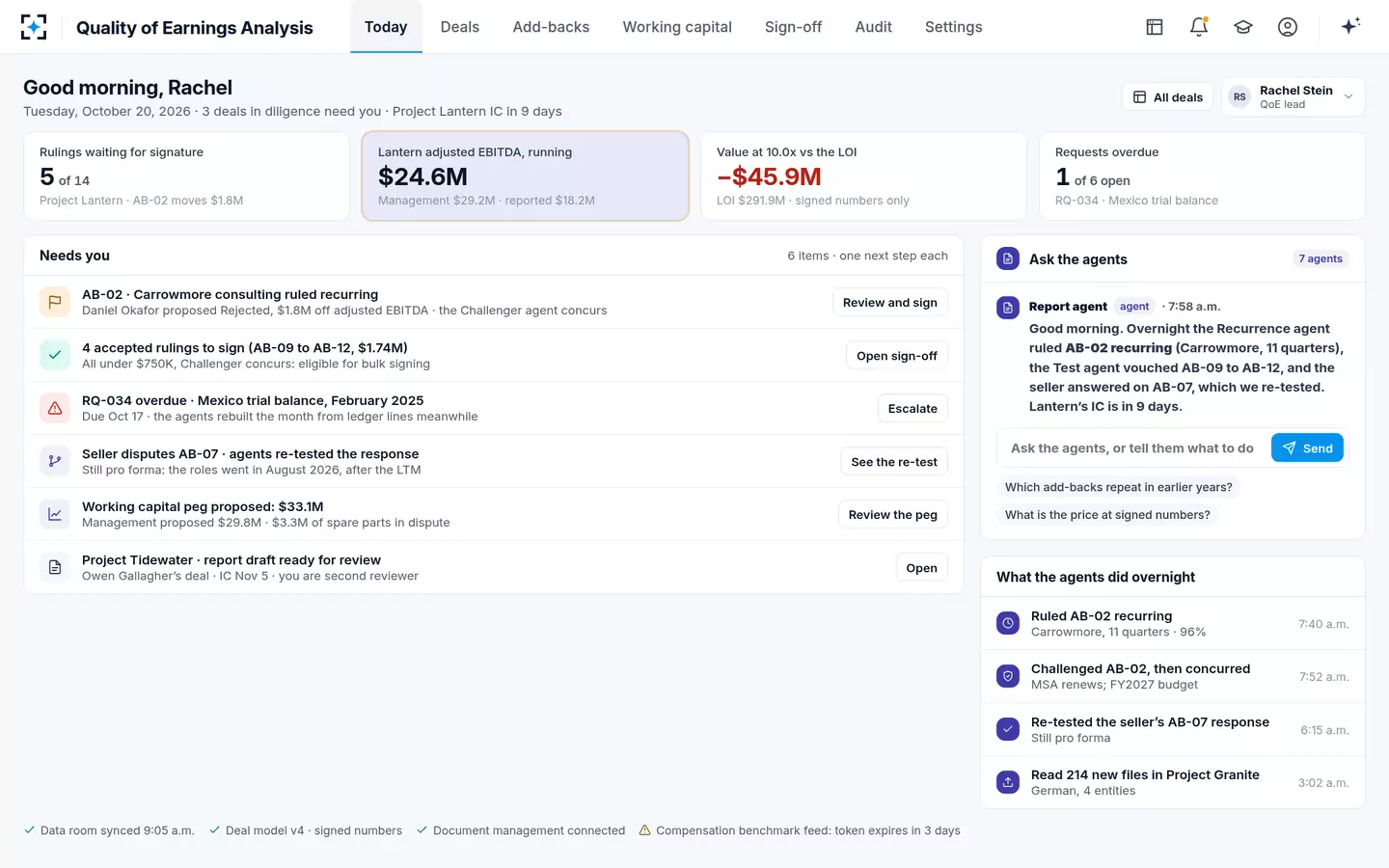
The anchor also shifts the burden of proof. Before the LOI, the seller has to persuade bidders that each add-back is real. After it, the buyer has to prove each one is not, against a deadline and in front of a seller who can point to the signed letter. On the sample deal the rulings that matter most were all signed in the last two weeks before committee: the $1.8 million consulting add-back on October 20, the $1.25 million headcount reduction and the $860,000 new-contract run-rate on October 15.
Nine days before committee: what the QoE lead still has to sign
What happens if the QoE finds lower EBITDA?
The buyer has three moves: re-price, re-structure or walk. Re-pricing applies the agreed multiple to the lower figure; on the sample deal, signed adjusted EBITDA of $22.8 million at 10.0x is $228.0 million of enterprise value against the $291.9 million LOI, $63.9 million less. Re-structuring keeps the headline but moves risk to the seller, through an earn-out on the disputed earnings, an escrow or a specific indemnity. Walking away is the answer when the gap says something about management's candour, not just its arithmetic.
Which move works depends on how the finding is documented. A ruling with the general-ledger entries, the invoices, the contract clause and the board minute behind it is a negotiating position. A finding that rests on an adviser's sample is an opinion the seller can dispute. That is why the process matters as much as the result: a docket in which every ruling carries its evidence turns a price conversation into a conversation about documents.
A finding with its invoices, clause and board minute attached is a negotiating position. A finding from a sample is an opinion the seller can dispute.
What research says about weak numbers and deals that fail
The research on public targets is consistent: poor financial reporting makes deals slower, more expensive and more fragile. Skaife and Wangerin find that "acquirers offer higher premiums for targets with low quality financial reporting," but also that low-quality reporting "increases the likelihood of deal renegotiation, and contributes to the probability of deals going bust," and that "failed targets are more likely to restate their financial statements after the announcement of the deal" (Contemporary Accounting Research, 2013).
Marquardt and Zur find the mirror image: target accounting quality is positively associated with a negotiated rather than auctioned deal, "the speed with which the deal reaches final resolution," and "the likelihood that the proposed deal is ultimately completed" (Management Science, 2015). And Wangerin, studying the time acquirers spend before closing, links less due diligence with weaker profitability and more goodwill impairments after the deal (Contemporary Accounting Research, 2019).
The first two studies are about public targets and the third about public acquirers, where buyers start from audited public filings. Private targets usually offer less, which makes the point stronger: the less a buyer can see before the LOI, the more the QoE process carries.
A first cut before the price hardens
The fix is not to skip the adviser's report; it is to stop waiting for it to learn the answer. A first cut, done by the deal team as soon as trial balances and the add-back schedule are available, changes three things. The buyer knows before committee which add-backs are in dispute. The questions to the seller go out in the first week, with the evidence that prompted them. And the adviser's work starts from a docket rather than a blank page.
Where a seller will share monthly trial balances before the LOI, even for a limited set of accounts, the first cut can come before the price. Where it will not, the next best moment is the day the data room opens. Quality of Earnings Analysis has a design target of a first-cut QoE three days after the data room opens. On the sample deal the data room opened on October 5 with one month of trial balances missing; the Rebuild agent reported its tie-out on October 14, and every add-back had a proposed ruling by the morning of October 20, nine days before committee.
Where a first cut's working days go, by hand and with agents
By hand · 25 days
- Intake and chart mapping · 16%
- Rebuild and tie-out · 20%
- Vouching add-backs · 28%
- Recurrence and missing adjustments · 12%
- Working capital and debt-like · 12%
- Databook and report · 12%
With agents · 3 days
- Intake and chart mapping · 17%
- Rebuild and tie-out · 17%
- Vouching add-backs · 33%
- Recurrence and missing adjustments · 8%
- Working capital and debt-like · 17%
- Databook and report · 8%
Who carries the process inside the deal team
A first cut only changes the negotiation if someone with authority stands behind it. In Quality of Earnings Analysis the associate proposes each ruling, the QoE lead signs it with a reason code, and the deal partner sees only signed numbers; unsigned rulings count at management's claim. That rule matters most under time pressure: it stops a draft finding from reaching the price, or the committee, before a person has read the evidence. How those roles divide, and why the proposer never signs, is the subject of who performs a quality of earnings report.
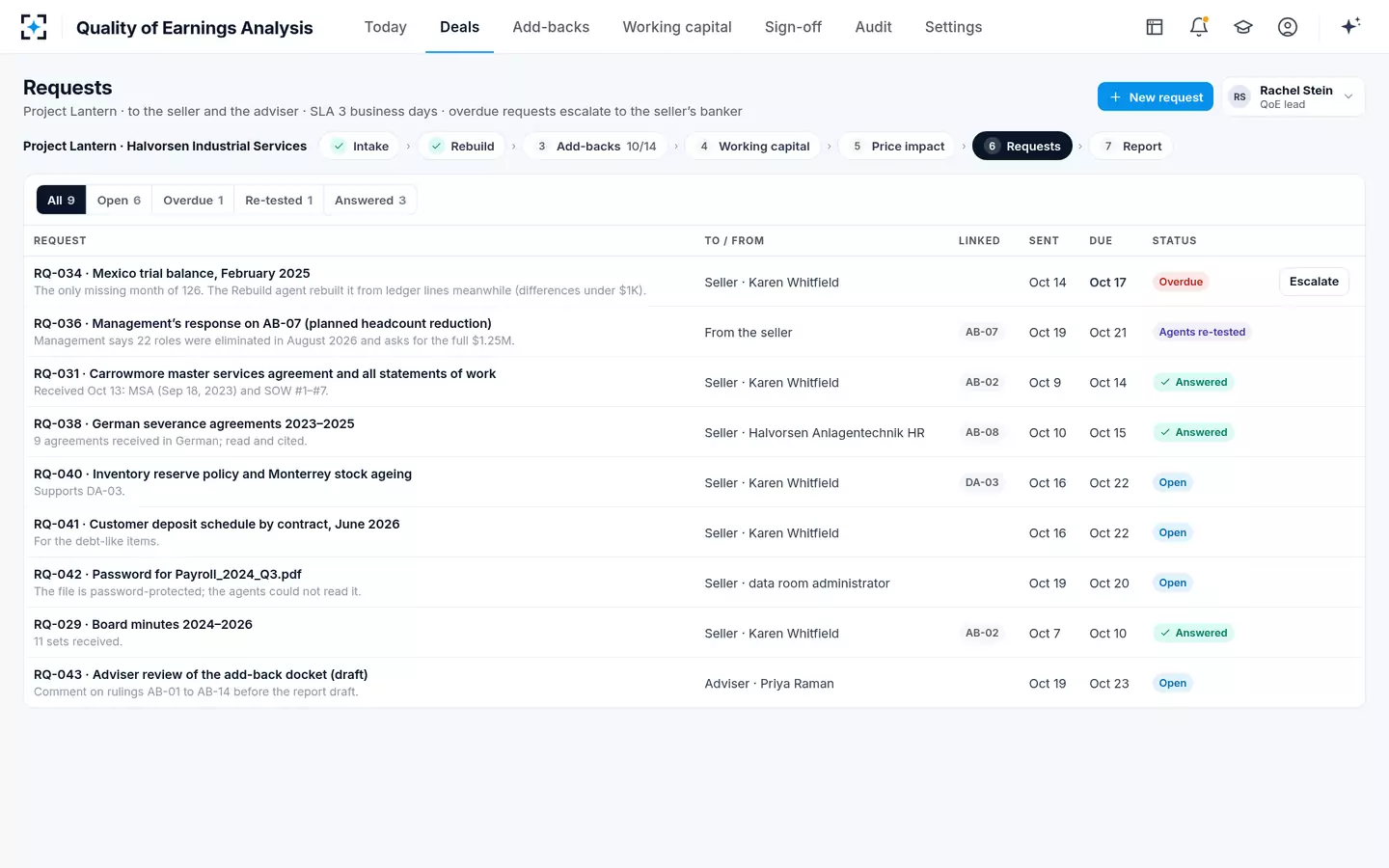
The seller's side of the process runs through requests. Each request carries a due date and an owner, and overdue items escalate to the seller's banker after three business days on the sample deal's settings. The request list is also where disputes end: the seller's rebuttal on a ruling arrives as an answer to a request, and the agents re-test it against the evidence before anyone replies.
Requests to the seller, with due dates and the disputes they carry
How long does the quality of earnings process take?
There is no published standard. Neither the SEC, the PCAOB nor the SBA sets a timetable, and advisers do not publish typical durations in a form anyone can check. What sets the length is the readiness of the seller's data, the number of entities and languages, the number of add-backs and the number of rounds of questions. The useful measure is not total weeks but how many of them fall after the LOI, and how many rulings are signed before the investment committee meets.
A deal team can measure that on its own last three deals: the LOI date, the data room date, the date of the adviser's first draft, and the date each material add-back was settled. The gap between the first and the last of those dates is the period in which the buyer was negotiating from the seller's number. For choosing between quality of earnings providers and an in-house first cut, that gap is the number to compare.
Questions people ask
Can a buyer renegotiate the price after the QoE?
Usually yes, because an LOI is typically non-binding on price, though it shapes expectations. On the sample deal the signed numbers put enterprise value at $228.0 million against a $291.9 million LOI. Research on public deals finds that poor target reporting raises the likelihood of renegotiation and of deals failing outright.
Who orders the QoE, the buyer or the lender?
In a buyout, usually the buyer, and sometimes the lender separately. For SBA 7(a) acquisition loans of $3 million or more, the rule is that the QoE "must be conducted for the benefit of the Lender"; a buyer's own report may be used only after one of the lender's vendors reviews it.
What is a sell-side QoE in the process?
A report the seller commissions before going to market, to find problems early and support its adjusted EBITDA. It can shorten a buyer's work, but it is the seller's case, and a buyer still tests the add-backs that matter to its price.
What slows the quality of earnings process most?
Missing data and disputed add-backs. On the sample deal one month of Mexican trial balances was overdue and rebuilt from general-ledger detail meanwhile, and the seller disputed the headcount add-back with an August 2026 payroll after the LTM had closed.
Is the QoE finished before signing or before closing?
Before signing the purchase agreement, in most buyouts, because the price and the peg are written into it. Closing-date work, such as the true-up of working capital against the peg, comes after and uses the definitions the QoE settled.