How long due diligence takes depends on the deal, and for a buyout no regulator prescribes a period and no independent study publishes a typical one; the best published evidence puts it in weeks, not days. Venture investors surveyed by Gompers, Gornall, Kaplan and Strebulaev reported that an average deal took 83 days to close, and in one acquisition documented by a Delaware court the buyer had largely finished diligence 32 days after it entered the data room and signed 70 days after. The time is hard to compress because most of it goes on reading thousands of files in the seller's languages, waiting for translations and answers, and reconciling advisers' findings. Botminds' Virtual Data Room Due Diligence shortens those stretches, reading and translating the whole room as it arrives, while every decision still waits for the deal lead.
Where this guide uses the product, it follows a fictional sample deal run through the solution: Quillfield Private Equity Fund V buying Skarvik Logistik AB, a Swedish contract-logistics company, from a seller's room of 5,418 documents in six languages that opened on Monday 12 October. The deal and its figures are sample data, not a customer result.
Four clocks a deal team works against
83days
average time to close a venture deal, as investors reported it (survey, 2020)
32days
from data room access to diligence largely finished, one documented acquisition (2017)
30days
US waiting period after the HSR filings, before a reportable deal may close
46hours
from access to a first full read and cited report, on the sample room
How long does due diligence take for an acquisition? What the evidence shows
The largest published survey puts the average venture deal at a little under three months to close, and it shows the time stretching with the complexity of the company. Venture capital is not buyout, and the firms surveyed review smaller companies with thinner data rooms, but it is the only large sample that asks investors the question directly. The authors report that the deal period and the time spent on diligence "are shorter for early-stage, IT, and California firms; and longer for late-stage, healthcare, and non-California firms" (NBER working paper 22587, published in the Journal of Financial Economics, 2020).
Days to close a venture deal, by kind of investor
The pattern is the useful part. Late-stage companies have more history and more documents, and healthcare companies carry regulatory files; both take longer. A mid-market buyout target, with years of audited accounts, hundreds of customer contracts and operations in several countries, sits closer to the long end of that range than the short one.
One acquisition, date by date: a diligence timeline from a court record
Court opinions rarely give a buyer's diligence calendar, but the Delaware Court of Chancery's opinion in Akorn v. Fresenius Kabi does, because the timing became evidence. The buyer and target signed confidentiality agreements on 8 November 2016. The target would not open its data room until the buyer improved its bid, telling it that it "would need to improve its bid to gain access to the data room". Access came on 13 February 2017. By 2 March, "the Fresenius due diligence team had been working for just over two weeks" and had a preliminary red-flag finding; "Fresenius had largely finalized its due diligence by March 17, 2017"; and "On April 24, 2017, they executed the Merger Agreement" (Akorn v. Fresenius Kabi, Del. Ch., 1 October 2018).
From confidentiality agreement to signing: 167 days, 32 of them in the room
- Bid negotiation before room access97 d
- Red flags17 d
- Finalised15 d
- Price and agreement38 d
Two things stand out. The data room phase was the shortest part of the calendar, about a month, framed by three months of negotiating access and five weeks of agreeing price and terms. And the same opinion shows what a month could not find: the final presentation to the buyer's supervisory board "did not identify risks related to data integrity", the issue at the centre of the later litigation. A fast calendar is only as good as what it covered.
When does due diligence start?
Due diligence starts in earnest when the data room opens, which usually follows a signed confidentiality agreement and an indicative bid the seller is willing to engage on; confirmatory diligence follows a letter of intent or exclusivity. The Akorn record shows the hurdle a seller can put in front of the room: a better bid first, then access. In the sample deal, access was granted on Monday 12 October at 10:05 under a non-disclosure agreement dated 2 October.
The start date matters beyond the calendar. Under the US tax rules on acquisition costs, investigatory spending generally becomes a cost of the acquisition, to be capitalised, from the earlier of the date "a letter of intent, exclusivity agreement, or similar written communication (other than a confidentiality agreement) is executed" or the date the board approves the material terms (26 CFR 1.263(a)-5(e)(1)). What that means for a diligence budget is set out in due diligence costs.
Where the weeks go: reading is the long part, deciding is not
Most diligence time goes on getting to the point of a decision: indexing, translating, reading and reconciling. The decisions themselves, what to do about a flag, take hours. Botminds estimates the split for a mid-market buyout room of about 5,000 files below; it is an estimate from the product's design, not a measurement on a customer's deal.
Where Virtual Data Room Due Diligence estimates the diligence days go, by hand and with the solution
- Index2
- Translate5
- Read12
- Link3
- Ask2
- Merge4
- All2
The longest bar by hand is reading by workstream, twelve days in the estimate, and the second is waiting for translation. The bar that is easiest to underrate is the last one: merging four advisers' red-flag reports into one report for the committee, which by hand means reconciling findings written in different formats, often about the same contract. On the sample room the first full read and the first cited report were ready 46 hours after access. What none of that changes is the time the deal lead needs to decide, the seller needs to answer, or the committee needs to meet.
What slows due diligence down?
Five things slow a diligence more than its size: documents in other languages, documents that cannot be read, documents that arrive late, questions that wait for the seller, and findings that need two workstreams to size. Each one is visible in the sample room.
Five things that slow due diligence, as they showed up in the sample room
| What slows it | In the sample room | What to do about it |
|---|---|---|
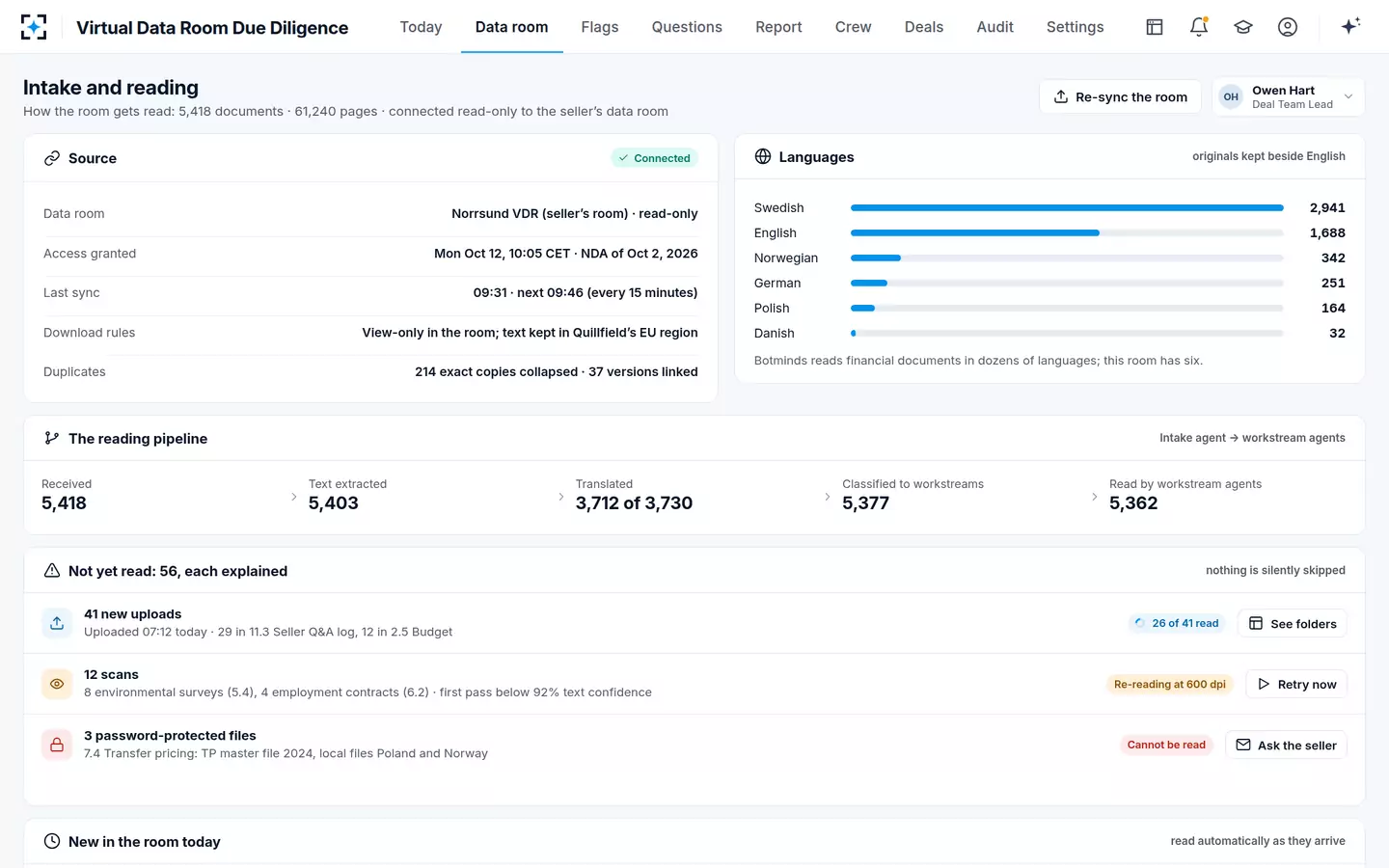
| Other languages | 3,730 of 5,418 documents needed translation: Swedish, Norwegian, German, Polish and Danish | Translate on arrival and keep the original beside the English, so a lawyer can check the clause |
| Files that cannot be read | 12 scans below 92% text confidence; 3 password-protected transfer-pricing files | Re-read scans at higher resolution; turn locked files into a question to the seller the same day |
| Late uploads | 41 files arrived at 07:12 on one morning, 29 of them in the seller’s Q&A log | Re-sync the room on a schedule and read new files through the same steps as the first ones |
| Questions waiting on the seller | 64 questions drafted, 12 merged as duplicates, released only by the deal lead | Merge duplicates across workstreams before release, and route each to the adviser in scope |
| Findings that need two workstreams | A termination right sized against the revenue file; a factoring line the agents disagreed on | Cross-check each flag with a second workstream, and send disagreements to a person at once |
Where the reading stands, and why the unread files are unread
Is longer due diligence better?
Less diligence is linked to worse results, but the evidence is about depth, and time is only its proxy. Studying public acquirers, Wangerin measured diligence by the time taken to negotiate the agreement and complete the deal, and found that less of it is associated with lower profitability after the acquisition, a higher chance of goodwill impairments and weaker fair value estimates; he also found that "competitive pressures, short‐term financial reporting incentives, and agency problems are associated with less due diligence" (Contemporary Accounting Research, 2019).
The practical reading for a buyout is not to ask for more weeks, which an auction rarely gives, but to stop spending the weeks on work that is not judgement. Twelve days of reading and five of waiting for translations are time the deal team cannot spend asking the seller the right questions. A shorter read that covers the whole room leaves more of the calendar for the part that the research ties to outcomes.
How long is exclusivity in private equity, and who sets it?
Exclusivity lasts as long as the letter of intent says, and no regulator or independent study publishes a typical period; it is negotiated deal by deal, and extended by agreement when diligence runs long. Two things make the number worth planning around. It is the window in which the buyer's reading has to be finished, so a buyer should set it against a reading plan for the room it has seen, not against a habit. And it is a tax date: signing an exclusivity agreement is one of the events that start the capitalisation of diligence costs under the US rules quoted above.
A seller in an auction will push for a short period; a buyer facing a room in five languages will want a longer one. The argument that wins is specific: the number of documents, the share needing translation, and the date by which the buyer will issue its first full red-flag report. How that report is structured and versioned is the subject of the red flag report guide.
What happens after due diligence? The clocks between signing and closing
After diligence comes the committee's decision, then signing, then the regulatory clocks, then closing; in the US, a reportable deal cannot close until the HSR waiting period has run. The waiting period ends 30 days after the filings are received, 15 for a cash tender offer, and a request for more information extends it until 30 days after the parties have substantially complied (15 U.S.C. 18a).
From the committee to closing: what remains after diligence
| Step | What governs it | What the deal team does |
|---|---|---|
| Investment committee | The firm’s own approval process | Presents the signed red-flag report, with open flags and the coverage statement |
| Signing | The purchase agreement | Turns each decided flag into price, protection, condition or plan |
| US merger filing | HSR Act, where thresholds are met | Both parties file; the form in use is the one from before February 2025, after the new form was vacated |
| Waiting period | 30 days from the filings (15 for a cash tender), longer after a request for more information | Keeps the target independent; no control, no coordination of prices or customers |
| Closing | Conditions in the agreement, including consents and waivers | Confirms conditions such as a customer’s written waiver are met |
| First 100 days | The value creation plan | Works the flags the deal lead assigned to the plan |
The waiting period is also where diligence habits can cause harm. In the record US gun-jumping case, settled for $5.6 million in January 2025, the buyers were alleged to have stopped the target's drilling and coordinated its customer prices before the period ended (FTC, 7 January 2025). Diligence information keeps flowing after signing, and what may flow, to whom, is governed by the clean team rules set out in the clean team agreement guide.
Planning the diligence calendar backwards from the committee date
Plan diligence backwards from the date the committee meets: the report it reads, the decisions the report needs, the answers those decisions need, and the reading the questions need. On the sample deal the committee was set for Tuesday 27 October, fifteen days after the room opened. The first full read and cited report came on 14 October, a second version with 24 decisions on 16 October, and a third with 33 on 19 October, leaving eight days for the remaining flags, the seller's answers and the two signatures.
The deal lead's morning, eight days before the committee
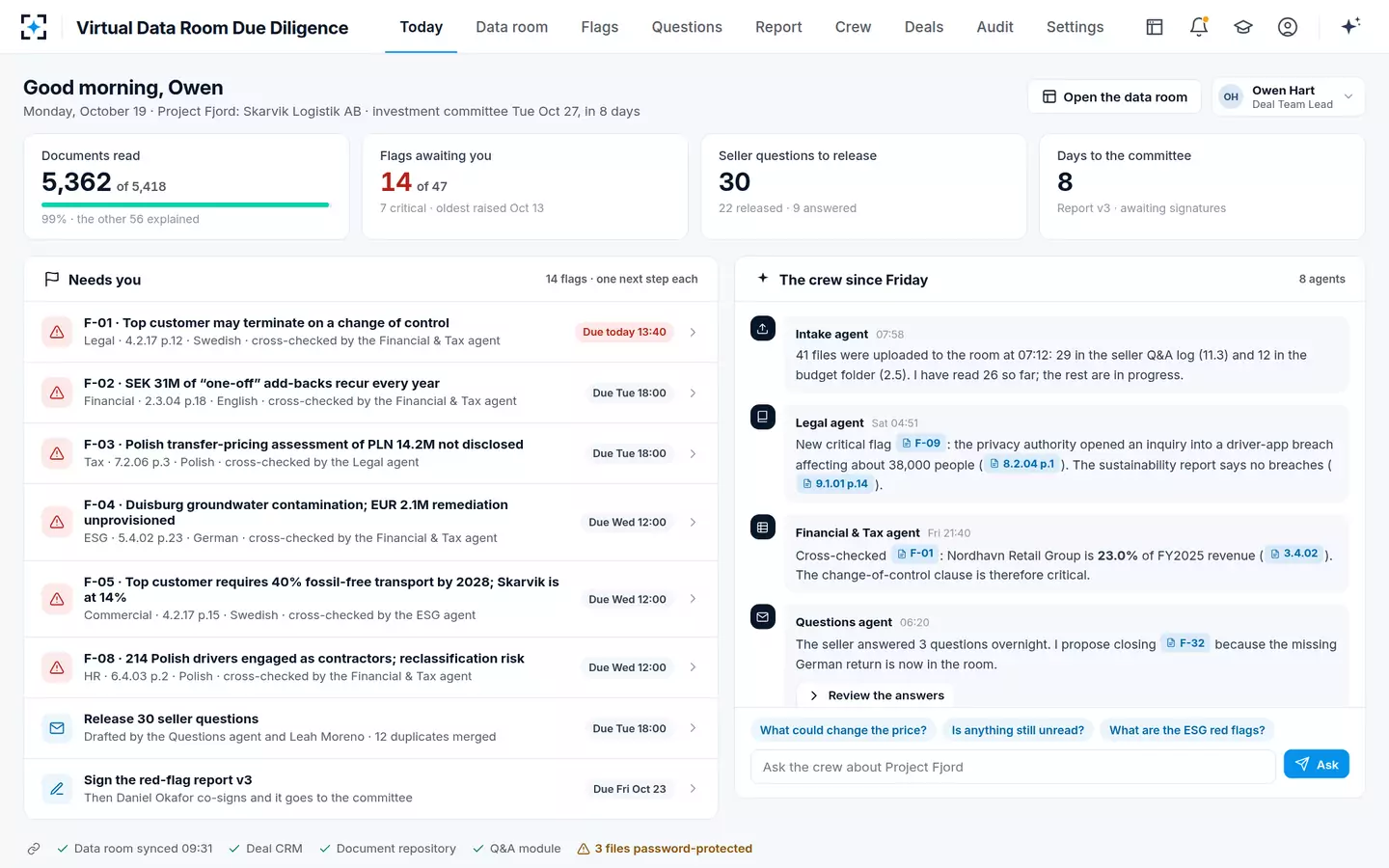
Working backwards turns the calendar into decisions with deadlines: the largest flag due that afternoon, the seller questions due for release the next day, the report due for signature four days before the committee. To see it on a room of your own, start from Virtual Data Room Due Diligence.
Questions people ask
How long does due diligence take when buying a business?
There is no standard period; it depends on the size of the business, the number of documents and countries, and how quickly the seller answers. For a small business with a few hundred documents it can be a matter of weeks; for a buyout with thousands of documents in several languages, the documented examples run to a month or more of reading inside a longer calendar.
Can the due diligence period be extended?
Yes, by agreement between buyer and seller, usually by extending the exclusivity period in the letter of intent. A request is stronger with specifics: what remains unread and why, which questions are with the seller, and when the red-flag report will be final.
How long does an HSR review take?
The statutory waiting period is 30 days after both filings are received, or 15 days for a cash tender offer. The agencies can end it early, or extend it by requesting more information, in which case it runs until 30 days after the parties have substantially complied. Other countries' merger reviews run on their own timetables.
How long does it take to read a data room with AI?
On the fictional sample room of 5,418 documents and 61,240 pages in six languages, the first full read and first cited red-flag report were ready 46 hours after access. That is a sample result, not a guarantee; scans, locked files and late uploads keep the count moving, which is why each unread file is listed with its reason.
How long does a data room stay open?
As long as the seller keeps it open, usually through signing and often to closing. If the deal ends, the confidentiality agreement governs return or destruction; in the sample firm's settings, seller material is destroyed within 30 days with a destruction certificate.