A change of control clause is a contract term that gives one party a right when control of the other changes hands: most often a right to terminate, a right to refuse consent, or, in a loan, a right to be repaid. In a buyout the target is the party whose control changes, so every customer, supplier, landlord, lender and licensor with such a clause gains an option the moment the deal closes. Finding the clauses is the legal workstream's job; deciding which ones matter needs the customer's share of revenue, which the financial workstream holds. Botminds' Virtual Data Room Due Diligence reads every contract in the data room for these clauses and has an agent from a second workstream size each one, so a clause reaches the deal team as a number, cited to the page that found it and the page that sized it.
The examples below come from a fictional sample deal run through the solution: Quillfield Private Equity Fund V buying Skarvik Logistik AB, a Swedish contract-logistics company with SEK 4,520 million ($429 million) of revenue, from a data room of 5,418 documents in six languages. The companies, the people and every figure about them are sample data, not a customer result.
One question to the room, and what it found
9documents
with change of control rights, found in answer to “which contracts need consent?”
23.0%
of the target’s revenue from the one customer that may terminate
$14.4M
EBITDA contribution of that customer, from the financial workstream
$42M
holdback the deal lead chose as the treatment, about 2.9 times that contribution
What is a change of control clause?
A change of control clause gives a counterparty a right that is triggered when control of the other party changes, whether or not anything else in the relationship changes. The right comes in five common forms, and each one is sized differently: termination, where the counterparty may simply leave; consent, where the deal needs the counterparty's agreement; repayment, where a lender may demand its money back; repricing, where terms reset; and payments, where an employee or manager receives money or accelerated vesting.
It is not the same as an anti-assignment clause, and the difference decides whether a buyout triggers it. An anti-assignment clause stops a party transferring the contract to someone else. In a share purchase, the target company keeps its contracts; only its owner changes, so nothing is assigned. A change of control clause is written for exactly that case. The sample room shows the range: a customer that may terminate, six smaller customers whose consent is needed, a revolving credit facility that becomes prepayable, a warehouse lease that needs the landlord's consent and a software licence that ends.
What does a change of control clause look like?
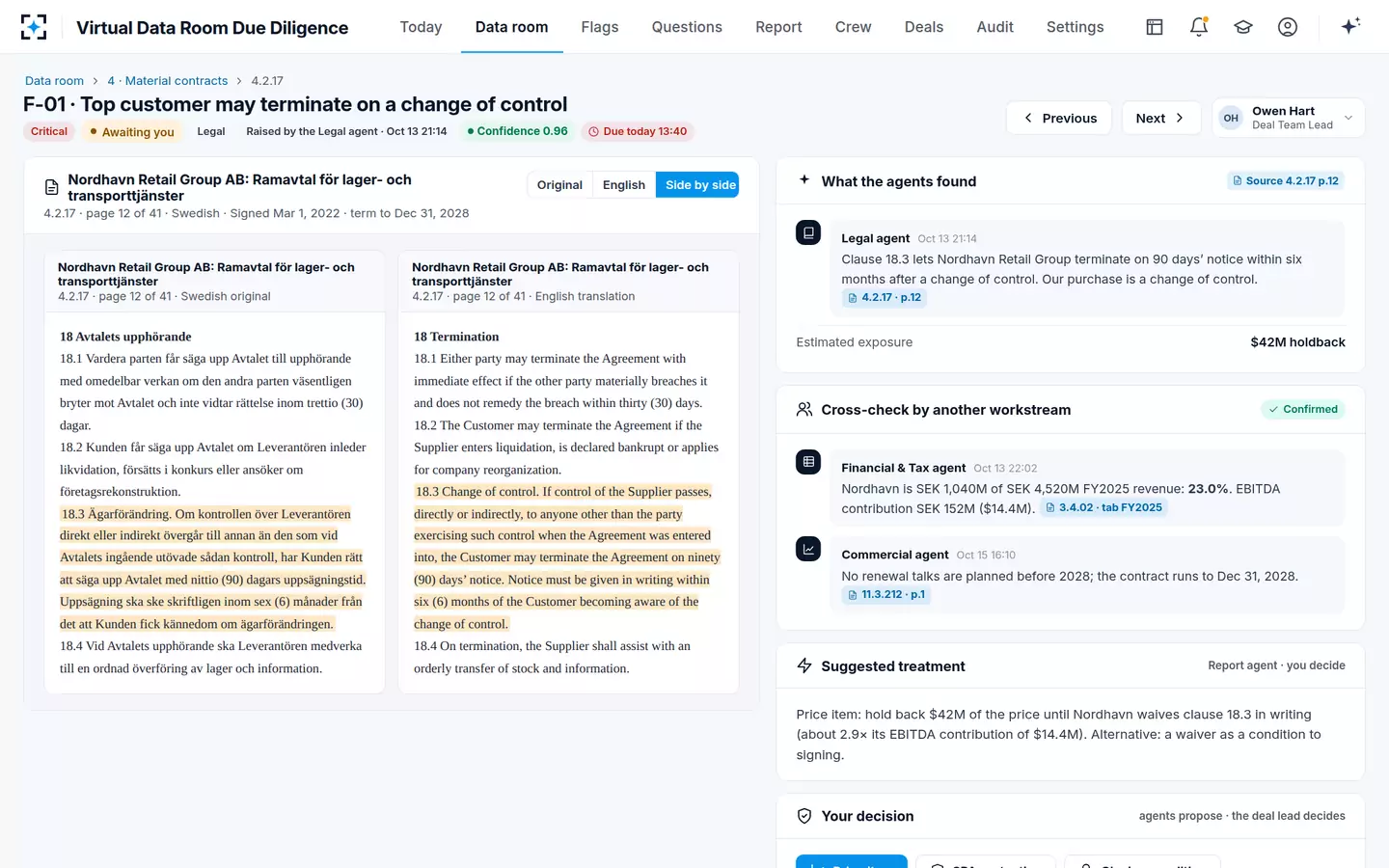
A change of control clause has five working parts: what triggers it, how far up the ownership chain it reaches, the baseline it is measured against, the right it gives, and the window in which the right can be used. Reading it part by part is what turns "there is a change of control clause" into a finding a buyer can price. Clause 18.3 of the sample customer contract, in the English translation the solution shows beside the Swedish original, has all five.
Clause 18.3 of the sample customer contract, read part by part
Trigger
If control of the Supplier passes,
Control, not ownership of a share: a definition elsewhere in the contract may set the threshold.
Reach
directly or indirectly,
Catches a sale of the parent or of any holding company above the supplier, not only of the supplier itself.
Baseline
to anyone other than the party exercising such control when the Agreement was entered into,
Measured against who controlled the supplier at signing in 2022, so any new owner triggers it.
Right
the Customer may terminate the Agreement on ninety (90) days’ notice.
A right to leave, not a right to consent: the customer does not need a breach or a reason.
Window
Notice must be given in writing within six (6) months of the Customer becoming aware of the change of control.
The exposure runs for six months from when the customer learns of the deal, which may be the announcement.
Two parts deserve a second read. "Directly or indirectly" means the clause does not care where in the structure the sale happens: a fund buying the target's parent triggers it as surely as buying the target. And the six-month window runs from when the customer becomes aware of the change, not from closing, so a deal announced months before it closes can start the clock early. The termination right also needs no reason. The customer does not have to show that the new owner is worse; it only has to give 90 days' notice.
Is a share sale a change of control? Read the clause, not the deal structure
A share sale is a change of control under any clause that says so, and usually not an assignment under a clause that only bans assignment. Delaware's Court of Chancery stated the second half plainly: "Under Delaware law, stock purchase transactions, by themselves, do not result in an assignment by operation of law." In the same case it held that a reverse triangular merger, the usual US structure for buying a company, "was not an assignment by operation of law or otherwise", reasoning that "Both stock acquisitions and reverse triangular mergers involve changes in legal ownership, and the law should reflect parallel results." Its answer to the counterparty that lost: "In sum, Meso could have negotiated for a “change of control provision.” They did not." (Meso Scale Diagnostics v. Roche Diagnostics, Del. Ch., 22 February 2013).
Anti-assignment or change of control: which one a buyout trips
Clause that bans assignment only: Under Delaware law, not an assignment by itself (Meso Scale)
Clause that names a change of control: Triggered, if control passes as the clause defines it
Clause that bans assignment only: Held not to be an assignment in Meso Scale
Clause that names a change of control: Triggered on the same test
Clause that bans assignment only: Nothing is assigned
Clause that names a change of control: Triggered if the clause reaches indirect changes, as “directly or indirectly” does
Clause that bans assignment only: An assignment: consent needed
Clause that names a change of control: Depends on drafting; the anti-assignment clause usually decides
The practical rule for a data room reader follows from the court's words. Search for both kinds of clause, read the definition of control the contract uses, and note the governing law, because a Delaware result says nothing about a Swedish, Norwegian or Polish contract. In the sample room, the customer contracts shown in one subfolder alone are written in Swedish, Norwegian, German and Polish.
Why is a change of control clause only half a finding without its revenue?
A change of control clause tells the buyer that a counterparty has an option; only the counterparty's weight in the business tells the buyer what the option is worth. The same clause in a contract worth 0.1% of revenue and in one worth 23% is a footnote in the first case and a price item in the second. The sample firm's playbook writes this down as rule L-07: a customer above 10% of revenue with a change of control right is a critical flag, and it must be cross-checked by the legal and financial workstreams together.
What sizes each kind of change of control right, with the sample deal's results
Customer agreement with a termination right
What the clause doesThe customer may leave
What sizes itIts revenue and EBITDA contribution, from the revenue file and the databook
In the sample roomNordhavn: 23.0% of revenue, SEK 152M ($14.4M) EBITDA contribution · price item, $42M holdback
Customer agreements needing consent
What the clause doesThe new owner needs a yes
What sizes itRevenue under the contracts, and how many consents are outstanding
In the sample roomSix smaller customers: SEK 118M of revenue · purchase agreement protection
Revolving credit facility
What the clause doesThe lenders may demand repayment
What sizes itDrawn amount, and whether the deal refinances it at closing anyway
In the sample roomPrepayable on a change of control · for the financing plan
Warehouse lease
What the clause doesThe landlord’s consent is needed
What sizes itThe site’s share of volume and the cost of moving
In the sample roomBorås lease needs consent · the playbook flags leases on sites above 10% of volume
Software licence
What the clause doesThe licence ends
What sizes itCost and time to replace the system
In the sample roomWarehouse management licence ends · for the 100-day plan
In the sample, the legal reading found clause 18.3 on the evening of 13 October. Within the hour the Financial & Tax agent had read the revenue file and reported that Nordhavn is SEK 1,040 million of SEK 4,520 million FY2025 revenue, 23.0%, with an EBITDA contribution of SEK 152 million. Two days later the Commercial agent added that the seller's Q&A showed no renewal talks planned before 2028. Three readers, three folders, one finding: that is what a flag sized across workstreams looks like, and it is the join a deal team splitting the room among advisers most often fails to make.
The clause in Swedish beside its translation, with the second workstream's numbers
How do you find change of control clauses in a data room?
Read every contract in the folders where they live, in its own language, for both change of control and assignment wording, and treat the search as one that must not miss. The research benchmark for this task explains why. The CUAD dataset, built by legal experts, labels 510 commercial contracts for 41 kinds of clause, including "Change Of Control" and "Anti-Assignment". Its authors found that the best model they tested performed well on some clause types and poorly on others, with results ranging from "close to the ceiling of 100% AUPR" to "around 20% AUPR", and in their chart of results by clause type, change of control sits near the bottom (Hendrycks et al., CUAD, NeurIPS 2021 Datasets track).
How the best model in the 2021 contract benchmark performed overall
The authors drew the right conclusion for diligence: "recall is more important than precision since CUAD is about finding needles in haystacks". A false alarm costs a reader a minute; a missed termination right can cost a fifth of revenue. That is why, in the sample, a question as simple as "which contracts need consent?" returns every document with a right, nine in all, each cited to its page, rather than the top few. The reading accuracy of contract AI, and the limits that follow from it, are set out in legal due diligence AI: eight agents and what none of them may do.
What happens if consent is not obtained on a change of control?
If the clause gives a termination right, the counterparty may leave; if it requires consent, closing without consent can put the target in breach and give the counterparty remedies under the contract. Either way, the risk lands on the new owner after closing. The question for diligence is not whether the right exists but what the buyer will do about it before signing, while the price and the agreement are still open.
Timing is the whole argument. Wangerin, studying public acquirers, describes due diligence as the buyer's final chance to reprice the deal or walk away (Contemporary Accounting Research, 2019). Once the agreement is signed, a known problem has to fit inside representations, indemnities and exclusions drafted before anyone sized it. The Akorn court observed that "If parties wish to carve out anything disclosed in due diligence from the scope of a representation, then they can do so" (Akorn v. Fresenius Kabi, Del. Ch. 2018): what was disclosed, and how the agreement treats it, is a drafting choice made before signing.
Five ways to treat a change of control flag before signing
A sized change of control flag has five possible treatments, and the right one depends on how likely the counterparty is to use its right and how much the business loses if it does.
Five treatments for a change of control finding, and when each fits
| Treatment | How it works | When it fits | In the sample |
|---|---|---|---|
| Price reduction | Pay less for the expected loss | The counterparty is likely to leave or reprice whatever the buyer does | Not chosen for Nordhavn |
| Holdback until a waiver | Part of the price is held until the counterparty waives in writing | The counterparty may stay, but the buyer will not carry the risk unpaid | F-01: $42M held until Nordhavn waives clause 18.3 |
| Condition to signing or closing | No deal until the waiver or consent is in hand | One counterparty is large enough to break the investment case | The alternative offered on F-01 |
| Protection in the purchase agreement | A specific indemnity or representation on consents | Many small consents, each unlikely to be refused | F-36: six smaller customers, SEK 118M of revenue |
| 100-day plan item | Renewal and relationship work after closing | The right is small or the relationship is strong | Software licence that ends on a change of control |
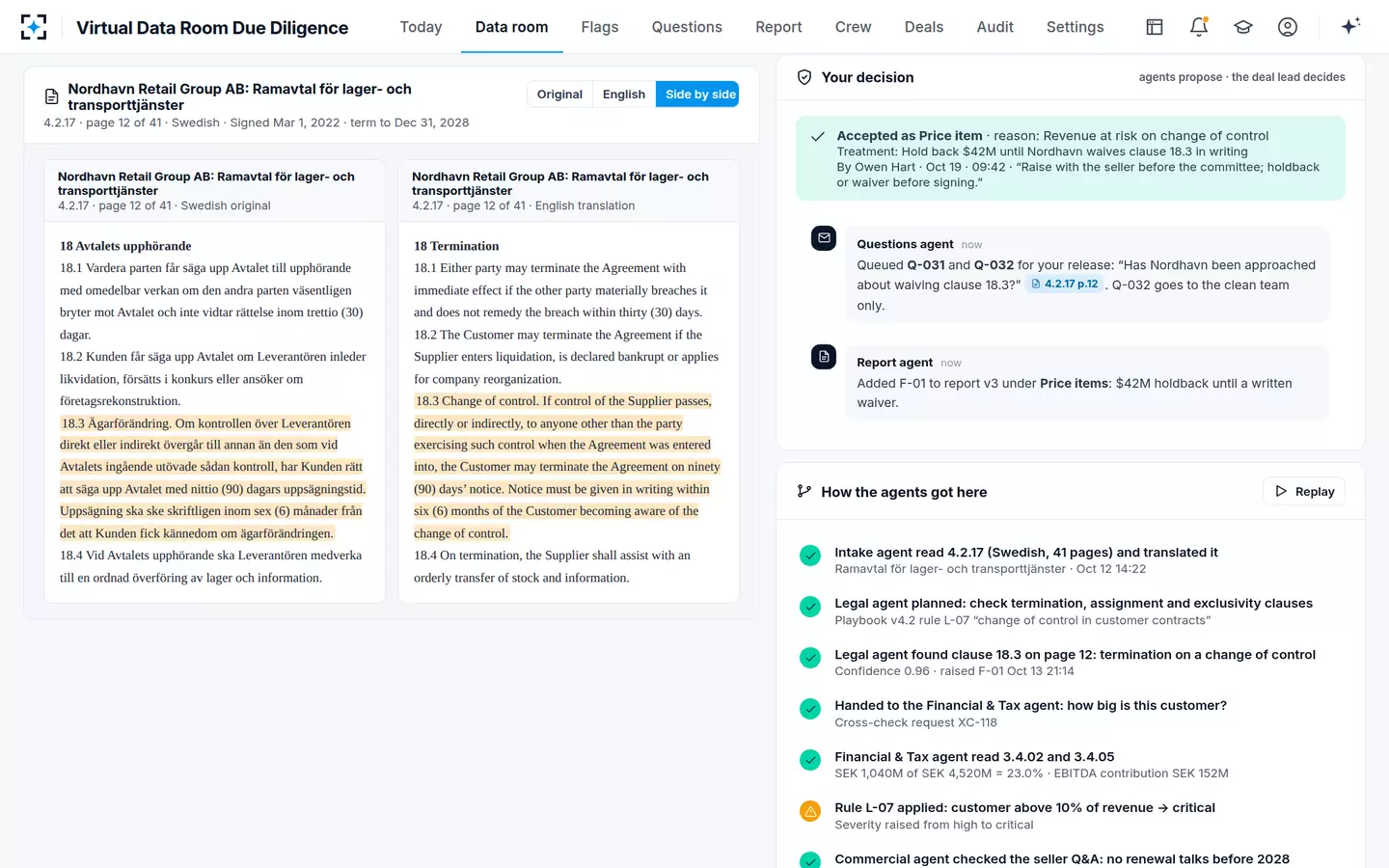
The decision on the clause, the questions it starts, and the trail behind it
Can a change of control clause be waived?
Yes: the party that holds the right can usually give it up, and a written waiver from the counterparty before signing is the cleanest outcome. Getting one is delicate. Approaching a customer before the deal is public tells it about the deal, so the seller usually controls the approach, and the buyer asks the seller what has been done. In the sample, question Q-031 asks the seller whether Nordhavn has been approached about waiving clause 18.3 and for any correspondence.
The companion question shows a second constraint. Q-032 asks for Nordhavn's FY2025 volumes and prices under the contract's pricing appendix, and it is routed to the clean team only, because the buyer's fund owns a competitor of the target and customer-level pricing must not reach people who set prices. How that fence works in a data room is set out in the clean team agreement guide. Once the seller's answers arrive, the treatment can change: a waiver in hand turns a $42 million holdback into a closed flag.
Change of control in leases, loans, licences and employment contracts
Customer contracts carry the largest revenue risk, but change of control rights sit in every folder, and each kind is sized by a different number. In the sample, the revolving credit facility becomes prepayable, which matters less if the deal refinances it at closing; the Borås warehouse lease needs the landlord's consent, sized by that site's share of volume; and the warehouse management software licence ends, sized by what it costs to replace. Bonds carry their own version, a put at a premium on a change of control, which the change of control put covers from the investor's side.
Employment contracts are read by the HR workstream for payments or accelerated vesting tied to a change of control, and for any key person whose departure would matter. They follow the same rule as everything else on this page: the clause is found in one folder and sized in another, in this case the payroll and the incentive plan. The broader method, reading the room by the questions that move the price rather than folder by folder, is in buy-side due diligence, and the solution itself is at Virtual Data Room Due Diligence.
Questions people ask
What does a change of control clause mean in a contract?
It means one party gets a right if control of the other party changes, typically to terminate, to give or withhold consent, or to be repaid. The clause defines what counts as control, often a majority of voting shares or the power to direct management. A buyout of the target almost always meets that definition.
What is the difference between a change of control clause and an anti-assignment clause?
An anti-assignment clause stops the contract being transferred to someone else; a change of control clause reacts to a new owner of the party itself. In Meso Scale, Delaware's Court of Chancery held that a reverse triangular merger was not an assignment and noted that the counterparty could have negotiated a change of control provision. Read both, and the governing law.
Does a change of control clause apply in a commercial lease?
It can, if the lease says so: some leases require the landlord's consent to a change in the tenant's control, or treat one as an assignment. In the sample room, the Borås warehouse lease needs consent, and the firm's playbook flags lease consents on sites above 10% of volume as high severity.
Does an IPO or a minority investment trigger a change of control clause?
Only if the clause's definition of control is met. A sale of a minority stake is not one unless the definition counts it, and a clause that counts any person acquiring a stated percentage of votes can be triggered by a smaller stake. The definition, not the label of the transaction, decides.
How long is the notice period in a change of control clause?
There is no standard; it is whatever the parties agreed. In the sample contract the customer may terminate on 90 days' notice, given in writing within six months of becoming aware of the change. Diary both dates from the moment the deal becomes known to the counterparty.
Who reviews change of control clauses in due diligence?
The legal workstream finds and interprets them; the financial workstream sizes the revenue or cost behind each; the deal lead decides the treatment. In the sample, rule L-07 requires the legal and financial agents to cross-check every customer above 10% of revenue with such a right.