Due diligence in private equity is the investigation a buyout firm makes into a target company before it commits its fund's capital: a review of the company's legal position, financial results, tax exposures, customers and market, environmental and social risks, and people, carried out mostly in the seller's data room and usually by outside advisers, each hired for one slice. The aim is to find what should change the price, the purchase agreement or the plan before signing. It is hard because the slices are read by different firms on different timetables, and the findings that move the price often need two of them to see. Botminds' Virtual Data Room Due Diligence gives each workstream its own agent over the same room and has a second workstream size every finding, so the deal team, which answers for the whole, sees the slices joined.
Where this guide shows the product, it follows a fictional sample deal: Quillfield Private Equity Fund V buying Skarvik Logistik AB, a Swedish contract-logistics company, with outside advisers for financial and tax, legal and HR, and ESG work. The firms, advisers, people and figures in the sample are fictional, not a customer result.
Many readers, one decision
37%
of buyout deals involve outside consultants before the deal, in a survey of private equity investors
6workstreams
reading the sample room: legal, financial, tax, commercial, ESG and HR
47flags
raised across the six in the sample deal’s first week
41of 47
sized by an agent from a second workstream; six still being checked
What is due diligence in private equity, and what does the law require of it?
In private equity, due diligence is both a commercial habit and, for regulated managers, a legal duty. In the EU, a fund manager must "implement an appropriate, documented and regularly updated due diligence process when investing on behalf of the AIF" (AIFMD, Article 15(3)(a)), and must "apply a high standard of diligence in the selection and ongoing monitoring of investments" (Delegated Regulation 231/2013, Article 18(1)). For an illiquid asset bought after a negotiation, the same regulation requires an assessment of "all relevant legal, tax-related, financial or other value affecting factors, human and material resources, and strategies, including exit strategies" (Article 19(1)(c)). That list maps closely onto the workstreams a buyout runs.
In the United States the duty comes from the adviser's fiduciary obligation. The SEC's examination staff wrote in 2022 that a reasonable belief that advice is in a client's best interest "requires that an adviser conduct a reasonable investigation into the investment that is sufficient to ensure that the adviser is not basing its advice on materially inaccurate or incomplete information" (SEC Division of Examinations, Risk Alert, 27 January 2022; staff views, not a rule). Neither regime says who must do the reading. Both make the manager answer for it.
What are the types of due diligence on a buyout?
A buyout usually runs six workstreams in the data room: legal, financial, tax, commercial, ESG and HR, with IT, insurance and operations added where the business needs them. Each has a typical reader and a typical deliverable, and each keeps the judgement that is its profession's, whatever reads the documents.
Six workstreams in one data room: what each reads, and what it keeps
Today
Reads corporate records, contracts, financing, real estate, litigation and data protection files for its own scope, and writes its own report.
With agents
Starts from every contract already read and flagged for change of control, assignment, exclusivity and liability caps, each cited to its page.
Still theirs: What a clause means, and the advice
Today
Builds the databook: earnings quality, add-backs, working capital, net debt and debt-like items.
With agents
Receives other workstreams’ findings to size, such as a customer’s share of revenue behind a legal flag.
Still theirs: The adjusted EBITDA and the net debt figure
Today
Reads returns, audits, assessments and transfer pricing, often in several countries.
With agents
Sees open audits and undisclosed assessments flagged against the disclosure letter, in the original language.
Still theirs: The exposure estimate and the structuring advice
Today
Reads customer and supplier contracts, pricing, renewals and management presentations, and often interviews customers.
With agents
Has pricing pages recognised and fenced to the clean team where the buyer competes.
Still theirs: The view of the market and the plan
Today
Runs environmental, social and governance diligence beside the deal, often on a different timetable.
With agents
Works in the same room: surveys, permits and emissions read and cited to the page.
Still theirs: Whether a finding is material, and the remediation plan
Today
Reads employment contracts, collective agreements, contractors, pensions and key-person terms.
With agents
Gets contractor and key-person findings with the tax and cost effect attached.
Still theirs: The people plan, and anything touching an individual
Who does due diligence for a private equity firm?
The deal team runs it and outside advisers do much of the reading. The deal team, usually a partner, a vice president or associate and an analyst, owns the investment case, the questions to the seller and the report to the investment committee. Outside counsel, an accounting firm for financial and tax work, and specialist advisers take the slices. Use of outside help varies: in Gompers, Kaplan and Mukharlyamov's survey of private equity investors, "the PE investors involve outside consultants in almost 37% of their deals", and "Smaller and younger private equity firms are less likely to engage outside consultants in their transactions" (NBER working paper 21133).
There is no official occupation called private equity associate, but the nearest ones show what each seat costs. In May 2025 the US median annual wage was $102,740 for financial and investment analysts, $83,680 for accountants and auditors and $159,670 for lawyers (BLS figures, as published on O*NET OnLine). Those are wages, not the rates advisers bill; the cost of a diligence is built from both, as the guide to due diligence costs shows.
What does a financial due diligence adviser do?
A financial due diligence adviser tests whether the earnings the seller presents are the earnings the buyer is paying for: it rebuilds adjusted EBITDA, examines each add-back, sets a normal level of working capital, and identifies net debt and debt-like items that should come off the price. Its main output is the databook, and that databook is also where every other workstream's findings get their size. The quality-of-earnings report itself has its own solution, Quality of Earnings Analysis, and a quality of earnings report, section by section shows what the databook holds.
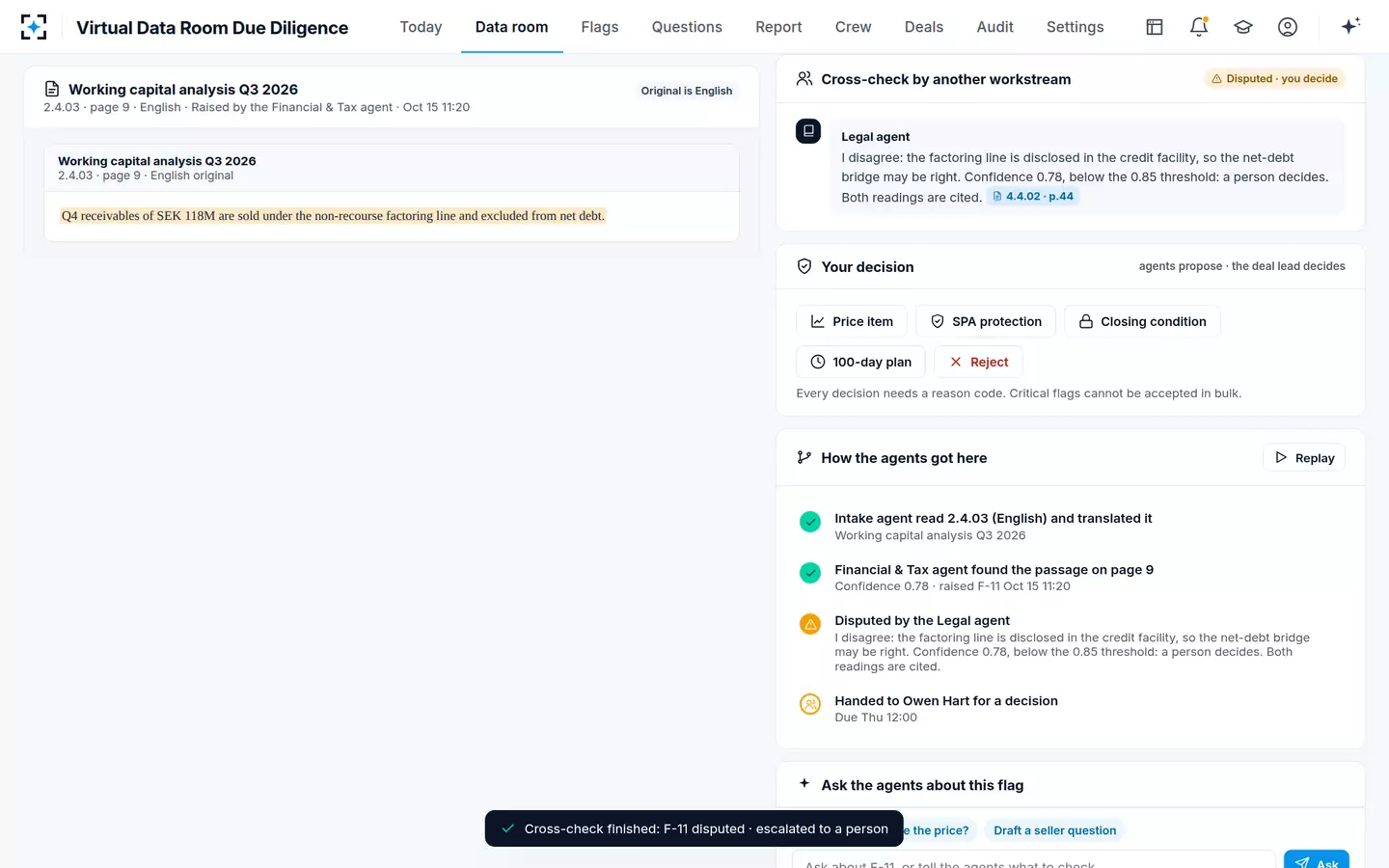
In the sample room, two financial flags show the range. F-02 found SEK 31 million of add-backs presented as one-off that recur every year, the pattern the firm's playbook rule on recurring add-backs is written to catch. F-11 found SEK 118 million of fourth-quarter receivables sold under a non-recourse factoring line and left out of the net-debt bridge, a finding the legal reader disputed, as the section on seams below shows.
What is commercial due diligence, and why does it meet the clean team?
Commercial due diligence tests the revenue: who the customers are, what they pay, how long they stay and what the market will do. It reads customer and supplier contracts, pricing and tenders, renewal histories and management presentations, and is often supplemented by customer calls and market work outside the room. It is also the workstream most likely to hit a competition-law fence, because customer-level prices are exactly what a buyer that competes with the target may not see before closing.
In the sample, the Commercial agent recognises competitively sensitive pages and fences them to a named clean team, because the sponsor's earlier fund owns a competitor of the target. Its other work is ordinary commercial diligence: it confirmed from the seller's answers that the largest customer has no renewal talks planned before 2028, and it raised the customer's fossil-free transport target as a commercial risk. How the fence works, and who may be inside it, is in the clean team agreement guide.
What is ESG due diligence, and what do the EU rules ask of it?
ESG due diligence reviews a target's environmental, social and governance risks before purchase: contamination and permits, emissions, health and safety, human rights in the supply chain, and governance failures. For EU fund managers it is part of the legal duty. Since 1 August 2022 the diligence article quoted above has carried an added paragraph: "AIFMs shall take into account sustainability risks when complying with the requirements set out in paragraphs 1 to 3" (Delegated Regulation (EU) 2021/1255). Managers that consider principal adverse impacts must also say how their due diligence policies take them into account.
The disclosure rules around it are under revision. The Commission's proposal of 19 November 2025 would mean financial market participants "are no longer required to disclose how at company level they consider principal adverse impact of investment decisions on sustainability factors" (European Commission), and would repeal the delegated regulation that defines the adverse impact indicators. It remains a proposal: the European Parliament's committee adopted its report on 10 September 2026 and the Council its mandate on 24 June 2026 (European Parliament, Legislative Train). Until it is adopted, the SFDR in force applies.
ESG diligence in the same room as everything else, cited to the page
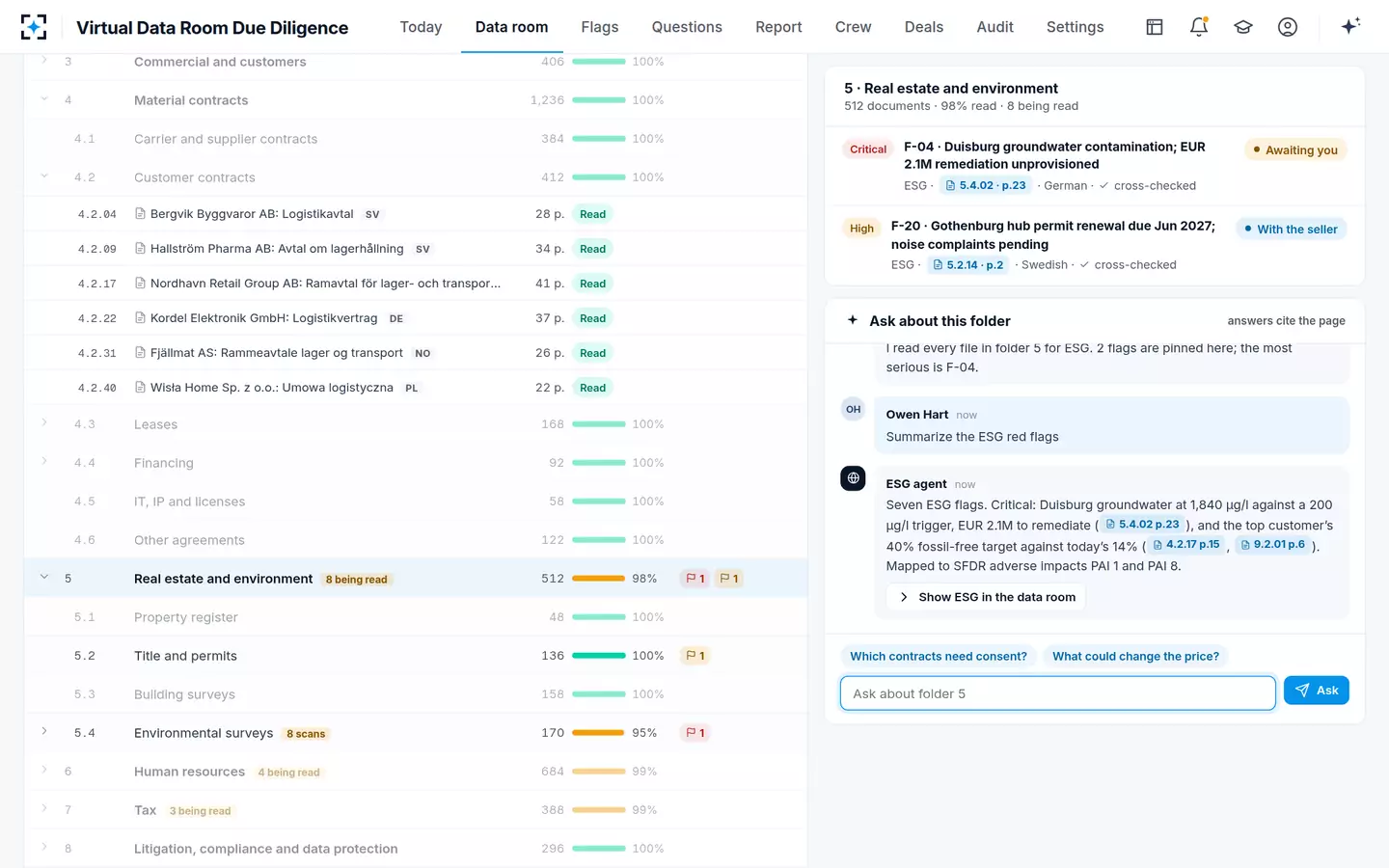
The sample shows why ESG belongs in the same room as the rest of diligence. The Duisburg groundwater finding, 1,840 µg/l against a 200 µg/l trigger with EUR 2.1 million to remediate and no provision, is an environmental flag and a price item at once; the playbook sends it to the financial workstream for a cross-check. The adverse impact indicators it maps to are defined in the current rules as greenhouse gas emissions and "Emissions to water" (Delegated Regulation (EU) 2022/1288, Annex I). After closing, collecting ESG data from portfolio companies is a different job, covered by Portfolio Company ESG Data Collection.
HR due diligence: employment terms, contractors and personal data
HR due diligence reads employment contracts, collective agreements, pension terms, contractor arrangements and key-person terms, and it is the workstream that handles the most personal data. The GDPR's data minimisation principle applies to a buyer reading a target's employee files: personal data must be "adequate, relevant and limited to what is necessary in relation to the purposes for which they are processed", and data concerning health or trade union membership is a special category (GDPR, Articles 5 and 9). Diligence needs terms and costs, rarely individuals.
In the sample, the HR agent's limit is written as a rule: it never reads personal files beyond what the playbook names. Its main finding, F-08, is that 214 drivers in Poland are engaged as contractors, a reclassification risk the playbook sends to tax for sizing, because the cost of reclassification is a tax and social charge as much as a wage.
Where findings fall between workstreams, and how to catch them
The findings that move a price usually need two workstreams: one to find the problem and one to size it. A legal reader finds a termination right; the financial reader knows the customer is 23% of revenue. When each adviser reads only its slice and writes its own report, the join depends on someone noticing. The sample firm writes the joins into its playbook, so each kind of flag names the two workstreams that must check it.
Who raised the sample deal's 47 flags
The sample playbook's rules, and the two workstreams each one joins
| Rule | When a flag is raised | Severity | Cross-checked by |
|---|---|---|---|
| L-07 | Customer above 10% of revenue with a change of control right | Critical | Legal + Financial |
| T-03 | Tax assessment above $1M not in the disclosure letter | Critical | Tax + Legal |
| E-02 | Environmental remediation above $1M without a provision | Critical | ESG + Financial |
| L-19 | Regulator inquiry or investigation | Critical | Legal + ESG |
| F-05 | Add-back recurring in two or more years | High | Financial + Tax |
| L-11 | Lease consent on a site above 10% of volume | High | Legal + Commercial |
| H-04 | Contractors above 50 people in one entity | High | HR + Tax |
Cross-checks can disagree, and a disagreement is a finding in itself. On F-11, the financial reader said the factored receivables should be in the net-debt bridge; the legal reader replied that the factoring line is disclosed in the credit facility, so the bridge may be right. At a confidence of 0.78, below the firm's 0.85 threshold, neither agent settles it: both readings are cited and a person decides. How far contract-reading AI can be trusted, and where it must stop, is the subject of legal due diligence AI and its limits.
A disputed cross-check goes to a person, with both readings
The deal team stays accountable for every slice
Outsourcing the reading does not outsource the responsibility. The SEC staff's 2022 alert described advisers that set out a diligence process in their fund documents without policies fitted to their own business behind it; an outside adviser's report does not cure that. And an adviser can only report on what it was asked to read. In the Akorn case, the buyer's parent described its forecasts as based on "the comprehensive but still outside[-]in due diligence process" (Akorn v. Fresenius Kabi, Del. Ch. 2018): an honest description of what any buyer's diligence is.
Who answers for what on the sample deal
Outside advisers
Interpret the findings in their scope and advise; see only the questions in their own scope, and any other screen shows that it is not in their scope.
Deal team lead
Decides every flag with a reason code, releases every seller question, signs the red-flag report. Critical flags cannot be accepted in bulk.
Legal counsel
Co-signs the report after the deal lead, and sits on the clean team.
Compliance
Approves clean team membership, the red flag rules and every change to the agents.
The design follows from that accountability: the agents read every slice and join the findings, but none of them decides, releases a question or signs. The method of reading the room by the buyer's questions rather than by workstream is set out in buy-side due diligence, and the solution is at Virtual Data Room Due Diligence.
Questions people ask
What is on a private equity due diligence checklist?
One list per workstream: corporate and legal documents, financial statements and the quality-of-earnings work, tax filings and audits, customer and supplier contracts, environmental and social reports, and employment terms. A checklist tells you what to request; it should be paired with a measure of what was actually read and a way to join findings across workstreams.
What is the due diligence process in private equity?
It runs from a confidentiality agreement and an indicative bid, through access to the seller's data room and the advisers' reviews, to questions to the seller, a red-flag report and an investment committee decision, then signing. In the EU, managers must keep a documented, regularly updated process and retain records of a negotiated illiquid investment's diligence for at least five years.
Is operational due diligence the same as due diligence on a buyout?
No. Operational due diligence usually means an investor's review of a fund manager's operations and controls before committing capital to its fund. Buyout diligence is the manager's review of a company before buying it. The first is covered by Operational Due Diligence.
Is ESG due diligence required by law?
For EU fund managers, sustainability risks must be taken into account in their due diligence under Delegated Regulation 2021/1255, applicable since 1 August 2022. The SFDR revision proposed in November 2025 would change what managers disclose, but it is still a proposal. Outside the EU, the requirement comes from investors' terms and the manager's own policy.
How many advisers work on a buyout's due diligence?
No regulator or independent study publishes a count, and it depends on the deal. The sample deal uses three outside firms, one for financial and tax, one for legal and HR, and one for ESG work. The survey evidence is that consultants are used in almost 37% of deals, less often by smaller and younger firms.