Due diligence costs are what a buyer spends to investigate a target before committing: outside advisers' fees for legal, financial, tax, commercial, ESG and HR work, the deal team's own time, the handling of the data room, and the cost of anything the review misses. No regulator or independent study publishes what buyout diligence typically costs; advisers quote it deal by deal, and the one large public figure comes from an SEC enforcement order. So the useful answer is a method: build the cost from your own last deals, know which tax and accounting rules apply, and find the input that moves the total most. Botminds' Virtual Data Room Due Diligence changes one part of that total, the hours spent reading, translating and reconciling a data room, and this guide is specific about which parts it leaves alone.
Product figures below come from a fictional sample deal run through the solution: Quillfield Private Equity Fund V buying Skarvik Logistik AB, a Swedish contract-logistics company, from a data room of 5,418 documents in six languages. They are sample data or Botminds' own estimates, labelled as such, never a customer's result.
The public numbers on diligence costs, and what they are
$338M
of diligence and similar expenses on buyouts that did not happen, one firm, 2006–2011
$30.2B
invested by the same firm’s flagship funds in 95 transactions over those years
$49.40
an hour: US median wage of financial and investment analysts, May 2025
$76.76
an hour: US median wage of lawyers, May 2025
How much does due diligence cost on a buyout?
Nobody outside the deal can say, because no regulator or independent study collects what buyers pay for diligence, and advisers' fees are private. The largest public figure is one firm's spending on deals that never closed. An SEC order found that between 2006 and 2011 Kohlberg Kravis Roberts "incurred $338 million in diligence expenses related to unsuccessful buyout opportunities and other similar types of expenses", over the same years in which its flagship funds "invested $30.2 billion in 95 transactions" (SEC Release IA-4131, 29 June 2015).
That is roughly $1.12 of broken-deal spending for every $100 invested (our arithmetic), and it should be read narrowly: one large firm, a single period, only the deals that died, and a category that includes other similar expenses. It says nothing about the cost of diligence on deals that closed. Its use is as a reminder that diligence on lost deals is a real line in a fund's economics, and that who bears it is written into the fund agreement, as the cases on broken deal expenses set out in detail.
A cost model you can build from your own last deal
Estimate due diligence costs as the sum of four terms, each built from records your firm already has: outside advisers, the deal team's hours, the data room's handling, and the expected cost of a finding missed. The first three are on invoices and timesheets. The fourth is not, and it is usually the largest.
Due diligence cost as four terms, each measurable on a past deal
Outside advisers
Σ quoted fee per workstream
Legal, financial and tax, commercial, ESG, HR; plus any re-scoping when the room grows late.
Engagement letters and final invoices
Deal team hours
hours × loaded hourly cost
Reading, translating, merging adviser reports, writing seller questions and the committee report.
Timesheets, or a reconstruction from the deal calendar
Room handling
translation + re-reads + tools
Documents needing translation, scans to re-read, data and tool costs for the deal.
Invoices for the deal
Findings missed
chance of a miss × size of the finding
A flag found after signing, when it can no longer be priced or protected.
The committee’s judgement, informed by your past deals
Run the model on a closed deal first. The numbers it gives are your own benchmark, and they reveal which term dominated: on a cross-border deal it is often translation and reconciliation; on a domestic deal with a thin room it may be the advisers' fixed fees. Only then is it worth asking what a tool or a different adviser structure would change.
What the deal team's time costs: wages as a floor
Price the deal team's hours at a loaded hourly cost, and use official wage data only as a floor. There is no official occupation for a private equity associate, so the nearest ones serve: in May 2025 the US median hourly wage was $49.40 for financial and investment analysts, $40.23 for accountants and auditors, $76.76 for lawyers and $30.24 for paralegals (BLS figures as published on O*NET OnLine). Deal professionals at buyout firms are a small and senior slice of those occupations, so their real cost, with bonus, benefits and overhead, is higher; your finance team knows the number.
US median hourly wages of the occupations nearest to diligence work, May 2025
An illustration shows the scale. Botminds estimates that, by hand, a mid-market buyout room of about 5,000 files takes twelve days of reading by workstream and four of merging advisers' reports. If three deal professionals each spent eight hours a day on those sixteen days, that is 384 hours; at the analyst median wage alone it is about $18,970 before bonus, benefits and overhead (our arithmetic, an illustration, not a benchmark). The figure is small next to advisers' fees, and that is the point: the deal team's hours are expensive mainly because of what they are not spent on, the seller's questions and the investment case. The calendar effect is set out in how long due diligence takes on a buyout.
Are due diligence costs tax deductible? The US rule on capitalising them
Under the US federal rules for a buyer acquiring a business, diligence costs incurred before a set date are generally not costs of the acquisition, while those incurred after it, and certain costs whenever incurred, must be capitalised into the acquisition. The date is the earlier of the day the two sides sign a letter of intent, an exclusivity agreement or a similar document (a confidentiality agreement does not count) and the day the material terms are "authorized or approved" by the board or equivalent (26 CFR 1.263(a)-5(e)(1)).
Which diligence costs a US buyer capitalises, under 26 CFR 1.263(a)-5
| Cost | Before the letter of intent or board approval | On or after it |
|---|---|---|
| Investigating the target: reading the data room, advisers’ diligence | Not a cost of the acquisition under this rule | Capitalised as a cost of the acquisition |
| Appraisal, formal written evaluation or fairness opinion | Capitalised: “inherently facilitative” | Capitalised |
| Structuring the deal, including tax advice on the structure | Capitalised: inherently facilitative | Capitalised |
| Preparing and reviewing the purchase agreement | Capitalised: inherently facilitative | Capitalised |
| Regulatory filings and approvals | Capitalised: inherently facilitative | Capitalised |
| Fee contingent on closing | Treated as facilitating the deal unless documentation shows part of it is for other work | Same |
The regulation's own example makes the line concrete: amounts paid "to conduct due diligence on T on and after March 1, 2005", the date of the exclusivity agreement, "must be capitalized", while diligence on other candidates before that date is not. Two practical consequences follow for a deal team. Keep timesheets and invoices dated against the letter of intent, because the date splits the cost. And keep the documentation behind any success fee, because without it the whole fee is presumed to facilitate the deal.
Can due diligence costs be capitalised in the accounts? IFRS says expense them
In financial statements prepared under IFRS, a buyer expenses its diligence costs as they are incurred; they are not added to the cost of the business acquired. IFRS 3 defines acquisition-related costs as "costs the acquirer incurs to effect a business combination", including "advisory, legal, accounting, valuation and other professional or consulting fees", and requires the acquirer to "account for acquisition-related costs as expenses in the periods in which the costs are incurred and the services are received, with one exception", the costs of issuing debt or equity (IFRS 3, paragraph 53, as adopted in the EU).
The same diligence invoice, treated two ways
US federal tax (26 CFR 1.263(a)-5): Capitalised into the acquisition
Financial statements under IFRS 3: Expensed as incurred
US federal tax (26 CFR 1.263(a)-5): Not capitalised under this rule
Financial statements under IFRS 3: Expensed as incurred
US federal tax (26 CFR 1.263(a)-5): Capitalised whenever incurred
Financial statements under IFRS 3: Expensed as incurred
US federal tax (26 CFR 1.263(a)-5): Governed by other rules
Financial statements under IFRS 3: The one exception: recognised under the financial instruments standards
Who pays for due diligence in an acquisition?
Each side pays its own diligence, and inside a private equity firm the fund agreement decides whether the fund or the manager bears it. The buyer pays its advisers and its team; a seller that commissions vendor due diligence pays for that. Where a deal dies, the cost becomes a broken-deal expense, and the SEC has brought cases over how managers allocated such expenses between funds and co-investors. In the KKR order, the firm "typically bore 20% of all broken deal expenses" under its fee-sharing arrangements with its funds, and the finding was about the share co-investors did not bear.
For a deal team, the practical point is that the cost model above needs a line for who pays, deal by deal, written before the work starts. How each kind of fund expense is allocated, and how to show it was allocated as the documents say, is the subject of Fund Expense Allocation.
What drives due diligence fees?
Fees follow scope, and scope follows the room: how many workstreams, how many documents and pages, how many languages and countries, how compressed the timetable is, and how much of the room arrives late. Each driver can be counted at the start of a deal, which is when a buyer can still negotiate the scope rather than pay for its overrun.
Which input moves the total most: drivers to count on day one
| Driver | How to measure it on your last deal | In the sample room |
|---|---|---|
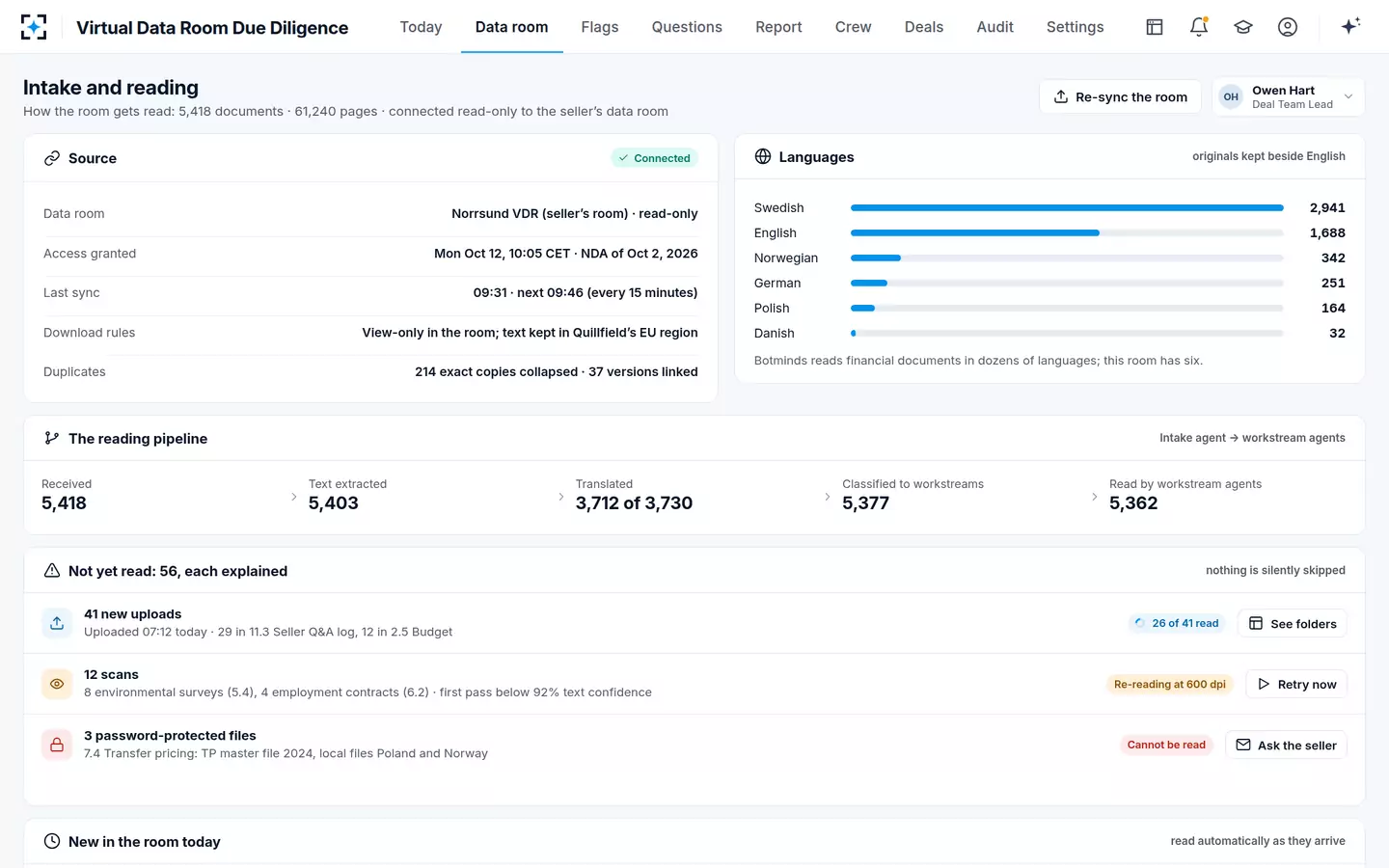
| Documents and pages | Files and pages received, by folder, at first full access | 5,418 documents, 61,240 pages |
| Languages | Documents needing translation, and in how many languages | 3,730 needed translation, across five languages besides English |
| Hard-to-read files | Scans re-read, password-protected files, corrupted files | 12 scans re-read at 600 dpi; 3 locked files |
| Late uploads | Files added after the first full read, and when | 41 files on one morning a week in |
| Cross-workstream findings | Flags that needed a second adviser to size | 41 of 47 flags sized by a second workstream |
| Timetable | Days from access to the committee | 15 days from access to the committee date |
The room's size and languages, counted on the day it opens
The cost that never appears on an invoice: a flag found after signing
The largest diligence cost is usually the finding the review did not size before signing, because after signing it can no longer be priced. An issue found days before signing leaves little time to reprice and tends to be pushed into exclusions and special indemnities; one found after closing is simply a loss. The research on public acquirers is consistent with that: Wangerin found that buyers who did less diligence went on to earn less from the acquisition, were likelier to impair its goodwill and booked poorer fair values (Contemporary Accounting Research, 2019).
The sample deal shows the scale against the rest of the model. One flag, a top customer's right to terminate on a change of control, became a $42 million holdback, about 2.9 times that customer's $14.4 million EBITDA contribution. No line of an adviser's invoice comes near it. A Delaware court record makes the same point from the other side: the buyer of Akorn described its diligence as unusually thorough, yet the court found the final presentation to its board "did not identify risks related to data integrity", the issue that later decided the case (Akorn v. Fresenius Kabi, Del. Ch. 2018). That is why the fourth term of the model belongs in any budget conversation.
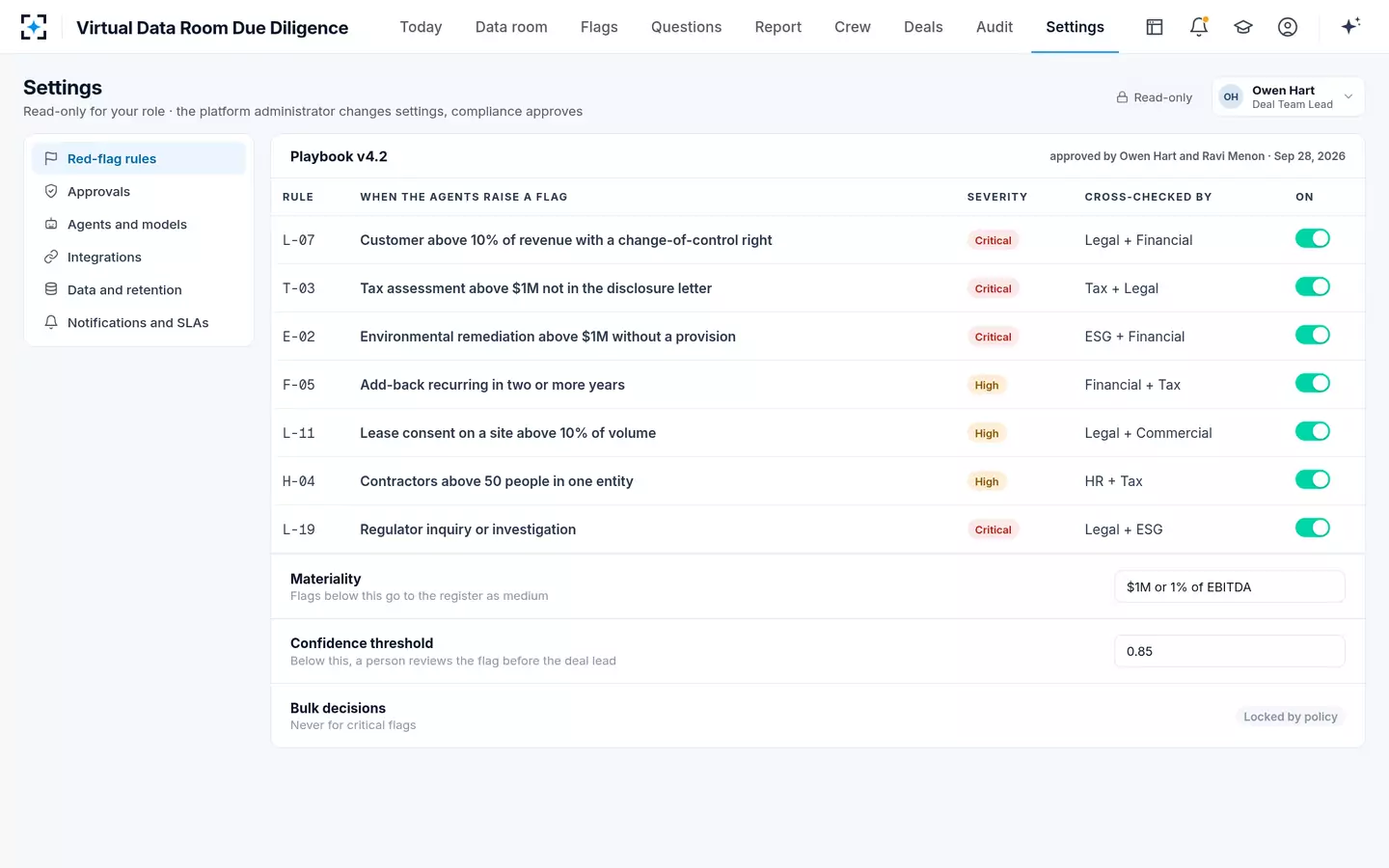
The materiality line that decides which findings reach the report
Where the solution changes the cost, and where it does not
Virtual Data Room Due Diligence changes the hours term and part of the room-handling term, and it is aimed at the fourth. Botminds estimates that indexing, translation, reading, linking clauses to numbers, drafting questions and merging reports, 28 days by hand on a 5,000-file room, take about two with the solution; on the sample room the first full read and cited report came 46 hours after access. Those are an estimate and a sample result, not a measured saving on a customer's deal. The aim on the fourth term is coverage: every file read or explained, and each flag sized by a second workstream before signing.
It does not change advisers' fees for opinions, structuring advice or negotiation, the investment committee's time, or the cost of the seller's delays. Its price is not published here; ask for it against your own deal volume and compare it with the model above. The inputs that decide how quickly it pays for itself are your own, which is the subject of what you bring to private equity due diligence software. The people whose hours the model counts are described in the six workstreams of private equity diligence, and the solution is at Virtual Data Room Due Diligence.
Questions people ask
What are due diligence costs?
They are the costs a buyer incurs to investigate a target before committing: advisers' fees, the deal team's time, data room handling such as translation, and travel and data costs. IFRS 3 lists "advisory, legal, accounting, valuation and other professional or consulting fees" among acquisition-related costs, which it requires to be expensed.
What are broken deal costs?
Broken deal costs are diligence and related expenses on deals that do not close. In private equity the fund agreement decides whether the fund or the manager bears them; the SEC's 2015 KKR order recorded $338 million of such expenses at one firm over 2006 to 2011 and penalised how they were allocated to co-investors.
Are due diligence costs refundable if the deal fails?
Not usually: advisers bill for the work done. Some agreements shift costs, for example through a break fee payable by the seller in defined circumstances, and in the KKR order the firm shared break-up fees with its funds. Whatever the agreement says, the cost should be on your model as a possible broken-deal line.
How do you budget for due diligence?
Count the room on day one, documents, languages, hard-to-read files, and price each workstream's scope against it; add the deal team's hours at a loaded cost and a line for translation. Then compare with your last three deals, the only benchmark that fits your firm. Re-scope early if the room grows late.
When do diligence costs have to be capitalised for US tax?
From the earlier of signing a letter of intent or exclusivity agreement (not a confidentiality agreement) and the board's approval of the material terms, under 26 CFR 1.263(a)-5(e)(1). Appraisals, fairness opinions, structuring advice, deal documents and regulatory filings are capitalised whenever incurred. Take advice on your own structure.